Map of Germany showing where the Peterkin arms are recorded
The Peterkin arms were recorded in Holstein, c. 1765.
Holstein was farming country between the North Sea and the Baltic, held in large estates. The same families kept the same land for generations, and generations of holding is what fills a register.
This is where the arms were entered in the register. Families often moved to other parts of the country, so the same name can turn up in more than one region.
The body that granted and recorded arms in Germany in this period.
Francis I, Holy Roman Emperor
Sovereign of the period
Francis I, Holy Roman Emperor
1745–1765
Reigning in Germany when the Peterkin arms are first recorded.
How Arms Worked in Germany
In the Holy Roman Empire, coats of arms were often granted to individuals by the Emperor or his representatives. These arms were then passed down through the generations to all legitimate descendants of the original holder. Younger branches of a family usually kept the same shield design without needing to change it, as the arms belonged to the entire lineage.
Granting authority
The Holy Roman Emperor held the sole power to grant new coats of arms throughout his vast imperial territories.
How they got arms
Families typically obtained their coats of arms through a formal imperial grant or by proving their noble status to the authorities.
Where arms were recorded
These grants were officially recorded in the Imperial Chancery registers, which began keeping formal records of such honors during the Middle Ages.
The family's standing
Recorded among the armigerous families of Holstein.
Origin & History of the Peterkin Family in Germany
The surname Peterkin is a diminutive form of the name Peter, which gained widespread popularity across Europe due to the influence of the Christian church. In the context of Germany, the name evolved as a way to identify a person as the son or a younger relative of someone named Peter. By the middle of the eighteenth century, the family was well-established in the region of Holstein. During this era, Holstein was a territory with complex political ties to both the Danish crown and the Holy Roman Empire. Families living in this area often worked in agriculture or local crafts, and they were subject to the shifting administrative records of the time. The presence of the Peterkin name in 1765 suggests that these individuals were part of the stable, land-holding or artisan classes that formed the backbone of rural German society before the major industrial changes of the nineteenth century.
Coat of Arms & Family Crest Details
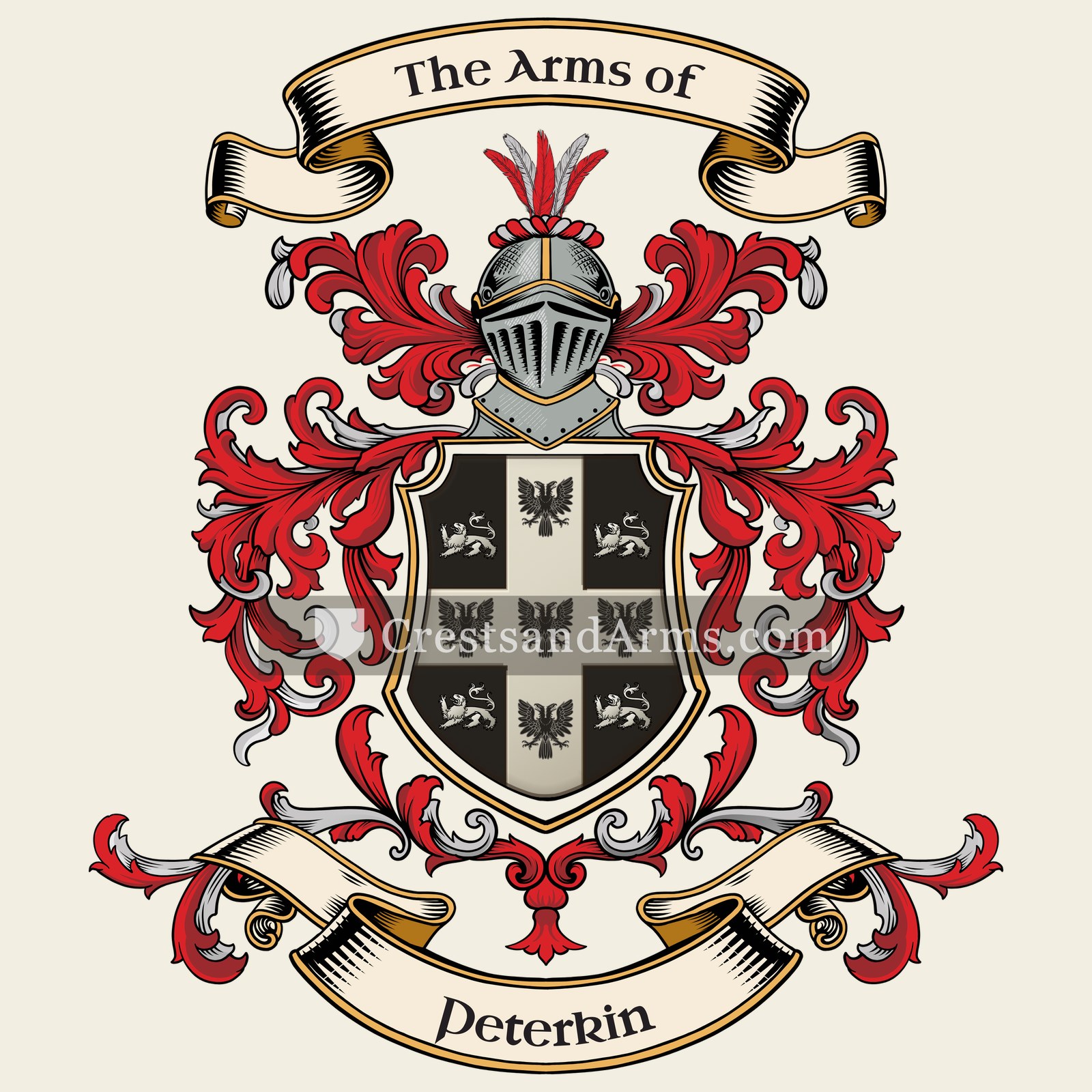
Symbols on this shield
cross symbolChristian faith and service
lionCourage, strength and royalty
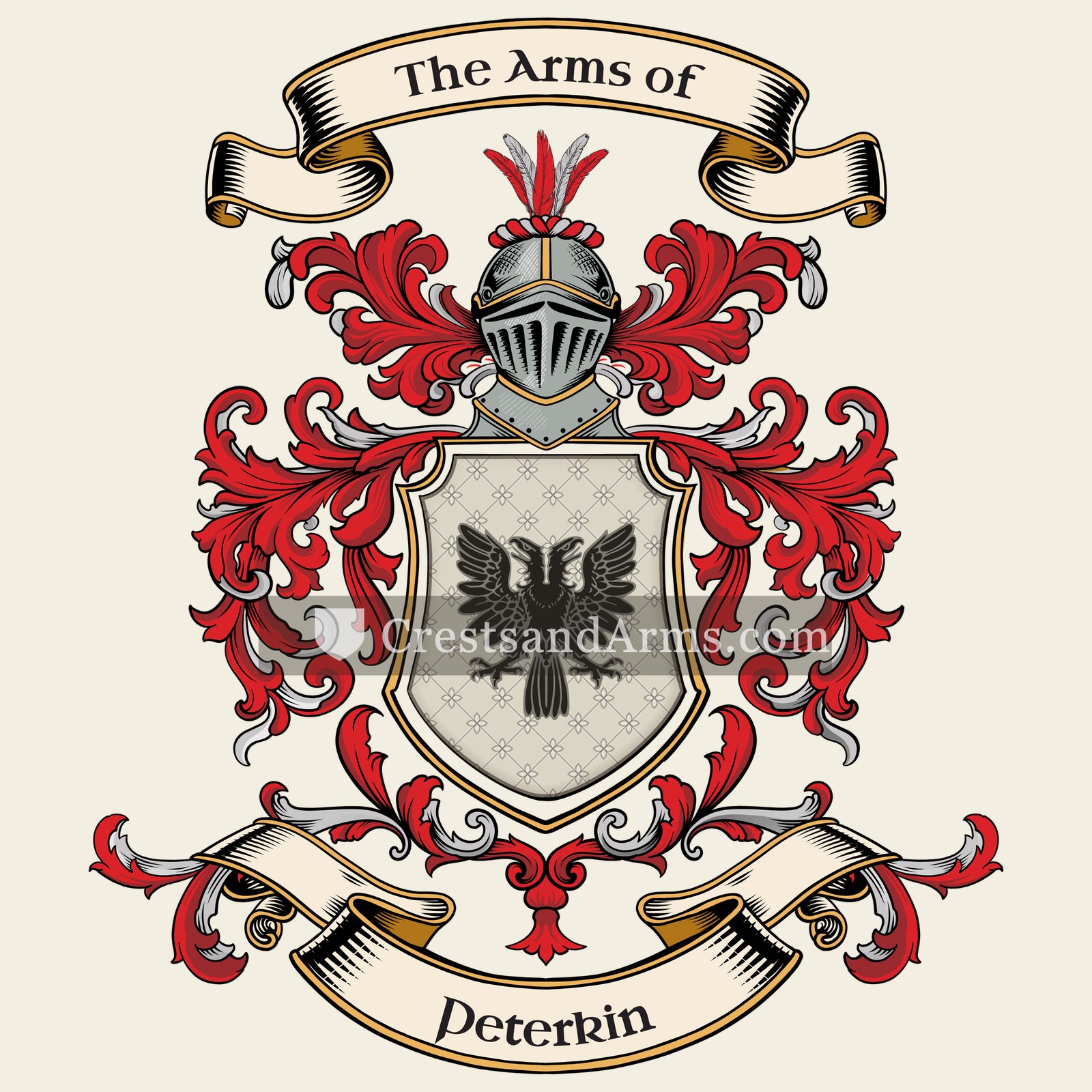
eagleNobility, strength and a keen mind
Colours
Black (Sable)Means: Constancy
Silver (Argent)Means: Peace and sincerity
Historical info
Source
Sir Bernard Burke, The General Armory of England, Scotland, Ireland and Wales, London: Harrison & Sons, 1884
Blazon (the actual original written record)
“Sa. on a cross betw. four lions ramp. ar. five eagles displ. of the field”
Englandc. 1620
Digital archive packCoat of arms PNG, gold border print PDF, vector SVG and the certificate of authenticity. Sent to your email in minutes.
Map of England showing where the Peterkin arms are recorded
The Peterkin arms were recorded in England, c. 1620.
Arms such as these were typically recorded in York.
Yorkshire is the largest of the English counties, and it held more gentry families than any other. Land there was split among a great many households rather than a few, so a great many of them carried arms.
This is where the arms were entered in the register. Families often moved to other parts of the country, so the same name can turn up in more than one region.
The body that granted and recorded arms in England in this period.
James VI and I
Sovereign of the period
James VI and I
1603–1625
Reigning in Germany when the Peterkin arms are first recorded.
How Arms Worked in England
English heraldry allowed arms to be shared by all legitimate descendants of the original owner. These symbols were treated as personal property that moved through the generations to all children. While the eldest son kept the original design, other family members could use the same shield without needing to change it or register their own unique versions.
Granting authority
The College of Arms in London has regulated the use of coats of arms throughout England and Wales since 1484.
How they got arms
Families typically obtained their coats of arms through a formal grant from the Crown or by proving their ancient right to them.
Where arms were recorded
All official coats of arms are recorded in the registers kept at the College of Arms, which date back to the fifteenth century.
The family's standing
Recorded among the armigerous families of England.
Origin & History of the Peterkin Family in England
The name Peterkin originated as a diminutive form of the name Peter, functioning as a affectionate way to describe a young Peter or a son of Peter. By the early seventeenth century, the name had established a firm presence in the northern English city of York. Records from 1620 indicate that members of the family were active participants in the social and economic life of this historic cathedral city. During this period, York served as a major administrative hub, and families like the Peterkins often integrated into the local merchant or tradesman classes. The name reflects a common naming tradition of the Middle Ages where suffixes were added to personal names to distinguish younger family members from their elders. As the family grew, they became part of the steady migration patterns that defined northern England, eventually spreading their name across the region through local commerce and community involvement.
Peterkin Meaning & Related Branches
Root word
Petrus
Latin for stone or rock.
This name
PeterkinA diminutive form meaning little Peter or son of Peter.
also spelled
Petersen
Petersonne
Peterson-Peterson
Documented Sources
J. B. Rietstap, Armorial Général, Gouda: G. B. van Goor Zonen, 1884–87
Bahlow, Hans. Deutsches Namenlexikon: Familien- und Vornamen nach Ursprung und Sinn erklärt. 1967
Gottschald, Max. Deutsche Namenkunde: Unsere Familiennamen nach ihrer Entstehung und Bedeutung. 1971
Digital archive packCoat of arms PNG, gold border print PDF, vector SVG and the certificate of authenticity. Sent to your email in minutes.


 eagleNobility, strength and a keen mind
 eagleNobility, strength and a keen mind


 cross symbolChristian faith and service
 lionCourage, strength and royalty