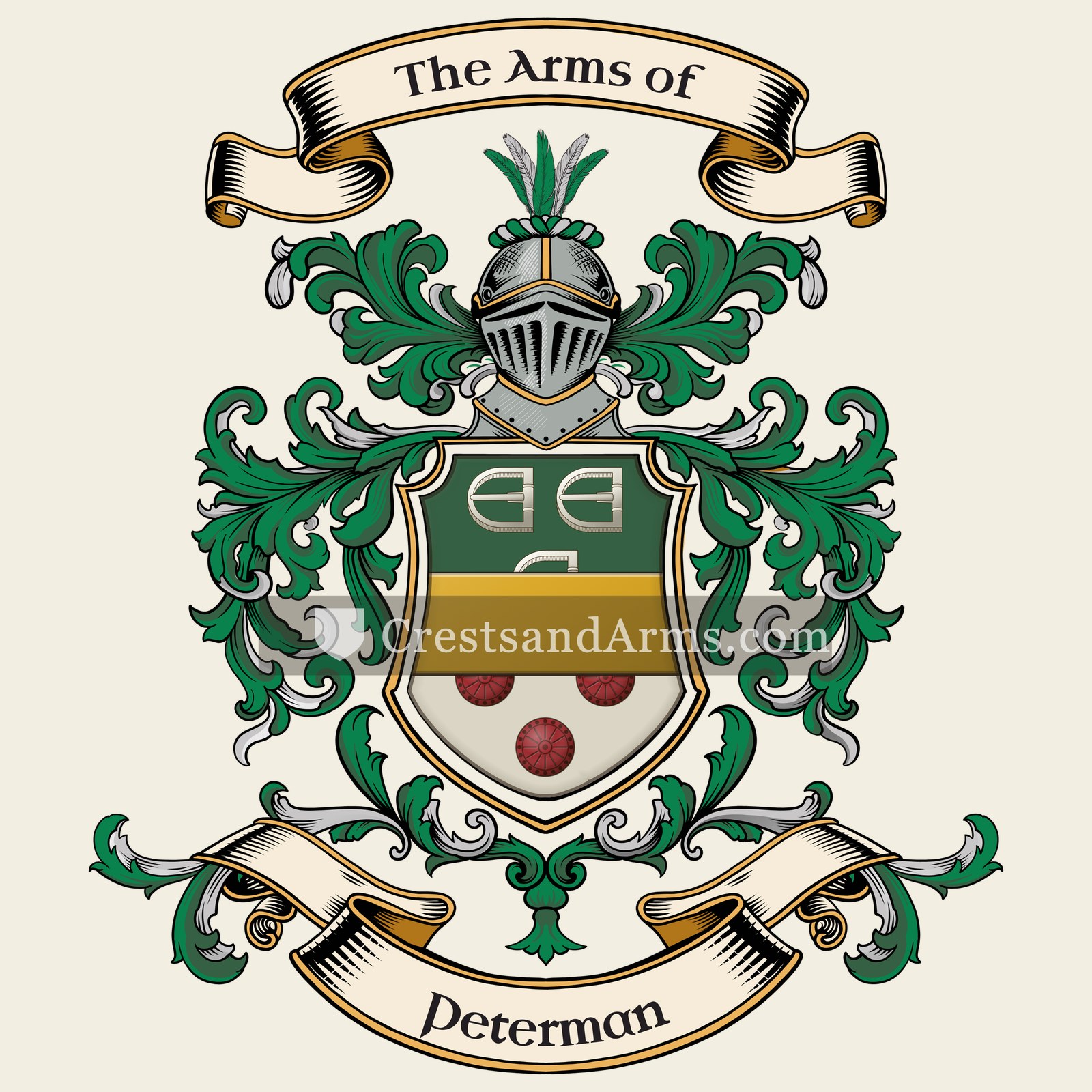
A record of documented arms, meaning and origin, researched for the Peterman family of Switzerland.
Reg. 6077 · Swiss, P–S
Coat of Arms & Family Crest Details
Symbols on this shield
fessThe military belt, and readiness to serve
buckleFidelity, and a bond firmly held
roundelA coin, and one who has been to the crusades
Colours
Green (Vert)Means: Hope
Silver (Argent)Means: Peace and sincerity
Gold (Or)Means: Generosity
Red (Gules)Means: Military strength
Historical info
Source
J. B. Rietstap, Armorial Général, Gouda: G. B. van Goor Zonen, 1884–87
Blazon (the actual original written record)
“Coupé, de sin. à trois fermaux rangés d'arg., sur arg. à trois tourt. de gu., 2 et 1; à la fasce d'or, br. sur le coupé. C.: un lion iss. d'or, lamp. de gu., tenant un fermail d'arg. L.: à dextre d'or et de sin., à sén. d'arg. et de gu.”
SwitzerlandBâle, c. 1745
Digital archive packCoat of arms PNG, gold border print PDF, vector SVG and the certificate of authenticity. Sent to your email in minutes.
Map of Switzerland showing where the Peterman arms are recorded
The Peterman arms were recorded in Bâle, c. 1745.
This is where the arms were entered in the register. Families often moved to other parts of the country, so the same name can turn up in more than one region.
The body that granted and recorded arms in Switzerland in this period.
How Arms Worked in Switzerland
In Switzerland, coats of arms were not restricted to the nobility and were often adopted by common citizens and families. These symbols were passed down through generations to show family identity. When branches of a family grew, they often changed small details of the design to distinguish their own line from the original group.
Granting authority
Cantonal and civic authorities managed the use of coats of arms within their specific regions and local jurisdictions.
How they got arms
Families typically assumed their own coats of arms based on local custom rather than receiving them from a central monarch.
Where arms were recorded
Arms were recorded in various cantonal and civic registers starting from the fourteenth century throughout the Swiss region.
The family's standing
Recorded among the armigerous families of Switzerland.
Origin & History of the Peterman Family in Switzerland
The surname Peterman is a variation of the name Peter, which was a very popular choice throughout Europe during the Middle Ages. The suffix "man" was often added to indicate that a person was a servant or a follower of someone named Peter. By the mid-18th century, the family had established a clear presence in the city of Bâle, Switzerland. At that time, Bâle was a bustling center for trade and craftsmanship, and families like the Petermans were often integrated into the local guilds or merchant networks that defined the city’s economy. Living in a major crossroads of the Rhine River, the family likely benefited from the movement of goods and ideas between Switzerland, France, and Germany. This location suggests that the early Petermans were part of a stable, urban community that valued record-keeping and civic participation.
Related Branches & Arms
Root word
Peter
Derived from the Greek word petros meaning stone or rock.
This name
PetermanAn occupational surname for a man who worked as a servant or employee of Peter.
also spelled
Pettermant
Pettermande
Pettermandt
Petermand
Documented Sources
J. B. Rietstap, Armorial Général, Gouda: G. B. van Goor Zonen, 1884–87
Staatsarchiv Basel-Stadt, Bürgerverzeichnisse und Einwohnerregister
Staatsarchiv Basel-Stadt, Kirchenbücher der Stadt Basel
Heintze, Albert, Die deutschen Familiennamen: geschichtlich, geographisch, sprachlich, 1903
Bahlow, Hans, Deutsches Namenlexikon: Familien- und Vornamen nach Ursprung und Sinn erklärt, 1967
Digital archive packCoat of arms PNG, gold border print PDF, vector SVG and the certificate of authenticity. Sent to your email in minutes.


 fessThe military belt, and readiness to serve
 buckleFidelity, and a bond firmly held
 roundelA coin, and one who has been to the crusades
 fessThe military belt, and readiness to serve
 buckleFidelity, and a bond firmly held
 roundelA coin, and one who has been to the crusades