Map of Netherlands showing where the Peters arms are recorded
The Peters arms were recorded in Netherlands, c. 1815.
Arms such as these were typically recorded in Friesland.
Friesland was low, wet country on the northern coast of the Netherlands, farmed by families who had held the same land for centuries. Free landholders were unusually common there, and a free landholder could carry arms.
This is where the arms were entered in the register. Families often moved to other parts of the country, so the same name can turn up in more than one region.
Region
Friesland
First recorded
1815
Granting Authority for the Peters Arms
Hoge Raad van Adel
Photograph made by me · CC BY-SA 3.0
The body that granted and recorded arms in Netherlands in this period.
William I of the Netherlands
Sovereign of the period
William I of the Netherlands
1815–1840
Reigning in Netherlands when the Peters arms are first recorded.
How Arms Worked in Netherlands
In the Netherlands, coats of arms were often used by noble families and those who held specific public offices. These arms were passed down through the generations to legitimate descendants. Younger branches of a family usually kept the original design without needing to add special marks. This system ensured that the family identity remained clear and consistent over many years.
Granting authority
The Hoge Raad van Adel is the official body that regulates and manages noble titles and coats of arms in the Netherlands.
How they got arms
Families typically obtained their coats of arms through official royal grants or by proving their long-standing historical use of the symbols.
Where arms were recorded
Coats of arms are officially recorded in the registers held by the Hoge Raad van Adel, which began its work in 1814.
The family's standing
Recorded among the armigerous families of Netherlands.
Origin & History of the Peters Family in Netherlands
The surname Peters is a patronymic name, which means it was originally created to identify a person as the son of Peter. In the Netherlands, this naming style became very common as families began to adopt permanent surnames to distinguish themselves from neighbors with similar given names. By the time the family was recorded in the province of Friesland in 1815, the name had already been established for generations as a way to track lineage and property rights. Friesland has a unique cultural history because it maintained its own language and legal customs for centuries, which often influenced how local families recorded their names in official documents. During the early 19th century, the French administration under Napoleon required citizens to register their surnames officially for tax and military purposes. This period was a turning point for many Dutch families, as it solidified the spelling and usage of names like Peters that had previously been written down in various ways by local clerks.
Coat of Arms & Family Crest Details
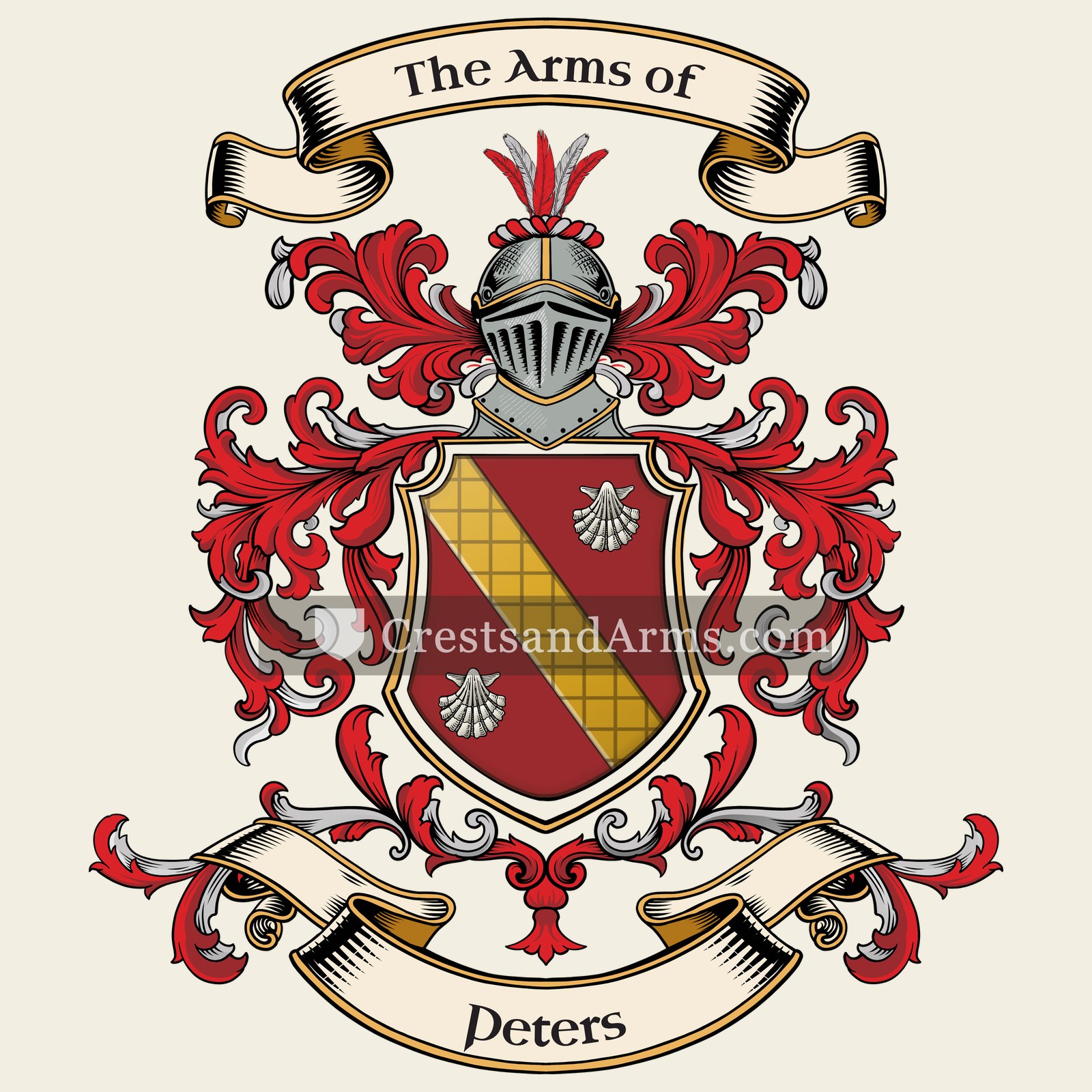
Symbols on this shield
bendDefence, and the scarf of a commander
escallopThe pilgrim's shell, and a long journey made
Colours
Red (Gules)Means: Military strength
Gold (Or)Means: Generosity
Silver (Argent)Means: Peace and sincerity
Historical info
Source
Sir Bernard Burke, The General Armory of England, Scotland, Ireland and Wales, London: Harrison & Sons, 1884
Blazon (the actual original written record)
“Gu. a bend or, betw. two escallops ar”
LancasterPlatbridge · Lancaster, c. 1620
Digital archive packCoat of arms PNG, gold border print PDF, vector SVG and the certificate of authenticity. Sent to your email in minutes.
Map of England showing where the Peters arms are recorded
The Peters arms were recorded in Lancaster, c. 1620.
Lancashire was divided among a great many small landed families, more than most northern counties. Estates were passed down whole rather than split up, so the same names hold the same ground for centuries in the records.
This is where the arms were entered in the register. Families often moved to other parts of the country, so the same name can turn up in more than one region.
The body that granted and recorded arms in England in this period.
James VI and I
Sovereign of the period
James VI and I
1603–1625
Reigning in Netherlands when the Peters arms are first recorded.
How Arms Worked in England
English heraldry allowed arms to be shared by all legitimate descendants of the original owner. These symbols were treated as personal property that moved through the generations to all children. While the eldest son kept the original design, other family members could use the same shield without needing to change it or register their own unique versions.
Granting authority
The College of Arms in London has regulated the use of coats of arms throughout England and Wales since 1484.
How they got arms
Families typically obtained their coats of arms through a formal grant from the Crown or by proving their ancient right to them.
Where arms were recorded
All official coats of arms are recorded in the registers kept at the College of Arms, which date back to the fifteenth century.
The family's standing
Recorded among the armigerous families of Lancaster.
Origin & History of the Peters Family in England
The surname Peters is a patronymic name, meaning it was originally derived from the given name Peter, which traces its roots back to the Greek word petros, meaning rock or stone. In England, the name became popular following the spread of Christianity, as Peter was one of the most significant figures in the New Testament. By the early 17th century, the name was well-established across various English counties, including Lancashire. Records confirm that families bearing the name Peters were living in the Lancaster area by 1620, a time when many English families were beginning to settle into more permanent local communities. During this period, the spelling of surnames was not yet standardized, so the name often appeared in local parish registers and legal documents as Peters, Peter, or Petre. These early families were typically part of the growing merchant or farming classes who helped shape the local economy of the region.
Coat of Arms & Family Crest Details
Colours
Blue (Azure)Means: Loyalty and truth
Black (Sable)Means: Constancy
Historical info
Source
Sir Bernard Burke, The General Armory of England, Scotland, Ireland and Wales, London: Harrison & Sons, 1884
Blazon (the actual original written record)
“Quarterly, 1st and 4th, az. an eagle displ. with two heads or, for PETERS; 2nd and 3rd, sa. a bend ar. in sinister chief a tower triple-towered of the last, for PLUNKETT”
GermanyUlster's Office, c. 1704
Digital archive packCoat of arms PNG, gold border print PDF, vector SVG and the certificate of authenticity. Sent to your email in minutes.
Map of Germany showing where the Peters arms are recorded
The Peters arms were recorded in Ulster's Office, c. 1704.
Arms such as these were typically recorded in Bavaria.
Bavaria was a country of old landed families and walled market towns. Estates passed down the same line for centuries, and both the landowners and the leading townsmen kept arms, which is why so many Bavarian names sit in the registers.
This is where the arms were entered in the register. Families often moved to other parts of the country, so the same name can turn up in more than one region.
The body that granted and recorded arms in Germany in this period.
Leopold I, Holy Roman Emperor
Sovereign of the period
Leopold I, Holy Roman Emperor
1658–1705
Reigning in Netherlands when the Peters arms are first recorded.
How Arms Worked in Germany
In the Holy Roman Empire, coats of arms were often granted to individuals by the Emperor or his representatives. These arms were then passed down through the generations to all legitimate descendants of the original holder. Younger branches of a family usually kept the same shield design without needing to change it, as the arms belonged to the entire lineage.
Granting authority
The Holy Roman Emperor held the sole power to grant new coats of arms throughout his vast imperial territories.
How they got arms
Families typically obtained their coats of arms through a formal imperial grant or by proving their noble status to the authorities.
Where arms were recorded
These grants were officially recorded in the Imperial Chancery registers, which began keeping formal records of such honors during the Middle Ages.
The family's standing
Recorded among the armigerous families of Germany.
Origin & History of the Peters Family in Germany
The surname Peters is a patronymic name, which means it was originally derived from the given name Peter. In Germany, this name became popular due to the widespread influence of Saint Peter, a central figure in Christian history. By the early 18th century, the family had established a notable presence in the region of Bavaria. During this period, Bavaria was a complex landscape of agricultural communities and small towns where families often identified themselves by their father’s name to distinguish between households. Records from 1704 confirm that members of the Peters family were living in this area, likely working as farmers or skilled tradespeople. As the family grew, they became part of the local social fabric, contributing to the development of their communities through their daily labor and local civic participation. This transition from a simple personal name to a permanent family identifier reflects the broader trend of surname adoption that occurred across German-speaking lands as populations became more settled and record-keeping became more formal.
Peters Meaning & Related Branches
Root word
Petros
Greek word meaning stone or rock
This name
PetersPatronymic surname meaning son of Peter
also spelled
Petters
Peterson
Petres
Related arms
Petersimilar arms
Peetersvariant spelling
Streetrecorded with Peters, same area
Stuartrecorded with Peters, same area
Documented Sources
J. B. Rietstap, Armorial Général, Gouda: G. B. van Goor Zonen, 1884–87
Meertens, P.J., De betekenis van de Nederlandse familienamen, 1970
Tresoar (Fries Historisch en Letterkundig Centrum), Burgerlijke Stand Friesland, 1811–1950
Van der Schaar, J., Woordenboek van voornamen, 1964
Digital archive packCoat of arms PNG, gold border print PDF, vector SVG and the certificate of authenticity. Sent to your email in minutes.


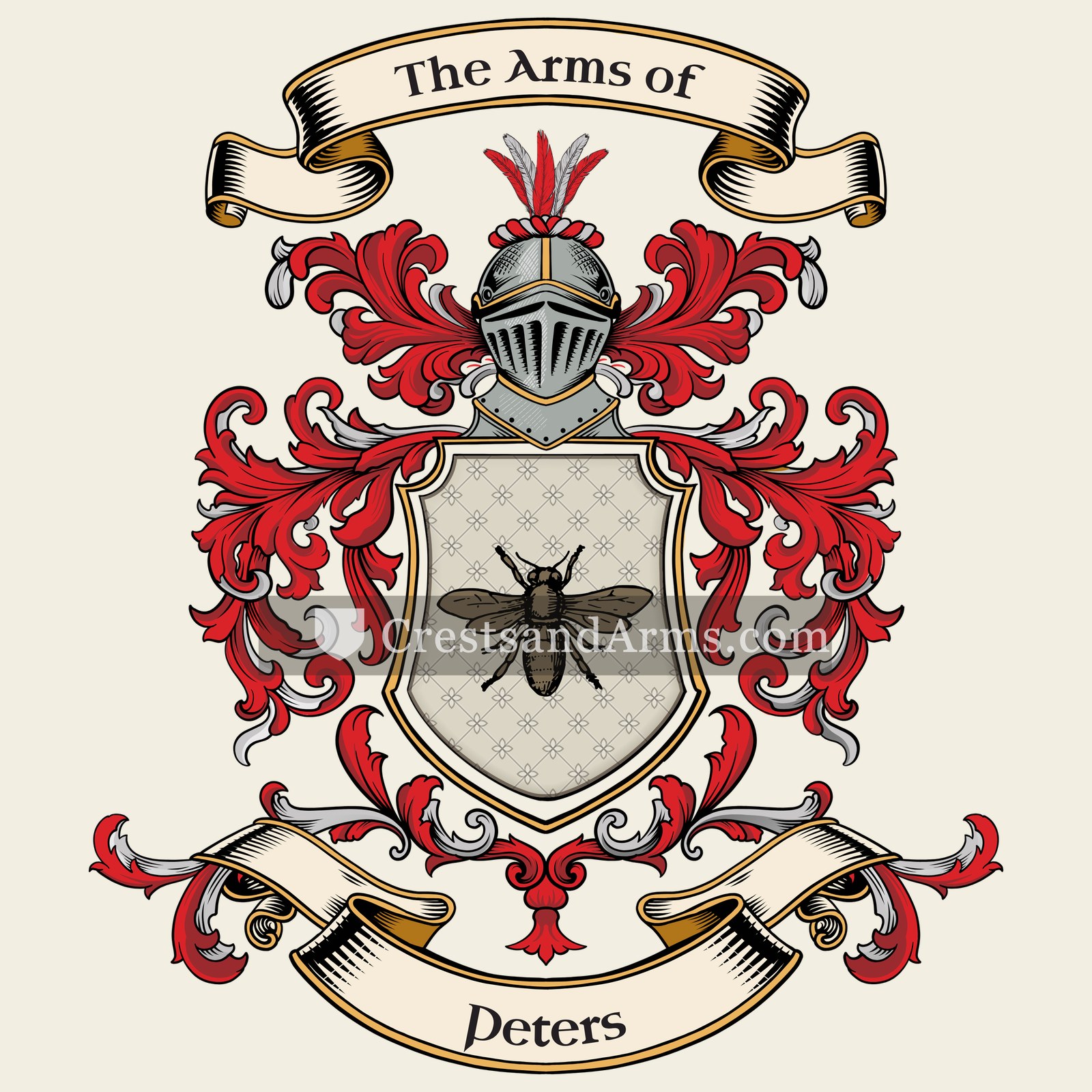
 beeIndustry, order and tireless work
 beeIndustry, order and tireless work


 bendDefence, and the scarf of a commander
 escallopThe pilgrim's shell, and a long journey made