Map of Belgium showing where the Petite arms are recorded
The Petite arms were recorded in Flandre, c. 1663.
Flandre grew rich on cloth, and its towns were among the busiest in Europe. Merchant families bought land with their profits and took arms to go with it, so trade put as many names in the registers here as land did.
This is where the arms were entered in the register. Families often moved to other parts of the country, so the same name can turn up in more than one region.
The body that granted and recorded arms in Belgium in this period.
Philip IV of Spain
Sovereign of the period
Philip IV of Spain
1621–1665
Reigning in Belgium when the Petite arms are first recorded.
How Arms Worked in Belgium
In Belgium, a coat of arms is considered personal property that is passed down through the male line to legitimate descendants. Families often use the same shield design across generations to show their shared heritage. If a branch of the family wants to change the design, they must apply for an official update to their specific version of the arms.
Granting authority
The Conseil héraldique is the official body that regulates and approves all coats of arms in Belgium.
How they got arms
Families obtain their coats of arms through formal royal grants or by confirming their historical right to use existing designs.
Where arms were recorded
All approved coats of arms are officially recorded in the public registers of the Conseil héraldique since 1844.
The family's standing
Recorded among the armigerous families of Flandre.
Origin & History of the Petite Family in Belgium
The family name Petite has deep roots in the historical region of Flanders, where records confirm members of the family were living as early as 1663. During the seventeenth century, this area was a busy center for trade and agriculture, which likely influenced the daily lives of the early Petite family. The name itself is derived from the Old French word for small, suggesting that it may have originally functioned as a descriptive nickname for a person of short stature or perhaps to distinguish a younger family member from an older one with the same name. As the family established themselves in the Flemish landscape, they became part of a complex society defined by shifting borders and local traditions. By settling in this region, the early members of the Petite family contributed to the long-standing cultural history of the Flemish people during a time of significant social change in Europe.
Meaning of the Petite family crest colors & symbols
Symbols on this shield
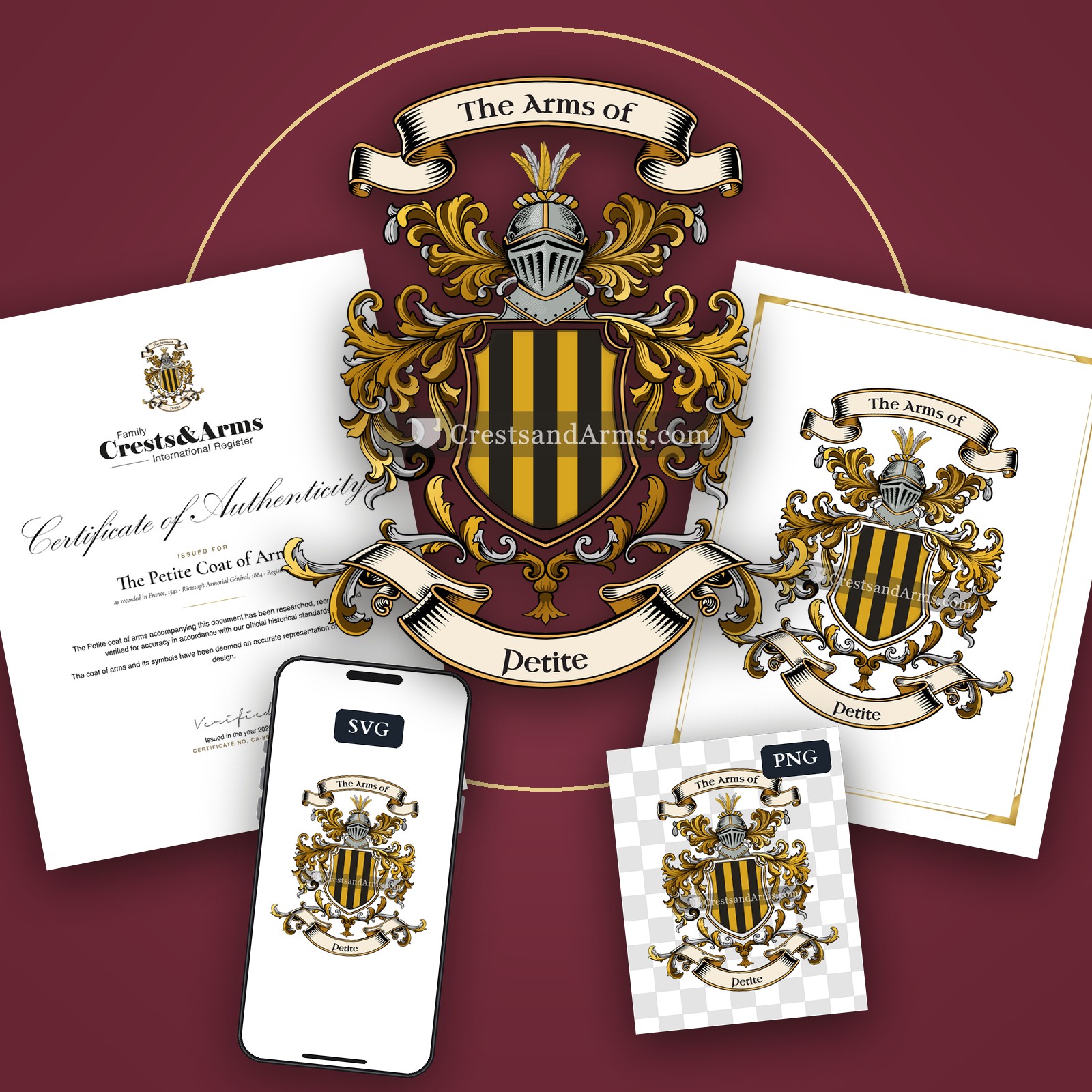
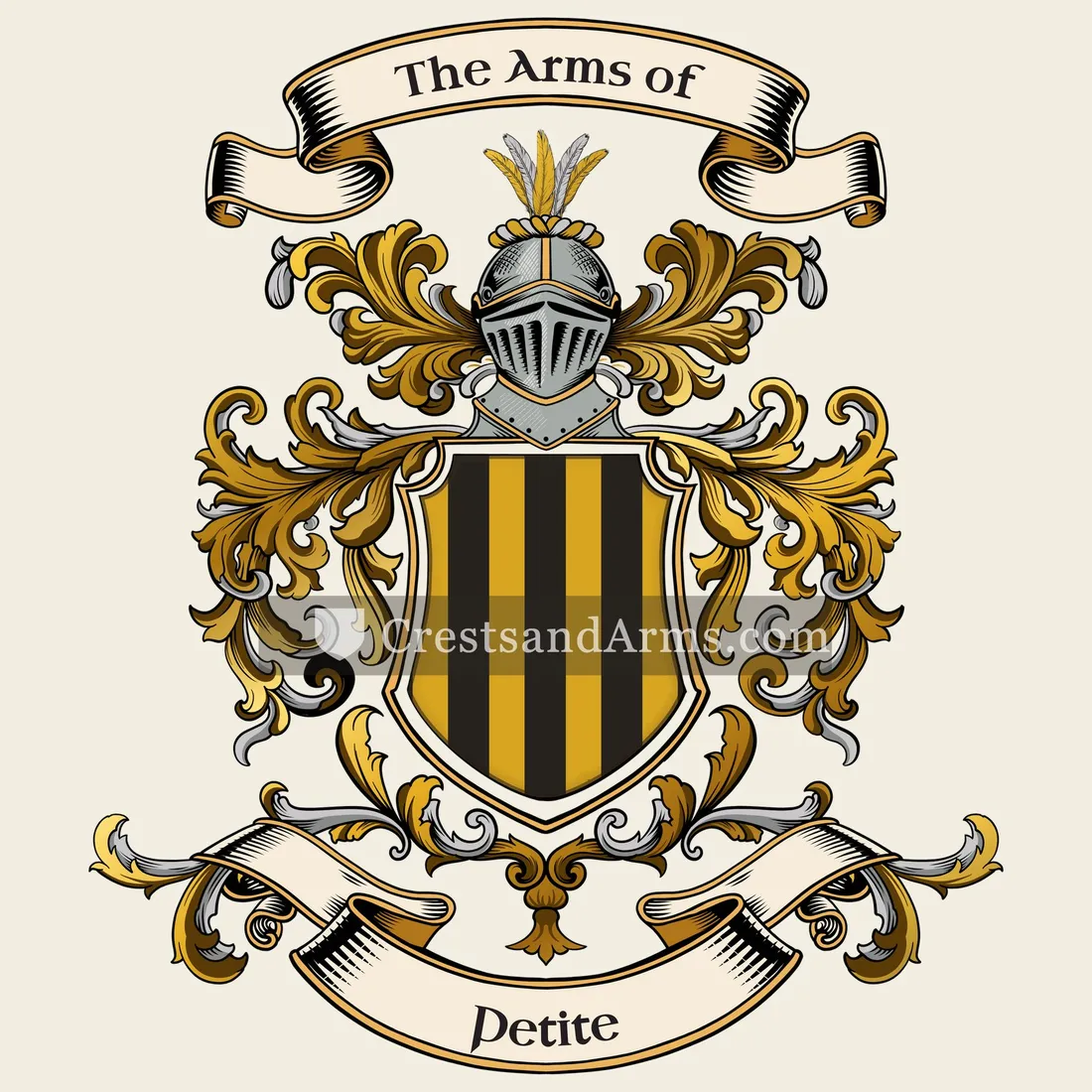
paleMilitary strength, and a fortified defence
Colours
Black (Sable)Means: Constancy
Gold (Or)Means: Generosity
Historical info
Source
J. B. Rietstap, Armorial Général, Gouda: G. B. van Goor Zonen, 1884–87
Blazon (the actual original written record)
“De sa. à quatre pals d'or.”
LorraineLorraine, c. 1542
Digital archive packCoat of arms PNG, gold border print PDF, vector SVG and the certificate of authenticity. Sent to your email in minutes.
Map of France showing where the Petite arms are recorded
The Petite arms were recorded in Lorraine, c. 1542.
Lorraine sat on the border between France and the German lands, and border country bred soldiers. Families here held small estates and served in arms, and a fighting man was exactly the sort who carried a shield of his own.
This is where the arms were entered in the register. Families often moved to other parts of the country, so the same name can turn up in more than one region.
The body that granted and recorded arms in France in this period.
Francis I of France
Sovereign of the period
Francis I of France
1515–1547
Reigning in Belgium when the Petite arms are first recorded.
How Arms Worked in France
In France, a coat of arms was a mark of honor that passed down through the male line to all legitimate descendants. Families often used the same shield without changes to show their shared heritage. If a branch wanted to stand out, they could add a small mark to their shield to show their specific place in the family tree.
Granting authority
The Juge d'armes de France acted as the official authority that regulated and verified coats of arms across the country.
How they got arms
Families typically inherited their arms from ancestors, though they could also receive them through royal grants or by proving their noble status.
Where arms were recorded
Coats of arms were officially recorded in the Armorial Général de France, which began its main collection in the year 1696.
The family's standing
Recorded among the armigerous families of Lorraine.
Origin & History of the Petite Family in France
The family name Petite finds its roots in the historical region of Lorraine, where records confirm the presence of family members as early as 1542. In the French language, the name is derived from the adjective meaning small or little, and it likely began as a descriptive nickname used to distinguish one person from another in a local community. During the sixteenth century, Lorraine was a crossroads of culture and trade located between the Kingdom of France and the Holy Roman Empire. Families living in this area often experienced significant shifts in borders and governance, which influenced how they documented their lives and movements. As the name transitioned from a simple nickname into a hereditary surname, it became a permanent marker of the family’s identity within the rural villages and growing towns of the Lorraine province. This evolution reflects the broader social trends of the era, where common descriptive terms gradually solidified into the formal family names that are still recognized today.
Meaning of the Petite family crest colors & symbols
Symbols on this shield
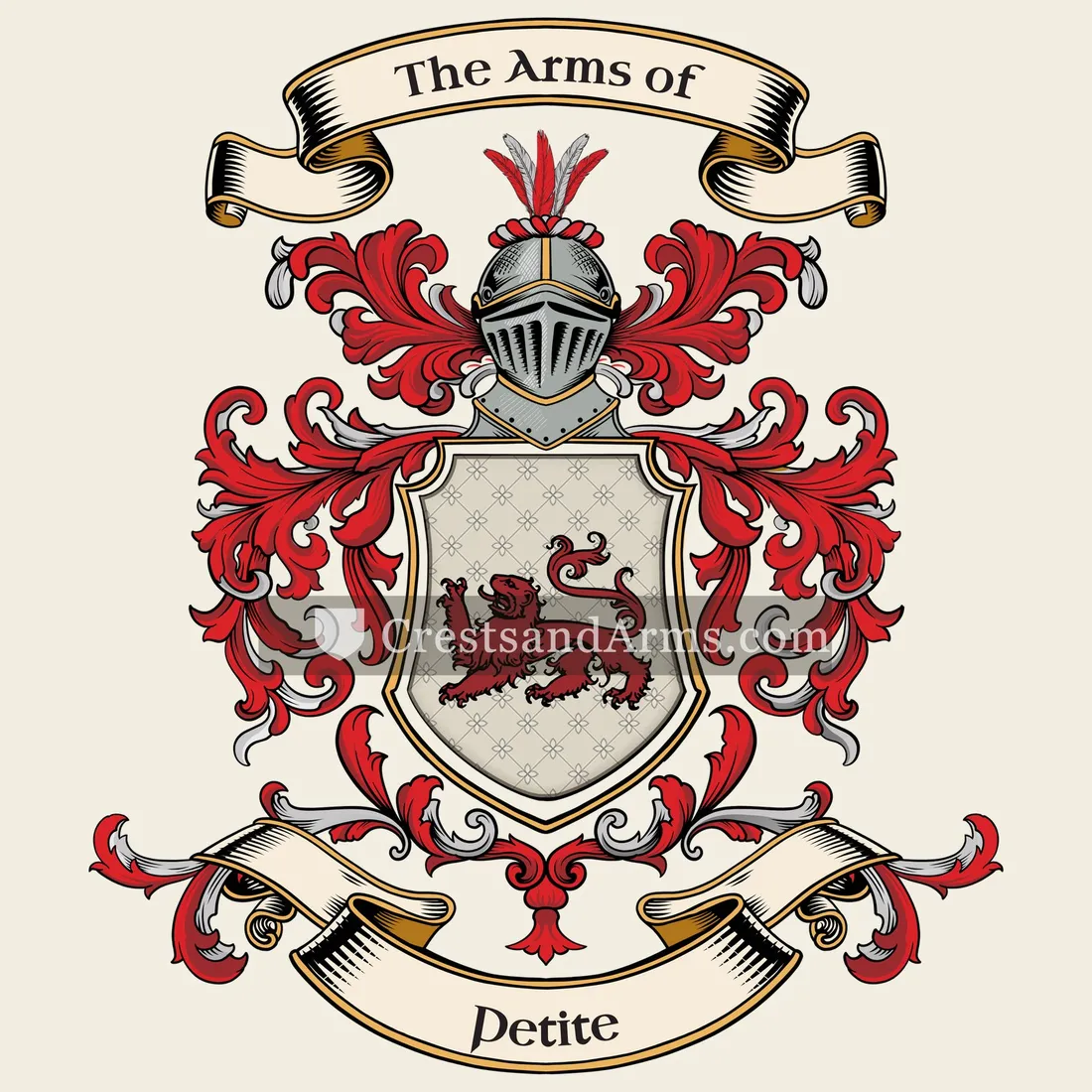
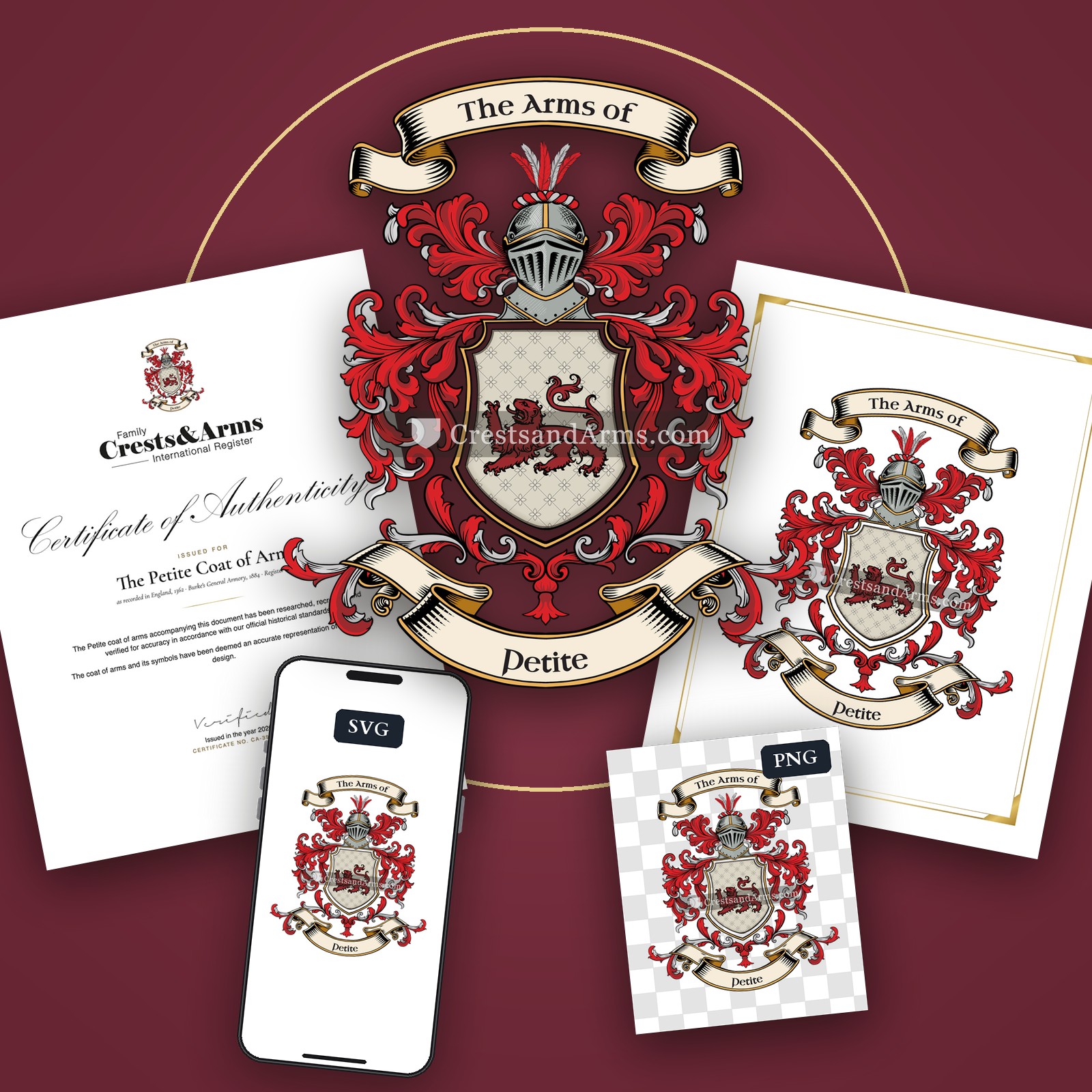
lionCourage, strength and royalty
Colours
Silver (Argent)Means: Peace and sincerity
Red (Gules)Means: Military strength
Historical info
Source
Sir Bernard Burke, The General Armory of England, Scotland, Ireland and Wales, London: Harrison & Sons, 1884
Blazon (the actual original written record)
“Ar. a lion pass. gu”
CornwallArdevora · Cornwall, c. 1362
Digital archive packCoat of arms PNG, gold border print PDF, vector SVG and the certificate of authenticity. Sent to your email in minutes.
Map of England showing where the Petite arms are recorded
The Petite arms were recorded in Cornwall, c. 1362.
Cornwall was a county apart, with its own language and its own tight-knit gentry. Tin and the sea made money there, and families who made it bought land, which is what brought arms with it.
This is where the arms were entered in the register. Families often moved to other parts of the country, so the same name can turn up in more than one region.
The body that granted and recorded arms in England in this period.
Edward III of England
Sovereign of the period
Edward III of England
1327–1377
Reigning in Belgium when the Petite arms are first recorded.
How Arms Worked in England
English heraldry allowed arms to be shared by all legitimate descendants of the original owner. These symbols were treated as personal property that moved through the generations to all children. While the eldest son kept the original design, other family members could use the same shield without needing to change it or register their own unique versions.
Granting authority
The College of Arms in London has regulated the use of coats of arms throughout England and Wales since 1484.
How they got arms
Families typically obtained their coats of arms through a formal grant from the Crown or by proving their ancient right to them.
Where arms were recorded
All official coats of arms are recorded in the registers kept at the College of Arms, which date back to the fifteenth century.
The family's standing
Recorded among the armigerous families of Cornwall.
Origin & History of the Petite Family in England
The surname Petite emerged in England as a descriptive nickname, likely used to distinguish a person of smaller stature or a younger member of a family. By the year 1362, historical records confirm the presence of the family in Cornwall, a region known for its distinct cultural identity and tin mining industry. During the fourteenth century, surnames were becoming increasingly common as the population grew and tax records required more specific identification for individuals. The name likely evolved from the Old French word "petit," which reflects the linguistic influence of the Norman Conquest on the English language. Families carrying this name in Cornwall were often integrated into the local agrarian or trade-based economy of the time. Over the centuries, the name persisted as a mark of identity, linking those who held it to the rugged landscape and the social structures of medieval southwestern England.
Petite Meaning & Related Branches
Root word
Petit
Derived from the Old French word for small or little.
This name
PetiteA descriptive nickname originally used to identify a person of small stature.
also spelled
Petyt
Petye
Peti
Petty
Petytt
Related arms
Pettitvariant spelling
Petytvariant spelling
Petyttvariant spelling
Documented Sources
J. B. Rietstap, Armorial Général, Gouda: G. B. van Goor Zonen, 1884–87
De Flou, Karel. Woordenboek der toponymie van westelijk Vlaanderen, Vlaamsch Artesië, het Land van den Hoek, de graafschappen Guines en Boulogne en een gedeelte van het graafschap Ponthieu, 1914
State Archives in Belgium (Rijksarchief te Gent), Parochieregisters van de provincie Oost-Vlaanderen, 1663
Digital archive packCoat of arms PNG, gold border print PDF, vector SVG and the certificate of authenticity. Sent to your email in minutes.


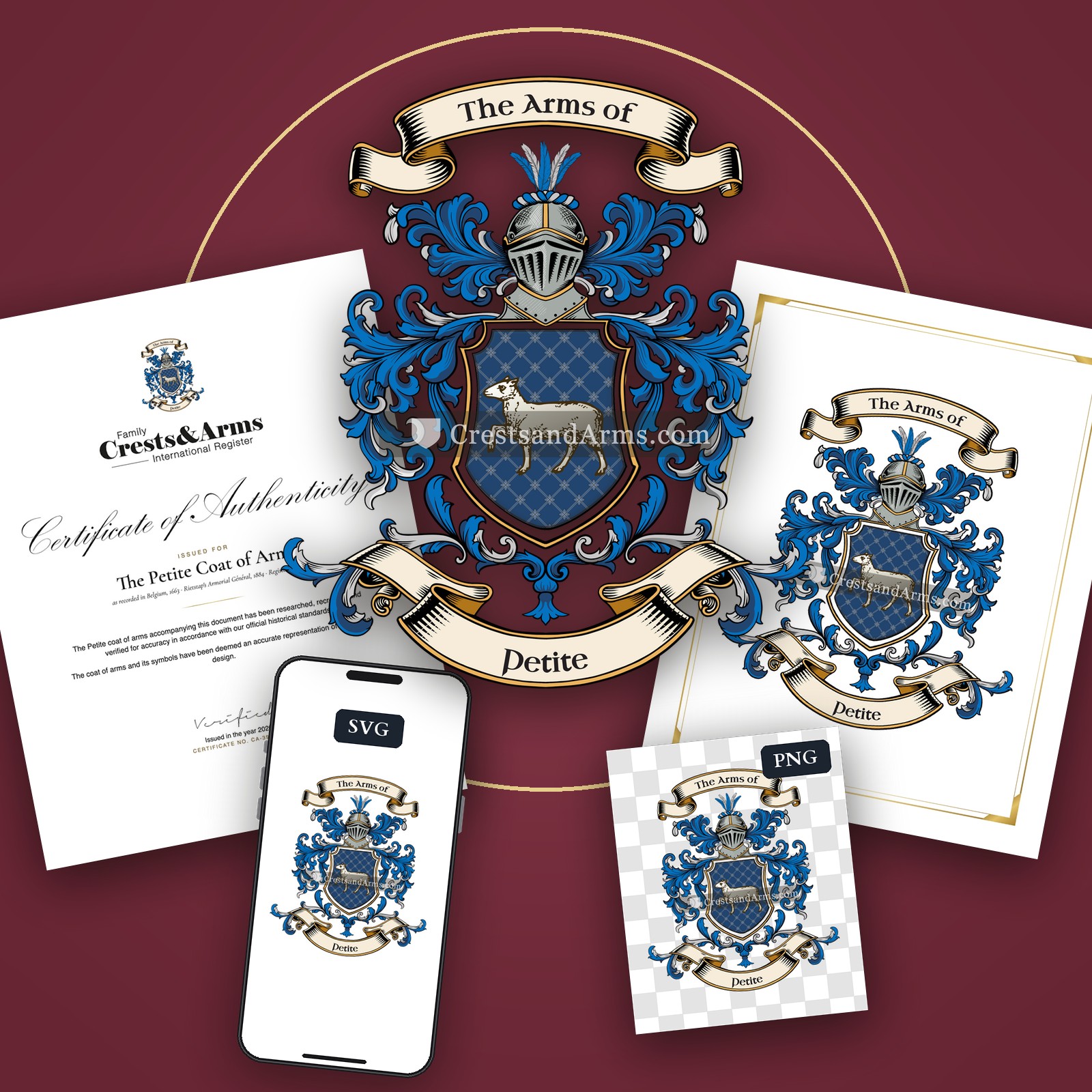
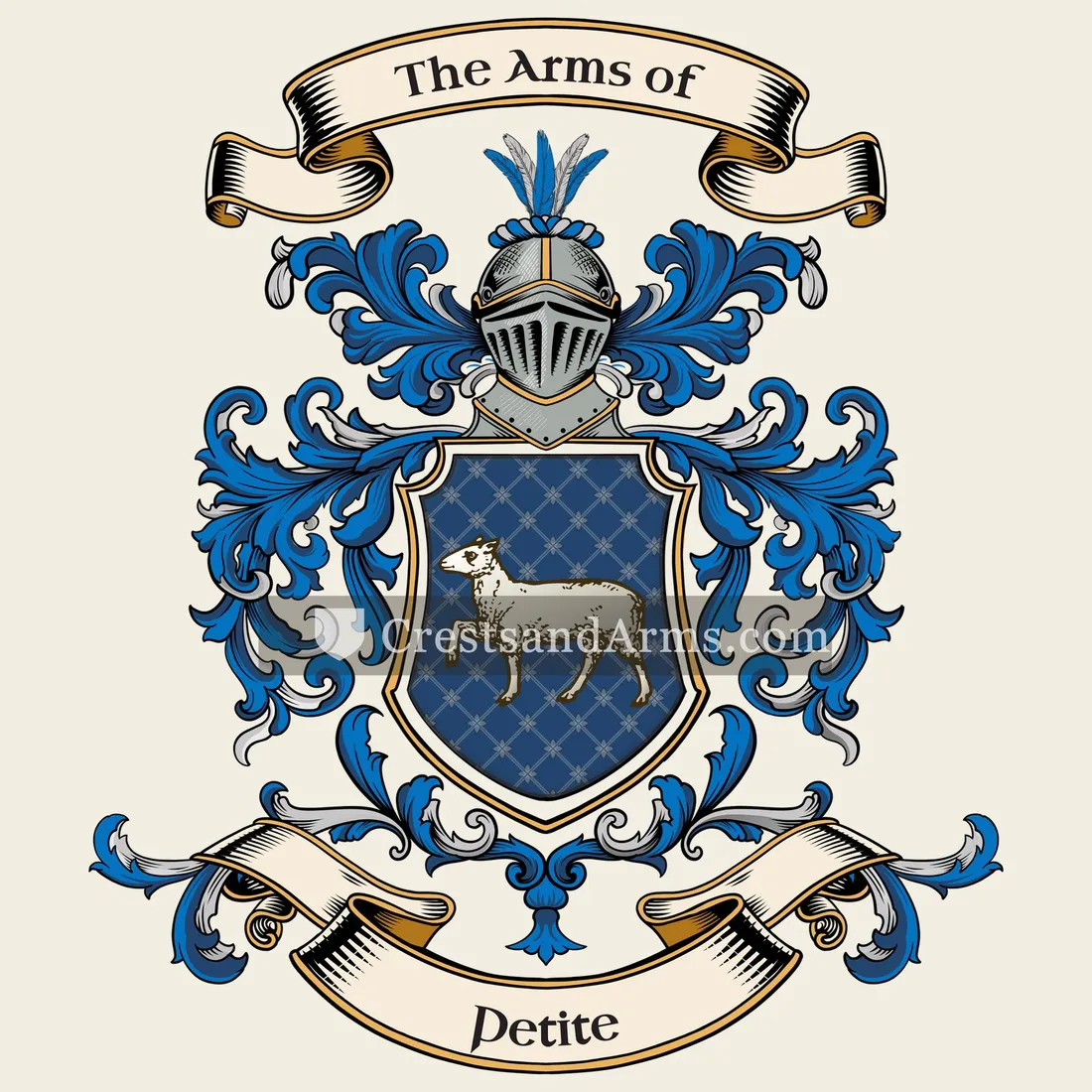
 lambGentleness, patience and faith
 lambGentleness, patience and faith


 paleMilitary strength, and a fortified defence


 lionCourage, strength and royalty