Map of Germany showing where the Petterson arms are recorded
The Petterson arms were recorded in Holstein, c. 1765.
Holstein was farming country between the North Sea and the Baltic, held in large estates. The same families kept the same land for generations, and generations of holding is what fills a register.
This is where the arms were entered in the register. Families often moved to other parts of the country, so the same name can turn up in more than one region.
The body that granted and recorded arms in Germany in this period.
Francis I, Holy Roman Emperor
Sovereign of the period
Francis I, Holy Roman Emperor
1745–1765
Reigning in Germany when the Petterson arms are first recorded.
How Arms Worked in Germany
In the Holy Roman Empire, coats of arms were often granted to individuals by the Emperor or his representatives. These arms were then passed down through the generations to all legitimate descendants of the original holder. Younger branches of a family usually kept the same shield design without needing to change it, as the arms belonged to the entire lineage.
Granting authority
The Holy Roman Emperor held the sole power to grant new coats of arms throughout his vast imperial territories.
How they got arms
Families typically obtained their coats of arms through a formal imperial grant or by proving their noble status to the authorities.
Where arms were recorded
These grants were officially recorded in the Imperial Chancery registers, which began keeping formal records of such honors during the Middle Ages.
The family's standing
Recorded among the armigerous families of Holstein.
Origin & History of the Petterson Family in Germany
The surname Petterson, while often associated with Nordic regions, has deep roots in the northern German territory of Holstein. By the mid-eighteenth century, families bearing this name were well-established in the region, which served as a cultural and linguistic bridge between the German states and Denmark. In 1765, the name appeared in local civil and church records, reflecting a period when surnames were becoming more standardized across rural German communities. These early family members likely worked as tradespeople or farmers, living in a landscape defined by the shifting political boundaries of the Holy Roman Empire. Because Holstein was a place where German and Scandinavian influences frequently overlapped, the name Petterson evolved as a patronymic, meaning it was originally derived from the name Peter to signify a son of that ancestor. This naming tradition helped families maintain a clear sense of identity as they navigated the social and economic changes of eighteenth-century northern Germany.
Meaning of the Petterson family crest colors & symbols
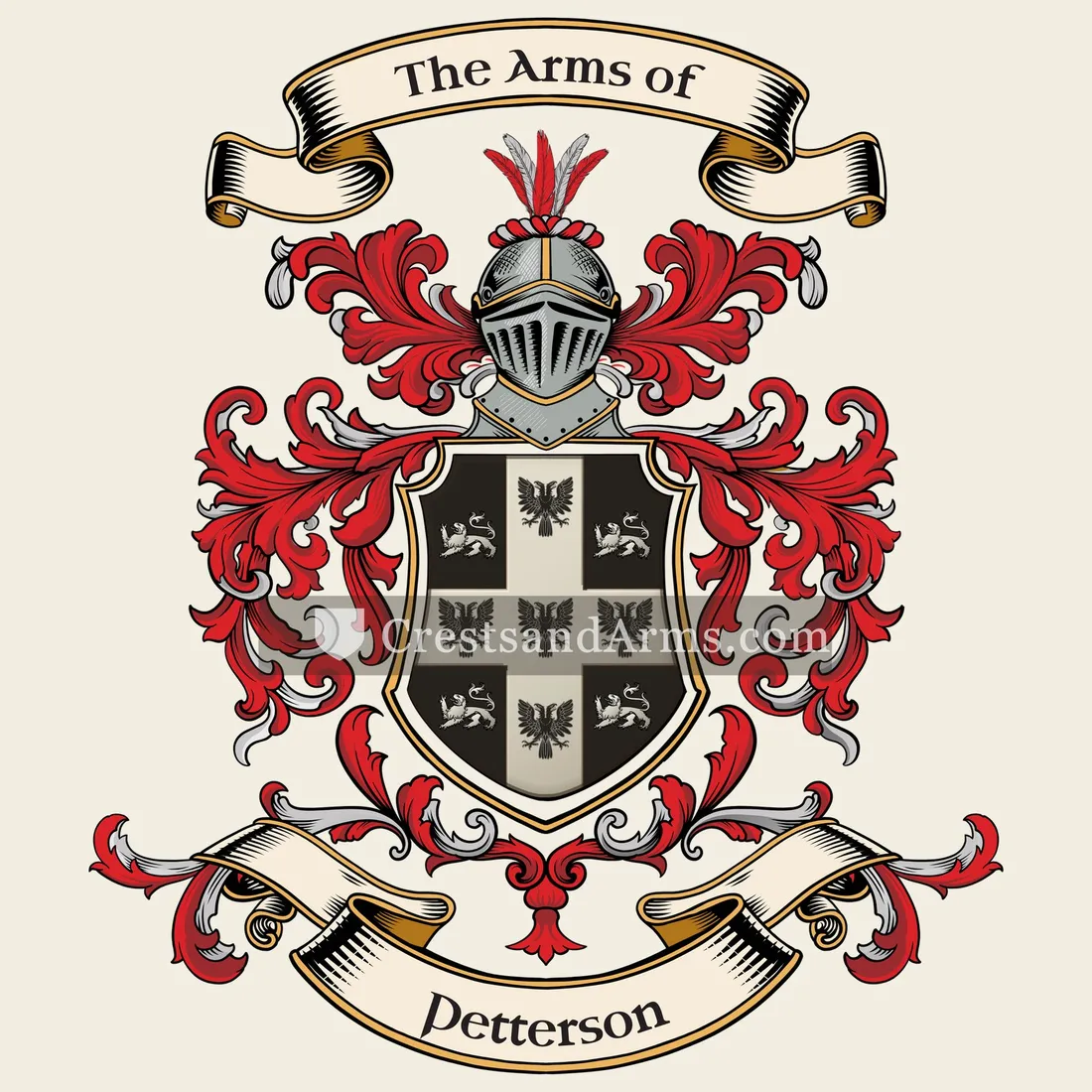
Symbols on this shield
cross symbolChristian faith and service
lionCourage, strength and royalty
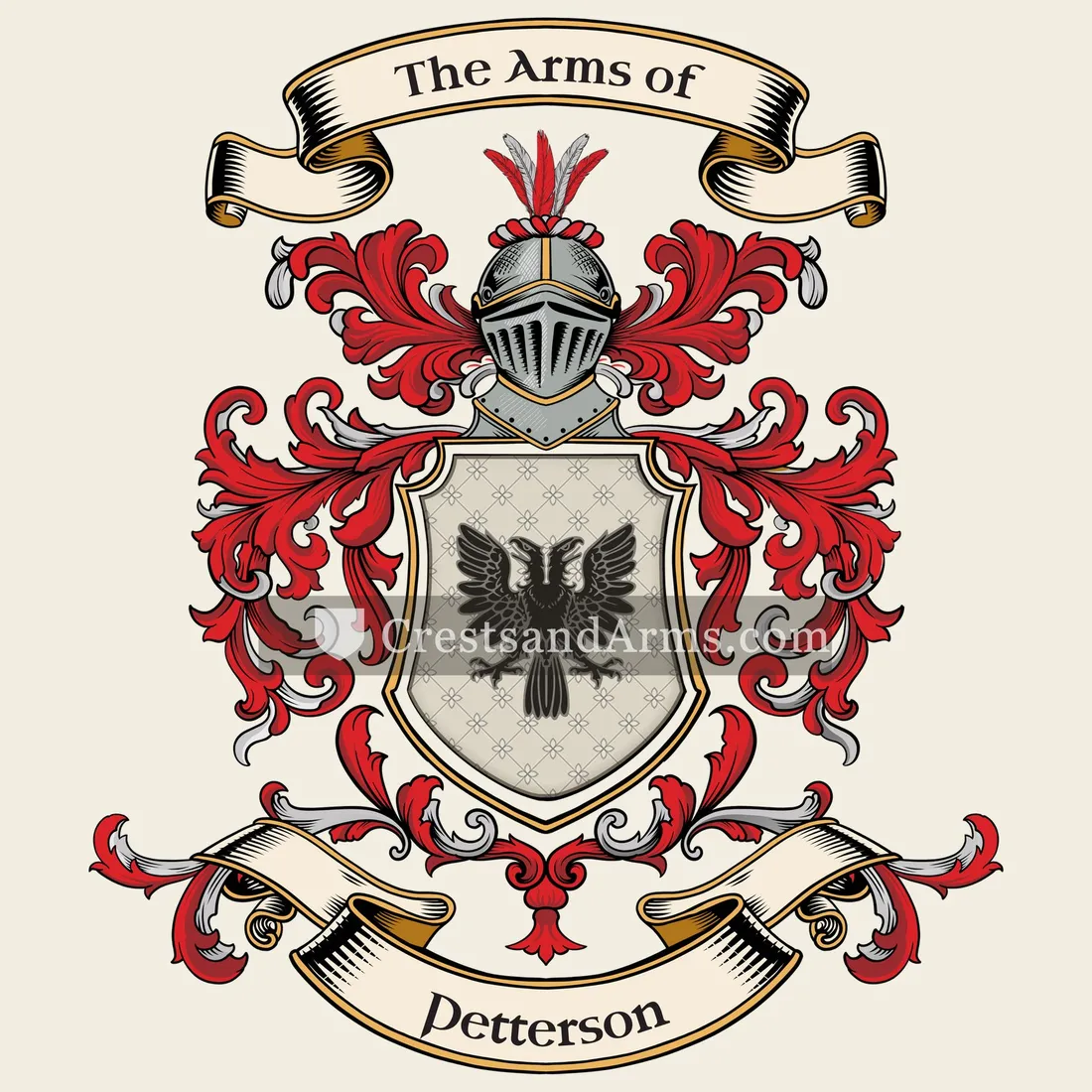
eagleNobility, strength and a keen mind
Colours
Black (Sable)Means: Constancy
Silver (Argent)Means: Peace and sincerity
Historical info
Source
Sir Bernard Burke, The General Armory of England, Scotland, Ireland and Wales, London: Harrison & Sons, 1884
Blazon (the actual original written record)
“Sa. on a cross betw. four lions ramp. ar. five eagles displ. of the field”
Englandc. 1620
Digital archive packCoat of arms PNG, gold border print PDF, vector SVG and the certificate of authenticity. Sent to your email in minutes.
Map of England showing where the Petterson arms are recorded
The Petterson arms were recorded in England, c. 1620.
Arms such as these were typically recorded in York.
Yorkshire is the largest of the English counties, and it held more gentry families than any other. Land there was split among a great many households rather than a few, so a great many of them carried arms.
This is where the arms were entered in the register. Families often moved to other parts of the country, so the same name can turn up in more than one region.
The body that granted and recorded arms in England in this period.
James VI and I
Sovereign of the period
James VI and I
1603–1625
Reigning in Germany when the Petterson arms are first recorded.
How Arms Worked in England
English heraldry allowed arms to be shared by all legitimate descendants of the original owner. These symbols were treated as personal property that moved through the generations to all children. While the eldest son kept the original design, other family members could use the same shield without needing to change it or register their own unique versions.
Granting authority
The College of Arms in London has regulated the use of coats of arms throughout England and Wales since 1484.
How they got arms
Families typically obtained their coats of arms through a formal grant from the Crown or by proving their ancient right to them.
Where arms were recorded
All official coats of arms are recorded in the registers kept at the College of Arms, which date back to the fifteenth century.
The family's standing
Recorded among the armigerous families of England.
Origin & History of the Petterson Family in England
The surname Petterson is a patronymic name, which means it was originally created to identify a person as the son of Peter. While the name has deep roots in Scandinavian regions, its presence in England became more established as trade and migration patterns brought families across the North Sea. By 1620, records confirm that members of the Petterson family were living in the historic city of York. During this period, York served as a vital northern hub for commerce and craftsmanship, providing a stable environment for families to settle and grow. As these early settlers integrated into English society, the spelling of the name often shifted to reflect local pronunciation and the way clerks recorded it in parish registers. This transition highlights how a name rooted in foreign traditions gradually became a part of the local landscape in northern England.
Petterson Meaning & Related Branches
Root word
Petrus
A Greek word meaning stone or rock.
This name
PettersonSon of Peter, indicating a patronymic lineage derived from the given name.
also spelled
Petersen
Petersonne
Peterson-Peterson
Documented Sources
J. B. Rietstap, Armorial Général, Gouda: G. B. van Goor Zonen, 1884–87
Kohlheim, Rosa and Volker Kohlheim, Duden Familiennamen: Herkunft und Bedeutung, 2005
Bahlow, Hans, Deutsches Namenlexikon: Familien- und Vornamen nach Ursprung und Sinn erklärt, 1967
Landesarchiv Schleswig-Holstein, Kirchenbücher der evangelisch-lutherischen Kirchengemeinden in Holstein, 1765
Digital archive packCoat of arms PNG, gold border print PDF, vector SVG and the certificate of authenticity. Sent to your email in minutes.


 eagleNobility, strength and a keen mind
 eagleNobility, strength and a keen mind


 cross symbolChristian faith and service
 lionCourage, strength and royalty