Map of France showing where the Pewter arms are recorded
The Pewter arms were recorded in Lorraine, c. 1663.
Lorraine sat on the border between France and the German lands, and border country bred soldiers. Families here held small estates and served in arms, and a fighting man was exactly the sort who carried a shield of his own.
This is where the arms were entered in the register. Families often moved to other parts of the country, so the same name can turn up in more than one region.
The body that granted and recorded arms in France in this period.
Louis XIV of France
Sovereign of the period
Louis XIV of France
1643–1715
Reigning in France when the Pewter arms are first recorded.
How Arms Worked in France
In France, a coat of arms was a mark of honor that passed down through the male line to all legitimate descendants. Families often used the same shield without changes to show their shared heritage. If a branch wanted to stand out, they could add a small mark to their shield to show their specific place in the family tree.
Granting authority
The Juge d'armes de France acted as the official authority that regulated and verified coats of arms across the country.
How they got arms
Families typically inherited their arms from ancestors, though they could also receive them through royal grants or by proving their noble status.
Where arms were recorded
Coats of arms were officially recorded in the Armorial Général de France, which began its main collection in the year 1696.
The family's standing
Recorded among the armigerous families of Lorraine.
Origin & History of the Pewter Family in France
The family name Pewter, often associated with the historical craft of metalworking, finds its roots in the vibrant region of Lorraine during the seventeenth century. By 1663, records confirm that family members were established in this area, which served as a vital crossroads for trade and craftsmanship between the French kingdom and the Holy Roman Empire. During this period, the name likely emerged as a descriptive occupational surname, identifying those who worked with the alloy of tin and lead that gave the name its character. Living in Lorraine meant that the family was situated in a landscape shaped by constant cultural exchange and the development of specialized guilds. These early ancestors were part of a society that valued technical skill and local industry, allowing the family to integrate into the social fabric of the region long before the political borders of modern France were fully finalized.
Coat of Arms & Family Crest Details
Colours
Red (Gules)Means: Military strength
Historical info
Source
J. B. Rietstap, Armorial Général, Gouda: G. B. van Goor Zonen, 1884–87
Blazon (the actual original written record)
“De gu. à un monde d'or, cintré d'arg., sommé d'une croix latine du même.”
SwitzerlandNeufchâtel, c. 1745
Digital archive packCoat of arms PNG, gold border print PDF, vector SVG and the certificate of authenticity. Sent to your email in minutes.
Map of Switzerland showing where the Pewter arms are recorded
The Pewter arms were recorded in Neufchâtel, c. 1745.
This is where the arms were entered in the register. Families often moved to other parts of the country, so the same name can turn up in more than one region.
The body that granted and recorded arms in Switzerland in this period.
How Arms Worked in Switzerland
In Switzerland, coats of arms were not restricted to the nobility and were often adopted by common citizens and families. These symbols were passed down through generations to show family identity. When branches of a family grew, they often changed small details of the design to distinguish their own line from the original group.
Granting authority
Cantonal and civic authorities managed the use of coats of arms within their specific regions and local jurisdictions.
How they got arms
Families typically assumed their own coats of arms based on local custom rather than receiving them from a central monarch.
Where arms were recorded
Arms were recorded in various cantonal and civic registers starting from the fourteenth century throughout the Swiss region.
The family's standing
Recorded among the armigerous families of Switzerland.
Origin & History of the Pewter Family in Switzerland
The family name Pewter holds a distinct place in the historical landscape of the Neuchâtel region of Switzerland. By the mid-eighteenth century, records confirm that members of the family were established within this area, which was then a principality with strong ties to the Prussian monarchy. During this period, the region was a center for craftsmanship and trade, often attracting families who specialized in metalworking or artisanal production. It is likely that the name evolved as a descriptive occupational surname, reflecting the family's historical involvement in the trade of pewter, a durable alloy of tin and other metals. As the family integrated into the social fabric of Neuchâtel in 1745, they became part of a community defined by its unique blend of French cultural influence and Swiss independence. Their presence in the local registers suggests they were active participants in the economic life of the town during a time of significant industrial growth.
Coat of Arms & Family Crest Details
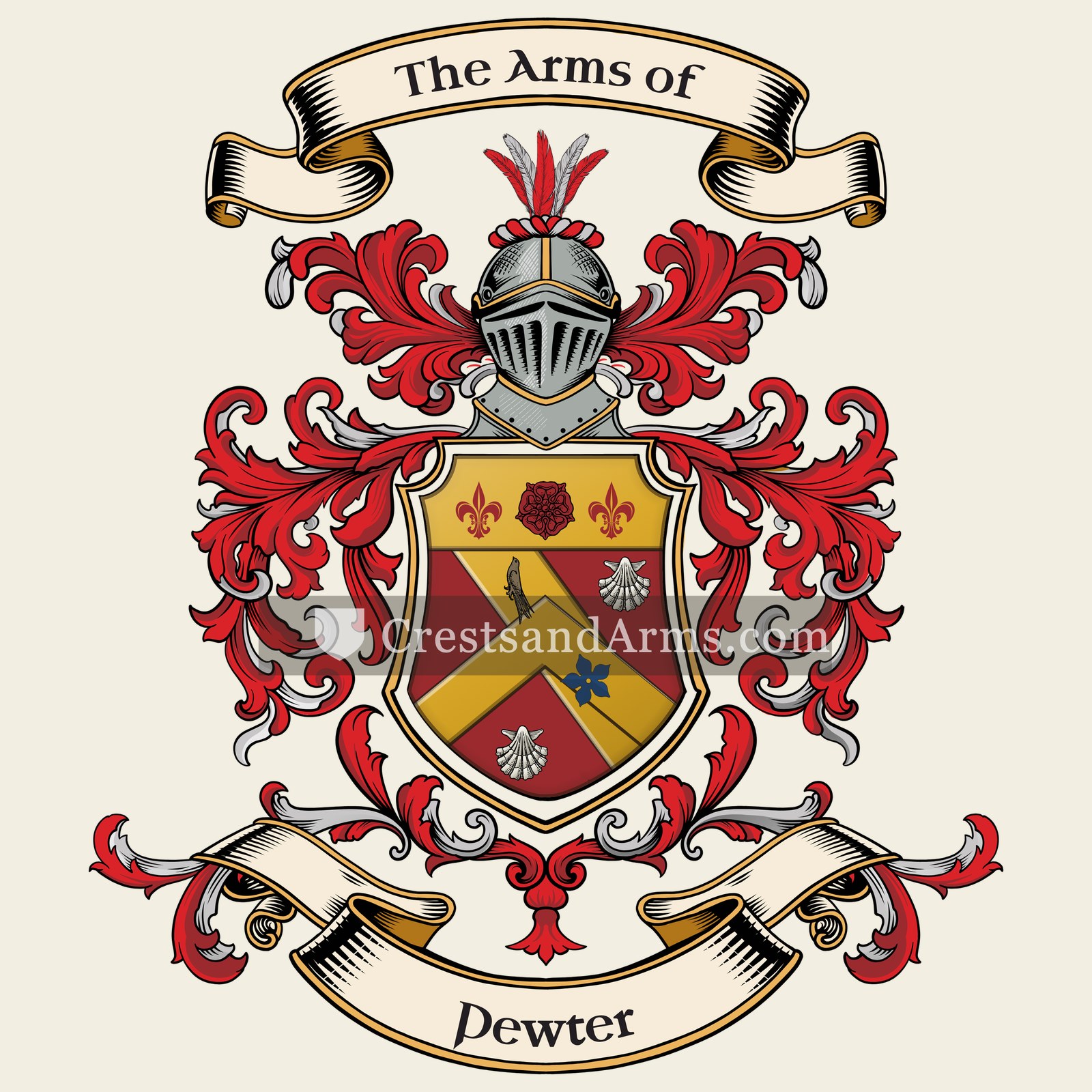
Symbols on this shield
bendDefence, and the scarf of a commander
chevronProtection, and faithful service completed
chiefAuthority, wisdom and dominion
roseThe seventh son, and beauty with grace
escallopThe pilgrim's shell, and a long journey made
martletA younger son, who must win his own land
cinquefoilHope and joy
fleur de lisPurity, light, and the sixth son
Colours
Red (Gules)Means: Military strength
Gold (Or)Means: Generosity
Silver (Argent)Means: Peace and sincerity
Blue (Azure)Means: Loyalty and truth
Historical info
Source
Sir Bernard Burke, The General Armory of England, Scotland, Ireland and Wales, London: Harrison & Sons, 1884
Blazon (the actual original written record)
“Gu. on a bend (sometimes a chev.) or, betw. two escallops ar. a Cornish chough ppr. enclosed by as many cinquefoils az. on a chief of the second a rose betw. two fleurs-de-lis of the first, seeded or, barbed and leaved vert”
EssexEssex, c. 1620
Digital archive packCoat of arms PNG, gold border print PDF, vector SVG and the certificate of authenticity. Sent to your email in minutes.
Map of England showing where the Pewter arms are recorded
The Pewter arms were recorded in Essex, c. 1620.
Essex lay close enough to London for City money to buy land there. Merchants who prospered moved out to estates within a day's ride, and a new landowner almost always wanted arms to go with the ground.
This is where the arms were entered in the register. Families often moved to other parts of the country, so the same name can turn up in more than one region.
The body that granted and recorded arms in England in this period.
James VI and I
Sovereign of the period
James VI and I
1603–1625
Reigning in France when the Pewter arms are first recorded.
How Arms Worked in England
English heraldry allowed arms to be shared by all legitimate descendants of the original owner. These symbols were treated as personal property that moved through the generations to all children. While the eldest son kept the original design, other family members could use the same shield without needing to change it or register their own unique versions.
Granting authority
The College of Arms in London has regulated the use of coats of arms throughout England and Wales since 1484.
How they got arms
Families typically obtained their coats of arms through a formal grant from the Crown or by proving their ancient right to them.
Where arms were recorded
All official coats of arms are recorded in the registers kept at the College of Arms, which date back to the fifteenth century.
The family's standing
Recorded among the armigerous families of Essex.
Origin & History of the Pewter Family in England
The surname Pewter likely originated as an occupational name, identifying ancestors who worked as makers or sellers of pewterware. This alloy, primarily composed of tin, was a staple of English households for centuries, serving as a durable and affordable alternative to expensive silver or fragile pottery. By the year 1620, records confirm that members of the Pewter family were established in the county of Essex. During this period, Essex was a bustling region with strong ties to London, making it a prime location for tradespeople to settle and conduct business. Families in this area often lived near market towns where metalworkers could easily source raw materials and sell their finished goods to a growing population. Over time, the name transitioned from a simple description of a craftsman’s trade into a permanent family identifier, marking the lineage of those who helped shape the domestic life of early modern England.
Related Branches & Arms
Root word
potier
a maker or seller of earthenware vessels
This name
Pewteran occupational surname for a worker who crafted or sold metal or clay containers
also spelled
Petter
Petre
Peters
Petrie
Documented Sources
J. B. Rietstap, Armorial Général, Gouda: G. B. van Goor Zonen, 1884–87
Archives départementales de la Meurthe-et-Moselle, Série B (Cours et juridictions)
Cabourdin, Guy. La Lorraine culturelle au XVIIIe siècle. 1966
Lepage, Henri. Les communes de la Meurthe: journal historique des villes, bourgs, villages, hameaux et censes de ce département. 1853
Digital archive packCoat of arms PNG, gold border print PDF, vector SVG and the certificate of authenticity. Sent to your email in minutes.


 hammerHonest labour, and the smith's craft
 hammerHonest labour, and the smith's craft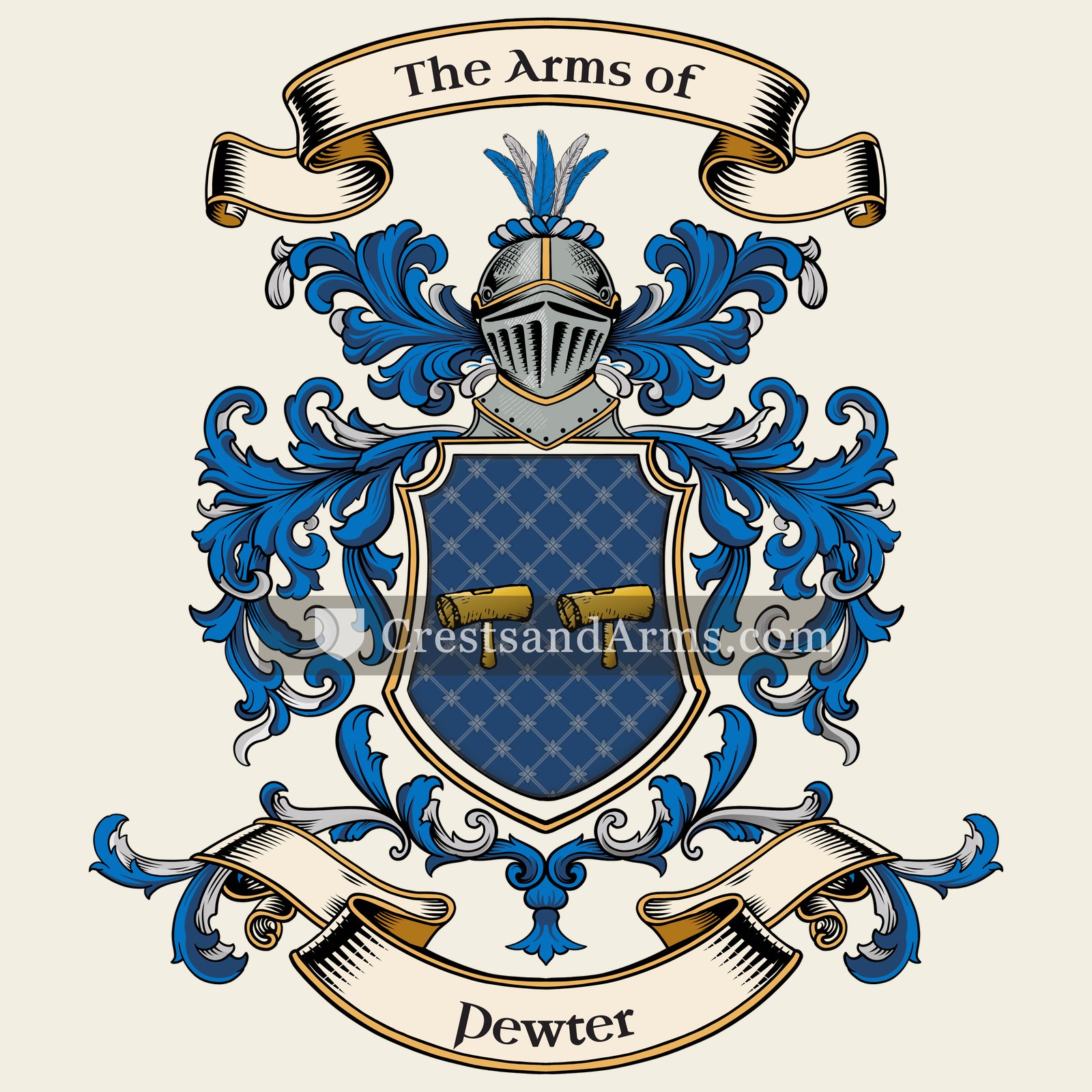



 bendDefence, and the scarf of a commander
 chevronProtection, and faithful service completed
 chiefAuthority, wisdom and dominion
 roseThe seventh son, and beauty with grace
 escallopThe pilgrim's shell, and a long journey made
 martletA younger son, who must win his own land
 cinquefoilHope and joy
 fleur de lisPurity, light, and the sixth son