A record of documented arms, meaning and origin, researched for the Pfaff family lines. Documented in 2 countries.
Reg. 5794 · German, P–S
Coat of Arms & Family Crest Details
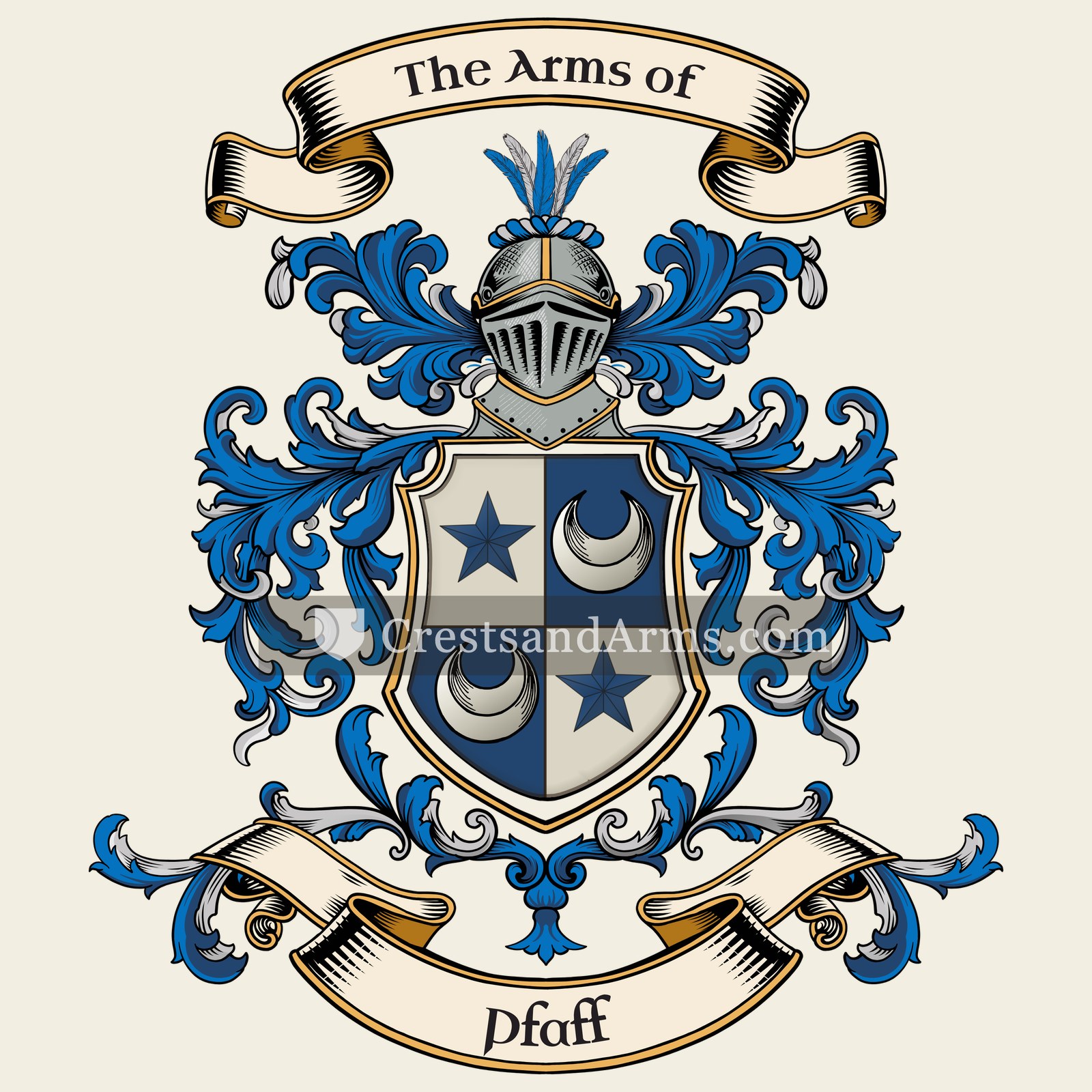
Symbols on this shield
mulletThe third son, and a divine quality from above
crescentHonour by the sovereign, and the second son
Colours
Silver (Argent)Means: Peace and sincerity
Blue (Azure)Means: Loyalty and truth
Historical info
Source
J. B. Rietstap, Armorial Général, Gouda: G. B. van Goor Zonen, 1884–87
Blazon (the actual original written record)
“Ec.: aux 1 et 4 d'arg. à une étoile d'azur; aux 2 et 3 d'azur à un croiss. cont. d'arg. C.: un homme iss., hab. d'un froc blanc, supp. de sa main dextre une étoile d'azur.”
GermanyEsslingen, c. 1765
Digital archive packCoat of arms PNG, gold border print PDF, vector SVG and the certificate of authenticity. Sent to your email in minutes.
Map of Germany showing where the Pfaff arms are recorded
The Pfaff arms were recorded in Esslingen, c. 1765.
This is where the arms were entered in the register. Families often moved to other parts of the country, so the same name can turn up in more than one region.
The body that granted and recorded arms in Germany in this period.
Francis I, Holy Roman Emperor
Sovereign of the period
Francis I, Holy Roman Emperor
1745–1765
Reigning in Germany when the Pfaff arms are first recorded.
How Arms Worked in Germany
In the Holy Roman Empire, coats of arms were often granted to individuals by the Emperor or his representatives. These arms were then passed down through the generations to all legitimate descendants of the original holder. Younger branches of a family usually kept the same shield design without needing to change it, as the arms belonged to the entire lineage.
Granting authority
The Holy Roman Emperor held the sole power to grant new coats of arms throughout his vast imperial territories.
How they got arms
Families typically obtained their coats of arms through a formal imperial grant or by proving their noble status to the authorities.
Where arms were recorded
These grants were officially recorded in the Imperial Chancery registers, which began keeping formal records of such honors during the Middle Ages.
The family's standing
Recorded among the armigerous families of Germany.
Origin & History of the Pfaff Family in Germany
The surname Pfaff originates from the Middle High German word *pfaffe*, which was a common term used to describe a member of the clergy or a priest. During the Middle Ages, this name was often given as a nickname to someone who worked for the church, served as a clerk, or perhaps displayed a serious and pious personality. By the time the family established a documented presence in the city of Esslingen in 1765, the name had long transitioned from a descriptive title into a hereditary family name. Esslingen was a significant Imperial City in southwestern Germany, and families living there during the eighteenth century were often part of a structured society defined by trade guilds and local civic administration. As the family settled into this region, they became part of the local history of the Neckar valley, where the name Pfaff remained a common identifier for generations of residents who contributed to the social and economic life of the German states.
Coat of Arms & Family Crest Details
Colours
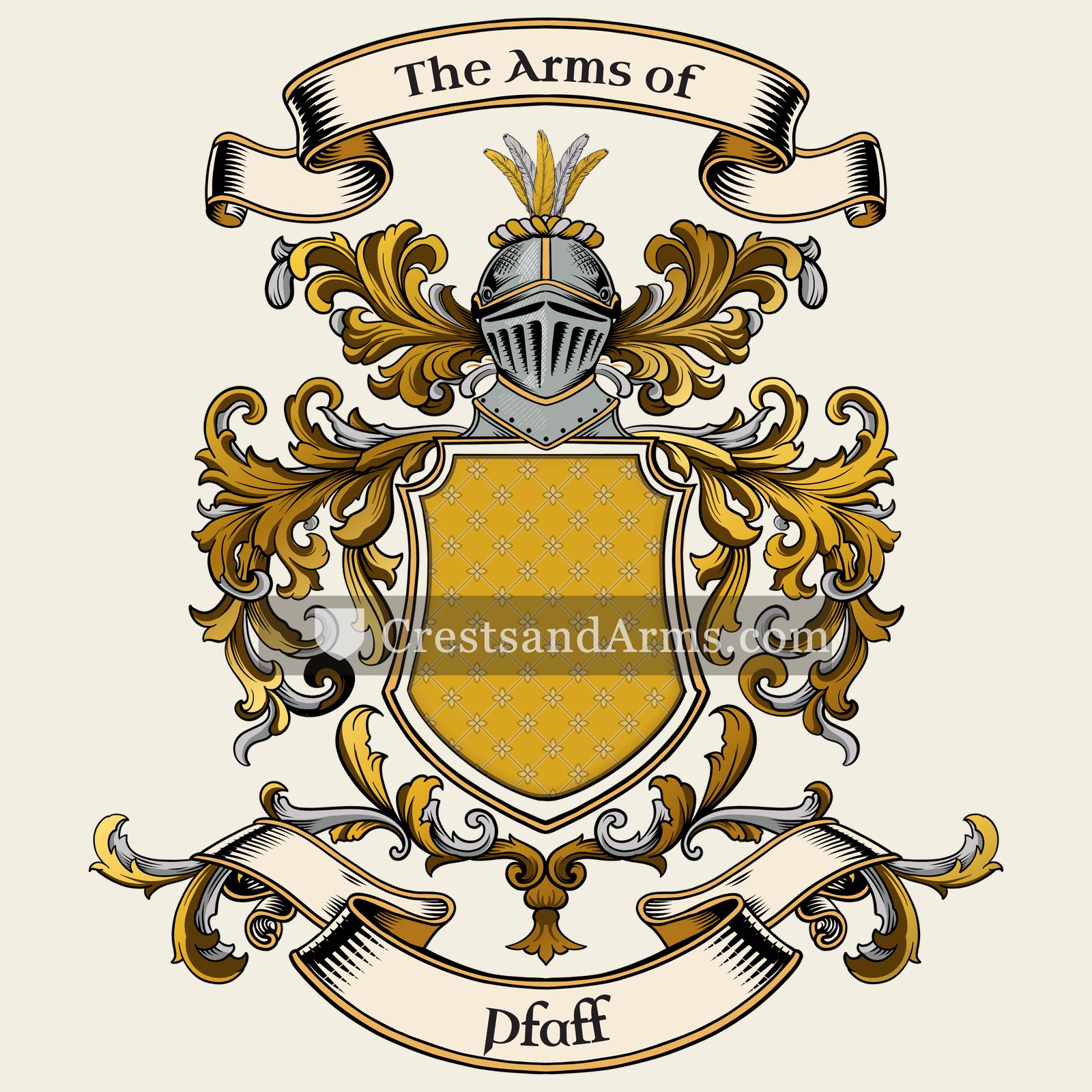
Gold (Or)Means: Generosity
Historical info
Source
J. B. Rietstap, Armorial Général, Gouda: G. B. van Goor Zonen, 1884–87
Blazon (the actual original written record)
“D'or à un prêtre pass., la soutane, les souliers et le bonnet à cornes de sa., le surplis d'arg., tenant des deux mains un livre du même. C.: le prêtre, iss.”
Switzerlandc. 1745
Digital archive packCoat of arms PNG, gold border print PDF, vector SVG and the certificate of authenticity. Sent to your email in minutes.
Map of Switzerland showing where the Pfaff arms are recorded
The Pfaff arms were recorded in Switzerland, c. 1745.
Arms such as these were typically recorded in Bern.
Bern was the largest of the Swiss cantons and ran itself, with its own council and its own courts. Its governing families held office for generations, and office of that kind carried a shield with it.
This is where the arms were entered in the register. Families often moved to other parts of the country, so the same name can turn up in more than one region.
The body that granted and recorded arms in Switzerland in this period.
How Arms Worked in Switzerland
In Switzerland, coats of arms were not restricted to the nobility and were often adopted by common citizens and families. These symbols were passed down through generations to show family identity. When branches of a family grew, they often changed small details of the design to distinguish their own line from the original group.
Granting authority
Cantonal and civic authorities managed the use of coats of arms within their specific regions and local jurisdictions.
How they got arms
Families typically assumed their own coats of arms based on local custom rather than receiving them from a central monarch.
Where arms were recorded
Arms were recorded in various cantonal and civic registers starting from the fourteenth century throughout the Swiss region.
The family's standing
Recorded among the armigerous families of Switzerland.
Origin & History of the Pfaff Family in Switzerland
The surname Pfaff is a classic example of a name derived from a person’s occupation or social status in medieval German-speaking regions. The word itself originates from the Middle High German term *pfaffe*, which was used to describe a member of the clergy or a priest. In the context of Swiss history, families bearing this name often settled in urban centers where they became integrated into the local administrative and social structures. By the time records confirm the presence of the Pfaff family in Bern in 1745, they were already well-established within the Swiss landscape. During this era, families with this name were frequently involved in the civic life of the Swiss cantons, often working as skilled tradespeople or local officials. The name serves as a historical marker of how religious roles in the Middle Ages eventually evolved into hereditary family surnames that persisted for centuries across the Swiss plateau.
Related Branches & Arms
Root word
papa
Latin term for father or bishop
This name
PfaffAn occupational name for a priest or someone employed by the church
also spelled
Pfaf
Phaff
Faf
Related arms
Phaffvariant spelling
Documented Sources
J. B. Rietstap, Armorial Général, Gouda: G. B. van Goor Zonen, 1884–87
Heintze, Albert. Die deutschen Familiennamen: geschichtlich, geographisch, sprachlich. 1903
Bahlow, Hans. Deutsches Namenlexikon: Familien- und Vornamen nach Ursprung und Sinn erklärt. 1967
Digital archive packCoat of arms PNG, gold border print PDF, vector SVG and the certificate of authenticity. Sent to your email in minutes.


 mulletThe third son, and a divine quality from above
 crescentHonour by the sovereign, and the second son
 mulletThe third son, and a divine quality from above
 crescentHonour by the sovereign, and the second son