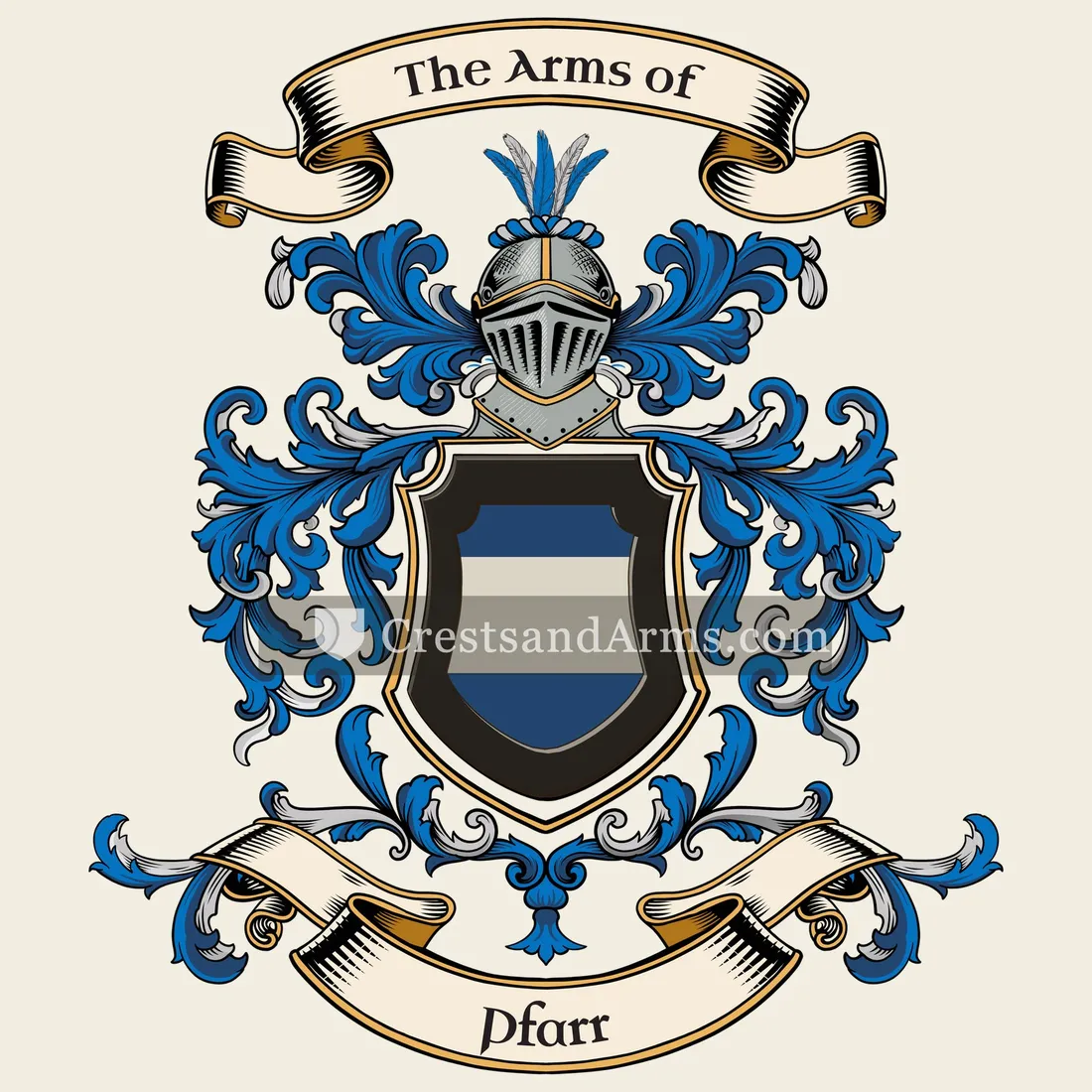
A record of documented arms, meaning and origin, researched for the Pfarr family lines. Documented in 2 countries.
Reg. 0852 · Austrian, P–S
Meaning of the Pfarr family crest colors & symbols
Symbols on this shield
fessThe military belt, and readiness to serve
Colours
Silver (Argent)Means: Peace and sincerity
Blue (Azure)Means: Loyalty and truth
Black (Sable)Means: Constancy
Historical info
Source
J. B. Rietstap, Armorial Général, Gouda: G. B. van Goor Zonen, 1884–87
Blazon (the actual original written record)
“D'arg. à deux fasces d'azur; à la bord. engr. de sa. C.: un buste de femme, hab. d'azur ou d'herm., cour. de roses alt. d'arg. et de gu., ou cour. à l'antique d'or. S.: à dextre un cerf d'or, à sen. un dragon d'azur. D.: AMOUR AVECQUE LOIAULTÉ.”
Austriac. 1546
Digital archive packCoat of arms PNG, gold border print PDF, vector SVG and the certificate of authenticity. Sent to your email in minutes.
Map of Austria showing where the Pfarr arms are recorded
The Pfarr arms were recorded in Austria, c. 1546.
Arms such as these were typically recorded in Tyrol.
Tyrol was mountain country in western Austria, where the valleys were held by families who had been there a very long time. Old tenure counted for more than money, and old families carried arms.
This is where the arms were entered in the register. Families often moved to other parts of the country, so the same name can turn up in more than one region.
Region
Tyrol
First recorded
1546
Granting Authority for the Pfarr Arms
Imperial and Royal chancery
Sodacan · CC BY-SA 3.0
The body that granted and recorded arms in Austria in this period.
Charles V
Sovereign of the period
Charles V
1519–1556
Reigning in Austria when the Pfarr arms are first recorded.
How Arms Worked in Austria
Austrian coats of arms were often linked directly to noble titles granted by the Emperor. These symbols belonged to the entire family line rather than just one individual. When a family grew, new branches kept the original design without needing to change it. This system allowed all members of a noble house to share the same identity across many generations.
Granting authority
The Imperial and Royal chancery managed all heraldic matters and controlled the official granting of arms throughout the Austrian lands.
How they got arms
Families typically received their arms through a formal imperial decree that often accompanied the elevation of a person to noble status.
Where arms were recorded
Official records of these grants were kept in the Imperial Register of Nobility which began its formal documentation process in 1453.
The family's standing
Recorded among the armigerous families of Austria.
Origin & History of the Pfarr Family in Austria
The family name Pfarr has deep roots in the mountainous landscape of Tyrol, where records confirm the presence of family members as early as 1546. The name itself is derived from the Middle High German word *pharr*, which refers to a parish or a church district. In the social structure of sixteenth-century Austria, this suggests that the earliest bearers of the name likely held positions of local importance or lived in close proximity to the village church. During this period, Tyrol served as a vital crossroads for trade and cultural exchange between the German lands and Italy. Families living in these alpine valleys were often deeply connected to the land and the administrative life of their local parishes. As the name spread through the region, it became a marker of those who lived within the organized religious and civil communities that defined life in the Austrian Alps.
Meaning of the Pfarr family crest colors & symbols
Symbols on this shield
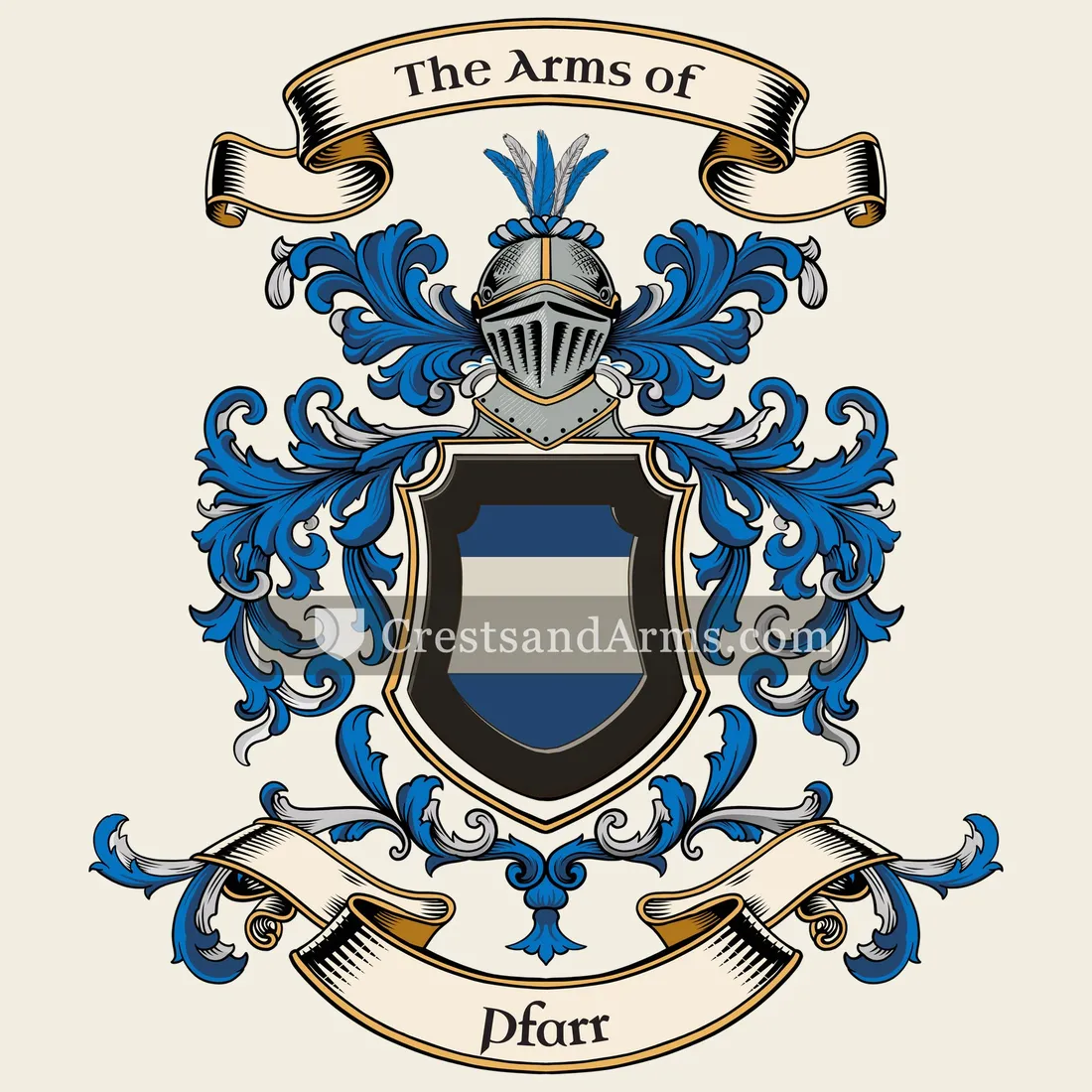
bordureA difference between branches of one family
Colours
Silver (Argent)Means: Peace and sincerity
Blue (Azure)Means: Loyalty and truth
Black (Sable)Means: Constancy
Historical info
Source
Sir Bernard Burke, The General Armory of England, Scotland, Ireland and Wales, London: Harrison & Sons, 1884
Blazon (the actual original written record)
“Ar. two bars az. within a bordure engr. sa”
LancasterKempnall · Lancaster, c. 1567
Digital archive packCoat of arms PNG, gold border print PDF, vector SVG and the certificate of authenticity. Sent to your email in minutes.
Map of England showing where the Pfarr arms are recorded
The Pfarr arms were recorded in Lancaster, c. 1567.
Lancashire was divided among a great many small landed families, more than most northern counties. Estates were passed down whole rather than split up, so the same names hold the same ground for centuries in the records.
This is where the arms were entered in the register. Families often moved to other parts of the country, so the same name can turn up in more than one region.
The body that granted and recorded arms in England in this period.
Elizabeth I of England
Sovereign of the period
Elizabeth I of England
1558–1603
Reigning in Austria when the Pfarr arms are first recorded.
How Arms Worked in England
English heraldry allowed arms to be shared by all legitimate descendants of the original owner. These symbols were treated as personal property that moved through the generations to all children. While the eldest son kept the original design, other family members could use the same shield without needing to change it or register their own unique versions.
Granting authority
The College of Arms in London has regulated the use of coats of arms throughout England and Wales since 1484.
How they got arms
Families typically obtained their coats of arms through a formal grant from the Crown or by proving their ancient right to them.
Where arms were recorded
All official coats of arms are recorded in the registers kept at the College of Arms, which date back to the fifteenth century.
The family's standing
Recorded among the armigerous families of Lancaster.
Origin & History of the Pfarr Family in England
The family name Pfarr has roots that reach back into the sixteenth century in the historic county of Lancaster, England. Records confirm that members of the family were established in this region by 1567, a time when England was undergoing significant social and religious changes under the reign of Queen Elizabeth I. The name itself is thought to be occupational or topographical in origin, likely derived from the Middle English or Germanic terms related to a parish or a local church official. During this era, families in Lancashire were often deeply connected to the local parish system, which served as the center of both community life and record-keeping. As the family settled into the landscape of Northern England, they became part of the local fabric of the region, contributing to the agricultural and trade-based economy that defined the area during the late Tudor period.
Pfarr Meaning & Related Branches
Root word
parochia
A Latin term referring to a district or ecclesiastical parish.
This name
PfarrAn occupational surname for someone who lived near or worked for a parish church.
also spelled
Par
Parra
Parrie
Documented Sources
J. B. Rietstap, Armorial Général, Gouda: G. B. van Goor Zonen, 1884–87
Kranzmayer, Eberhard. Ortsnamenbuch von Österreich. 1956


 fessThe military belt, and readiness to serve
 fessThe military belt, and readiness to serve


 bordureA difference between branches of one family