Map of Poland showing where the Pfohl arms are recorded
The Pfohl arms were recorded in Prusse, c. 1772.
Arms such as these were typically recorded in Mazovia.
Mazovia held Warsaw, the Polish court and the assemblies where the szlachta met. Poland's nobles were unusually numerous and every one of them bore arms, and Warsaw is where those arms were argued over and recorded.
This is where the arms were entered in the register. Families often moved to other parts of the country, so the same name can turn up in more than one region.
Region
Mazovia
Town
Prusse
First recorded
1772
Granting Authority for the Pfohl Arms
Ennoblement by the Sejm
Author: Olek Remesz · CC BY-SA 3.0
The body that granted and recorded arms in Poland in this period.
Stanisław August Poniatowski
Sovereign of the period
Stanisław August Poniatowski
1764–1795
Reigning in Poland when the Pfohl arms are first recorded.
How Arms Worked in Poland
Polish noble families shared a single coat of arms across many different surnames, creating large clans rather than individual designs. These symbols were held collectively by all members of the clan regardless of their specific family name. When a new family joined the nobility, they were adopted into an existing clan and began using that group's established shield.
Granting authority
The Sejm, which was the Polish parliament, held the power to grant noble status and the right to bear arms.
How they got arms
Families typically received their coat of arms through a formal act of ennoblement granted by the Sejm for distinguished service.
Where arms were recorded
These grants were officially recorded in the Crown Metrica, which served as the central archive for state documents starting in the sixteenth century.
The family's standing
Recorded among the armigerous families of Poland.
Origin & History of the Pfohl Family in Poland
The family name Pfohl has deep roots in the historical landscape of Central Europe, with records confirming their presence in the Mazovia region of Poland by 1772. During this period, Mazovia was a central hub for families of Germanic descent who had migrated eastward to settle in rural and growing urban areas. The name Pfohl is linguistically linked to the Middle High German word *pfol*, which often referred to a person living near a specific type of marshy ground or a pool of water. As these families settled into Polish society, they adapted to the local customs and administrative systems of the Polish-Lithuanian Commonwealth. Over time, the Pfohl family became integrated into the local economy, likely working as skilled tradespeople or landowners who contributed to the development of the Mazovian countryside. Their survival and growth in this region reflect the broader patterns of migration and cultural blending that defined the history of Poland during the late eighteenth century.
Coat of Arms & Family Crest Details
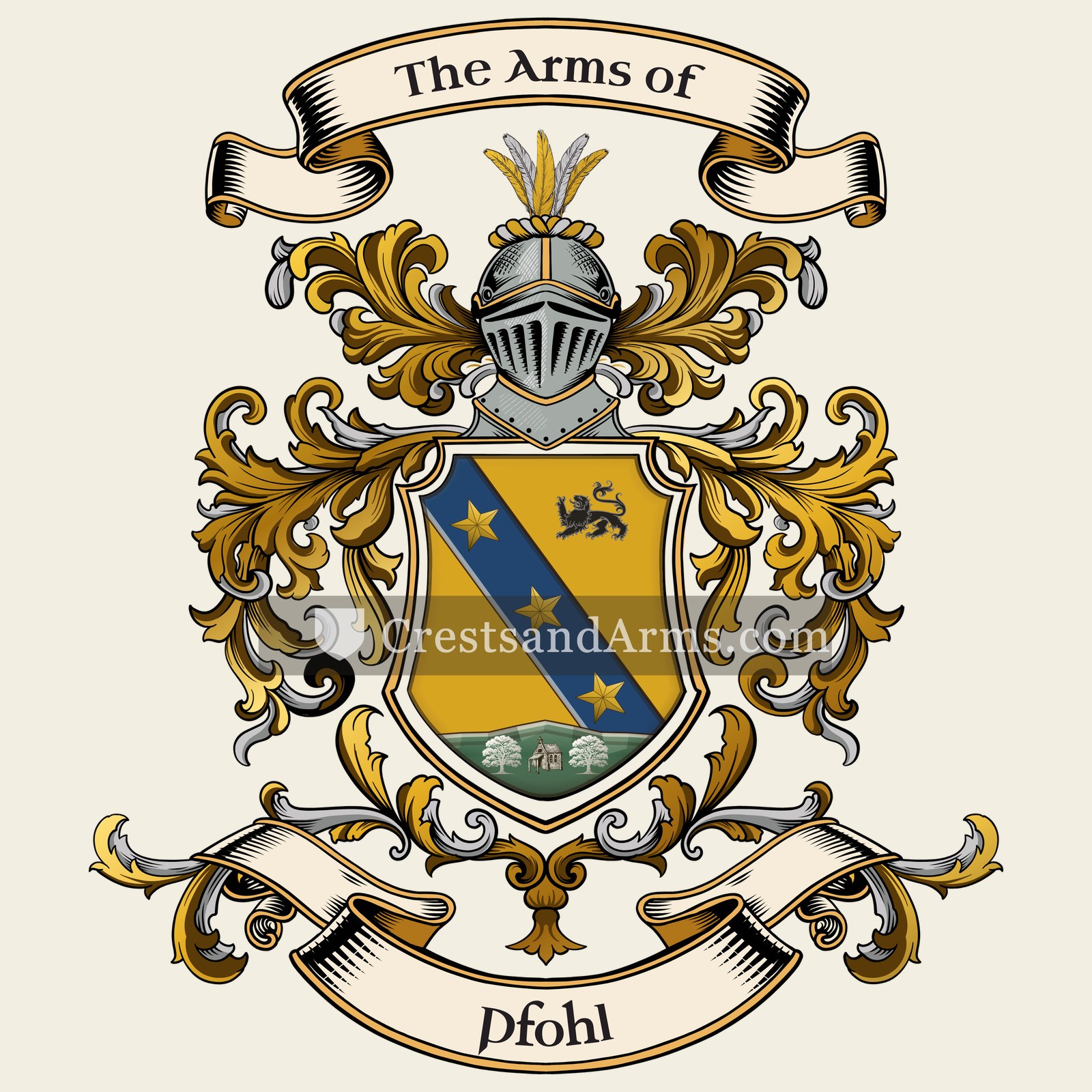
Symbols on this shield
bendDefence, and the scarf of a commander
mountThe ground held, and steadfastness upon it
lionCourage, strength and royalty
churchFaith, and the endowment of a house of God
mulletThe third son, and a divine quality from above
treeLife, endurance and deep roots
Colours
Gold (Or)Means: Generosity
Blue (Azure)Means: Loyalty and truth
Green (Vert)Means: Hope
Black (Sable)Means: Constancy
Historical info
Source
J. B. Rietstap, Armorial Général, Gouda: G. B. van Goor Zonen, 1884–87
Blazon (the actual original written record)
“D'or à la bande d'azur, ch. de trois étoiles d'or, et acc. en chef d'un lion de sa. tenant une épée au nat. et en p. d'une chapelle au nat., accostée de deux cyprès, le tout sur une colline de sin. D.: AUDACES FORTUNA JUVAT.”
Austriac. 1872
Digital archive packCoat of arms PNG, gold border print PDF, vector SVG and the certificate of authenticity. Sent to your email in minutes.
Map of Austria showing where the Pfohl arms are recorded
The Pfohl arms were recorded in Austria, c. 1872.
Arms such as these were typically recorded in Tyrol.
Tyrol was mountain country in western Austria, where the valleys were held by families who had been there a very long time. Old tenure counted for more than money, and old families carried arms.
This is where the arms were entered in the register. Families often moved to other parts of the country, so the same name can turn up in more than one region.
Region
Tyrol
First recorded
1872
Granting Authority for the Pfohl Arms
Imperial and Royal chancery
Sodacan · CC BY-SA 3.0
The body that granted and recorded arms in Austria in this period.
Franz Joseph I of Austria
Sovereign of the period
Franz Joseph I of Austria
1848–1916
Reigning in Poland when the Pfohl arms are first recorded.
How Arms Worked in Austria
Austrian coats of arms were often linked directly to noble titles granted by the Emperor. These symbols belonged to the entire family line rather than just one individual. When a family grew, new branches kept the original design without needing to change it. This system allowed all members of a noble house to share the same identity across many generations.
Granting authority
The Imperial and Royal chancery managed all heraldic matters and controlled the official granting of arms throughout the Austrian lands.
How they got arms
Families typically received their arms through a formal imperial decree that often accompanied the elevation of a person to noble status.
Where arms were recorded
Official records of these grants were kept in the Imperial Register of Nobility which began its formal documentation process in 1453.
The family's standing
Recorded among the armigerous families of Austria.
Origin & History of the Pfohl Family in Austria
The family name Pfohl has deep roots in the mountainous landscape of Tyrol, Austria, where records confirm members of the family were established by 1872. The name itself is thought to be a variation of the Middle High German word pfol, which was often used as a nickname for someone who lived near a pool or a marshy area. During the nineteenth century, families in the Tyrol region were frequently tied to the land, working as farmers, craftsmen, or local officials in small alpine villages. As the region underwent significant social changes during the late 1800s, the Pfohl family likely participated in the traditional life of the Austro-Hungarian Empire, balancing their agricultural heritage with the growing influence of nearby urban centers. Their presence in the historical records of this era reflects a time when families were beginning to move more freely across the valleys, helping to shape the cultural identity of the region through their daily work and community involvement.
Related Branches & Arms
Root word
Pfahl
A wooden stake or post used for fencing or construction.
This name
PfohlAn occupational name for someone who lived near a boundary post or worked with stakes.
also spelled
Pole
Documented Sources
J. B. Rietstap, Armorial Général, Gouda: G. B. van Goor Zonen, 1884–87
Archiwum Główne Akt Dawnych, Księgi metrykalne parafii rzymskokatolickich z terenu Mazowsza
Brückner, Aleksander, Słownik etymologiczny języka polskiego, 1927
Kutschera, Hans, Die deutschen Siedlungen in Polen, 1935
Digital archive packCoat of arms PNG, gold border print PDF, vector SVG and the certificate of authenticity. Sent to your email in minutes.


 bullValour and generosity
 bullValour and generosity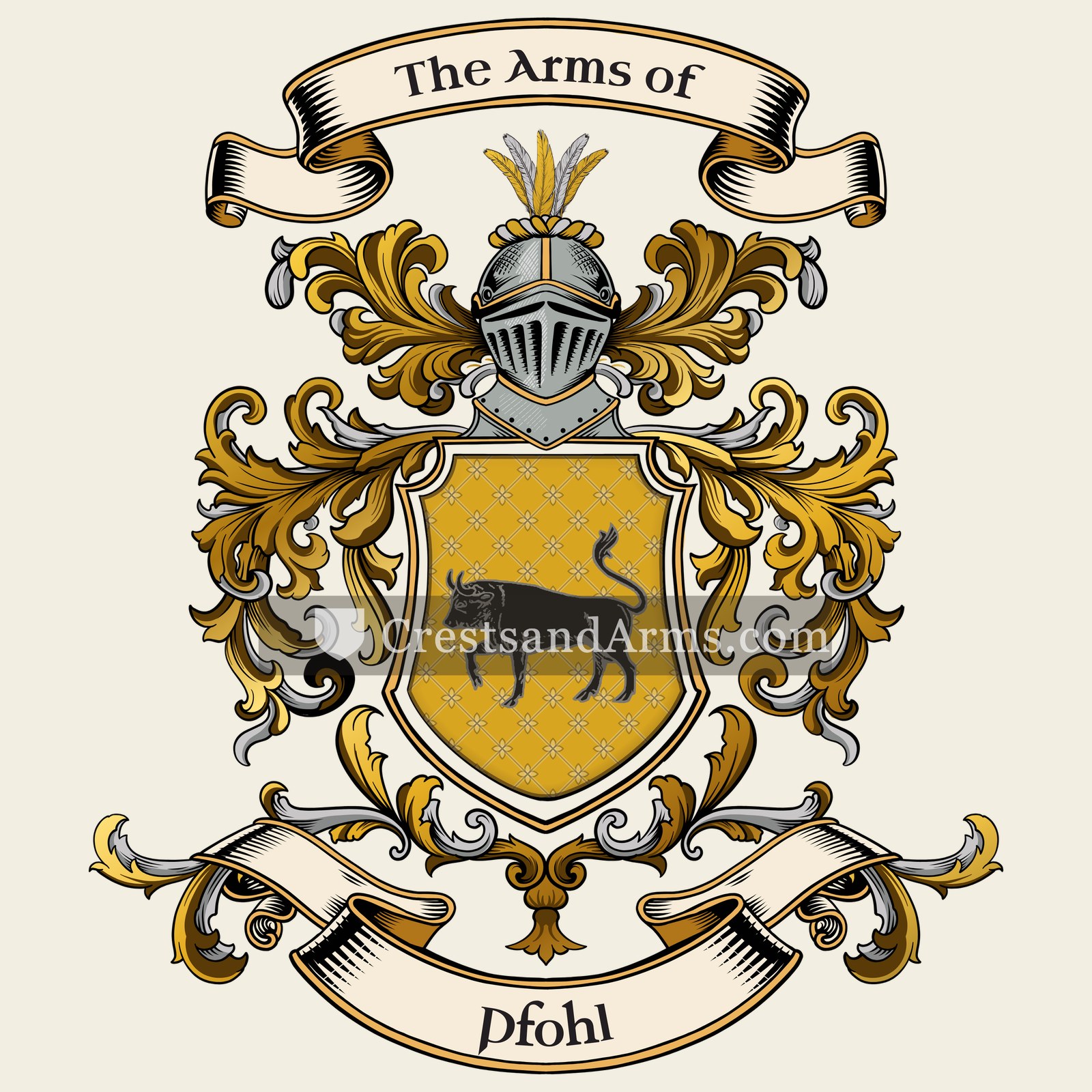


 bendDefence, and the scarf of a commander
 mountThe ground held, and steadfastness upon it
 lionCourage, strength and royalty
 churchFaith, and the endowment of a house of God
 mulletThe third son, and a divine quality from above
 treeLife, endurance and deep roots