Map of France showing where the Phelps arms are recorded
The Phelps arms were recorded in New-York, c. 1725.
Arms such as these were typically recorded in Bretagne.
More families held coats of arms in Bretagne than anywhere else in France. The land was divided into many small estates rather than a few large ones, so far more households counted as gentry, and each needed a shield of its own to be told apart.
This is where the arms were entered in the register. Families often moved to other parts of the country, so the same name can turn up in more than one region.
The body that granted and recorded arms in France in this period.
Louis XV of France
Sovereign of the period
Louis XV of France
1715–1774
Reigning in France when the Phelps arms are first recorded.
How Arms Worked in France
In France, a coat of arms was a mark of honor that passed down through the male line to all legitimate descendants. Families often used the same shield without changes to show their shared heritage. If a branch wanted to stand out, they could add a small mark to their shield to show their specific place in the family tree.
Granting authority
The Juge d'armes de France acted as the official authority that regulated and verified coats of arms across the country.
How they got arms
Families typically inherited their arms from ancestors, though they could also receive them through royal grants or by proving their noble status.
Where arms were recorded
Coats of arms were officially recorded in the Armorial Général de France, which began its main collection in the year 1696.
The family's standing
Recorded among the armigerous families of France.
Origin & History of the Phelps Family in France
The roots of the Phelps family name in France are deeply connected to the rugged landscape of Bretagne. By the year 1725, records confirm that family members were established within this coastal region, which was known for its distinct cultural identity and maritime traditions. The name itself is thought to be a variation of the name Philip, which gained widespread popularity across Europe due to its religious significance. In the context of eighteenth-century Bretagne, families with this name were often integrated into the local agrarian or artisan communities that defined the provincial economy. These early ancestors lived through a time of significant social change in France, navigating the transition from traditional feudal structures toward the modern era. Their presence in the region highlights how families moved and adapted within the French provinces, leaving behind a trail of records that document their daily lives, marriages, and contributions to their local parishes.
Coat of Arms & Family Crest Details
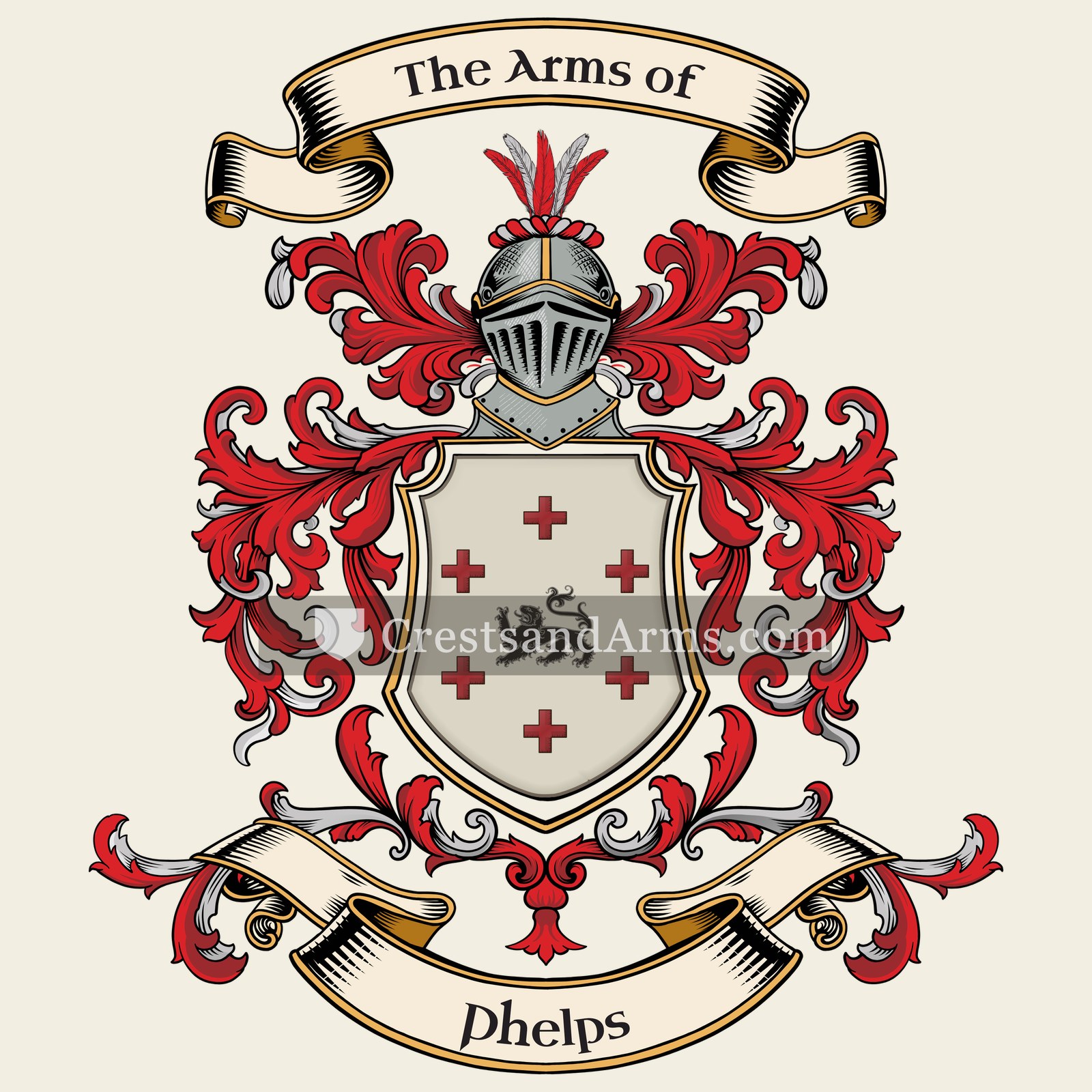
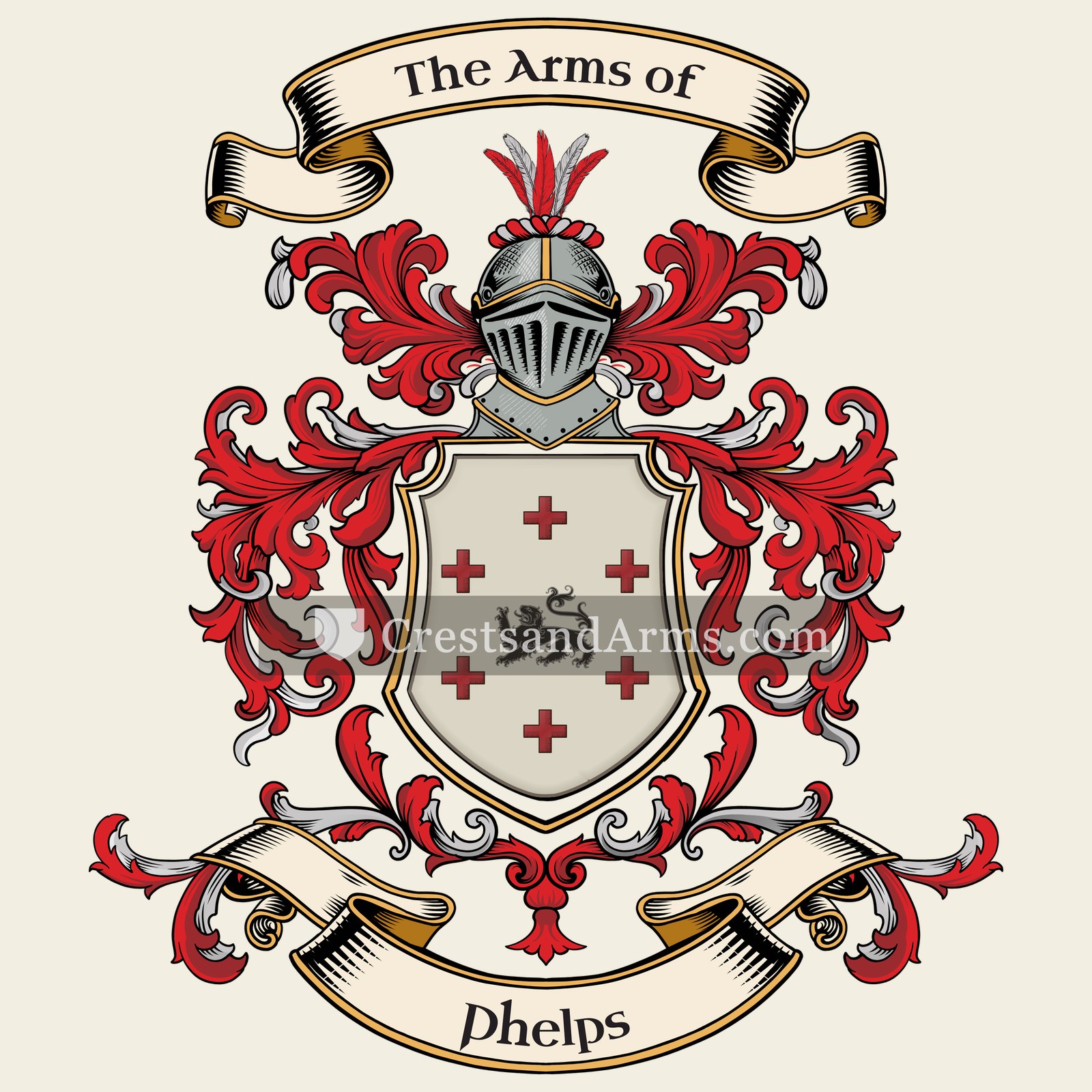
Symbols on this shield
cross symbolChristian faith and service
lionCourage, strength and royalty
Colours
Silver (Argent)Means: Peace and sincerity
Black (Sable)Means: Constancy
Red (Gules)Means: Military strength
Historical info
Source
Sir Bernard Burke, The General Armory of England, Scotland, Ireland and Wales, London: Harrison & Sons, 1884
Blazon (the actual original written record)
“Ar. a lion ramp. sa. betw. six crosses crosslet fitchée gu”
Englandc. 1620
Digital archive packCoat of arms PNG, gold border print PDF, vector SVG and the certificate of authenticity. Sent to your email in minutes.
Map of England showing where the Phelps arms are recorded
The Phelps arms were recorded in England, c. 1620.
Arms such as these were typically recorded in York.
Yorkshire is the largest of the English counties, and it held more gentry families than any other. Land there was split among a great many households rather than a few, so a great many of them carried arms.
This is where the arms were entered in the register. Families often moved to other parts of the country, so the same name can turn up in more than one region.
The body that granted and recorded arms in England in this period.
James VI and I
Sovereign of the period
James VI and I
1603–1625
Reigning in France when the Phelps arms are first recorded.
How Arms Worked in England
English heraldry allowed arms to be shared by all legitimate descendants of the original owner. These symbols were treated as personal property that moved through the generations to all children. While the eldest son kept the original design, other family members could use the same shield without needing to change it or register their own unique versions.
Granting authority
The College of Arms in London has regulated the use of coats of arms throughout England and Wales since 1484.
How they got arms
Families typically obtained their coats of arms through a formal grant from the Crown or by proving their ancient right to them.
Where arms were recorded
All official coats of arms are recorded in the registers kept at the College of Arms, which date back to the fifteenth century.
The family's standing
Recorded among the armigerous families of England.
Origin & History of the Phelps Family in England
The surname Phelps is a patronymic name, which means it originated as a way to identify a person as the son of someone named Philip. The name evolved from the Greek name Philippos, which translates to a lover of horses. By the time the name became established in England, it had shifted through various spellings such as Philips, Philps, and eventually Phelps. While the family had roots in various parts of the country, records confirm that members of the Phelps family were well-established in the city of York by 1620. During this period, the family lived in a society where surnames were becoming permanent markers of identity rather than just descriptions. As the family grew in York, they participated in the local economy and social life of the city, helping to cement the name as a recognized part of the regional history.
Phelps Meaning & Related Branches
Root word
Philippos
Greek for lover of horses
This name
PhelpsA patronymic surname derived from the medieval given name Philip
also spelled
Phelp
Phelpes
Phelpps
Felps
Phelips
Related arms
Berkeleyrecorded with Phelps, same area
Cliftonrecorded with Phelps, same area
Purnellrecorded with Phelps, same area
Stiffrecorded with Phelps, same area
Documented Sources
J. B. Rietstap, Armorial Général, Gouda: G. B. van Goor Zonen, 1884–87
Archives Départementales du Morbihan, Registres paroissiaux et d'état civil
Archives Départementales du Finistère, Série E, État civil et registres paroissiaux
Dauzat, Albert, Dictionnaire étymologique des noms de famille et prénoms de France, 1951
Digital archive packCoat of arms PNG, gold border print PDF, vector SVG and the certificate of authenticity. Sent to your email in minutes.


 cross symbolChristian faith and service
 lionCourage, strength and royalty
 cross symbolChristian faith and service
 lionCourage, strength and royalty