Map of France showing where the Philip arms are recorded
The Philip arms were recorded in Provence, c. 1663.
Provence was old country, with towns dating to the Romans and families who traced their land back nearly as far. Its gentry were many and long-settled, and long settlement is what fills a register.
This is where the arms were entered in the register. Families often moved to other parts of the country, so the same name can turn up in more than one region.
The body that granted and recorded arms in France in this period.
Louis XIV of France
Sovereign of the period
Louis XIV of France
1643–1715
Reigning in France when the Philip arms are first recorded.
How Arms Worked in France
In France, a coat of arms was a mark of honor that passed down through the male line to all legitimate descendants. Families often used the same shield without changes to show their shared heritage. If a branch wanted to stand out, they could add a small mark to their shield to show their specific place in the family tree.
Granting authority
The Juge d'armes de France acted as the official authority that regulated and verified coats of arms across the country.
How they got arms
Families typically inherited their arms from ancestors, though they could also receive them through royal grants or by proving their noble status.
Where arms were recorded
Coats of arms were officially recorded in the Armorial Général de France, which began its main collection in the year 1696.
The family's standing
Recorded among the armigerous families of Provence.
Origin & History of the Philip Family in France
The surname Philip finds its roots in the ancient Greek name Philippos, meaning lover of horses, which gained immense popularity across Europe due to the influence of early Christian saints and royalty. In France, the name evolved through various regional dialects and became a common identifier for families long before the formal adoption of hereditary surnames. By the time members of the family were documented in the Provence region in 1663, the name had already been shaped by centuries of local linguistic shifts and the social structure of the French countryside. Families living in Provence during the seventeenth century often relied on agriculture and trade, and the presence of the Philip name in official records from this era suggests that they were established members of the local community. These early records typically appear in parish registers, which were maintained by the Catholic Church to track baptisms, marriages, and burials. As the family settled into the landscape of southern France, the name Philip became a permanent part of the regional identity, reflecting a long history of migration and social integration within the French provinces.
Meaning of the Philip family crest colors & symbols
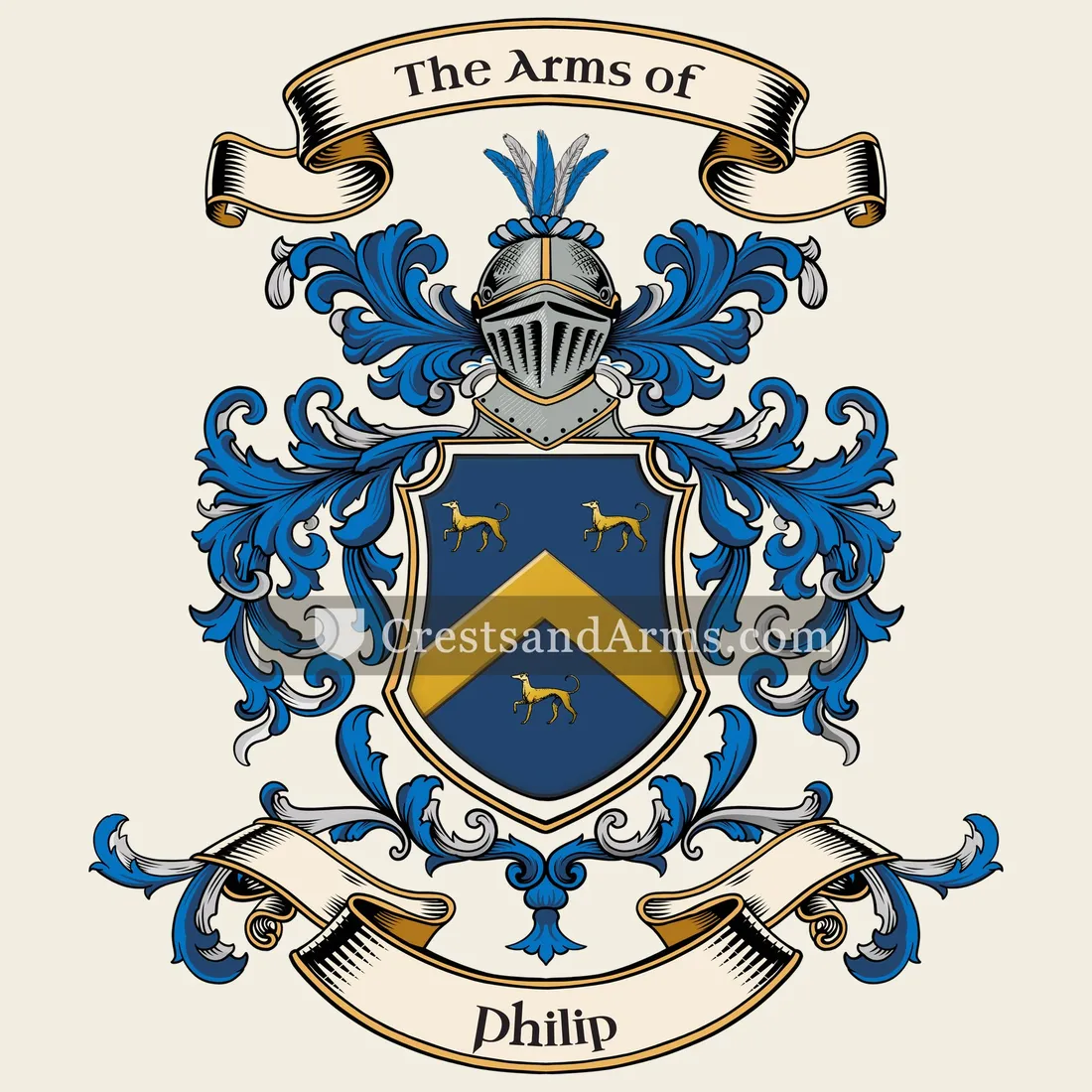
Symbols on this shield
chevronProtection, and faithful service completed
greyhoundCourage, vigilance and loyalty
Colours
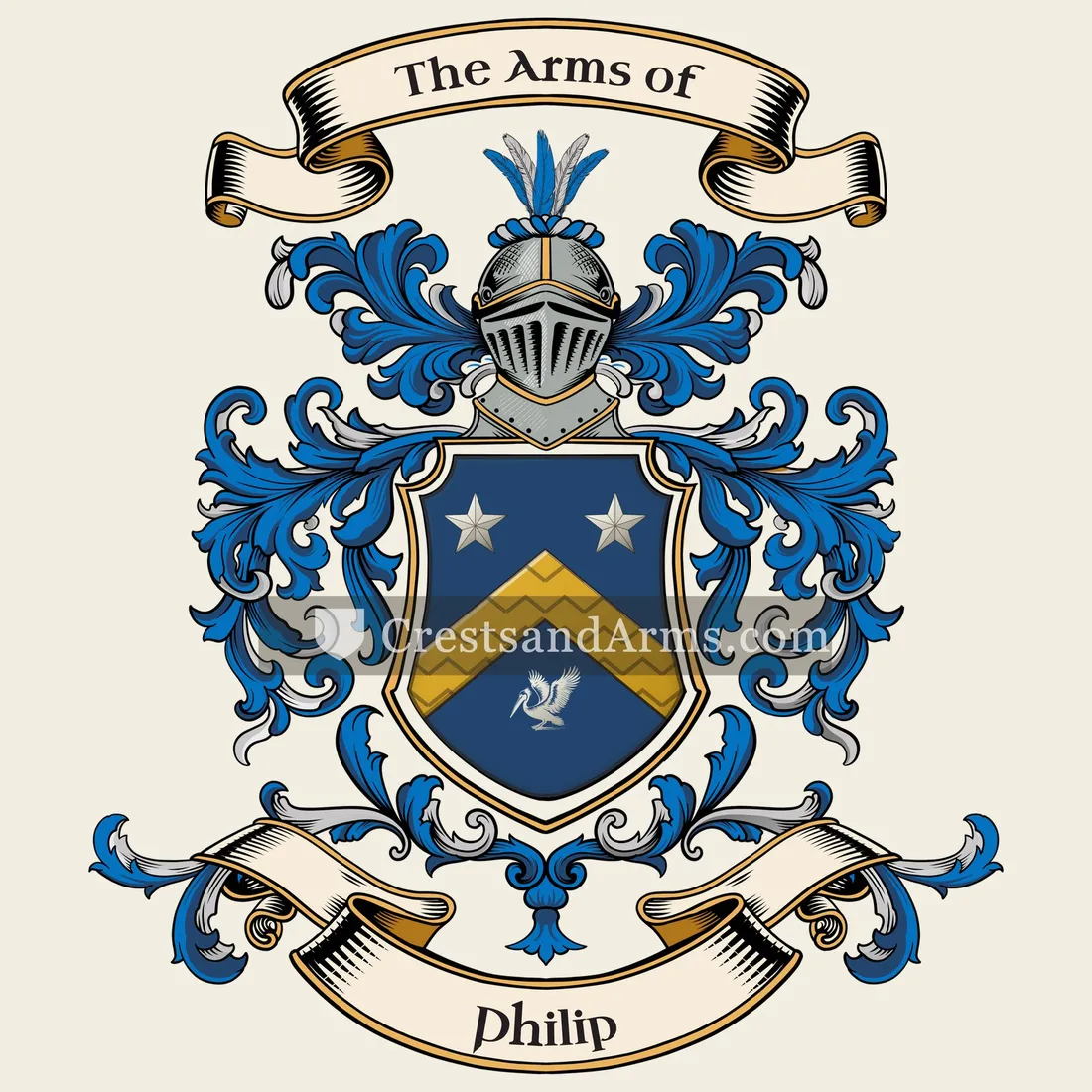
Blue (Azure)Means: Loyalty and truth
Gold (Or)Means: Generosity
Historical info
Source
Sir Bernard Burke, The General Armory of England, Scotland, Ireland and Wales, London: Harrison & Sons, 1884
Blazon (the actual original written record)
“Az. a chev. invecked betw. three talbots' heads erased or”
FifeOver Carnbie · Fife, c. 1672
Digital archive packCoat of arms PNG, gold border print PDF, vector SVG and the certificate of authenticity. Sent to your email in minutes.
Map of Scotland showing where the Philip arms are recorded
The Philip arms were recorded in Fife, c. 1672.
Fife was farming country between two firths, with royal palaces and old burghs along its coast. Its landed families were numerous and close to the court, and closeness to the court brought arms.
This is where the arms were entered in the register. Families often moved to other parts of the country, so the same name can turn up in more than one region.
The body that granted and recorded arms in Scotland in this period.
Charles II of England
Sovereign of the period
Charles II of England
1660–1685
Reigning in France when the Philip arms are first recorded.
How Arms Worked in Scotland
Scottish heraldry is unique because it treats a coat of arms as a piece of personal property protected by law. Only one person can own a specific design at any given time. When a family grows, the head keeps the original shield while other relatives must apply for their own distinct version with slight changes to prove their specific identity.
Granting authority
The Court of the Lord Lyon acts as the official body that regulates and controls all heraldic matters throughout Scotland.
How they got arms
Individuals obtain a legal right to their arms through a formal petition process that confirms their identity and family connection.
Where arms were recorded
All valid coats of arms are officially entered into the Public Register of All Arms and Bearings starting from 1672.
The family's standing
Recorded among the armigerous families of Fife.
Origin & History of the Philip Family in Scotland
The surname Philip traces its roots to the ancient Greek name Philippos, which means lover of horses. In Scotland, the name became established through the influence of the church and the spread of personal names during the Middle Ages. By the late 17th century, the family had firmly planted roots in the region of Fife. Records from 1672 confirm their presence in this area, where they likely worked as farmers, tradespeople, or local landowners. During this period, Fife was a bustling center of Scottish commerce and religious life, and families like the Philips contributed to the local community by participating in parish activities and regional trade. Over time, the name evolved from a simple given name into a hereditary surname that passed down through generations, reflecting the family's long-standing connection to the Scottish landscape.
Philip Meaning & Related Branches
Root word
Philippos
Ancient Greek for lover of horses
This name
PhilipDerived from Greek, signifying one who has an affinity for or loves horses.
also spelled
Philipp
Philippe
Phillipp
Filip
Phylip
Related arms
Marshsimilar arms
Phillipsvariant spelling
Phillippsvariant spelling
Documented Sources
J. B. Rietstap, Armorial Général, Gouda: G. B. van Goor Zonen, 1884–87
Dauzat, Albert, Dictionnaire étymologique des noms de famille et prénoms de France, 1951
Morlet, Marie-Thérèse, Dictionnaire étymologique des noms de famille, 1991
Archives départementales des Bouches-du-Rhône, Registres paroissiaux et d'état civil
Digital archive packCoat of arms PNG, gold border print PDF, vector SVG and the certificate of authenticity. Sent to your email in minutes.


 chevronProtection, and faithful service completed
 mulletThe third son, and a divine quality from above
 pelicanSelf-sacrifice and devotion to one's children
 chevronProtection, and faithful service completed
 mulletThe third son, and a divine quality from above
 pelicanSelf-sacrifice and devotion to one's children


 greyhoundCourage, vigilance and loyalty