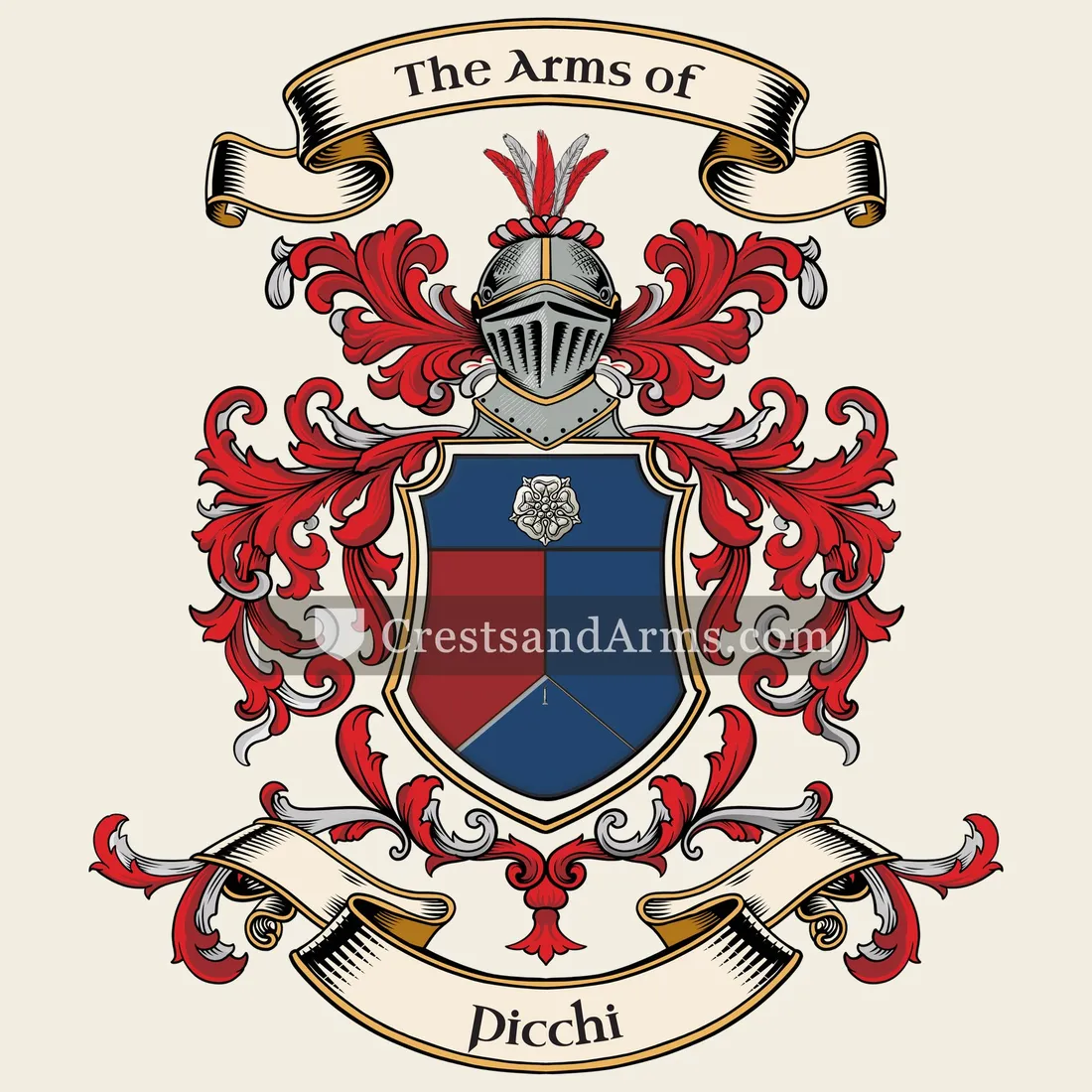
A record of documented arms, meaning and origin, researched for the Picchi family of Italy.
Reg. 1978 · Italian, P–S
Meaning of the Picchi family crest colors & symbols
Symbols on this shield
chiefAuthority, wisdom and dominion
columnFortitude and constancy
roseThe seventh son, and beauty with grace
Colours
Red (Gules)Means: Military strength
Blue (Azure)Means: Loyalty and truth
Silver (Argent)Means: Peace and sincerity
Historical info
Source
J. B. Rietstap, Armorial Général, Gouda: G. B. van Goor Zonen, 1884–87
Blazon (the actual original written record)
“Parti de gu. et d'azur; au chef en forme de triangle evasé d'azur, la pointe en bas; à une colonne d'arg., le chapiteau d'or, br. sur le parti, soutenue d'un piédestal d'arg., mouv. de la p., et accosté de deux oiseaux adossés d'arg., les têtes affr., le bec ouv., posés sur le piédestal; le chef ch. d'une rose d'arg.”
ItalyRome, c. 1775
Digital archive packCoat of arms PNG, gold border print PDF, vector SVG and the certificate of authenticity. Sent to your email in minutes.
Map of Italy showing where the Picchi arms are recorded
The Picchi arms were recorded in Rome, c. 1775.
This is where the arms were entered in the register. Families often moved to other parts of the country, so the same name can turn up in more than one region.
The body that granted and recorded arms in Italy in this period.
Alvise Giovanni Mocenigo
Sovereign of the period
Alvise Giovanni Mocenigo
1763–1778
Reigning in Italy when the Picchi arms are first recorded.
How Arms Worked in Italy
In the Italian states, coats of arms were often used by noble families to show their status and history. These symbols were passed down through the generations to all legitimate male descendants. Younger branches of a family usually kept the original design but sometimes added small changes to distinguish their specific line from the main branch.
Granting authority
Various local rulers and city governments controlled the use of coats of arms across the different Italian states.
How they got arms
Families often assumed their own arms or received them as official grants from local lords, popes, or city councils.
Where arms were recorded
Arms were recorded in local city archives or private family books rather than in one single national register.
The family's standing
Recorded among the armigerous families of Italy.
Origin & History of the Picchi Family in Italy
The surname Picchi originates from the Italian word "picchio," which refers to a woodpecker. In medieval Italy, surnames often began as descriptive nicknames that highlighted a person's physical traits, personality, or habits. A person might have been given this name because they were energetic, persistent, or perhaps had a sharp, pointed nose that reminded others of the bird. By the time the family was documented in Rome in 1775, the name had already transitioned from a simple nickname into a stable family identifier passed down through generations. Living in the heart of the Papal States during the late 18th century, the Picchi family would have been part of a vibrant urban culture defined by the influence of the Catholic Church and the complex social hierarchies of the era. Their presence in Roman records suggests they were integrated into the city’s administrative life, likely participating in the trades or civic roles common to established families of that time.
Picchi Meaning & Related Branches
Root word
Picco
Derived from the Italian word for peak or pointed object.
This name
PicchiA nickname for a small person or someone with a sharp, pointed physical feature.
also spelled
Pich
Pichis
Peechee
Documented Sources
J. B. Rietstap, Armorial Général, Gouda: G. B. van Goor Zonen, 1884–87
De Felice, Emidio. Dizionario dei cognomi italiani. 1978
Fucilla, Joseph G. Our Italian Surnames. 1949
Archivio di Stato di Roma. Stato delle Anime. 1775
Digital archive packCoat of arms PNG, gold border print PDF, vector SVG and the certificate of authenticity. Sent to your email in minutes.


 chiefAuthority, wisdom and dominion
 columnFortitude and constancy
 roseThe seventh son, and beauty with grace
 chiefAuthority, wisdom and dominion
 columnFortitude and constancy
 roseThe seventh son, and beauty with grace