Map of France showing where the Pichard arms are recorded
The Pichard arms were recorded in Poitou, c. 1663.
Poitou was western French farming country, divided among a large number of small landed families. Its gentry were numerous and modest, and even a small estate was enough to justify a shield.
This is where the arms were entered in the register. Families often moved to other parts of the country, so the same name can turn up in more than one region.
The body that granted and recorded arms in France in this period.
Louis XIV of France
Sovereign of the period
Louis XIV of France
1643–1715
Reigning in France when the Pichard arms are first recorded.
How Arms Worked in France
In France, a coat of arms was a mark of honor that passed down through the male line to all legitimate descendants. Families often used the same shield without changes to show their shared heritage. If a branch wanted to stand out, they could add a small mark to their shield to show their specific place in the family tree.
Granting authority
The Juge d'armes de France acted as the official authority that regulated and verified coats of arms across the country.
How they got arms
Families typically inherited their arms from ancestors, though they could also receive them through royal grants or by proving their noble status.
Where arms were recorded
Coats of arms were officially recorded in the Armorial Général de France, which began its main collection in the year 1696.
The family's standing
Recorded among the armigerous families of Poitou.
Origin & History of the Pichard Family in France
The surname Pichard has deep roots in the western regions of France, with historical evidence placing members of the family in the province of Poitou as early as 1663. The name is believed to have originated as a descriptive nickname, likely derived from the Old French word "piche," which referred to a small pitcher or a specific type of container. In medieval society, such names were often given to individuals based on their trade, such as a potter or a merchant who sold earthenware goods. As the family established itself in the rural landscape of Poitou, they became part of the local social fabric, living through a period of significant agricultural and regional development. Over the generations, the family name spread from these provincial beginnings, reflecting the common patterns of movement and settlement that shaped the identity of many families in early modern France.
Coat of Arms & Family Crest Details
Symbols on this shield
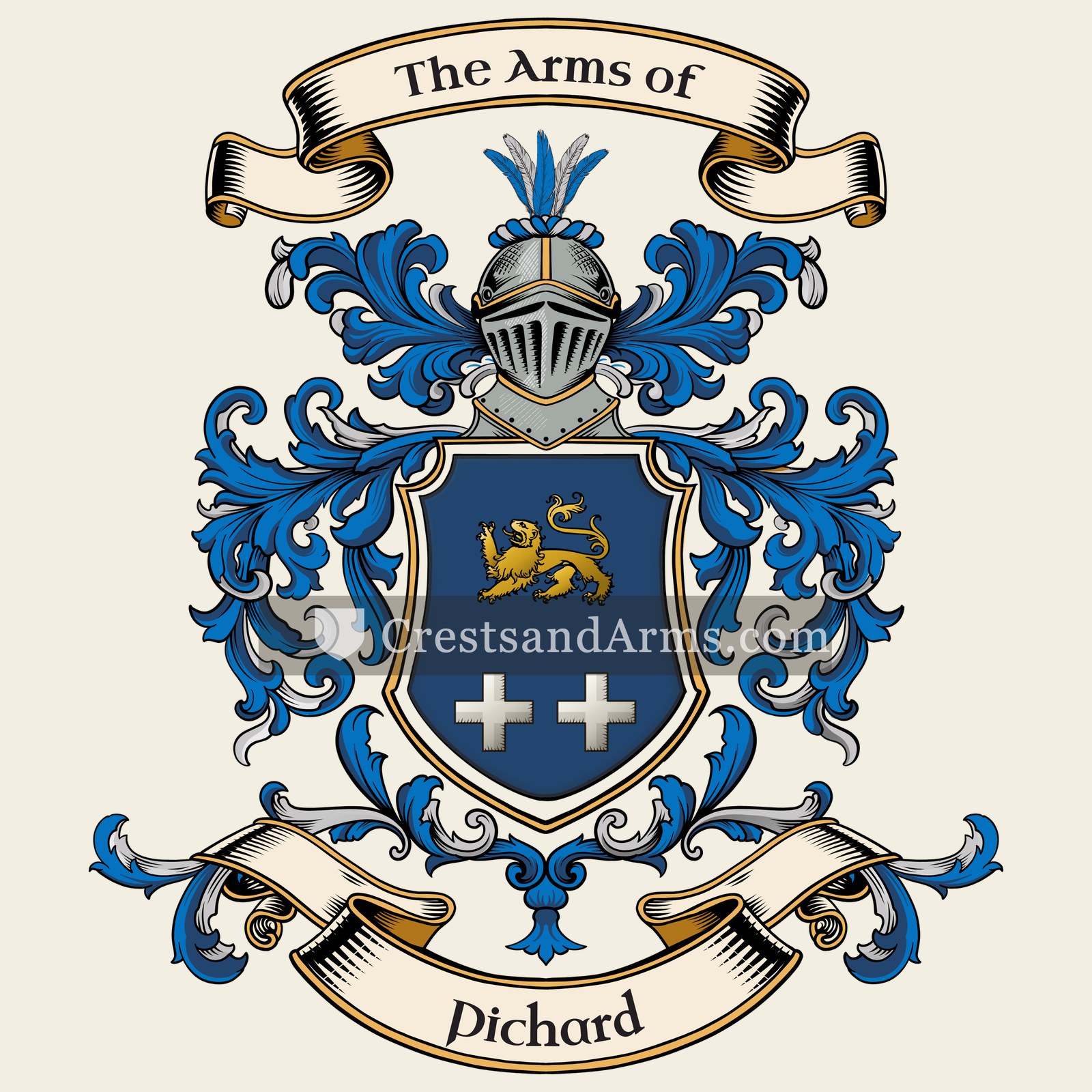
cross symbolChristian faith and service
lionCourage, strength and royalty
Colours
Blue (Azure)Means: Loyalty and truth
Gold (Or)Means: Generosity
Silver (Argent)Means: Peace and sincerity
Historical info
Source
J. B. Rietstap, Armorial Général, Gouda: G. B. van Goor Zonen, 1884–87
Blazon (the actual original written record)
“Coupé: au 1 d'azur au lion naiss. d'or, mouv. du coupé; au 2 d'azur à deux croix treflées d'arg., accostées. C.: le lion, iss. L.: d'or et d'azur.”
Germanyc. 1765
Digital archive packCoat of arms PNG, gold border print PDF, vector SVG and the certificate of authenticity. Sent to your email in minutes.
Map of Germany showing where the Pichard arms are recorded
The Pichard arms were recorded in Germany, c. 1765.
Arms such as these were typically recorded in Bavaria.
Bavaria was a country of old landed families and walled market towns. Estates passed down the same line for centuries, and both the landowners and the leading townsmen kept arms, which is why so many Bavarian names sit in the registers.
This is where the arms were entered in the register. Families often moved to other parts of the country, so the same name can turn up in more than one region.
The body that granted and recorded arms in Germany in this period.
Francis I, Holy Roman Emperor
Sovereign of the period
Francis I, Holy Roman Emperor
1745–1765
Reigning in France when the Pichard arms are first recorded.
How Arms Worked in Germany
In the Holy Roman Empire, coats of arms were often granted to individuals by the Emperor or his representatives. These arms were then passed down through the generations to all legitimate descendants of the original holder. Younger branches of a family usually kept the same shield design without needing to change it, as the arms belonged to the entire lineage.
Granting authority
The Holy Roman Emperor held the sole power to grant new coats of arms throughout his vast imperial territories.
How they got arms
Families typically obtained their coats of arms through a formal imperial grant or by proving their noble status to the authorities.
Where arms were recorded
These grants were officially recorded in the Imperial Chancery registers, which began keeping formal records of such honors during the Middle Ages.
The family's standing
Recorded among the armigerous families of Germany.
Origin & History of the Pichard Family in Germany
The family name Pichard carries a deep connection to the historical landscape of southern Germany, particularly within the region of Bavaria. By the mid-eighteenth century, the name was already established in local communities, as evidenced by records confirming the presence of family members in the area by 1765. The name itself is thought to have roots in older linguistic traditions, likely evolving from occupational or descriptive terms used to identify individuals in rural settings. During this era, families with this name were often integrated into the agricultural and social fabric of Bavarian towns, where they contributed to the local economy and participated in the traditions of their parishes. As the family grew, they moved through the changing political landscape of the Holy Roman Empire and later the German states, maintaining their identity through generations of community life. Their history reflects the broader patterns of settlement and migration that defined the lives of many families living in the heart of Europe during the late 1700s.
Coat of Arms & Family Crest Details
Symbols on this shield
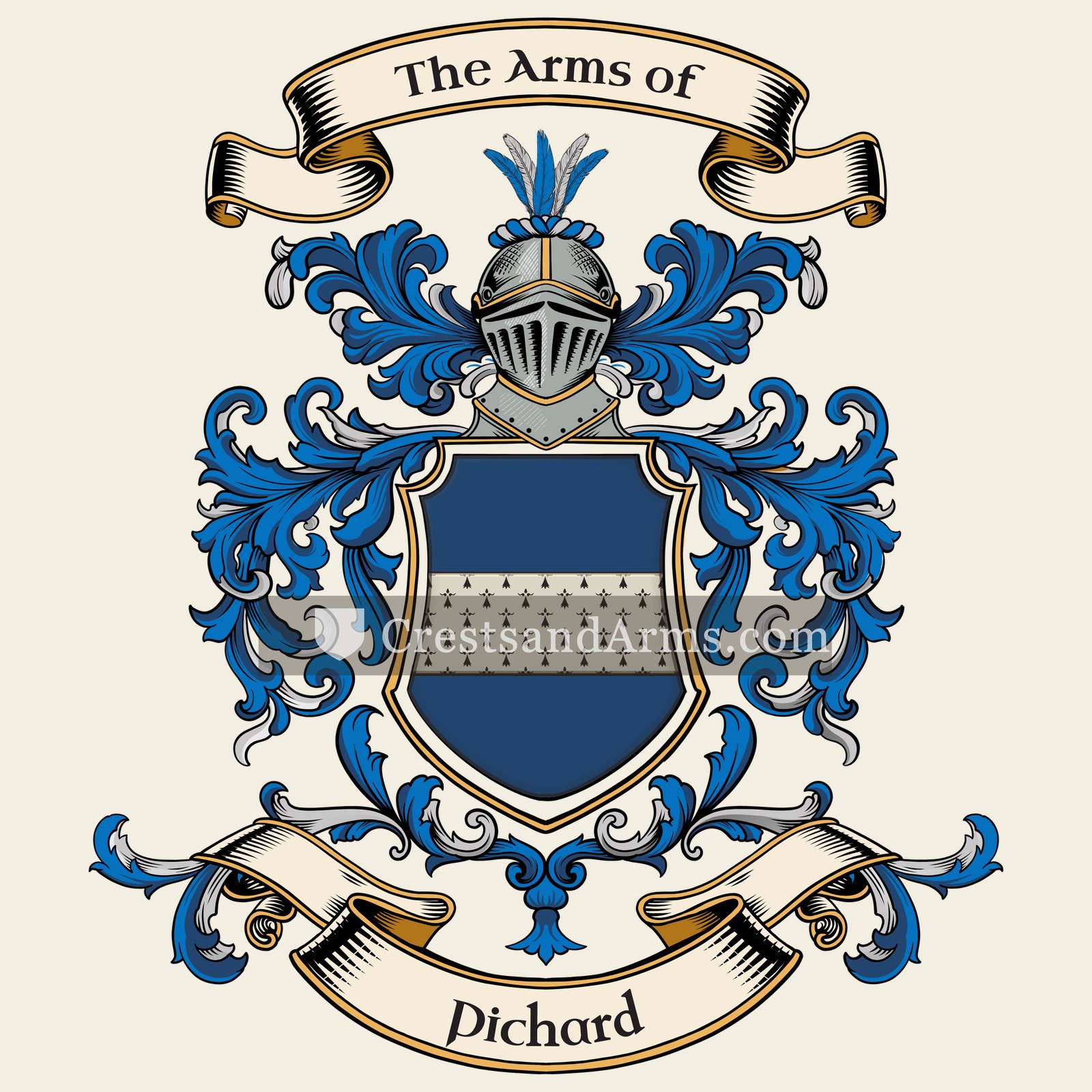
fessThe military belt, and readiness to serve
Colours
Blue (Azure)Means: Loyalty and truth
ErmineMeans: Dignity
Historical info
Source
Sir Bernard Burke, The General Armory of England, Scotland, Ireland and Wales, London: Harrison & Sons, 1884
Blazon (the actual original written record)
“Az. a fess erm. betw. three pilchers or”
Walesc. 1647
Digital archive packCoat of arms PNG, gold border print PDF, vector SVG and the certificate of authenticity. Sent to your email in minutes.
Map of Wales showing where the Pichard arms are recorded
The Pichard arms were recorded in Wales, c. 1647.
Arms such as these were typically recorded in Denbigh.
Denbighshire was north Welsh country of hills and small estates. Land was held by a great many families rather than a few, and each holding brought its own claim to a coat of arms.
This is where the arms were entered in the register. Families often moved to other parts of the country, so the same name can turn up in more than one region.
The body that granted and recorded arms in Wales in this period.
Charles I of England
Sovereign of the period
Charles I of England
1625–1649
Reigning in France when the Pichard arms are first recorded.
How Arms Worked in Wales
English heraldry allowed arms to be shared by all legitimate descendants of the original owner. These symbols were treated as personal property that moved through the generations to all children. While the eldest son kept the original design, other family members could use the same shield without needing to change it or register their own unique versions.
Granting authority
The College of Arms in London has regulated the use of coats of arms throughout England and Wales since 1484.
How they got arms
Families typically obtained their coats of arms through a formal grant from the Crown or by proving their ancient right to them.
Where arms were recorded
All official coats of arms are recorded in the registers kept at the College of Arms, which date back to the fifteenth century.
The family's standing
Recorded among the armigerous families of Wales.
Origin & History of the Pichard Family in Wales
The history of the Pichard family in Wales is deeply connected to the social landscape of the seventeenth century. By 1647, records confirm that members of the family were established in the town of Denbigh, a location that served as a significant administrative and military hub in North Wales. During this period, the region was recovering from the intense conflicts of the English Civil War, which had seen Denbigh Castle endure a long siege. Families living in the area at this time were often involved in local trade or land management, navigating the shift from traditional feudal structures to a more modern society. The presence of the Pichard name in Denbigh suggests that these early ancestors were part of a community that was rebuilding its local economy and social ties in the wake of national political upheaval. Their residence in such a prominent town indicates that they were likely integrated into the professional or merchant classes that helped define the character of North Wales during the mid-1600s.
Related Branches & Arms
Root word
Pic
A pointed object or a sharp peak.
This name
PichardA diminutive form referring to someone who lived near a sharp hill or peak.
also spelled
Pychard
Pichart
Pishar
Pickard
Related arms
Pychardvariant spelling
Ancelrecorded with Pichard, same area
Christinrecorded with Pichard, same area
du Thonrecorded with Pichard, same area
Documented Sources
J. B. Rietstap, Armorial Général, Gouda: G. B. van Goor Zonen, 1884–87
Dauzat, Albert, Dictionnaire étymologique des noms et prénoms de France, 1951
Morlet, Marie-Thérèse, Dictionnaire étymologique des noms de famille, 1991
Archives Départementales de la Vienne, Registres paroissiaux et d'état civil, 1663
Digital archive packCoat of arms PNG, gold border print PDF, vector SVG and the certificate of authenticity. Sent to your email in minutes.


 chevronProtection, and faithful service completed
 cross symbolChristian faith and service
 lionCourage, strength and royalty
 mulletThe third son, and a divine quality from above
 eagleNobility, strength and a keen mind
 chevronProtection, and faithful service completed
 cross symbolChristian faith and service
 lionCourage, strength and royalty
 mulletThe third son, and a divine quality from above
 eagleNobility, strength and a keen mind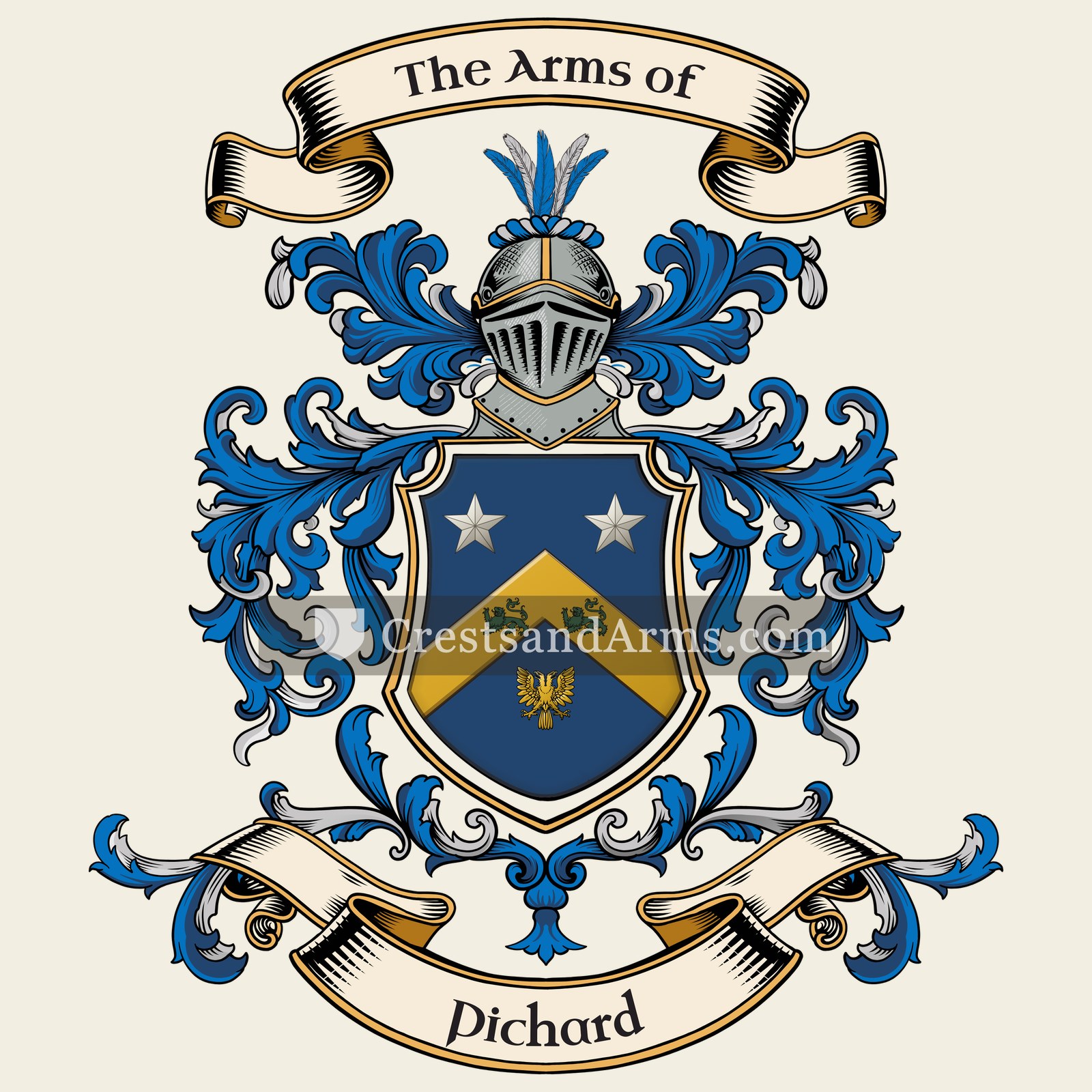




 fessThe military belt, and readiness to serve