Map of Belgium showing where the Pichette arms are recorded
The Pichette arms were recorded in Tournaisis, c. 1737.
This is where the arms were entered in the register. Families often moved to other parts of the country, so the same name can turn up in more than one region.
The body that granted and recorded arms in Belgium in this period.
Charles VI, Holy Roman Emperor
Sovereign of the period
Charles VI, Holy Roman Emperor
1711–1740
Reigning in Belgium when the Pichette arms are first recorded.
How Arms Worked in Belgium
In Belgium, a coat of arms is considered personal property that is passed down through the male line to legitimate descendants. Families often use the same shield design across generations to show their shared heritage. If a branch of the family wants to change the design, they must apply for an official update to their specific version of the arms.
Granting authority
The Conseil héraldique is the official body that regulates and approves all coats of arms in Belgium.
How they got arms
Families obtain their coats of arms through formal royal grants or by confirming their historical right to use existing designs.
Where arms were recorded
All approved coats of arms are officially recorded in the public registers of the Conseil héraldique since 1844.
The family's standing
Recorded among the armigerous families of Belgium.
Origin & History of the Pichette Family in Belgium
The family name Pichette is rooted in the historic region of Tournaisis, a territory centered around the city of Tournai in present-day Belgium. By 1737, records confirm that members of the family were well-established within this area, which was known for its complex history of shifting borders between French and Austrian rule. The name itself likely originated as a descriptive nickname, as the suffix "ette" was commonly used in Old French to denote something small or to create a diminutive form of a base word. In the context of the eighteenth century, families in the Tournaisis region were often tied to the local agricultural economy or the thriving textile trade that defined the city of Tournai. As the family grew, they became part of the social fabric of this borderland, living through a period where the region served as a vital crossroads for European commerce and cultural exchange.
Pichette Meaning & Related Branches
Root word
Piche
Old French term for a pitcher or a small container.
This name
PichetteA diminutive occupational name for a maker or user of pitchers.
also spelled
Piquette
Pyquette
Pikquette
Piket
Documented Sources
J. B. Rietstap, Armorial Général, Gouda: G. B. van Goor Zonen, 1884–87
Archives de l'État à Tournai, Registres paroissiaux de l'ancien régime
Chotin, Adolphe, Histoire de Tournai et du Tournésis, 1840
Dauzat, Albert, Dictionnaire étymologique des noms et prénoms de France, 1951
Digital archive packCoat of arms PNG, gold border print PDF, vector SVG and the certificate of authenticity. Sent to your email in minutes.


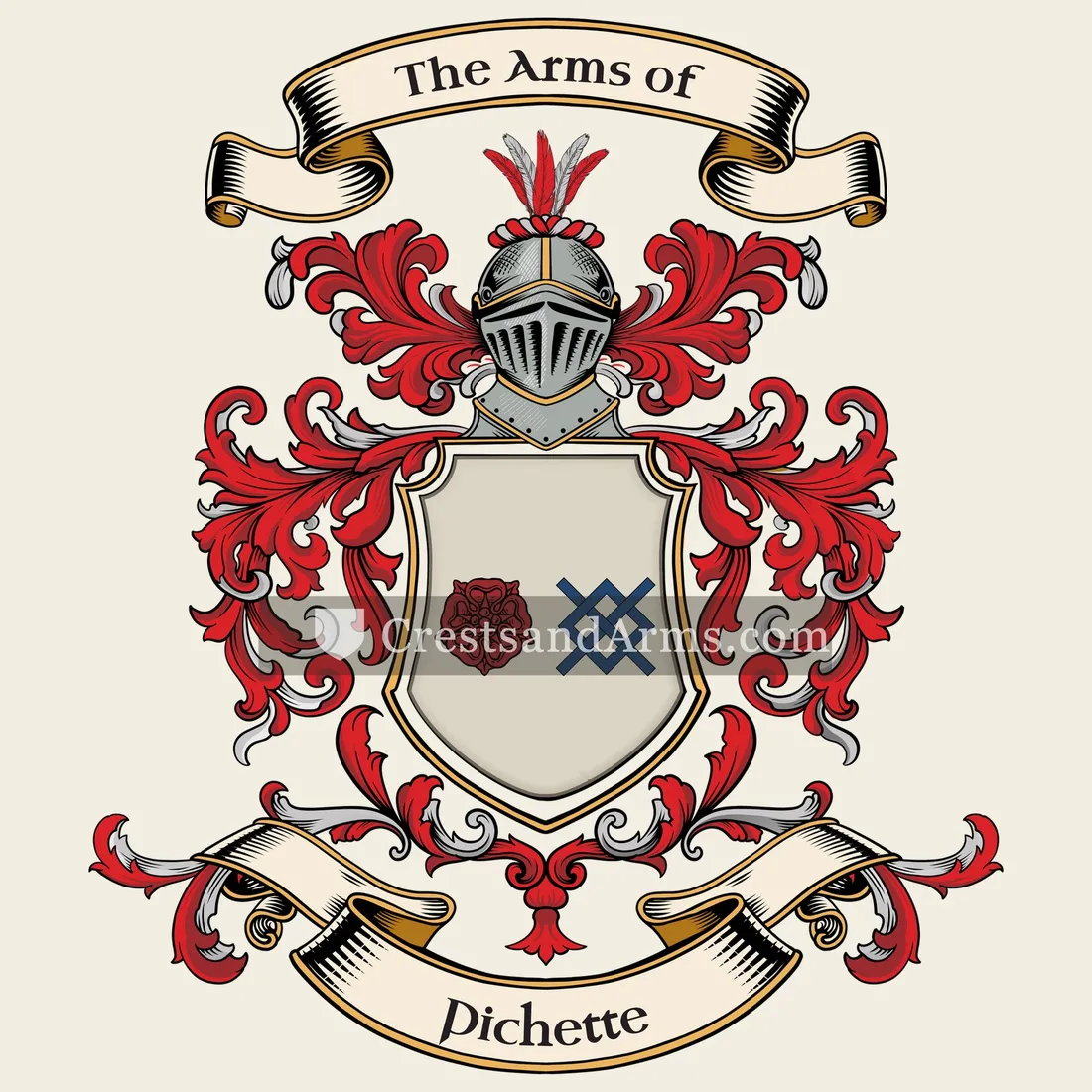
 roseThe seventh son, and beauty with grace
 fretPersuasion, and the net that holds
 roseThe seventh son, and beauty with grace
 fretPersuasion, and the net that holds