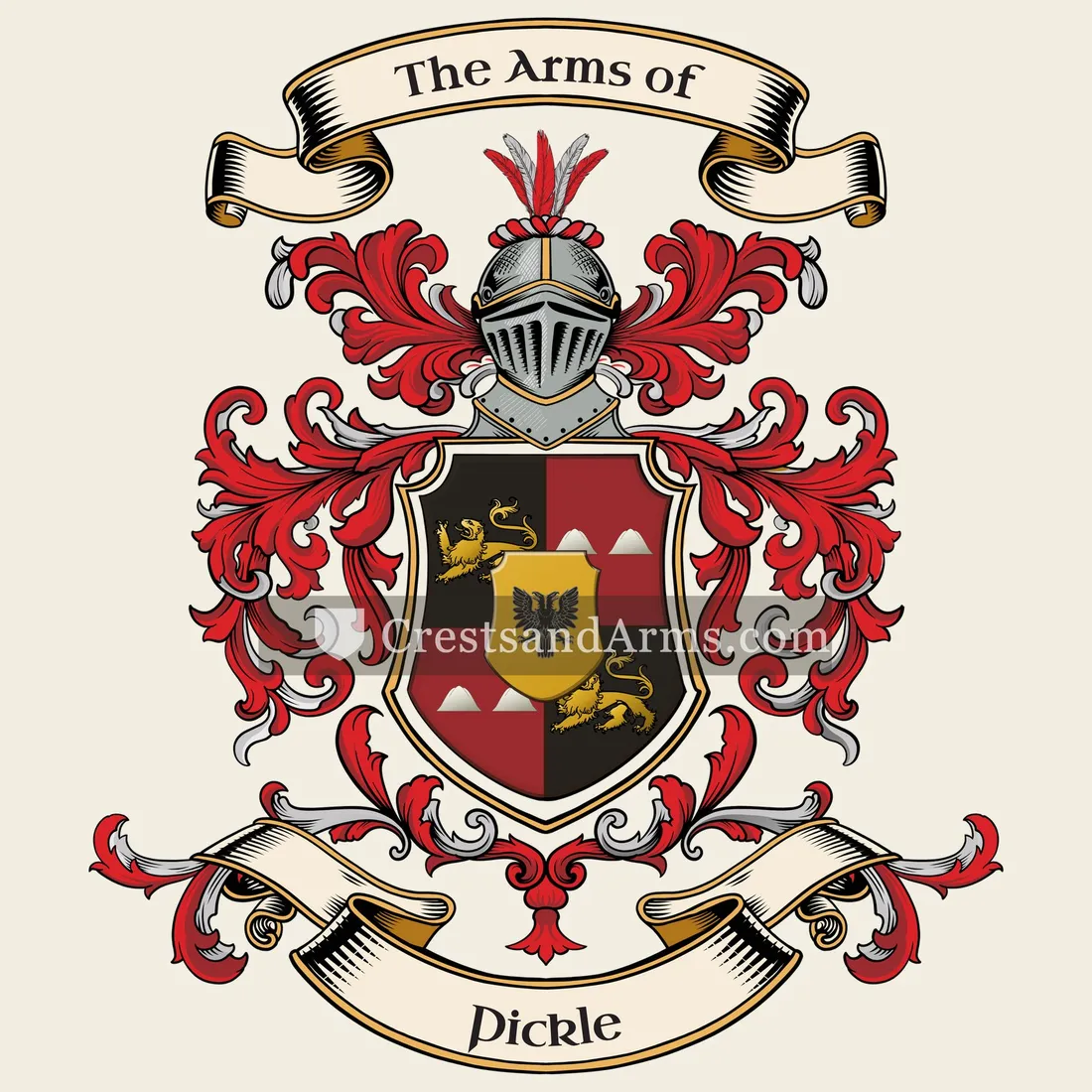
A record of documented arms, meaning and origin, researched for the Pickle family of Austria.
Reg. 4236 · Austrian, P–S
Meaning of the Pickle family crest colors & symbols
Symbols on this shield
mountThe ground held, and steadfastness upon it
eagleNobility, strength and a keen mind
lionCourage, strength and royalty
Colours
Black (Sable)Means: Constancy
Red (Gules)Means: Military strength
Gold (Or)Means: Generosity
Silver (Argent)Means: Peace and sincerity
Historical info
Source
J. B. Rietstap, Armorial Général, Gouda: G. B. van Goor Zonen, 1884–87
Blazon (the actual original written record)
“Ec.: aux 1 et 4 de sa. au lion d'or; aux 2 et 3 de gu. à deux pics de rocher accostés d'arg. Sur le tout d'or à l'aigle ép. de sa. Trois cq. cour. C.: 1° un lion iss. et cont. d'or, tenant de sa patte sen. trois roses de gu., mouv. d'une seule tige; 2° l'aigle; 3° un lion iss. d'arg., tenant de sa patte dextre trois roses de gu., mouv. d'une seule tige. L.: à dextre d'or et de sa., à sen. d'arg. et de gu.”
Austriac. 1600
Digital archive packCoat of arms PNG, gold border print PDF, vector SVG and the certificate of authenticity. Sent to your email in minutes.
Map of Austria showing where the Pickle arms are recorded
The Pickle arms were recorded in Austria, c. 1600.
Arms such as these were typically recorded in Tyrol.
Tyrol was mountain country in western Austria, where the valleys were held by families who had been there a very long time. Old tenure counted for more than money, and old families carried arms.
This is where the arms were entered in the register. Families often moved to other parts of the country, so the same name can turn up in more than one region.
Region
Tyrol
First recorded
1600
Granting Authority for the Pickle Arms
Imperial and Royal chancery
Sodacan · CC BY-SA 3.0
The body that granted and recorded arms in Austria in this period.
Emperor Rudolf II
Sovereign of the period
Emperor Rudolf II
1576–1612
Reigning in Austria when the Pickle arms are first recorded.
How Arms Worked in Austria
Austrian coats of arms were often linked directly to noble titles granted by the Emperor. These symbols belonged to the entire family line rather than just one individual. When a family grew, new branches kept the original design without needing to change it. This system allowed all members of a noble house to share the same identity across many generations.
Granting authority
The Imperial and Royal chancery managed all heraldic matters and controlled the official granting of arms throughout the Austrian lands.
How they got arms
Families typically received their arms through a formal imperial decree that often accompanied the elevation of a person to noble status.
Where arms were recorded
Official records of these grants were kept in the Imperial Register of Nobility which began its formal documentation process in 1453.
The family's standing
Recorded among the armigerous families of Austria.
Origin & History of the Pickle Family in Austria
The family name Pickle finds its roots in the mountainous region of Tyrol during the early 17th century. At that time, the name was often recorded in German documents as Pickel, which was a common occupational or descriptive term. In the local dialect, this word was frequently used to describe a sharp tool like a pickaxe or a pointed mountain peak. It is likely that the first people to carry this name were either skilled miners working in the rich silver and salt deposits of the Austrian Alps or families living near distinctively jagged mountain summits. As these families moved through the valleys of Tyrol, the name became a way to identify their trade or their home. Over many generations, the spelling evolved to suit different languages and regions, eventually becoming the version used by the family today.
Pickle Meaning & Related Branches
Root word
Pikkel
A Middle High German term referring to a pickaxe or pointed tool.
This name
PickleAn occupational surname for a miner, stonecutter, or someone who used a pickaxe.
also spelled
Pychl
Pikkel
Pikhl
Pickle
Documented Sources
J. B. Rietstap, Armorial Général, Gouda: G. B. van Goor Zonen, 1884–87
Kranzmayer, Eberhard. Ortsnamenbuch von Kärnten. 1956


 mountThe ground held, and steadfastness upon it
 eagleNobility, strength and a keen mind
 lionCourage, strength and royalty
 mountThe ground held, and steadfastness upon it
 eagleNobility, strength and a keen mind
 lionCourage, strength and royalty