A record of documented arms, meaning and origin, researched for the Pickler family lines. Documented in 2 countries.
Reg. 5020 · German, P–S
Coat of Arms & Family Crest Details
Symbols on this shield
mountThe ground held, and steadfastness upon it
fessThe military belt, and readiness to serve
roseThe seventh son, and beauty with grace
Colours
Silver (Argent)Means: Peace and sincerity
Blue (Azure)Means: Loyalty and truth
Green (Vert)Means: Hope
Historical info
Source
J. B. Rietstap, Armorial Général, Gouda: G. B. van Goor Zonen, 1884–87
Blazon (the actual original written record)
“Ec.: aux 1 et 4 d'arg. à une cuve au nat., posée sur un tertre de sin.; aux 2 et 3 d'azur à trois roses d'arg. Cq. cour. C.: la cuve, entre un vol d'arg., chaque aile ch. d'une fasce d'azur surch. de trois roses d'arg. L. d'arg. et d'azur.”
BavariaBavaria, c. 1818
Digital archive packCoat of arms PNG, gold border print PDF, vector SVG and the certificate of authenticity. Sent to your email in minutes.
Map of Germany showing where the Pickler arms are recorded
The Pickler arms were recorded in Bavaria, c. 1818.
Bavaria was a country of old landed families and walled market towns. Estates passed down the same line for centuries, and both the landowners and the leading townsmen kept arms, which is why so many Bavarian names sit in the registers.
This is where the arms were entered in the register. Families often moved to other parts of the country, so the same name can turn up in more than one region.
The body that granted and recorded arms in Germany in this period.
Frederick William III of Prussia
Sovereign of the period
Frederick William III of Prussia
1797–1840
Reigning in Germany when the Pickler arms are first recorded.
How Arms Worked in Germany
Prussian heraldry was strictly tied to social rank and noble status rather than being a free choice for every citizen. These symbols were treated as permanent family property that moved through the generations to all legitimate heirs. If a family branch wanted to change their design to stand out, they had to apply for official permission to alter their specific version of the shield.
Granting authority
The Prussian Heroldsamt acted as the central state office that managed and strictly controlled all noble titles and coats of arms.
How they got arms
Families usually obtained their arms through formal royal grants or by proving their long-standing noble status to the state authorities.
Where arms were recorded
All official coats of arms were kept in the rolls of the Prussian Heroldsamt, which functioned from 1706 until 1918.
The family's standing
Recorded among the armigerous families of Bavaria.
Origin & History of the Pickler Family in Germany
The surname Pickler is deeply rooted in the historical landscape of southern Germany, particularly within the region of Bavaria. Linguistically, the name is derived from the Middle High German word *bickel*, which often referred to a person who worked with a pickaxe or a small tool used in mining and stone masonry. This suggests that the earliest ancestors of the Pickler family were likely skilled laborers or tradespeople who played a vital role in the local economy. By the early 19th century, records confirm that families bearing this name were well-established members of the Bavarian community. These individuals lived through a time of significant political change as the region transitioned into the Kingdom of Bavaria. Their presence in official documents from 1818 highlights their integration into the social structure of the era, where they contributed to the agricultural and craft-based traditions that defined rural German life during the post-Napoleonic period.
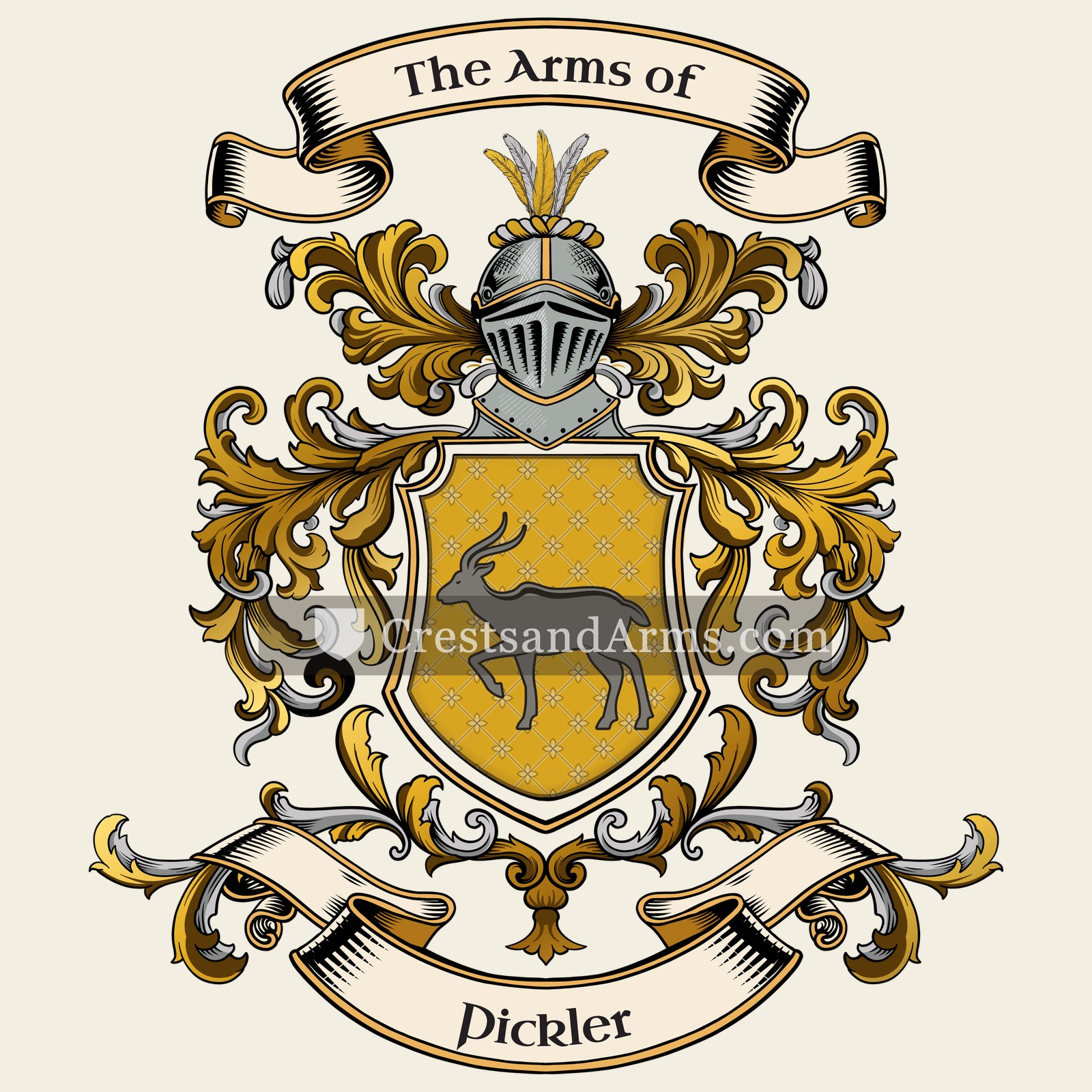
Coat of Arms & Family Crest Details
Symbols on this shield
antelopeHarmony, polity and peace
Colours
Gold (Or)Means: Generosity
Black (Sable)Means: Constancy
Historical info
Source
J. B. Rietstap, Armorial Général, Gouda: G. B. van Goor Zonen, 1884–87
Blazon (the actual original written record)
“D'or à un chamois ramp. de sa.”
StyriaStyria, c. 1772
Digital archive packCoat of arms PNG, gold border print PDF, vector SVG and the certificate of authenticity. Sent to your email in minutes.
Map of Austria showing where the Pickler arms are recorded
The Pickler arms were recorded in Styria, c. 1772.
Styria was mountain and forest country in southern Austria, with iron in its hills. Mining and landholding both made money, and families who held either kind of property took arms to seal their papers with.
This is where the arms were entered in the register. Families often moved to other parts of the country, so the same name can turn up in more than one region.
Region
Styria
First recorded
1772
Granting Authority for the Pickler Arms
Imperial and Royal chancery
Sodacan · CC BY-SA 3.0
The body that granted and recorded arms in Austria in this period.
Joseph II, Holy Roman Emperor
Sovereign of the period
Joseph II, Holy Roman Emperor
1765–1790
Reigning in Germany when the Pickler arms are first recorded.
How Arms Worked in Austria
Austrian coats of arms were often linked directly to noble titles granted by the Emperor. These symbols belonged to the entire family line rather than just one individual. When a family grew, new branches kept the original design without needing to change it. This system allowed all members of a noble house to share the same identity across many generations.
Granting authority
The Imperial and Royal chancery managed all heraldic matters and controlled the official granting of arms throughout the Austrian lands.
How they got arms
Families typically received their arms through a formal imperial decree that often accompanied the elevation of a person to noble status.
Where arms were recorded
Official records of these grants were kept in the Imperial Register of Nobility which began its formal documentation process in 1453.
The family's standing
Recorded among the armigerous families of Styria.
Origin & History of the Pickler Family in Austria
The family name Pickler originates from the German word *Pickel*, which historically referred to a tool like a pickaxe or a small spade. In the context of early Austrian history, this suggests that the name began as an occupational surname for someone who worked in mining, agriculture, or stone masonry. By the year 1772, records confirm that families bearing this name were well-established in the region of Styria. During this period, Styria was a vital part of the Habsburg Monarchy, and the local economy relied heavily on iron production and forestry. Families like the Picklers were likely integrated into these rural industries, living in the mountainous terrain that defines the Styrian landscape. As the population grew and moved through these Alpine valleys, the name became a permanent fixture of the local community, reflecting the hardworking nature of the people who helped shape the region’s development during the eighteenth century.
Related Branches & Arms
Root word
Pickel
A pointed tool or a sharp, spiked implement.
This name
PicklerAn occupational surname for someone who worked with a pickaxe or a pointed tool.
also spelled
Pychler
Pichlar
Pikler
Pickler
Documented Sources
J. B. Rietstap, Armorial Général, Gouda: G. B. van Goor Zonen, 1884–87
Bavarian State Archives (Bayerisches Hauptstaatsarchiv), Königlich Bayerisches Intelligenzblatt, 1818
Bahlow, Hans, Deutsches Namenlexikon: Familien- und Vornamen nach Ursprung und Sinn erklärt, 1967
Heintze, Albert, Die deutschen Familiennamen: geschichtlich, geographisch, sprachlich, 1903
Digital archive packCoat of arms PNG, gold border print PDF, vector SVG and the certificate of authenticity. Sent to your email in minutes.


 mountThe ground held, and steadfastness upon it
 fessThe military belt, and readiness to serve
 roseThe seventh son, and beauty with grace
 mountThe ground held, and steadfastness upon it
 fessThe military belt, and readiness to serve
 roseThe seventh son, and beauty with grace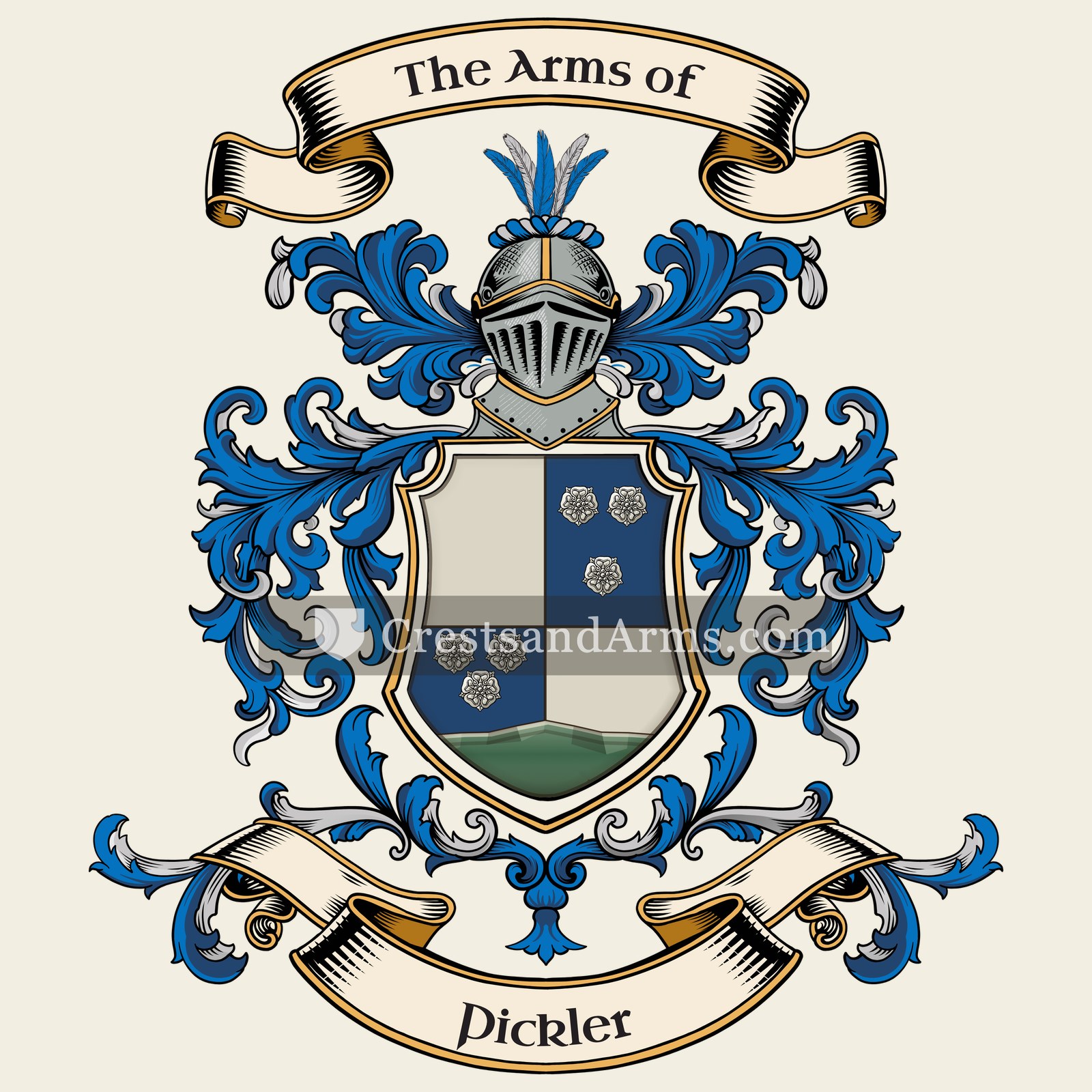


 antelopeHarmony, polity and peace