Map of France showing where the Picon arms are recorded
The Picon arms were recorded in Lyonnais, c. 1663.
Lyonnais centred on Lyon, one of the great banking and silk towns of France. Money made in the city bought estates in the countryside around it, and those estates brought arms with them.
This is where the arms were entered in the register. Families often moved to other parts of the country, so the same name can turn up in more than one region.
The body that granted and recorded arms in France in this period.
Louis XIV of France
Sovereign of the period
Louis XIV of France
1643–1715
Reigning in France when the Picon arms are first recorded.
How Arms Worked in France
In France, a coat of arms was a mark of honor that passed down through the male line to all legitimate descendants. Families often used the same shield without changes to show their shared heritage. If a branch wanted to stand out, they could add a small mark to their shield to show their specific place in the family tree.
Granting authority
The Juge d'armes de France acted as the official authority that regulated and verified coats of arms across the country.
How they got arms
Families typically inherited their arms from ancestors, though they could also receive them through royal grants or by proving their noble status.
Where arms were recorded
Coats of arms were officially recorded in the Armorial Général de France, which began its main collection in the year 1696.
The family's standing
Recorded among the armigerous families of Lyonnais.
Origin & History of the Picon Family in France
The Picon family name has deep roots in the historical province of Lyonnais, where records confirm members of the family were well-established by 1663. During this period, the Lyonnais region served as a vital center for trade and silk production, placing the family at the heart of French economic life. The name itself is thought to be a topographic surname, likely originating from the word "pique" or "pic," which refers to a pointed mountain or a sharp peak. This suggests that the earliest ancestors may have lived near a prominent hill or a jagged rock formation in the rugged landscape of southeastern France. As the family grew, they became integrated into the local social fabric, participating in the agricultural and craft-based traditions that defined the region before the French Revolution. By documenting their presence in the seventeenth century, we see a family that was firmly planted in the local community, contributing to the long-standing cultural identity of the Lyonnais area.
Coat of Arms & Family Crest Details
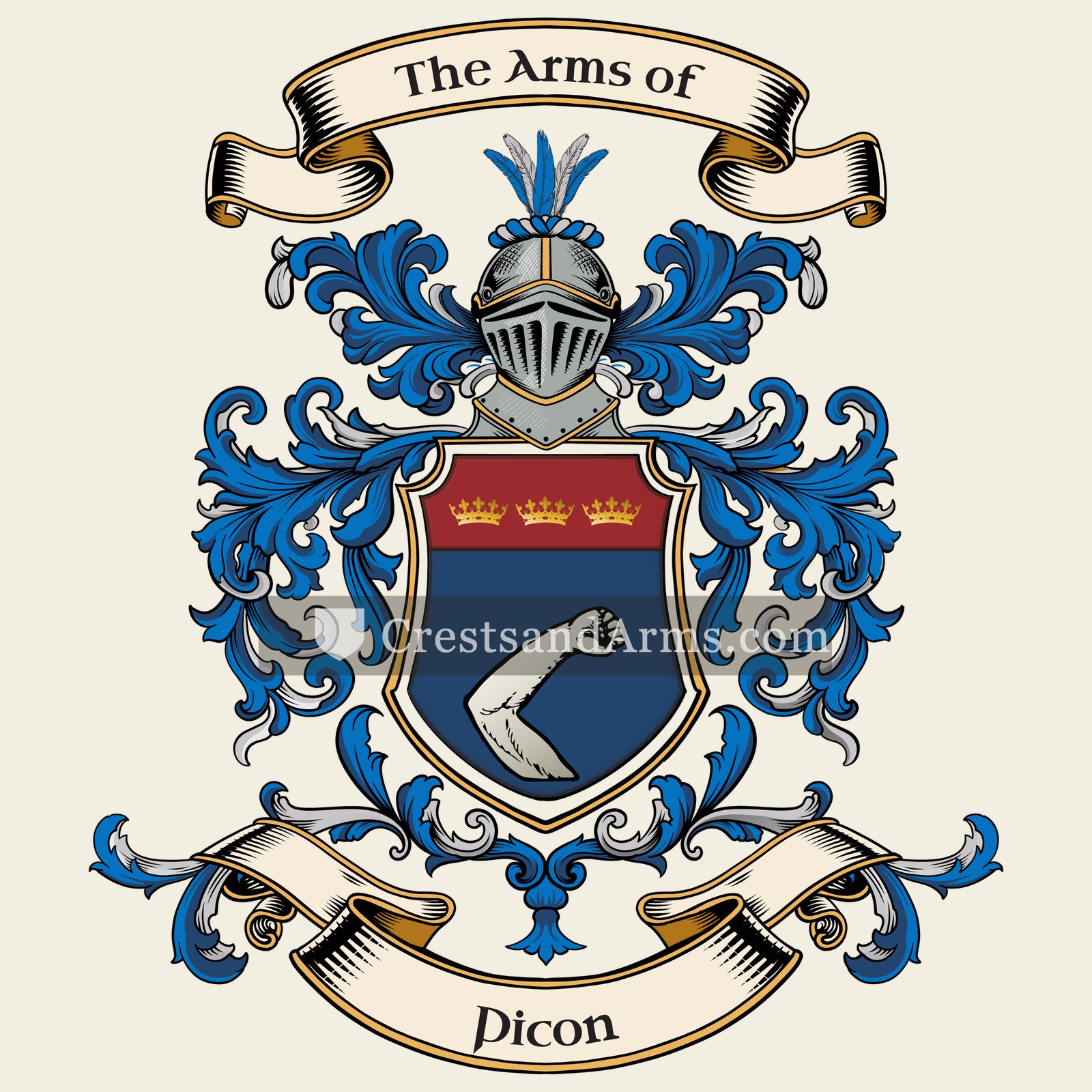
Symbols on this shield
chiefAuthority, wisdom and dominion
armA person of action, industrious and laborious
crownSovereignty, authority and just reward
Colours
Blue (Azure)Means: Loyalty and truth
Red (Gules)Means: Military strength
Silver (Argent)Means: Peace and sincerity
Gold (Or)Means: Generosity
Historical info
Source
J. B. Rietstap, Armorial Général, Gouda: G. B. van Goor Zonen, 1884–87
Blazon (the actual original written record)
“D'azur à un senestrochère, arm. d'arg., tenant une pique du même, en barre, fûtée d'or; au chef de gu., ch. de trois couronnes d'or.”
LimousinGènes · Limousin, c. 1775
Digital archive packCoat of arms PNG, gold border print PDF, vector SVG and the certificate of authenticity. Sent to your email in minutes.
Map of Italy showing where the Picon arms are recorded
The Picon arms were recorded in Limousin, c. 1775.
Limousin was upland farming country in central France, poor in money but full of old families. Estates were small and held for a very long time, and long tenure counted for more than wealth when arms were recorded.
This is where the arms were entered in the register. Families often moved to other parts of the country, so the same name can turn up in more than one region.
The body that granted and recorded arms in Italy in this period.
Alvise Giovanni Mocenigo
Sovereign of the period
Alvise Giovanni Mocenigo
1763–1778
Reigning in France when the Picon arms are first recorded.
How Arms Worked in Italy
In the Italian states, coats of arms were often used by noble families to show their status and history. These symbols were passed down through the generations to all legitimate male descendants. Younger branches of a family usually kept the original design but sometimes added small changes to distinguish their specific line from the main branch.
Granting authority
Various local rulers and city governments controlled the use of coats of arms across the different Italian states.
How they got arms
Families often assumed their own arms or received them as official grants from local lords, popes, or city councils.
Where arms were recorded
Arms were recorded in local city archives or private family books rather than in one single national register.
The family's standing
Recorded among the armigerous families of Limousin.
Origin & History of the Picon Family in Italy
The surname Picon finds its historical roots in the linguistic landscape of the Occitan region, which spans parts of southern France and historically shares cultural ties with northern Italy. While the family established a documented presence in the Limousin region of France by 1775, the name itself likely derives from the Old Occitan word "picon," which refers to a small pickaxe or a tool used by stonecutters. This suggests that the earliest ancestors were likely skilled laborers or craftsmen who moved across the porous borders between the Alpine regions of Italy and France. During the medieval period, families often took names based on their specific trade, and the movement of workers through the mountain passes facilitated the spread of the name across these neighboring territories. By the time the family settled firmly in Limousin, they carried with them a legacy rooted in the industrious traditions of the mountain communities that connected the Italian Piedmont to the French interior.
Related Branches & Arms
Root word
pica
Latin term for a magpie or a pointed object.
This name
PiconA topographic name for someone living near a pointed hill or a nickname for a chatterer.
also spelled
Pycon
Pikkon
Piconn
Peekon
Related arms
Bélichonsame arms
Brossiersame arms
Giraudonsame arms
Xaintongesame arms
Documented Sources
J. B. Rietstap, Armorial Général, Gouda: G. B. van Goor Zonen, 1884–87
Archives départementales du Rhône, Registres paroissiaux de la ville de Lyon, 1663
Dauzat, Albert, Dictionnaire étymologique des noms de famille et prénoms de France, 1951
Moreri, Louis, Le Grand Dictionnaire historique ou le mélange curieux de l'histoire sacrée et profane, 1759
Digital archive packCoat of arms PNG, gold border print PDF, vector SVG and the certificate of authenticity. Sent to your email in minutes.


 chevronProtection, and faithful service completed
 mulletThe third son, and a divine quality from above
 crescentHonour by the sovereign, and the second son
 chevronProtection, and faithful service completed
 mulletThe third son, and a divine quality from above
 crescentHonour by the sovereign, and the second son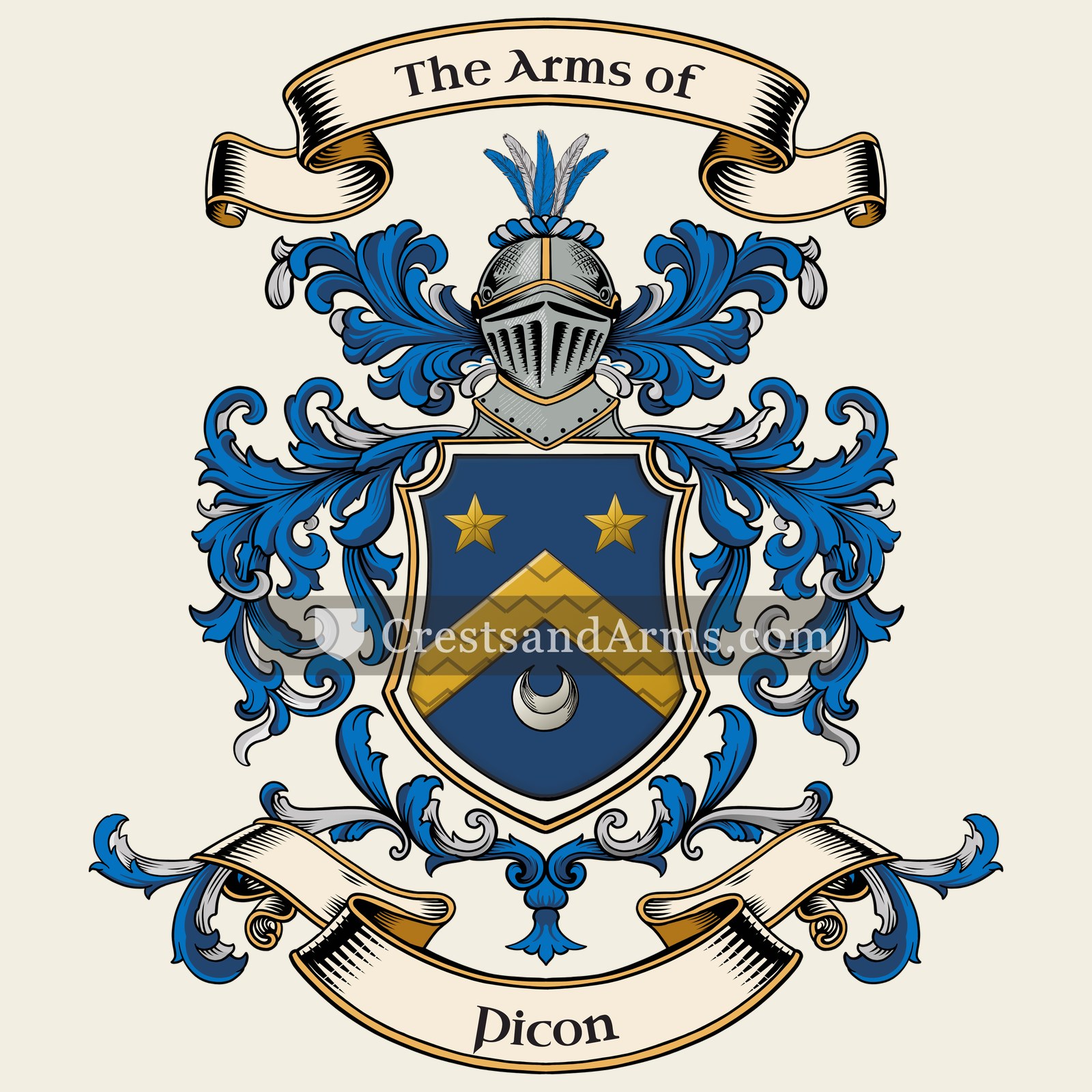


 chiefAuthority, wisdom and dominion
 armA person of action, industrious and laborious
 crownSovereignty, authority and just reward