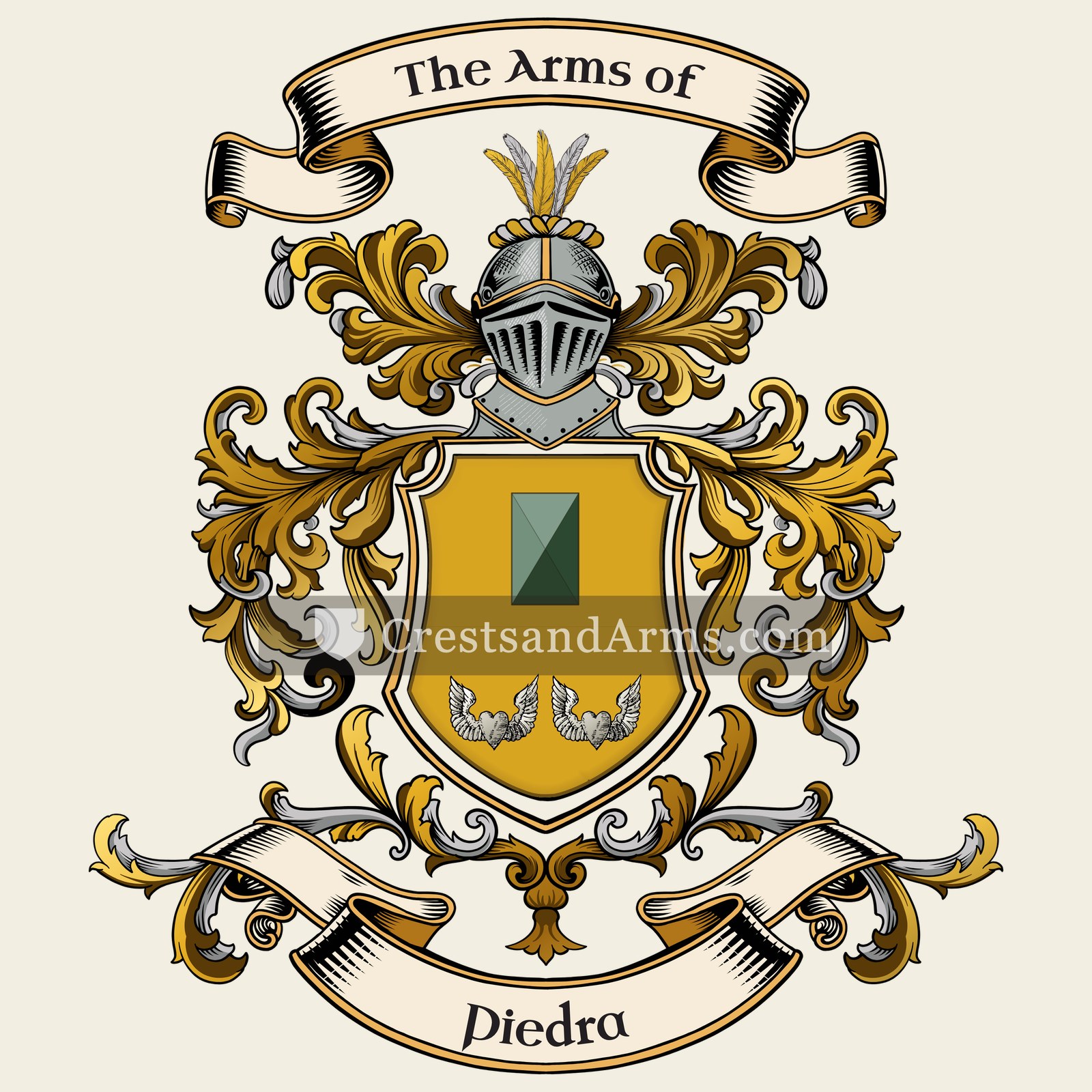
A record of documented arms, meaning and origin, researched for the Piedra family of Spain.
Reg. 5370 · Spanish, P–S
Coat of Arms & Family Crest Details
Symbols on this shield
billetThe sealed letter, and a message delivered
heartSincerity, charity and true affection
Colours
Gold (Or)Means: Generosity
Green (Vert)Means: Hope
Silver (Argent)Means: Peace and sincerity
Historical info
Source
J. B. Rietstap, Armorial Général, Gouda: G. B. van Goor Zonen, 1884–87
Blazon (the actual original written record)
“Coupé: au 1 d'or à deux têtes de Sarasin affr. au nat., le col dégouttant de sang, coiffées de turbans rayés d'arg. et de gu., acc. en p. d'une pierre carrée plate de sin.; au 2 d'or à deux coeurs accostés d'arg., dégouttants de sang.”
NavarreBiscaye · Navarre, c. 1722
Digital archive packCoat of arms PNG, gold border print PDF, vector SVG and the certificate of authenticity. Sent to your email in minutes.
Map of Spain showing where the Piedra arms are recorded
The Piedra arms were recorded in Navarre, c. 1722.
Navarre was mountain country straddling the Pyrenees, with a strong class of small independent landholders. A great many households counted as gentry there, and each needed a shield to be told apart.
This is where the arms were entered in the register. Families often moved to other parts of the country, so the same name can turn up in more than one region.
The body that granted and recorded arms in Spain in this period.
Philip V of Spain
Sovereign of the period
Philip V of Spain
1714–1724
Reigning in Spain when the Piedra arms are first recorded.
How Arms Worked in Spain
In Spain, a coat of arms was considered a form of property that belonged to the entire family line. These arms were passed down from a father to all his children equally. Younger branches of the family usually kept the original design without needing to add any special marks to distinguish their specific line.
Granting authority
The Cronista Rey de Armas was the official body that regulated and granted coats of arms throughout Spain.
How they got arms
Families often obtained their arms through royal grants or by proving their noble status to the official heraldic authority.
Where arms were recorded
Coats of arms were officially recorded in the registers of the Cronista Rey de Armas starting in 1496.
The family's standing
Recorded among the armigerous families of Navarre.
Origin & History of the Piedra Family in Spain
The surname Piedra originates from the Spanish word for stone, which suggests that the family name was likely a topographic descriptor used to identify people living near a prominent rock formation or a stony landscape. By the early 18th century, records confirm that the family was established in the region of Navarre, a historic kingdom in northern Spain known for its rugged terrain and deep cultural roots. During this period, families in Navarre were often deeply connected to the local land, and the name Piedra likely served as a way to distinguish individuals within their rural communities. As the family moved and grew throughout the 1700s, the name remained a testament to their connection to the geography of the Iberian Peninsula. This naming tradition reflects a time when a person's identity was closely tied to the physical environment they inhabited.
Related Branches & Arms
Root word
petra
Latin word meaning rock or stone.
This name
PiedraA topographic surname for someone who lived near a prominent rock formation or stone quarry.
also spelled
Pyedra
Piedrah
Piedras
Peedra
Documented Sources
J. B. Rietstap, Armorial Général, Gouda: G. B. van Goor Zonen, 1884–87
Archivo General de Navarra, Sección de Procesos Judiciales (Tribunal de la Corte Mayor), 1722
Mendiburu, Manuel de, Diccionario histórico-biográfico del Perú, 1874
Mogrobejo, Endika de, Diccionario hispano de apellidos y heráldica, 1995
Digital archive packCoat of arms PNG, gold border print PDF, vector SVG and the certificate of authenticity. Sent to your email in minutes.


 billetThe sealed letter, and a message delivered
 heartSincerity, charity and true affection
 billetThe sealed letter, and a message delivered
 heartSincerity, charity and true affection