Map of France showing where the Piening arms are recorded
The Piening arms were recorded in France, c. 1725.
Arms such as these were typically recorded in Bretagne.
More families held coats of arms in Bretagne than anywhere else in France. The land was divided into many small estates rather than a few large ones, so far more households counted as gentry, and each needed a shield of its own to be told apart.
This is where the arms were entered in the register. Families often moved to other parts of the country, so the same name can turn up in more than one region.
The body that granted and recorded arms in France in this period.
Louis XV of France
Sovereign of the period
Louis XV of France
1715–1774
Reigning in France when the Piening arms are first recorded.
How Arms Worked in France
In France, a coat of arms was a mark of honor that passed down through the male line to all legitimate descendants. Families often used the same shield without changes to show their shared heritage. If a branch wanted to stand out, they could add a small mark to their shield to show their specific place in the family tree.
Granting authority
The Juge d'armes de France acted as the official authority that regulated and verified coats of arms across the country.
How they got arms
Families typically inherited their arms from ancestors, though they could also receive them through royal grants or by proving their noble status.
Where arms were recorded
Coats of arms were officially recorded in the Armorial Général de France, which began its main collection in the year 1696.
The family's standing
Recorded among the armigerous families of France.
Origin & History of the Piening Family in France
The history of the Piening family in France is rooted in the coastal region of Bretagne, where records confirm their presence by 1725. During the eighteenth century, Bretagne was a hub for maritime trade and seafaring, which likely shaped the lives of families living in the area. The name Piening is often associated with Germanic or Low German linguistic origins, suggesting that the family may have migrated to the French coast from northern territories for work or trade opportunities. Settling in a region known for its strong regional identity and distinct cultural traditions, the family became part of the local social fabric during a time of significant economic change. By integrating into the community of Bretagne, the early Piening family members contributed to the diverse demographic landscape of the province during the final decades of the French monarchy.
Coat of Arms & Family Crest Details
Symbols on this shield
lionCourage, strength and royalty
roseThe seventh son, and beauty with grace
bullValour and generosity
roundelA coin, and one who has been to the crusades
Colours
Black (Sable)Means: Constancy
Silver (Argent)Means: Peace and sincerity
Blue (Azure)Means: Loyalty and truth
Gold (Or)Means: Generosity
Historical info
Source
J. B. Rietstap, Armorial Général, Gouda: G. B. van Goor Zonen, 1884–87
Blazon (the actual original written record)
“Ec.: au 1 de sa. au lion d'arg.; au 2 d'arg. à trois pensées d'azur, tigées du mème; au 3 d'azur à trois rencontres de boeuf au nat.; au 4 de gu. à cinq bes. d'or, 3 et 2. C.: un lion ramp. d'arg.”
NetherlandsSchiedam, c. 1725
Digital archive packCoat of arms PNG, gold border print PDF, vector SVG and the certificate of authenticity. Sent to your email in minutes.
Map of Netherlands showing where the Piening arms are recorded
The Piening arms were recorded in Schiedam, c. 1725.
This is where the arms were entered in the register. Families often moved to other parts of the country, so the same name can turn up in more than one region.
Region
Schiedam
Town
Schiedam
First recorded
1725
Granting Authority for the Piening Arms
Hoge Raad van Adel
Photograph made by me · CC BY-SA 3.0
The body that granted and recorded arms in Netherlands in this period.
How Arms Worked in Netherlands
In the Netherlands, coats of arms were often used by noble families and those who held specific public offices. These arms were passed down through the generations to legitimate descendants. Younger branches of a family usually kept the original design without needing to add special marks. This system ensured that the family identity remained clear and consistent over many years.
Granting authority
The Hoge Raad van Adel is the official body that regulates and manages noble titles and coats of arms in the Netherlands.
How they got arms
Families typically obtained their coats of arms through official royal grants or by proving their long-standing historical use of the symbols.
Where arms were recorded
Coats of arms are officially recorded in the registers held by the Hoge Raad van Adel, which began its work in 1814.
The family's standing
Recorded among the armigerous families of Netherlands.
Origin & History of the Piening Family in Netherlands
The Piening family name has roots that reach back into the historical landscape of the Netherlands, with clear documentation placing family members in the city of Schiedam by 1725. During this period, Schiedam was a bustling center for the gin industry and maritime trade, which likely influenced the daily lives and occupations of early family members living in the region. The name itself is thought to be a patronymic or a topographical descriptor, common for families residing in the coastal provinces where naming conventions often reflected local geography or ancestral origins. As the family established themselves in Schiedam, they became part of the growing urban population that defined the economic prosperity of the eighteenth-century Dutch Republic. By integrating into the social fabric of this port city, the early Pienings navigated a time of significant commercial expansion, leaving behind records that confirm their presence in the heart of Dutch industrial history.
Coat of Arms & Family Crest Details
Symbols on this shield
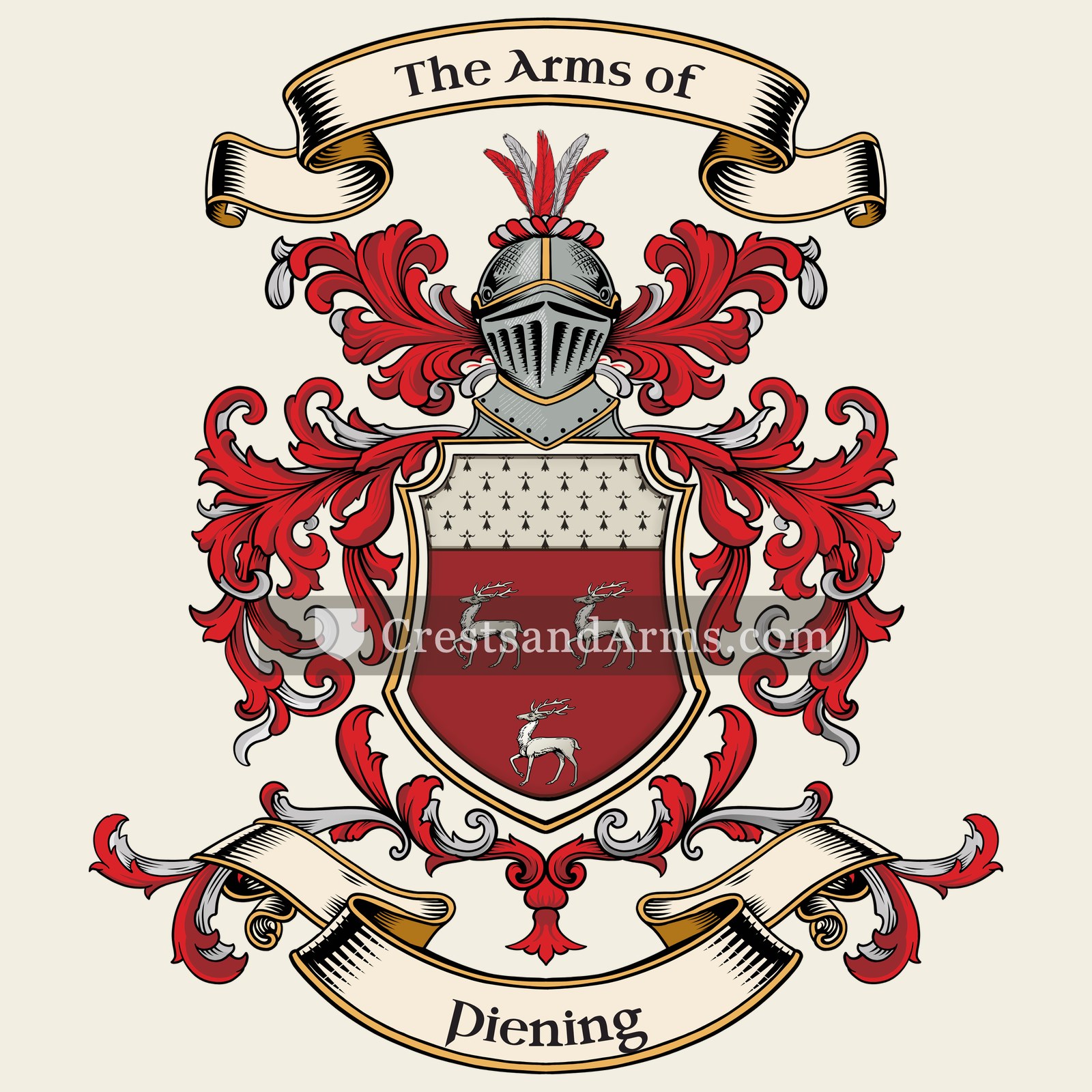
chiefAuthority, wisdom and dominion
stagPeace and harmony, and one who will not fight unprovoked
Colours
Red (Gules)Means: Military strength
ErmineMeans: Dignity
Silver (Argent)Means: Peace and sincerity
Historical info
Source
Sir Bernard Burke, The General Armory of England, Scotland, Ireland and Wales, London: Harrison & Sons, 1884
Blazon (the actual original written record)
“Gu. three bucks' heads cabossed ar., a chief indented erm”
SuffolkIpswich · Suffolk, c. 1594
Digital archive packCoat of arms PNG, gold border print PDF, vector SVG and the certificate of authenticity. Sent to your email in minutes.
Map of England showing where the Piening arms are recorded
The Piening arms were recorded in Suffolk, c. 1594.
Suffolk was wool country, and its cloth towns were among the wealthiest in England. Clothier families bought manors with their profits, and holding a manor was the ordinary route to a coat of arms.
This is where the arms were entered in the register. Families often moved to other parts of the country, so the same name can turn up in more than one region.
The body that granted and recorded arms in England in this period.
Elizabeth I of England
Sovereign of the period
Elizabeth I of England
1558–1603
Reigning in France when the Piening arms are first recorded.
How Arms Worked in England
English heraldry allowed arms to be shared by all legitimate descendants of the original owner. These symbols were treated as personal property that moved through the generations to all children. While the eldest son kept the original design, other family members could use the same shield without needing to change it or register their own unique versions.
Granting authority
The College of Arms in London has regulated the use of coats of arms throughout England and Wales since 1484.
How they got arms
Families typically obtained their coats of arms through a formal grant from the Crown or by proving their ancient right to them.
Where arms were recorded
All official coats of arms are recorded in the registers kept at the College of Arms, which date back to the fifteenth century.
The family's standing
Recorded among the armigerous families of Suffolk.
Origin & History of the Piening Family in England
The Piening family name has roots that trace back to the late sixteenth century in the county of Suffolk, England. By 1594, records confirm that members of the family were established within this region, which was then a prominent center for the textile trade and agricultural production. The name itself is believed to be of Low German origin, likely brought to the British Isles by merchants or skilled laborers who migrated across the North Sea during a period of significant economic exchange. Settling in Suffolk allowed the family to integrate into the local parish systems, where their names began appearing in church registers and legal documents. These early records suggest that the Pienings were part of the growing class of independent families who contributed to the social and economic fabric of East Anglia during the reign of Queen Elizabeth I.
Related Branches & Arms
Root word
Pien
A diminutive form of the Germanic name Peter meaning stone or rock.
This name
PieningA patronymic surname indicating descent from a person named Peter or Pien.
also spelled
Pening
Pynning
Penyng
Documented Sources
J. B. Rietstap, Armorial Général, Gouda: G. B. van Goor Zonen, 1884–87
Archives départementales du Morbihan, Registres paroissiaux et d'état civil
Archives départementales du Finistère, Série E, État civil et registres paroissiaux
Le Moyne de La Borderie, Arthur, Histoire de Bretagne, 1905
Tanguy, Bernard, Dictionnaire des noms de communes, trèves et paroisses du Finistère, 1990
Digital archive packCoat of arms PNG, gold border print PDF, vector SVG and the certificate of authenticity. Sent to your email in minutes.


 fessThe military belt, and readiness to serve
 wingSwiftness, and protection under a raised wing
 fessThe military belt, and readiness to serve
 wingSwiftness, and protection under a raised wing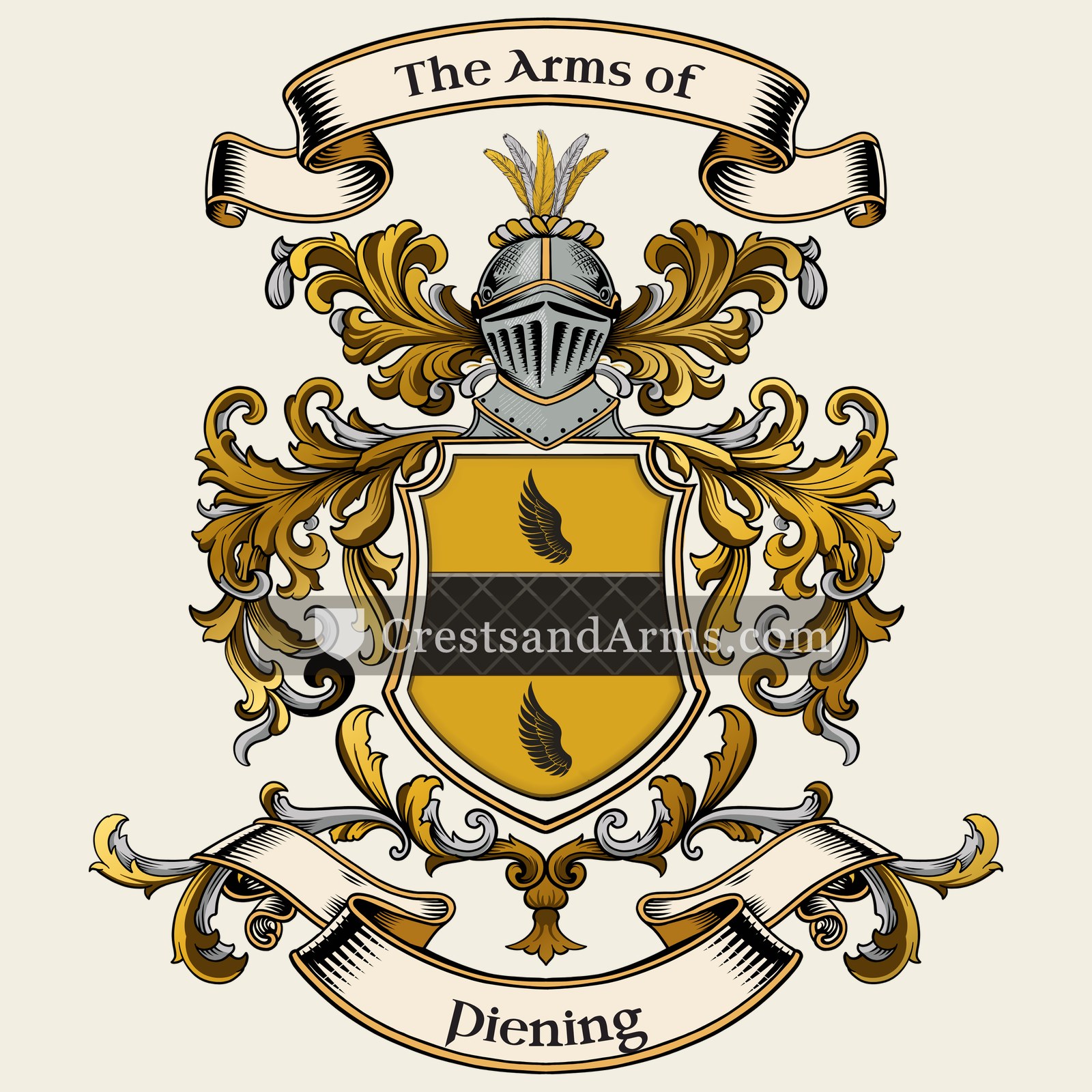


 lionCourage, strength and royalty
 roseThe seventh son, and beauty with grace
 bullValour and generosity
 roundelA coin, and one who has been to the crusades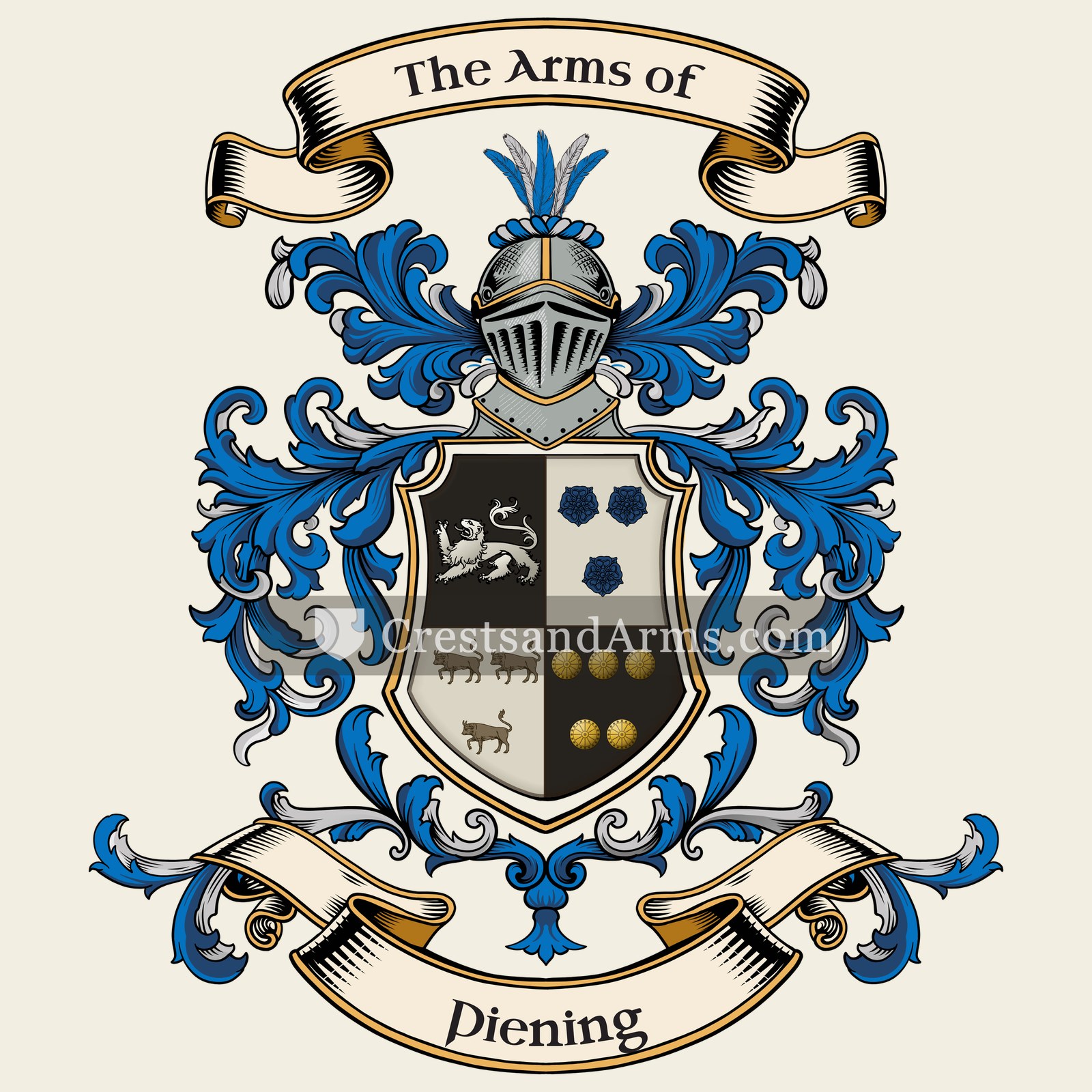

 chiefAuthority, wisdom and dominion
 stagPeace and harmony, and one who will not fight unprovoked