A record of documented arms, meaning and origin, researched for the Pieper family lines. Documented in 3 countries.
Reg. 6417 · Swedish, P–S
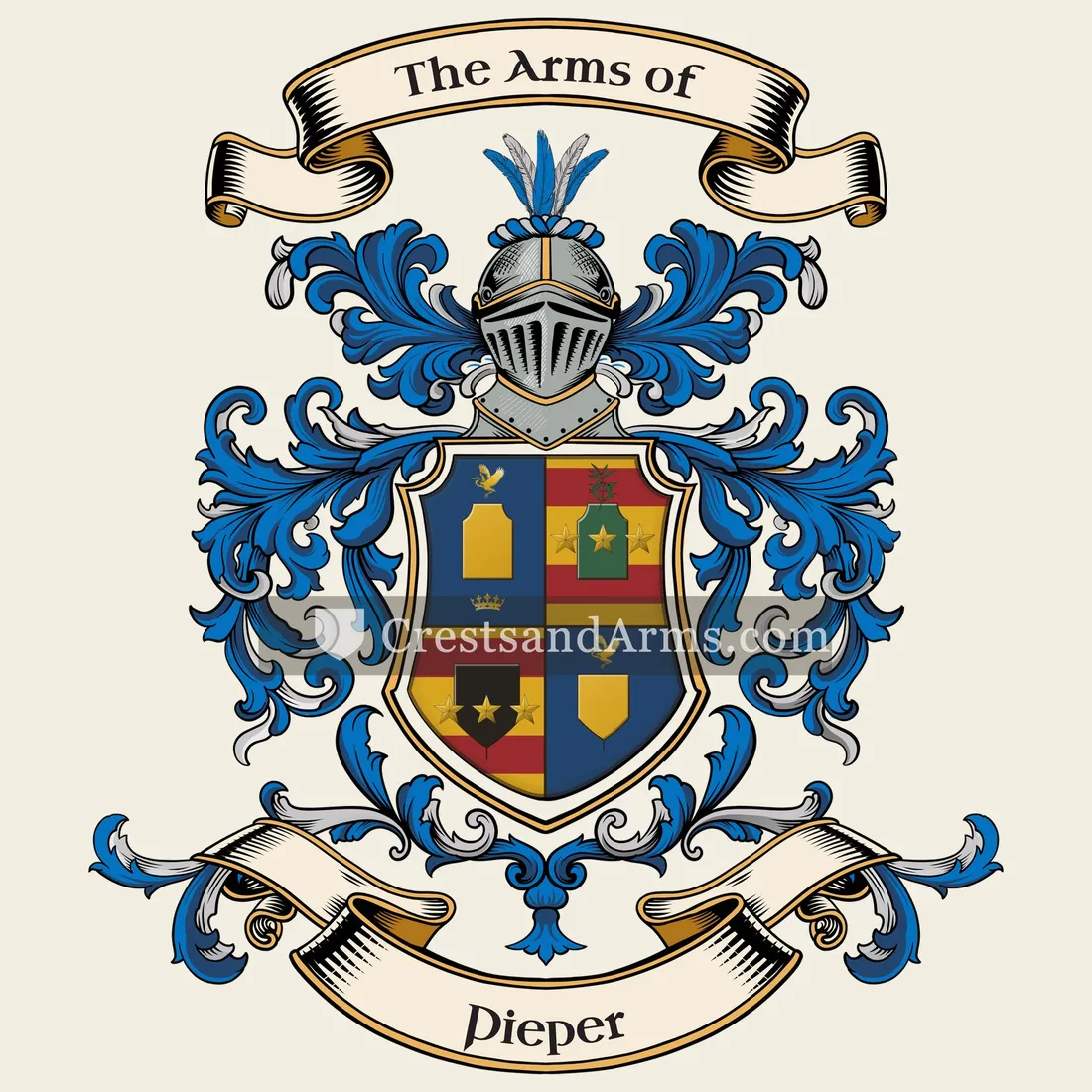
Meaning of the Pieper family crest colors & symbols
Symbols on this shield
fessThe military belt, and readiness to serve
heronPatience and quiet watchfulness
crownSovereignty, authority and just reward
mulletThe third son, and a divine quality from above
branchPeace, and new growth
Colours
Blue (Azure)Means: Loyalty and truth
Gold (Or)Means: Generosity
Red (Gules)Means: Military strength
Green (Vert)Means: Hope
Historical info
Source
J. B. Rietstap, Armorial Général, Gouda: G. B. van Goor Zonen, 1884–87
Blazon (the actual original written record)
“Ec.: aux 1 et 4 coupé d'azur sur or, à une grue avec sa vigilance de l'un en l'autre; aux 2 et 3 d'arg. à deux fasces de gu., ch. de trois étoiles (5) d'or, 2 et 1. Sur le tout parti: a. d'azur à une couronne d'or; b. d'or à un rameau de laurier de sin. Trois cq. cour. C.: 1° un demi-vol cont. coupé d'azur sur or, et un noeud d'azur, br. sur le coupé; 2° deux rameaux de laurier de sin., passés en saut. dans une couronne d'or; 3° un demi-vol aux armes du 2.”
Swedenc. 1698
Digital archive packCoat of arms PNG, gold border print PDF, vector SVG and the certificate of authenticity. Sent to your email in minutes.
Map of Sweden showing where the Pieper arms are recorded
The Pieper arms were recorded in Sweden, c. 1698.
Arms such as these were typically recorded in Stockholm.
Stockholm held the Swedish court and the House of Nobility, where every noble family's arms were entered and kept. Families ennobled for service registered there, which is why so many are recorded around the city.
This is where the arms were entered in the register. Families often moved to other parts of the country, so the same name can turn up in more than one region.
The body that granted and recorded arms in Sweden in this period.
Carl XII of Sweden
Sovereign of the period
Carl XII of Sweden
1697–1718
Reigning in Sweden when the Pieper arms are first recorded.
How Arms Worked in Sweden
In Sweden, a coat of arms belonged to a noble family as a whole rather than just one individual. These arms were passed down through the generations to all legitimate descendants. Younger branches of the family used the same shield without needing to change it. This system ensured that the entire lineage shared the same identity and status under the law.
Granting authority
The Riddarhuset, or House of Nobility, regulated all noble coats of arms in Sweden under royal authority.
How they got arms
Families received their coats of arms through royal grants of nobility which were then officially registered with the House.
Where arms were recorded
Coats of arms were officially recorded in the Swedish House of Nobility register starting in the year 1626.
The family's standing
Recorded among the armigerous families of Sweden.
Origin & History of the Pieper Family in Sweden
The history of the Pieper family in Sweden begins with their established presence in Stockholm by 1698, a time when the city was a bustling center of trade and administration within the Swedish Empire. The name itself is of Low German origin and typically functioned as an occupational surname for a professional musician or a pipe player. During the late seventeenth century, Stockholm attracted many skilled workers and merchants from across the Baltic region who sought opportunities in the growing capital. Members of the Pieper family likely integrated into this urban environment by participating in the city's craft guilds or administrative sectors. As they settled into Swedish society, they became part of the diverse population that helped shape the cultural and economic life of Stockholm during the transition into the eighteenth century.
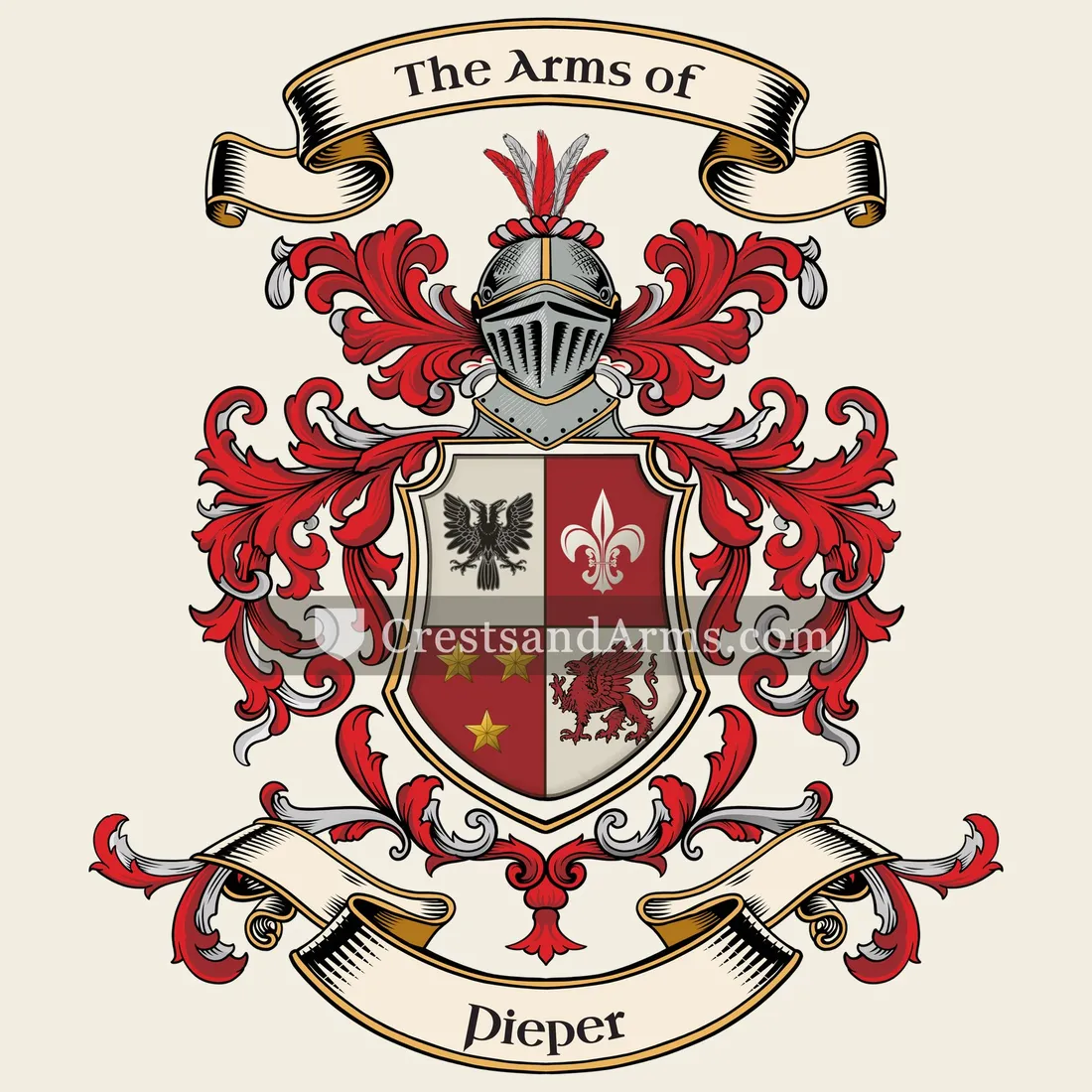
Meaning of the Pieper family crest colors & symbols
Symbols on this shield
eagleNobility, strength and a keen mind
fleur de lisPurity, light, and the sixth son
mulletThe third son, and a divine quality from above
griffinValour and vigilance, guarding great treasure
Colours
Silver (Argent)Means: Peace and sincerity
Red (Gules)Means: Military strength
Black (Sable)Means: Constancy
Gold (Or)Means: Generosity
Historical info
Source
J. B. Rietstap, Armorial Général, Gouda: G. B. van Goor Zonen, 1884–87
Blazon (the actual original written record)
“Ec.: au 1 d'arg. à une aigle de Prusse, la poitrine ch. du chiffre F W R d'or, surm. d'une couronne royale du même; au 2 de gu. à une fleur-de-lis d'arg.; au 3 d'azur à trois étoiles d'or; au 4 d'or à un griffon de gu., les pattes et les jambes d'or. C.: une étoile d'or, entre un vol de l'aigle de Prusse. L.: à dextre d'or, d'azur et de gu.; à sen. d'arg., de gu. et de sa.”
Germanyc. 1736
Digital archive packCoat of arms PNG, gold border print PDF, vector SVG and the certificate of authenticity. Sent to your email in minutes.
Map of Germany showing where the Pieper arms are recorded
The Pieper arms were recorded in Germany, c. 1736.
Arms such as these were typically recorded in Bavaria.
Bavaria was a country of old landed families and walled market towns. Estates passed down the same line for centuries, and both the landowners and the leading townsmen kept arms, which is why so many Bavarian names sit in the registers.
This is where the arms were entered in the register. Families often moved to other parts of the country, so the same name can turn up in more than one region.
The body that granted and recorded arms in Germany in this period.
Charles VI, Holy Roman Emperor
Sovereign of the period
Charles VI, Holy Roman Emperor
1711–1740
Reigning in Sweden when the Pieper arms are first recorded.
How Arms Worked in Germany
In the Holy Roman Empire, coats of arms were often granted to individuals by the Emperor or his representatives. These arms were then passed down through the generations to all legitimate descendants of the original holder. Younger branches of a family usually kept the same shield design without needing to change it, as the arms belonged to the entire lineage.
Granting authority
The Holy Roman Emperor held the sole power to grant new coats of arms throughout his vast imperial territories.
How they got arms
Families typically obtained their coats of arms through a formal imperial grant or by proving their noble status to the authorities.
Where arms were recorded
These grants were officially recorded in the Imperial Chancery registers, which began keeping formal records of such honors during the Middle Ages.
The family's standing
Recorded among the armigerous families of Germany.
Origin & History of the Pieper Family in Germany
The surname Pieper is rooted in the linguistic landscape of medieval Germany, where it functioned as an occupational name for a professional musician. Derived from the Middle High German word *pīpære*, the name identified those who played the pipe or flute, often serving as town musicians or performers at local festivals. By the time the family was documented in Bavaria in 1736, the name had become a stable hereditary surname passed down through generations of rural and town-dwelling families. During this era, the Pieper family lived within a society defined by strict social hierarchies and agricultural traditions. Their presence in the Bavarian region suggests they were part of the hardworking middle or laboring classes who helped shape the local economy and culture of the eighteenth century. As the family moved through the German states, they carried this musical legacy as a reminder of their ancestors who once provided the soundtrack to village life.
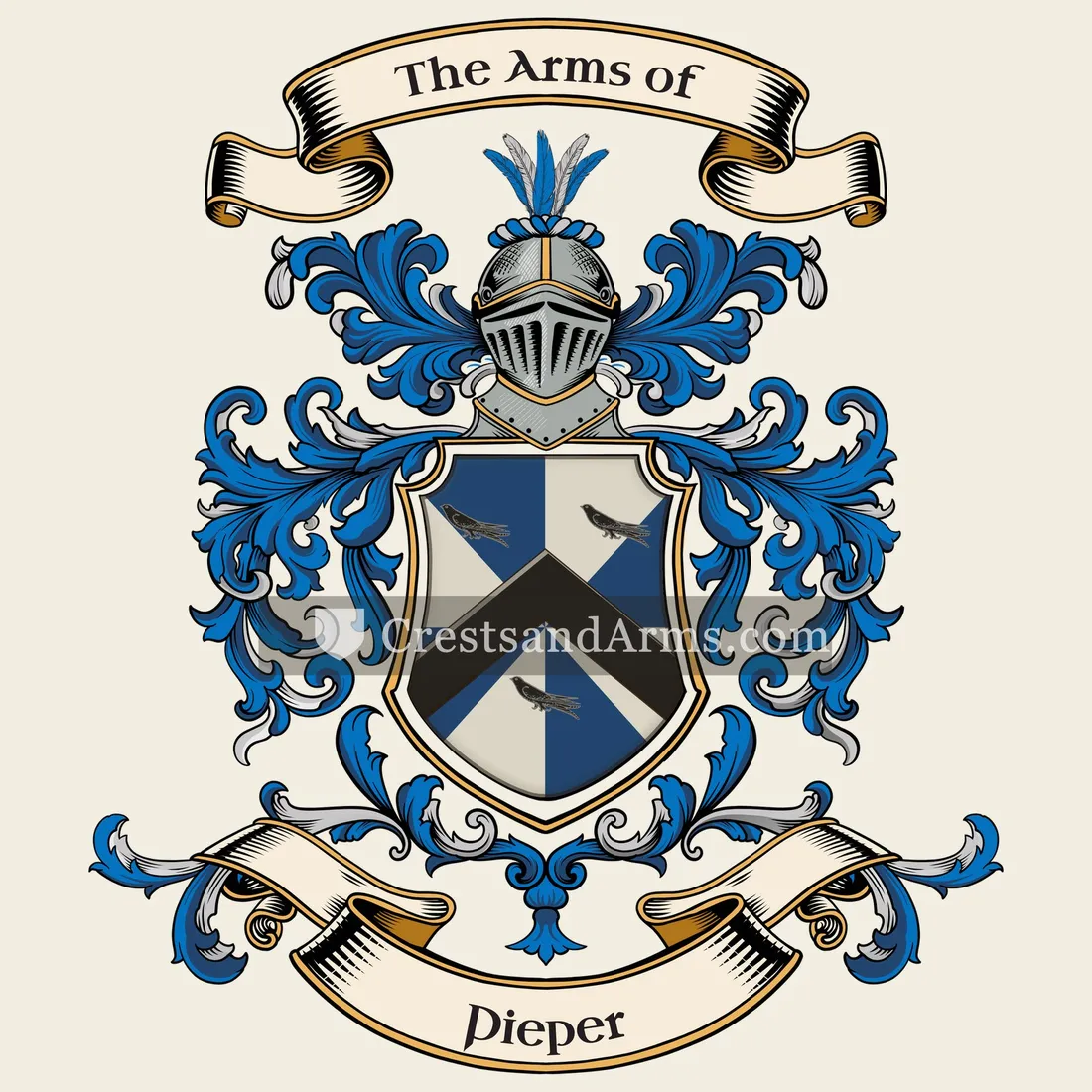
Meaning of the Pieper family crest colors & symbols
Symbols on this shield
chevronProtection, and faithful service completed
martletA younger son, who must win his own land
Colours
Silver (Argent)Means: Peace and sincerity
Blue (Azure)Means: Loyalty and truth
Black (Sable)Means: Constancy
Historical info
Source
Sir Bernard Burke, The General Armory of England, Scotland, Ireland and Wales, London: Harrison & Sons, 1884
Blazon (the actual original written record)
“Ar. a chev. betw. three magpies sa. Another Coat—Gyronny of four or and az”
CornwallTresmarrow · Cornwall, c. 1620
Digital archive packCoat of arms PNG, gold border print PDF, vector SVG and the certificate of authenticity. Sent to your email in minutes.
Map of England showing where the Pieper arms are recorded
The Pieper arms were recorded in Cornwall, c. 1620.
Cornwall was a county apart, with its own language and its own tight-knit gentry. Tin and the sea made money there, and families who made it bought land, which is what brought arms with it.
This is where the arms were entered in the register. Families often moved to other parts of the country, so the same name can turn up in more than one region.
The body that granted and recorded arms in England in this period.
James VI and I
Sovereign of the period
James VI and I
1603–1625
Reigning in Sweden when the Pieper arms are first recorded.
How Arms Worked in England
English heraldry allowed arms to be shared by all legitimate descendants of the original owner. These symbols were treated as personal property that moved through the generations to all children. While the eldest son kept the original design, other family members could use the same shield without needing to change it or register their own unique versions.
Granting authority
The College of Arms in London has regulated the use of coats of arms throughout England and Wales since 1484.
How they got arms
Families typically obtained their coats of arms through a formal grant from the Crown or by proving their ancient right to them.
Where arms were recorded
All official coats of arms are recorded in the registers kept at the College of Arms, which date back to the fifteenth century.
The family's standing
Recorded among the armigerous families of Cornwall.
Origin & History of the Pieper Family in England
The surname Pieper is rooted in the occupational history of medieval Europe, where it served as a descriptive label for individuals who played the pipe or flute. While the name is often associated with Germanic origins, its presence in England became firmly established by the early seventeenth century. Records confirm that members of the Pieper family were living in Cornwall by 1620, a time when the region was heavily focused on tin mining and maritime trade. These early settlers likely arrived as part of the broader movement of skilled laborers and merchants across the English Channel. Once in Cornwall, the family integrated into the local community, adapting to the unique social and economic landscape of the southwestern peninsula. Their transition from continental origins to the rugged coast of England highlights the mobility of families during this era as they sought new opportunities in trade and industry.
Pieper Meaning & Related Branches
Root word
Piper
An occupational term for a person who plays a musical pipe.
This name
PieperA surname of German origin denoting a professional flute or pipe player.
also spelled
Pyper
Pyppert
Peeper
Pypere
Documented Sources
J. B. Rietstap, Armorial Général, Gouda: G. B. van Goor Zonen, 1884–87
Stockholms stadsarkiv (Stockholm City Archives), Mantalslängder för Stockholms stad (Tax census records for the city of Stockholm), 1698
Riksarkivet (National Archives of Sweden), Inrikes passhandlingar (Domestic passport records)
Hellquist, Elof, Svensk etymologisk ordbok (Swedish Etymological Dictionary), 1922
Lundkvist, Sven, Stockholms historia (History of Stockholm), 1967
Digital archive packCoat of arms PNG, gold border print PDF, vector SVG and the certificate of authenticity. Sent to your email in minutes.


 fessThe military belt, and readiness to serve
 heronPatience and quiet watchfulness
 crownSovereignty, authority and just reward
 mulletThe third son, and a divine quality from above
 branchPeace, and new growth
 fessThe military belt, and readiness to serve
 heronPatience and quiet watchfulness
 crownSovereignty, authority and just reward
 mulletThe third son, and a divine quality from above
 branchPeace, and new growth


 eagleNobility, strength and a keen mind
 fleur de lisPurity, light, and the sixth son
 griffinValour and vigilance, guarding great treasure


 chevronProtection, and faithful service completed
 martletA younger son, who must win his own land