Map of France showing where the Pierre arms are recorded
The Pierre arms were recorded in Franche-Comte, c. 1556.
Franche-Comte sat between France and the Empire and changed hands more than once. Border families held their land under arms and expected to defend it, so a shield was a practical thing rather than an ornament.
This is where the arms were entered in the register. Families often moved to other parts of the country, so the same name can turn up in more than one region.
The body that granted and recorded arms in France in this period.
Henry II of France
Sovereign of the period
Henry II of France
1547–1559
Reigning in France when the Pierre arms are first recorded.
How Arms Worked in France
In France, a coat of arms was a mark of honor that passed down through the male line to all legitimate descendants. Families often used the same shield without changes to show their shared heritage. If a branch wanted to stand out, they could add a small mark to their shield to show their specific place in the family tree.
Granting authority
The Juge d'armes de France acted as the official authority that regulated and verified coats of arms across the country.
How they got arms
Families typically inherited their arms from ancestors, though they could also receive them through royal grants or by proving their noble status.
Where arms were recorded
Coats of arms were officially recorded in the Armorial Général de France, which began its main collection in the year 1696.
The family's standing
Recorded among the armigerous families of Franche-Comte.
Origin & History of the Pierre Family in France
The surname Pierre originates from the ancient Greek name Petros, which translates to stone or rock. In France, the name became deeply associated with Saint Peter, making it a popular choice for families across the country during the Middle Ages. By the mid-16th century, the family established a notable presence in the region of Franche-Comté. This area, located along the border of modern-day France and Switzerland, was a melting pot of cultural influences and trade. Families living there in 1556 often worked as landholders or skilled laborers who contributed to the local economy of the Jura mountains. Because the name was derived from a common religious figure, it was frequently adopted by families who wanted to show their devotion to the church. Over time, the name evolved from a simple given name into a hereditary surname that identified these specific family lines as they moved through the towns and villages of eastern France.
Coat of Arms & Family Crest Details
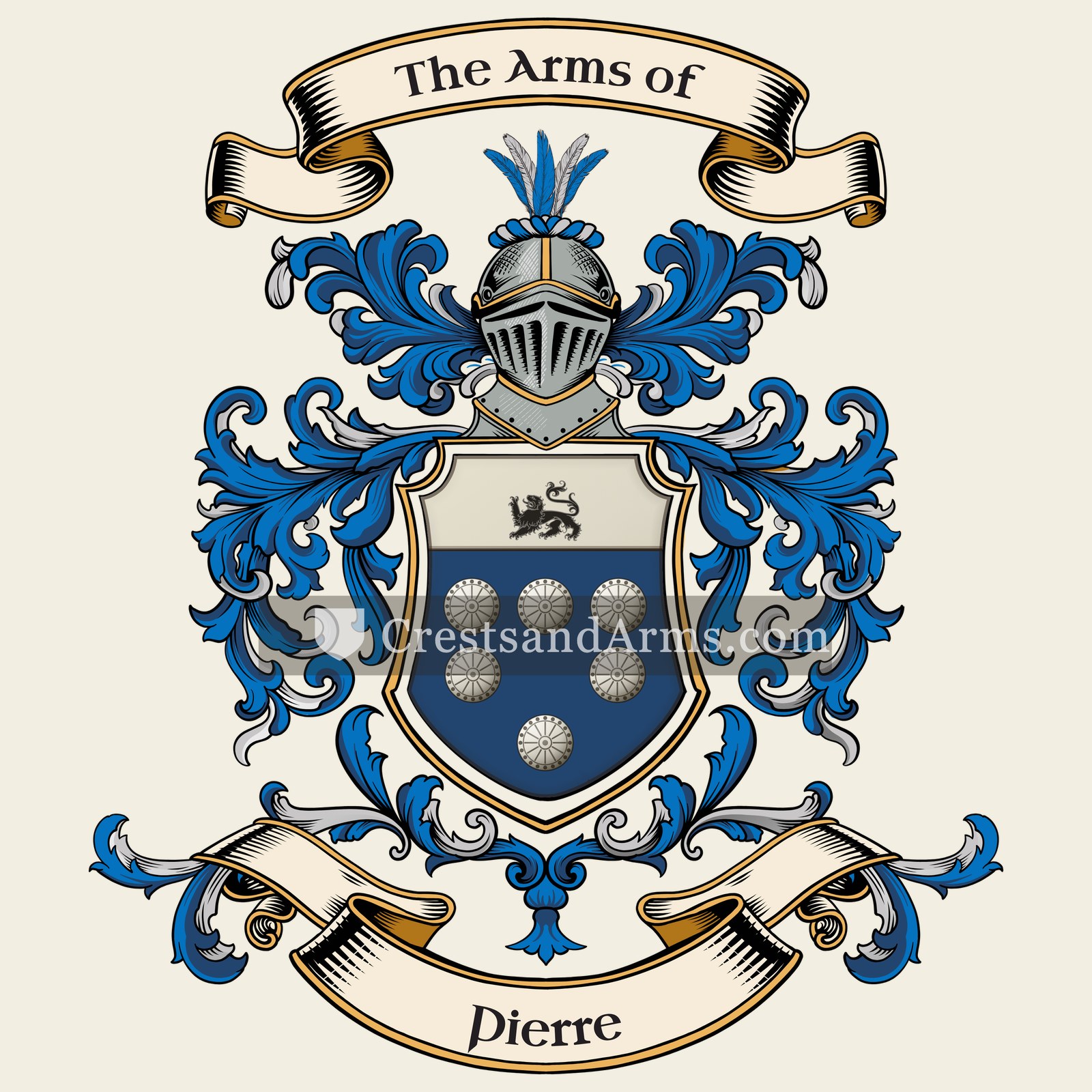
Symbols on this shield
chiefAuthority, wisdom and dominion
roundelA coin, and one who has been to the crusades
lionCourage, strength and royalty
Colours
Blue (Azure)Means: Loyalty and truth
Silver (Argent)Means: Peace and sincerity
Black (Sable)Means: Constancy
Historical info
Source
J. B. Rietstap, Armorial Général, Gouda: G. B. van Goor Zonen, 1884–87
Blazon (the actual original written record)
“D'azur à six bes. d'arg.; au chef du même, ch. d'un lion léopardé de sa.”
FlandreFlandre, c. 1663
Digital archive packCoat of arms PNG, gold border print PDF, vector SVG and the certificate of authenticity. Sent to your email in minutes.
Map of Belgium showing where the Pierre arms are recorded
The Pierre arms were recorded in Flandre, c. 1663.
Flandre grew rich on cloth, and its towns were among the busiest in Europe. Merchant families bought land with their profits and took arms to go with it, so trade put as many names in the registers here as land did.
This is where the arms were entered in the register. Families often moved to other parts of the country, so the same name can turn up in more than one region.
The body that granted and recorded arms in Belgium in this period.
Philip IV of Spain
Sovereign of the period
Philip IV of Spain
1621–1665
Reigning in France when the Pierre arms are first recorded.
How Arms Worked in Belgium
In Belgium, a coat of arms is considered personal property that is passed down through the male line to legitimate descendants. Families often use the same shield design across generations to show their shared heritage. If a branch of the family wants to change the design, they must apply for an official update to their specific version of the arms.
Granting authority
The Conseil héraldique is the official body that regulates and approves all coats of arms in Belgium.
How they got arms
Families obtain their coats of arms through formal royal grants or by confirming their historical right to use existing designs.
Where arms were recorded
All approved coats of arms are officially recorded in the public registers of the Conseil héraldique since 1844.
The family's standing
Recorded among the armigerous families of Flandre.
Origin & History of the Pierre Family in Belgium
The history of the Pierre family in Belgium is deeply rooted in the cultural landscape of the Flanders region, where records confirm their presence as early as 1663. During the seventeenth century, the name Pierre functioned as a patronymic, meaning it was adopted to honor a patriarch named Peter, a common practice in a society that placed great importance on lineage and religious tradition. Living in Flandre during this era meant navigating a period of significant political transition, as the region was often caught between the interests of neighboring powers. Families like the Pierres were typically involved in the local agricultural or artisanal economies that defined Flemish life at the time. By maintaining a consistent presence in the area, the family became part of the long-standing demographic fabric of the Low Countries, preserving their identity through generations of social and economic change.
Pierre Meaning & Related Branches
Root word
Petros
Ancient Greek word meaning a stone or a rock.
This name
PierreA French masculine given name and surname derived from the Greek word for rock.
also spelled
Pyerre
Pier
Peters
Documented Sources
J. B. Rietstap, Armorial Général, Gouda: G. B. van Goor Zonen, 1884–87
Dauzat, Albert. Dictionnaire étymologique des noms de famille et prénoms de France, 1951
Archives départementales du Doubs, Série B: Cours et juridictions, 1556
Morlet, Marie-Thérèse. Dictionnaire étymologique des noms de famille, 1991
Digital archive packCoat of arms PNG, gold border print PDF, vector SVG and the certificate of authenticity. Sent to your email in minutes.


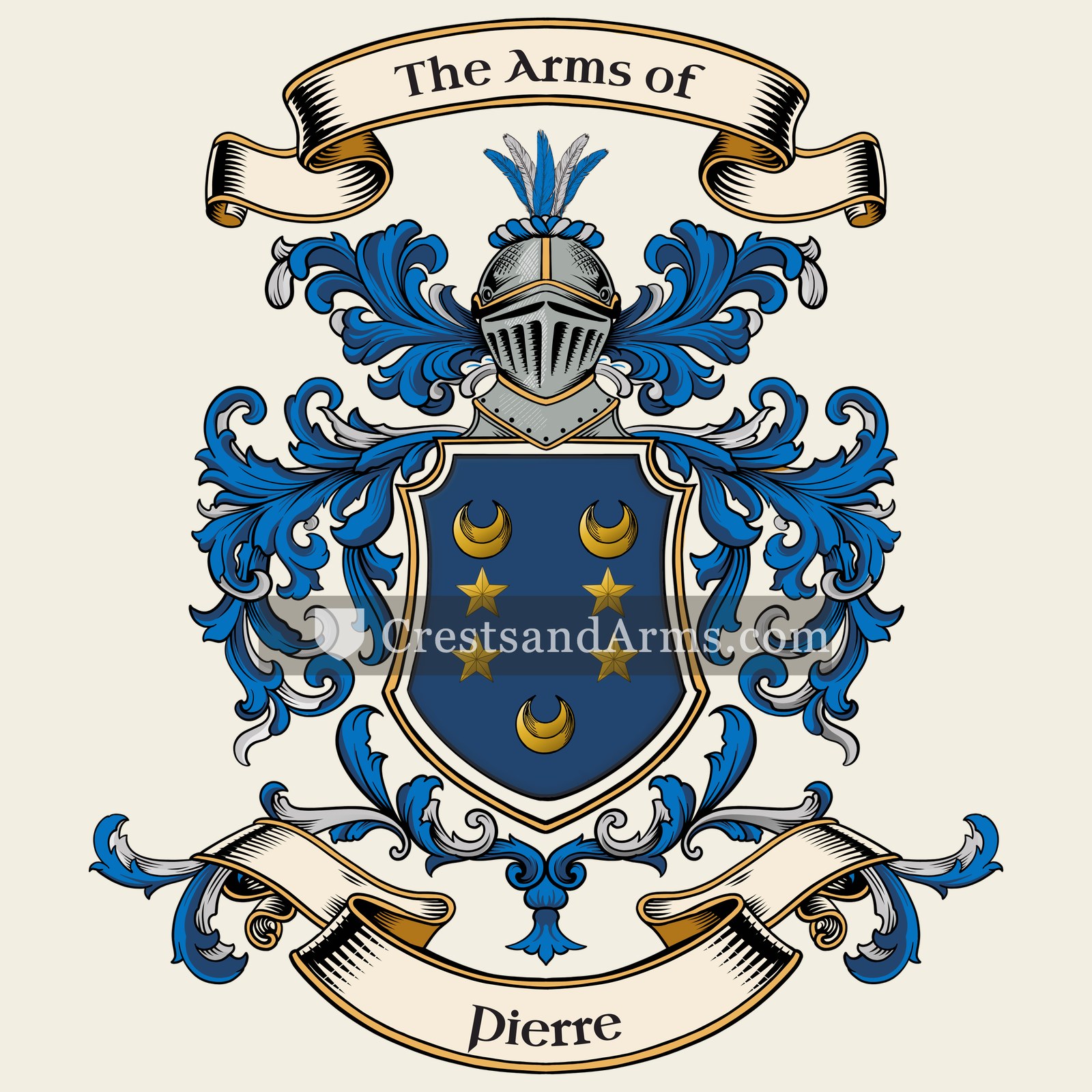
 crescentHonour by the sovereign, and the second son
 mulletThe third son, and a divine quality from above
 crescentHonour by the sovereign, and the second son
 mulletThe third son, and a divine quality from above


 chiefAuthority, wisdom and dominion
 roundelA coin, and one who has been to the crusades
 lionCourage, strength and royalty