Map of Italy showing where the Pierro arms are recorded
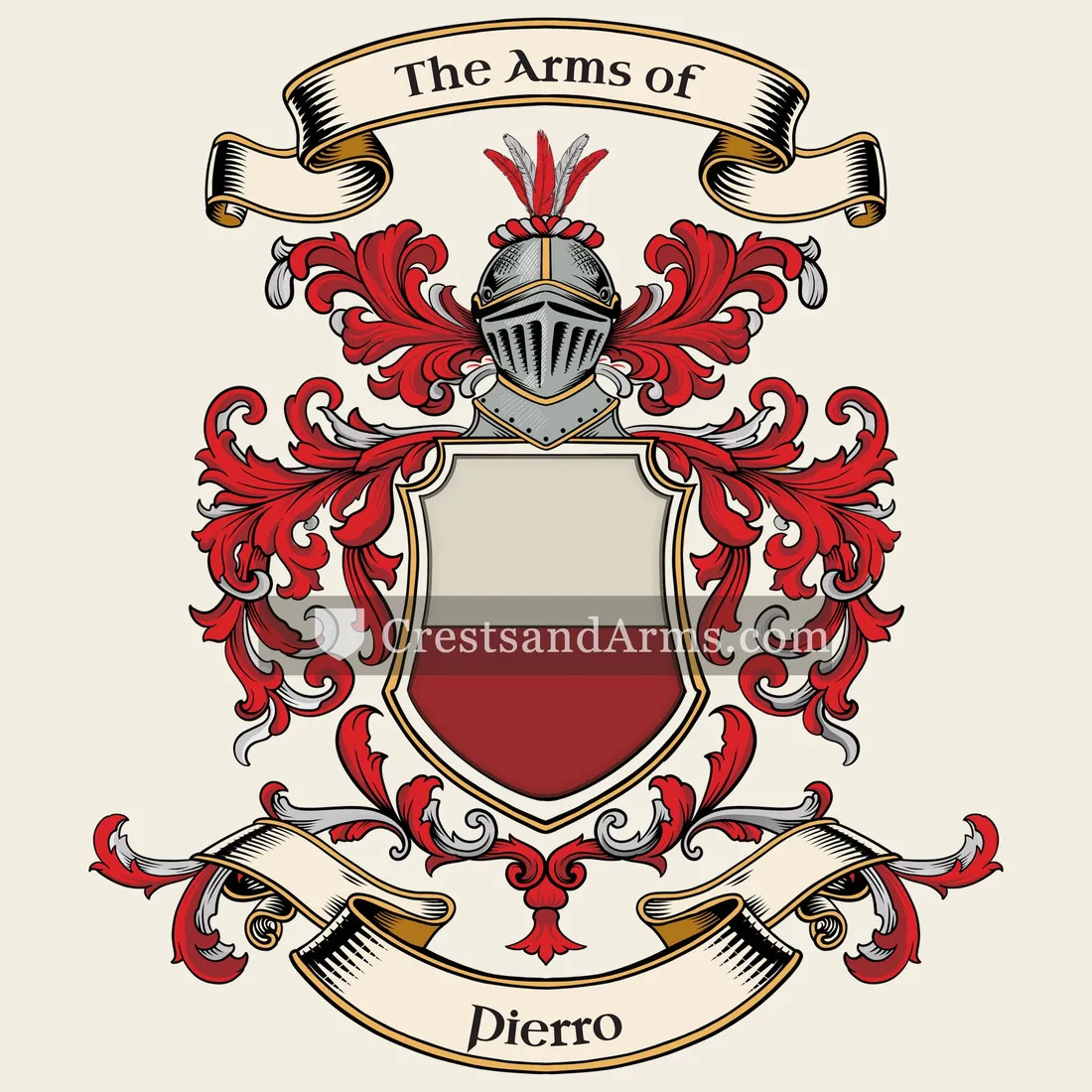
The Pierro arms were recorded in Venice, c. 1775.
Venice ran on trade, and its great families were merchants before they were anything else. The city kept a formal list of its noble houses, and a name on that list carried arms as a matter of record.
This is where the arms were entered in the register. Families often moved to other parts of the country, so the same name can turn up in more than one region.
The body that granted and recorded arms in Italy in this period.
Alvise Giovanni Mocenigo
Sovereign of the period
Alvise Giovanni Mocenigo
1763–1778
Reigning in Italy when the Pierro arms are first recorded.
How Arms Worked in Italy
In the Italian states, coats of arms were often used by noble families to show their status and history. These symbols were passed down through the generations to all legitimate male descendants. Younger branches of a family usually kept the original design but sometimes added small changes to distinguish their specific line from the main branch.
Granting authority
Various local rulers and city governments controlled the use of coats of arms across the different Italian states.
How they got arms
Families often assumed their own arms or received them as official grants from local lords, popes, or city councils.
Where arms were recorded
Arms were recorded in local city archives or private family books rather than in one single national register.
The family's standing
Recorded among the armigerous families of Venice.
Origin & History of the Pierro Family in Italy
The family name Pierro finds its roots in the linguistic evolution of the name Peter, which was a popular choice across Italy during the Middle Ages. As a derivative of the name Pietro, the variation Pierro likely emerged as a regional or dialectal shift common in the northern territories near the Adriatic coast. By the year 1775, records confirm that the family was well-established in Venice, a city that served as a major hub for trade and cultural exchange. During this period, families in Venice were often deeply integrated into the local guilds or maritime commerce, reflecting the city’s status as a gateway between Western Europe and the East. The presence of the Pierro name in Venetian records from the late 18th century suggests that the family was part of the vibrant urban fabric of the Venetian Republic before its eventual fall to outside powers.
Pierro Meaning & Related Branches
Root word
Petrus
Latin for stone or rock derived from Greek Petros.
This name
PierroAn Italian patronymic or variant form signifying a descendant of Peter.
also spelled
Pyero
Pierro
Pieroh
Documented Sources
J. B. Rietstap, Armorial Général, Gouda: G. B. van Goor Zonen, 1884–87
Cessi, Roberto. Storia della Repubblica di Venezia. 1944
Lane, Frederic C. Venice: A Maritime Republic. 1973
Archivio di Stato di Venezia, Anagrafi di Popolazione
Digital archive packCoat of arms PNG, gold border print PDF, vector SVG and the certificate of authenticity. Sent to your email in minutes.