Map of Belgium showing where the Piers arms are recorded
The Piers arms were recorded in Audenarde, c. 1737.
This is where the arms were entered in the register. Families often moved to other parts of the country, so the same name can turn up in more than one region.
The body that granted and recorded arms in Belgium in this period.
Charles VI, Holy Roman Emperor
Sovereign of the period
Charles VI, Holy Roman Emperor
1711–1740
Reigning in Belgium when the Piers arms are first recorded.
How Arms Worked in Belgium
In Belgium, a coat of arms is considered personal property that is passed down through the male line to legitimate descendants. Families often use the same shield design across generations to show their shared heritage. If a branch of the family wants to change the design, they must apply for an official update to their specific version of the arms.
Granting authority
The Conseil héraldique is the official body that regulates and approves all coats of arms in Belgium.
How they got arms
Families obtain their coats of arms through formal royal grants or by confirming their historical right to use existing designs.
Where arms were recorded
All approved coats of arms are officially recorded in the public registers of the Conseil héraldique since 1844.
The family's standing
Recorded among the armigerous families of Belgium.
Origin & History of the Piers Family in Belgium
The family name Piers has deep roots in the historical landscape of Flanders, particularly within the city of Audenarde. By the early eighteenth century, the family was already well-established in this region, which was then part of the Austrian Netherlands. During this period, Audenarde served as a vital center for the textile industry, and families like the Piers were often integrated into the local merchant and civic networks that defined the city’s economy. The name itself reflects the linguistic traditions of the Low Countries, evolving from older naming customs that favored short, recognizable forms of common names. As residents of Audenarde in 1737, the family lived through a time of transition where local families played an essential role in maintaining the social and administrative stability of their town. Their presence in the city records highlights a long history of involvement in the daily life and administrative functions of the Flemish region.
Coat of Arms & Family Crest Details
Symbols on this shield
pelicanSelf-sacrifice and devotion to one's children
Colours
Blue (Azure)Means: Loyalty and truth
Historical info
Source
Sir Bernard Burke, The General Armory of England, Scotland, Ireland and Wales, London: Harrison & Sons, 1884
Blazon (the actual original written record)
“Az. a pelican in her piety ppr”
YorkYork, c. 1588
Digital archive packCoat of arms PNG, gold border print PDF, vector SVG and the certificate of authenticity. Sent to your email in minutes.
Map of England showing where the Piers arms are recorded
The Piers arms were recorded in York, c. 1588.
Yorkshire is the largest of the English counties, and it held more gentry families than any other. Land there was split among a great many households rather than a few, so a great many of them carried arms.
This is where the arms were entered in the register. Families often moved to other parts of the country, so the same name can turn up in more than one region.
The body that granted and recorded arms in England in this period.
Elizabeth I of England
Sovereign of the period
Elizabeth I of England
1558–1603
Reigning in Belgium when the Piers arms are first recorded.
How Arms Worked in England
English heraldry allowed arms to be shared by all legitimate descendants of the original owner. These symbols were treated as personal property that moved through the generations to all children. While the eldest son kept the original design, other family members could use the same shield without needing to change it or register their own unique versions.
Granting authority
The College of Arms in London has regulated the use of coats of arms throughout England and Wales since 1484.
How they got arms
Families typically obtained their coats of arms through a formal grant from the Crown or by proving their ancient right to them.
Where arms were recorded
All official coats of arms are recorded in the registers kept at the College of Arms, which date back to the fifteenth century.
The family's standing
Recorded among the armigerous families of York.
Origin & History of the Piers Family in England
The surname Piers traces its roots to the medieval period as a patronymic name, meaning it was derived from the given name Peter. In the centuries following the Norman Conquest, the name evolved through various spellings as it spread across the English landscape. By the late sixteenth century, the family had established a notable presence in the northern city of York. Records from 1588 confirm that individuals bearing this name were active participants in the local community during a time of significant religious and political transition in England. As the family settled into urban life in York, they became part of the growing merchant and artisan classes that defined the city’s economy. Their presence in such a historic center suggests that the family was well-integrated into the social fabric of northern England during the Elizabethan era.
Coat of Arms & Family Crest Details
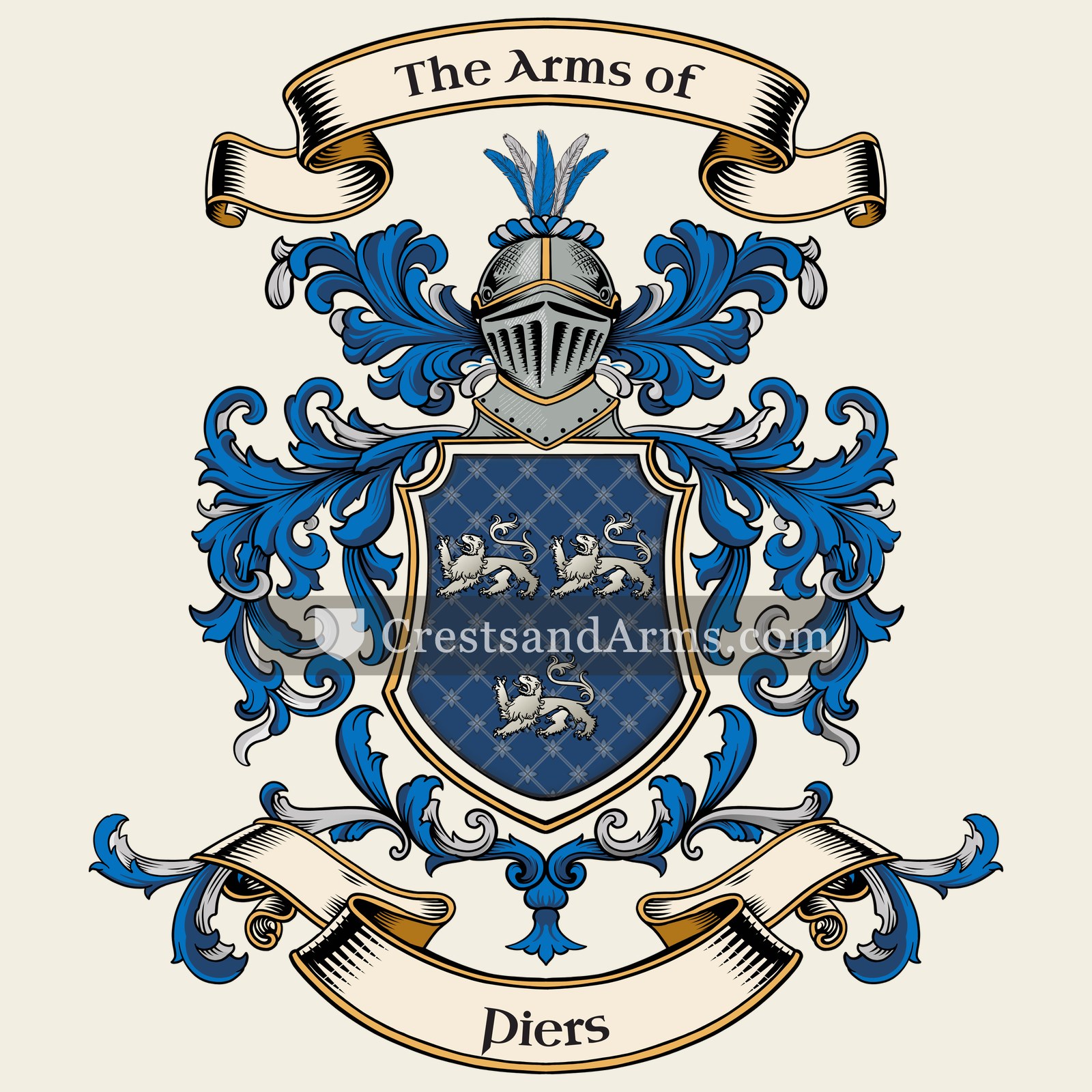
Symbols on this shield
lionCourage, strength and royalty
Colours
Blue (Azure)Means: Loyalty and truth
Silver (Argent)Means: Peace and sincerity
Historical info
Source
Sir Bernard Burke, The General Armory of England, Scotland, Ireland and Wales, London: Harrison & Sons, 1884
Blazon (the actual original written record)
“Az. three lions pass. guard. in fess betw. two double cotises ar”
WestmeathTristernagh Abbey · Westmeath, c. 1645
Digital archive packCoat of arms PNG, gold border print PDF, vector SVG and the certificate of authenticity. Sent to your email in minutes.
Map of Ireland showing where the Piers arms are recorded
The Piers arms were recorded in Westmeath, c. 1645.
Westmeath was midland grazing country in Ireland, taken by Norman families and held for centuries. Its estates were large and passed down whole, and unbroken tenure brought arms with it.
This is where the arms were entered in the register. Families often moved to other parts of the country, so the same name can turn up in more than one region.
The body that granted and recorded arms in Ireland in this period.
Charles I of England
Sovereign of the period
Charles I of England
1625–1649
Reigning in Belgium when the Piers arms are first recorded.
How Arms Worked in Ireland
The Ulster King of Arms granted coats of arms to individuals who proved their social standing and good character. These symbols were typically inherited by all legitimate descendants of the original holder. If a family branch wanted a unique look, they could apply for a specific change to their design through the office to ensure their identity remained distinct.
Granting authority
The Ulster King of Arms acted as the official body that regulated and issued all coats of arms throughout Ireland.
How they got arms
Families obtained their arms through formal grants issued by the office after proving their eligibility and paying the required fees.
Where arms were recorded
All official grants were recorded in the registers held by the Ulster King of Arms starting from the year 1552.
The family's standing
Recorded among the armigerous families of Westmeath.
Origin & History of the Piers Family in Ireland
The history of the Piers family in Ireland is closely tied to the shifting political landscape of the seventeenth century. By 1645, the family had established a significant presence in County Westmeath, where they became prominent landowners. This settlement was part of a broader trend of English families moving to Ireland to manage estates and participate in local administration during a time of great upheaval. The family gained local influence through their involvement in regional governance and their management of large tracts of land in the Irish Midlands. Over time, they integrated into the social fabric of the area, transitioning from newcomers to established members of the landed gentry. Their survival and growth in Westmeath during this turbulent period reflect the broader patterns of migration and land acquisition that defined the history of the Anglo-Irish class in the mid-1600s.
Related Branches & Arms
Root word
Petrus
Latin word meaning rock or stone.
This name
PiersA patronymic surname derived from the personal name Peter, signifying a descendant of Peter.
also spelled
Pyers
Peers
Pierce
Peirse
Pearce
Related arms
Peeressame arms
Pearcevariant spelling
Pearsevariant spelling
Peirsevariant spelling
Documented Sources
J. B. Rietstap, Armorial Général, Gouda: G. B. van Goor Zonen, 1884–87
De Potter, Frans and Jan Broeckaert, Geschiedenis van de stad Oudenaarde, 1882
Stadsarchief Oudenaarde, Registers van de Burgerlijke Stand en Parochieregisters
Digital archive packCoat of arms PNG, gold border print PDF, vector SVG and the certificate of authenticity. Sent to your email in minutes.




 pelicanSelf-sacrifice and devotion to one's children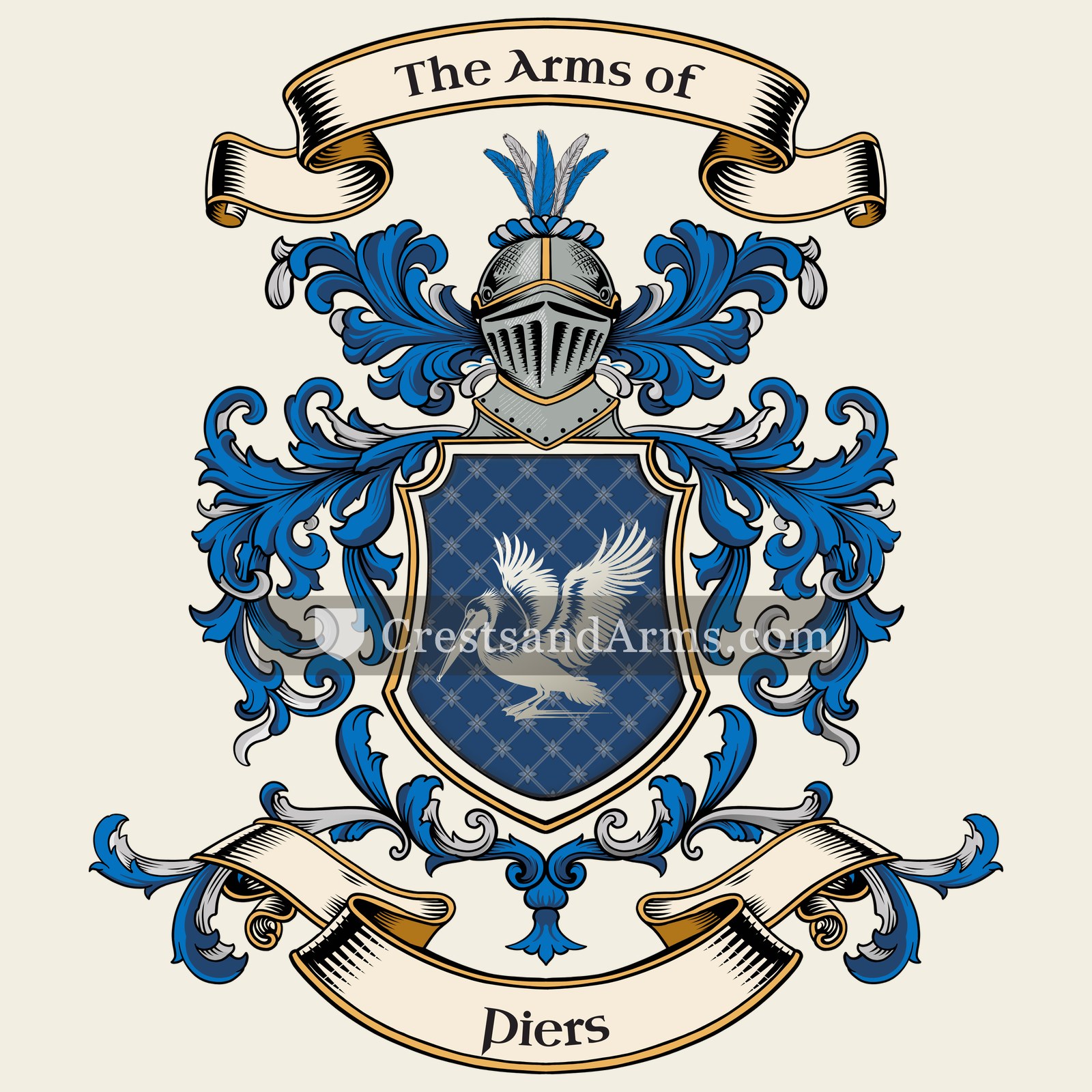


 lionCourage, strength and royalty