Map of England showing where the Piette arms are recorded
The Piette arms were recorded in London, c. 1611.
This is where the arms were entered in the register. Families often moved to other parts of the country, so the same name can turn up in more than one region.
The body that granted and recorded arms in England in this period.
James VI and I
Sovereign of the period
James VI and I
1603–1625
Reigning in England when the Piette arms are first recorded.
How Arms Worked in England
English heraldry allowed arms to be shared by all legitimate descendants of the original owner. These symbols were treated as personal property that moved through the generations to all children. While the eldest son kept the original design, other family members could use the same shield without needing to change it or register their own unique versions.
Granting authority
The College of Arms in London has regulated the use of coats of arms throughout England and Wales since 1484.
How they got arms
Families typically obtained their coats of arms through a formal grant from the Crown or by proving their ancient right to them.
Where arms were recorded
All official coats of arms are recorded in the registers kept at the College of Arms, which date back to the fifteenth century.
The family's standing
Recorded among the armigerous families of England.
Origin & History of the Piette Family in England
The family name Piette has deep roots that connect to the movement of people across Europe during the early seventeenth century. While the name is often associated with French origins, the presence of family members in London by 1611 suggests that they were part of a wave of immigrants who sought new opportunities or religious freedom in England. During this period, London was a bustling center for trade and craft, and families like the Piettes often integrated into the local economy as skilled workers or merchants. These early settlers helped shape the diverse social landscape of the city as they established their lives in a foreign land. By settling in London during the reign of King James I, the family became part of the historical record that documents the growth of international communities in the capital. Their transition from their ancestral home to the streets of London highlights a history of resilience and adaptation that defines the early chapters of the Piette family story.
Related Branches & Arms
Root word
Petrus
Latin for stone or rock
This name
PietteA diminutive form of Peter, signifying a small stone or rock.
also spelled
Pyett
Pyet
Documented Sources
Sir Bernard Burke, The General Armory of England, Scotland, Ireland and Wales, London: Harrison & Sons, 1884
Gwynn, Robin D., Huguenot Heritage: The History and Contribution of the Huguenots in Britain, 1985
Scouloudi, Irene, Returns of Strangers in the Metropolis 1593, 1627, 1635, 1639, 1985
The National Archives, State Papers Domestic, James I
London Metropolitan Archives, Registers of the French Protestant Church of Threadneedle Street
Digital archive packCoat of arms PNG, gold border print PDF, vector SVG and the certificate of authenticity. Sent to your email in minutes.


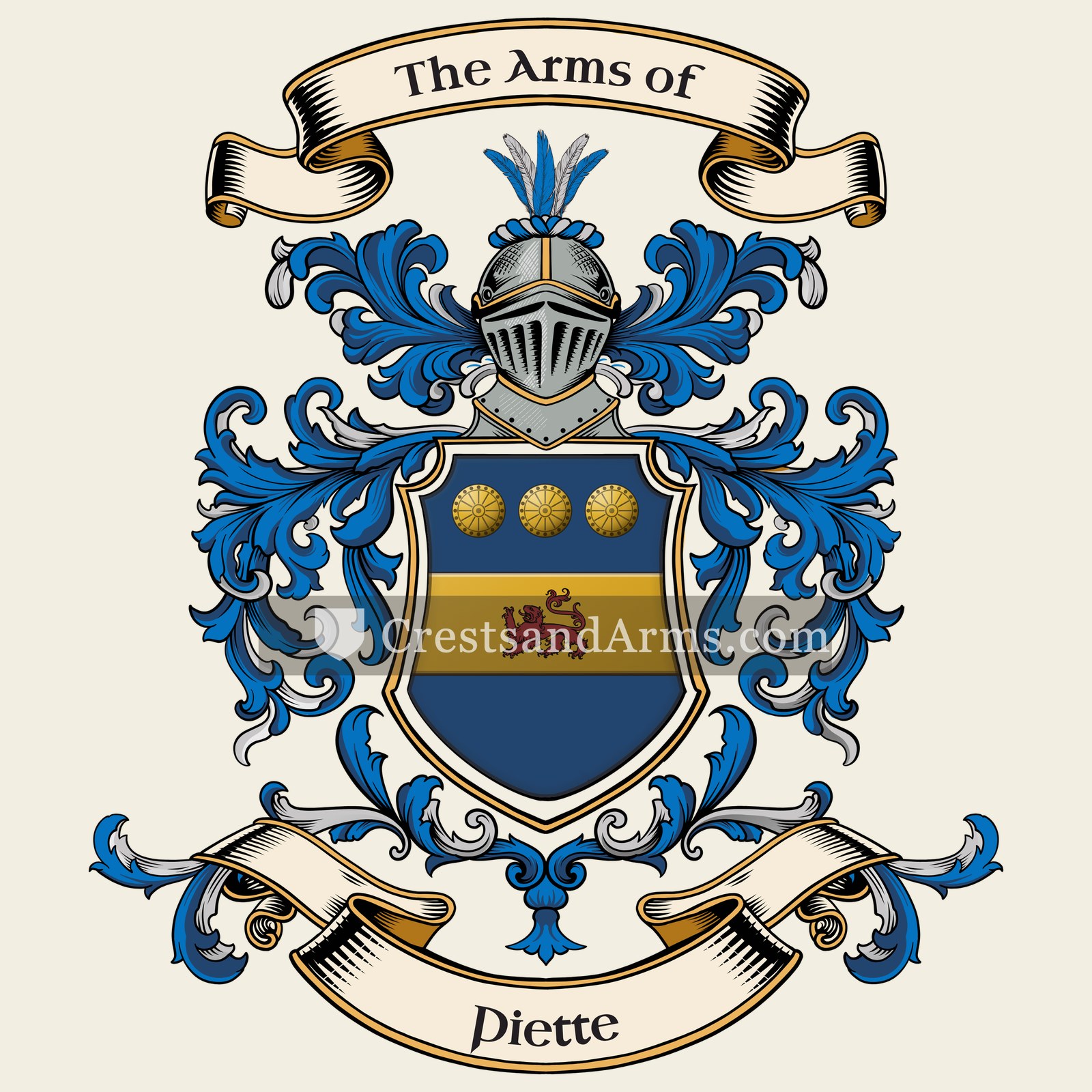
 fessThe military belt, and readiness to serve
 lionCourage, strength and royalty
 roundelA coin, and one who has been to the crusades
 fessThe military belt, and readiness to serve
 lionCourage, strength and royalty
 roundelA coin, and one who has been to the crusades