Map of England showing where the Pigott arms are recorded
The Pigott arms were recorded in Somerset, c. 1620.
Somerset was rich farming country with a thick scattering of manor houses. Its gentry were numerous and long-settled, and a settled landed family almost always ended up with arms.
This is where the arms were entered in the register. Families often moved to other parts of the country, so the same name can turn up in more than one region.
The body that granted and recorded arms in England in this period.
James VI and I
Sovereign of the period
James VI and I
1603–1625
Reigning in England when the Pigott arms are first recorded.
How Arms Worked in England
English heraldry allowed arms to be shared by all legitimate descendants of the original owner. These symbols were treated as personal property that moved through the generations to all children. While the eldest son kept the original design, other family members could use the same shield without needing to change it or register their own unique versions.
Granting authority
The College of Arms in London has regulated the use of coats of arms throughout England and Wales since 1484.
How they got arms
Families typically obtained their coats of arms through a formal grant from the Crown or by proving their ancient right to them.
Where arms were recorded
All official coats of arms are recorded in the registers kept at the College of Arms, which date back to the fifteenth century.
The family's standing
Recorded among the armigerous families of Somerset.
Origin & History of the Pigott Family in England
The surname Pigott has deep roots in the English landscape, with historical records placing the family firmly in the county of Somerset by the early 17th century. The name itself is believed to be a diminutive form of the name Pic or Piga, which likely originated as a descriptive nickname for a person of small stature or a sharp personality. During the medieval period, surnames often evolved from these personal traits or local occupations, and the Pigott family became well-established as landowners and members of the local gentry in the West Country. By 1620, the family was recognized as a settled presence in Somerset, where they participated in the social and administrative life of the region. This period was a time of significant transition in England, and families like the Pigotts often played roles in local governance and agriculture that helped define the character of their home county for generations.
Coat of Arms & Family Crest Details
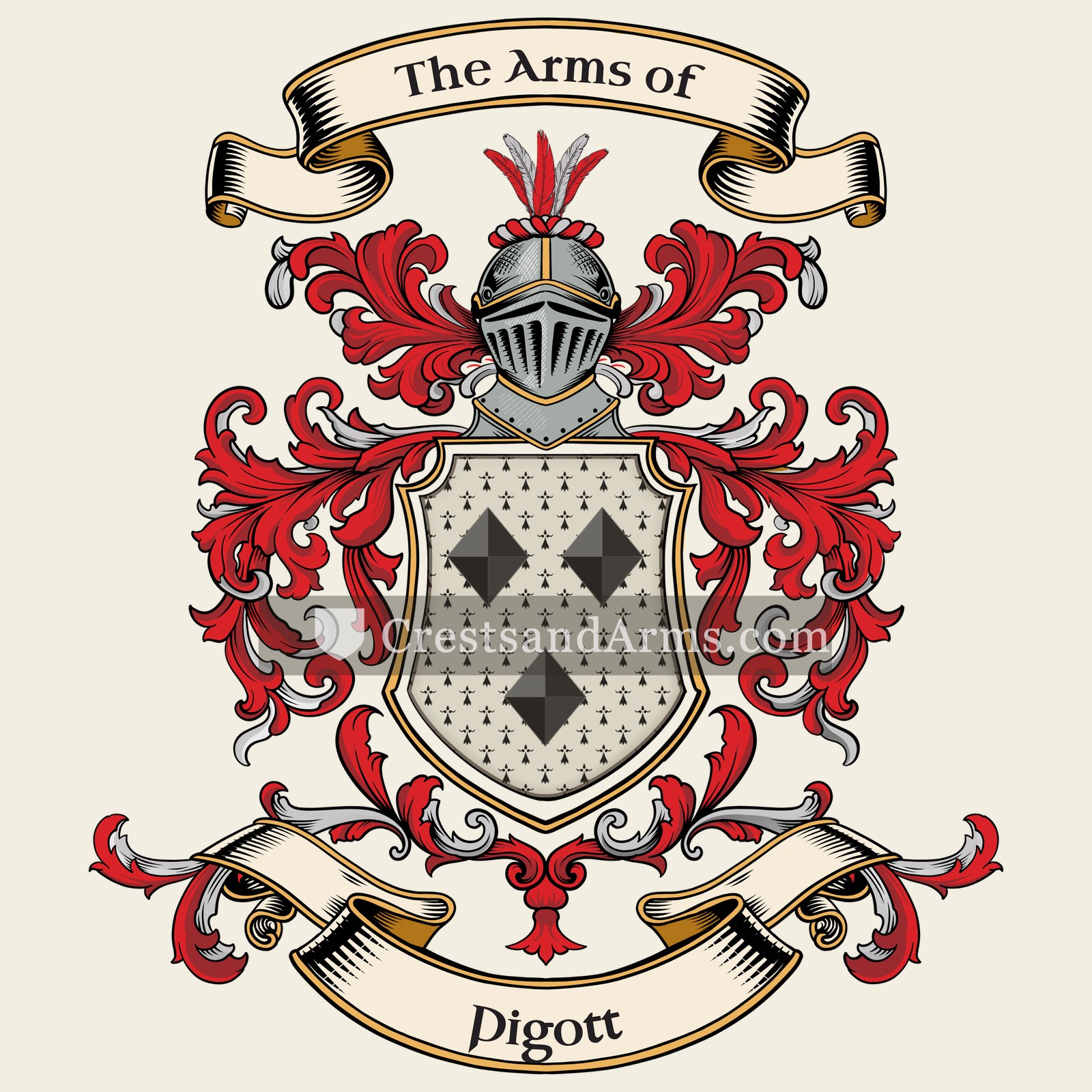
Symbols on this shield
fusilTravail and industry
lozengeHonour and nobility, and the arms of a woman
Colours
ErmineMeans: Dignity
Black (Sable)Means: Constancy
Historical info
Source
Sir Bernard Burke, The General Armory of England, Scotland, Ireland and Wales, London: Harrison & Sons, 1884
Blazon (the actual original written record)
“Erm. three fusils conjoined in fess sa”
GalwayEagle Hill · Galway, c. 1645
Digital archive packCoat of arms PNG, gold border print PDF, vector SVG and the certificate of authenticity. Sent to your email in minutes.
Map of Ireland showing where the Pigott arms are recorded
The Pigott arms were recorded in Galway, c. 1645.
Galway was western Irish country of poor land and a rich port. A small group of merchant families ran the town for centuries and held estates around it, and both kinds of property carried arms.
This is where the arms were entered in the register. Families often moved to other parts of the country, so the same name can turn up in more than one region.
The body that granted and recorded arms in Ireland in this period.
Charles I of England
Sovereign of the period
Charles I of England
1625–1649
Reigning in England when the Pigott arms are first recorded.
How Arms Worked in Ireland
The Ulster King of Arms granted coats of arms to individuals who proved their social standing and good character. These symbols were typically inherited by all legitimate descendants of the original holder. If a family branch wanted a unique look, they could apply for a specific change to their design through the office to ensure their identity remained distinct.
Granting authority
The Ulster King of Arms acted as the official body that regulated and issued all coats of arms throughout Ireland.
How they got arms
Families obtained their arms through formal grants issued by the office after proving their eligibility and paying the required fees.
Where arms were recorded
All official grants were recorded in the registers held by the Ulster King of Arms starting from the year 1552.
The family's standing
Recorded among the armigerous families of Galway.
Origin & History of the Pigott Family in Ireland
The Pigott family name in Ireland has deep roots that connect to the turbulent political landscape of the seventeenth century. While the name itself is of Anglo-Norman origin, members of the family established a significant presence in County Galway by 1645. During this era, Ireland was undergoing major social shifts as land ownership and local power structures were frequently challenged by conflict and colonization. The Pigotts in Galway were part of a group of settlers who integrated into the local economy and society during a time of great instability. By maintaining their residence in the west of Ireland, they navigated the complex legal and social systems of the period to secure their place in the region. Their early history reflects the broader movement of families who moved across the Irish Sea to build new lives and manage estates during a transformative time in Irish history.
Related Branches & Arms
Root word
Picot
A diminutive form of the Old French name Pic meaning pointed.
This name
PigottA patronymic surname derived from a nickname for someone with a pointed feature.
also spelled
Pygott
Related arms
Pigetvariant spelling
Pygottvariant spelling
Barringtonrecorded with Pigott, same area
Chanurecorded with Pigott, same area
Documented Sources
Sir Bernard Burke, The General Armory of England, Scotland, Ireland and Wales, London: Harrison & Sons, 1884
Collinson, John. The History and Antiquities of the County of Somerset. 1791
The National Archives. Records of the Prerogative Court of Canterbury, Wills and Administrations. PROB 11
Digital archive packCoat of arms PNG, gold border print PDF, vector SVG and the certificate of authenticity. Sent to your email in minutes.


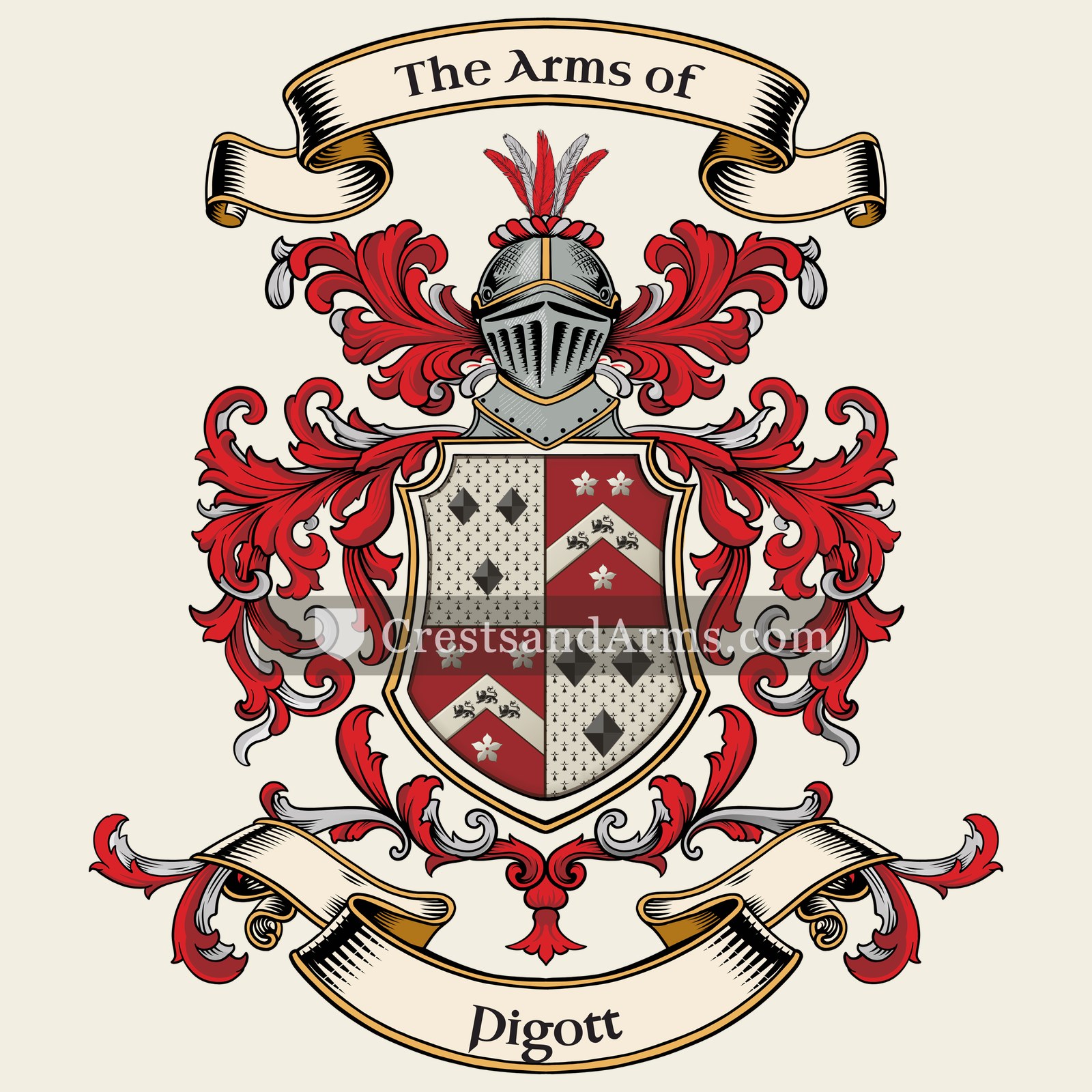
 fusilTravail and industry
 chevronProtection, and faithful service completed
 lozengeHonour and nobility, and the arms of a woman
 lionCourage, strength and royalty
 cinquefoilHope and joy
 fusilTravail and industry
 chevronProtection, and faithful service completed
 lozengeHonour and nobility, and the arms of a woman
 lionCourage, strength and royalty
 cinquefoilHope and joy