Map of Sweden showing where the Pike arms are recorded
The Pike arms were recorded in Gottenburgh, c. 1751.
Arms such as these were typically recorded in Stockholm.
Stockholm held the Swedish court and the House of Nobility, where every noble family's arms were entered and kept. Families ennobled for service registered there, which is why so many are recorded around the city.
This is where the arms were entered in the register. Families often moved to other parts of the country, so the same name can turn up in more than one region.
The body that granted and recorded arms in Sweden in this period.
Frederick I of Sweden
Sovereign of the period
Frederick I of Sweden
1720–1751
Reigning in Sweden when the Pike arms are first recorded.
How Arms Worked in Sweden
In Sweden, a coat of arms belonged to a noble family as a whole rather than just one individual. These arms were passed down through the generations to all legitimate descendants. Younger branches of the family used the same shield without needing to change it. This system ensured that the entire lineage shared the same identity and status under the law.
Granting authority
The Riddarhuset, or House of Nobility, regulated all noble coats of arms in Sweden under royal authority.
How they got arms
Families received their coats of arms through royal grants of nobility which were then officially registered with the House.
Where arms were recorded
Coats of arms were officially recorded in the Swedish House of Nobility register starting in the year 1626.
The family's standing
Recorded among the armigerous families of Sweden.
Origin & History of the Pike Family in Sweden
The history of the Pike family in Sweden is closely tied to the urban development of Stockholm during the mid-eighteenth century. By 1751, members of the family were already established residents within the city, a time when Stockholm was a bustling center of trade and political change under the Swedish monarchy. The name itself likely originated as a descriptive nickname or a reference to a specific occupation, which was a common practice for families living in growing European capitals at the time. As these early ancestors navigated life in the capital, they became part of the city’s social fabric during the Age of Liberty. This era encouraged a rise in the middle class and allowed families to build lives through craftsmanship, commerce, or service to the state. While the records from this period are often found in church registers and tax documents, they provide a clear picture of a family that was integrated into the daily routines and administrative systems of eighteenth-century Sweden.
Coat of Arms & Family Crest Details
Symbols on this shield
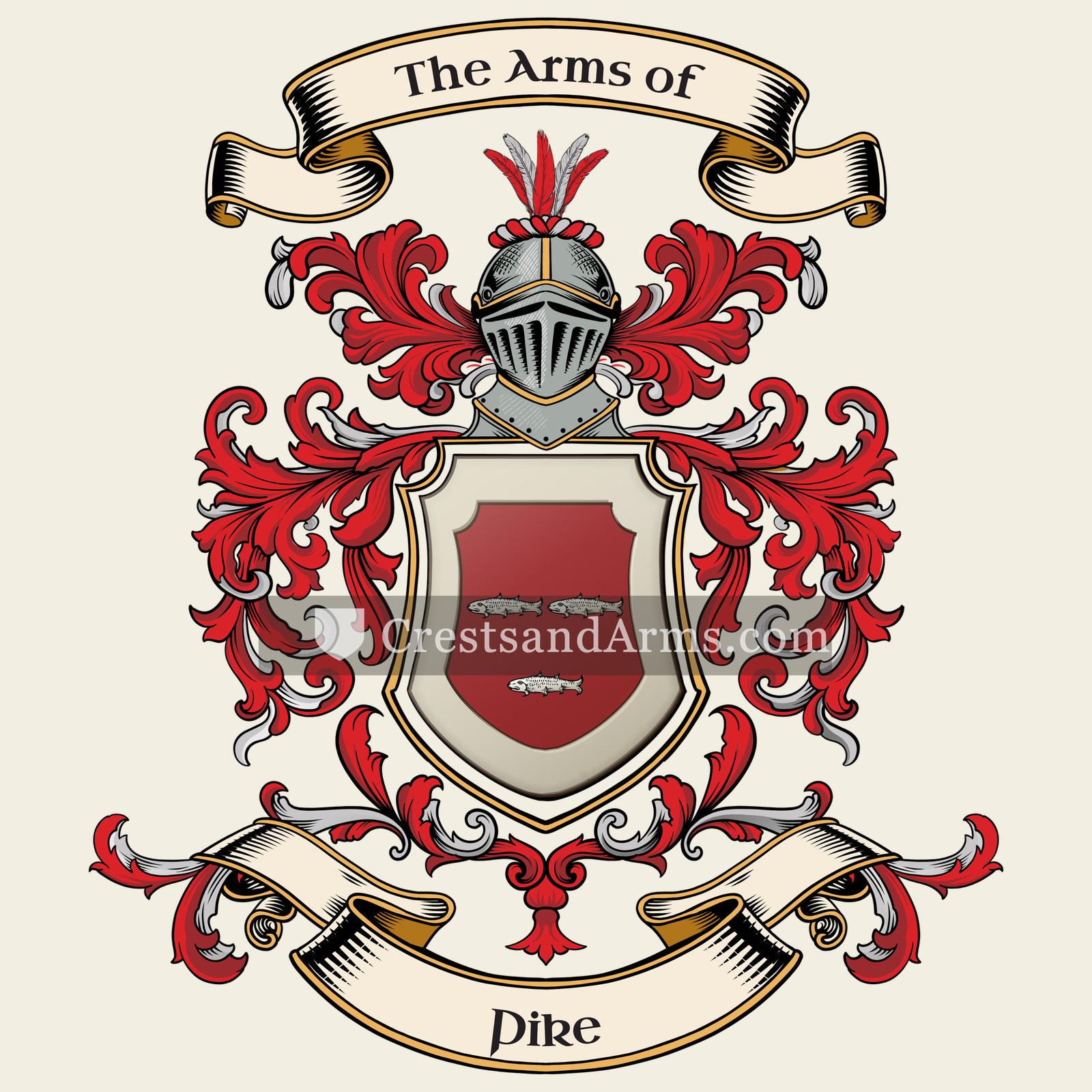
bordureA difference between branches of one family
fishA true and generous mind, and Christian faith
Colours
Red (Gules)Means: Military strength
Silver (Argent)Means: Peace and sincerity
Historical info
Source
Sir Bernard Burke, The General Armory of England, Scotland, Ireland and Wales, London: Harrison & Sons, 1884
Blazon (the actual original written record)
“Gu. three pikes naiant wavy ar. a bordure engr. of the second”
EnglandLondon, c. 1620
Digital archive packCoat of arms PNG, gold border print PDF, vector SVG and the certificate of authenticity. Sent to your email in minutes.
Map of England showing where the Pike arms are recorded
The Pike arms were recorded in London, c. 1620.
This is where the arms were entered in the register. Families often moved to other parts of the country, so the same name can turn up in more than one region.
The body that granted and recorded arms in England in this period.
James VI and I
Sovereign of the period
James VI and I
1603–1625
Reigning in Sweden when the Pike arms are first recorded.
How Arms Worked in England
English heraldry allowed arms to be shared by all legitimate descendants of the original owner. These symbols were treated as personal property that moved through the generations to all children. While the eldest son kept the original design, other family members could use the same shield without needing to change it or register their own unique versions.
Granting authority
The College of Arms in London has regulated the use of coats of arms throughout England and Wales since 1484.
How they got arms
Families typically obtained their coats of arms through a formal grant from the Crown or by proving their ancient right to them.
Where arms were recorded
All official coats of arms are recorded in the registers kept at the College of Arms, which date back to the fifteenth century.
The family's standing
Recorded among the armigerous families of England.
Origin & History of the Pike Family in England
The surname Pike is a classic example of an English occupational or descriptive name that emerged during the Middle Ages. It likely originated as a nickname for a person who was tall and thin like the freshwater fish, or perhaps for someone who worked with a long, pointed spear known as a pike. By the time the family appeared in London records around 1620, the name was already well-established across various English counties. During this period, the Pikes were part of the growing urban population of London, which was a bustling center of trade and migration. Many families with this name were involved in the merchant classes or skilled trades, helping to build the city into a global power. As the seventeenth century progressed, members of the Pike family were among those who sought new opportunities, eventually carrying their name from the streets of London to the distant shores of the American colonies.
Coat of Arms & Family Crest Details
Symbols on this shield
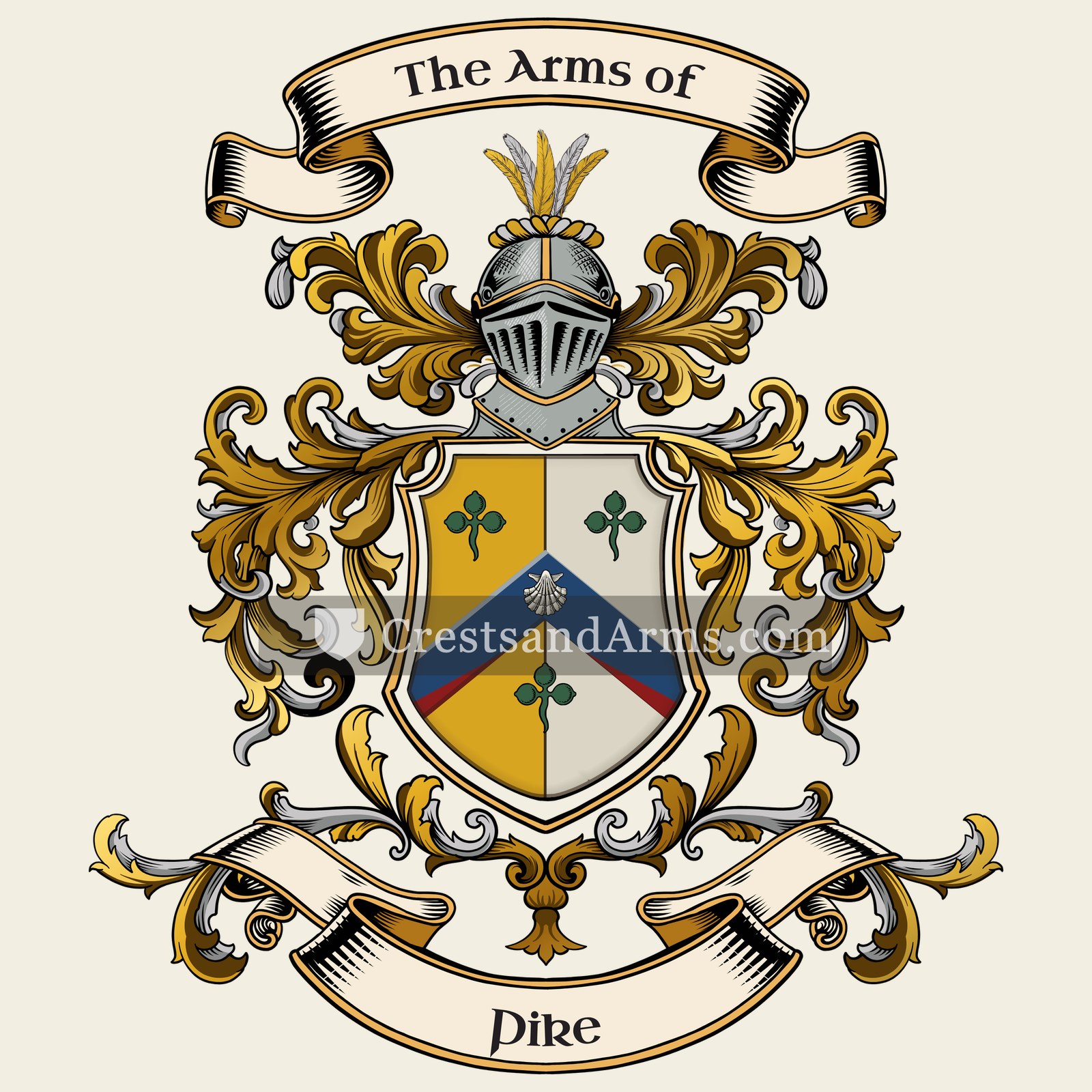
chevronProtection, and faithful service completed
trefoilPerpetuity, and the Trinity
escallopThe pilgrim's shell, and a long journey made
Colours
Gold (Or)Means: Generosity
Silver (Argent)Means: Peace and sincerity
Blue (Azure)Means: Loyalty and truth
Green (Vert)Means: Hope
Historical info
Source
Sir Bernard Burke, The General Armory of England, Scotland, Ireland and Wales, London: Harrison & Sons, 1884
Blazon (the actual original written record)
“Per pale or and ar. on a chev. az. betw. three trefoils slipped vert an escallop of the second”
MayoGlendarary · Mayo, c. 1645
Digital archive packCoat of arms PNG, gold border print PDF, vector SVG and the certificate of authenticity. Sent to your email in minutes.
Map of Ireland showing where the Pike arms are recorded
The Pike arms were recorded in Mayo, c. 1645.
Mayo was poor western Irish country of bog and mountain, held by a small number of old families. Land changed hands rarely there, and families who held on appear in the records.
This is where the arms were entered in the register. Families often moved to other parts of the country, so the same name can turn up in more than one region.
The body that granted and recorded arms in Ireland in this period.
Charles I of England
Sovereign of the period
Charles I of England
1625–1649
Reigning in Sweden when the Pike arms are first recorded.
How Arms Worked in Ireland
The Ulster King of Arms granted coats of arms to individuals who proved their social standing and good character. These symbols were typically inherited by all legitimate descendants of the original holder. If a family branch wanted a unique look, they could apply for a specific change to their design through the office to ensure their identity remained distinct.
Granting authority
The Ulster King of Arms acted as the official body that regulated and issued all coats of arms throughout Ireland.
How they got arms
Families obtained their arms through formal grants issued by the office after proving their eligibility and paying the required fees.
Where arms were recorded
All official grants were recorded in the registers held by the Ulster King of Arms starting from the year 1552.
The family's standing
Recorded among the armigerous families of Mayo.
Origin & History of the Pike Family in Ireland
The history of the Pike family in Ireland is deeply rooted in the turbulent events of the seventeenth century. While the name is often associated with English origins, records confirm that members of the family were firmly established in County Mayo by 1645. During this period, Ireland was experiencing significant social and political upheaval due to the Cromwellian conquest and the subsequent redistribution of land. Families like the Pikes often arrived as part of the administrative or military movements that defined this era. Once settled in the west of Ireland, they integrated into the local landscape, transitioning from their roles in the colonial administration to becoming part of the regional community. Their presence in Mayo during the mid-1600s highlights the broader movement of families across the Irish Sea, marking the start of a long-standing connection to the province of Connacht.
Pike Meaning & Related Branches
Root word
Pik
A sharp pointed object or a spear
This name
PikeAn occupational name for a fisherman or a nickname for a sharp-featured person
also spelled
Pyke
Pyk
Related arms
Pykevariant spelling
Documented Sources
Sir Bernard Burke, The General Armory of England, Scotland, Ireland and Wales, London: Harrison & Sons, 1884
Stockholm City Archives (Stockholms stadsarkiv), Överståthållarämbetet för uppbördsärenden
National Archives of Sweden (Riksarkivet), Mantalslängder 1642–1820
Lundkvist, Sven, Stockholms historia, 1965
Söderlund, Ernst F., Stockholms hantverkarklass 1720–1780, 1943
Digital archive packCoat of arms PNG, gold border print PDF, vector SVG and the certificate of authenticity. Sent to your email in minutes.


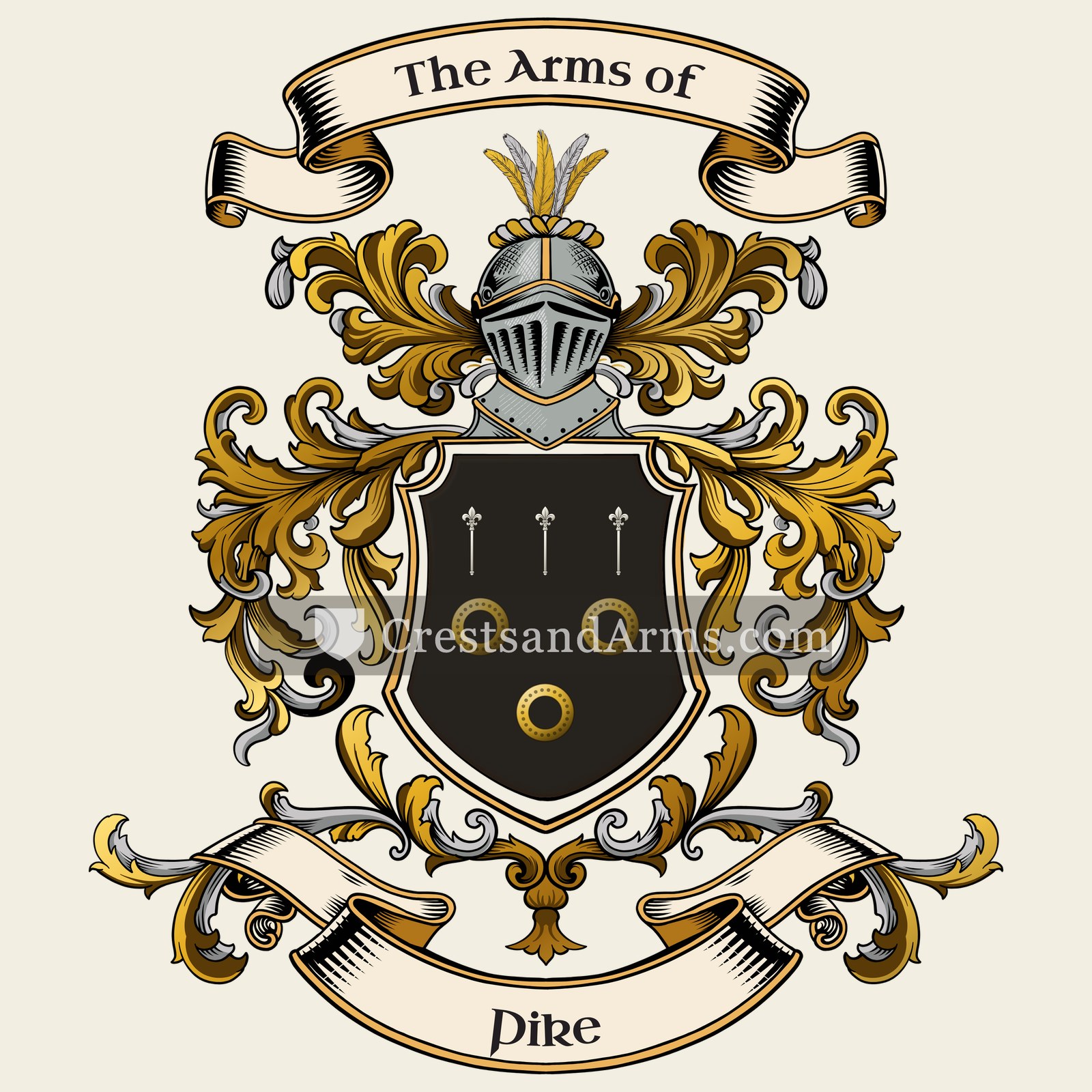
 batonAuthority and office held under the crown
 ringFidelity, and a promise kept
 batonAuthority and office held under the crown
 ringFidelity, and a promise kept


 bordureA difference between branches of one family
 fishA true and generous mind, and Christian faith


 chevronProtection, and faithful service completed
 trefoilPerpetuity, and the Trinity
 escallopThe pilgrim's shell, and a long journey made