Map of Britain showing where the Pilkington arms are recorded
The Pilkington arms were recorded in Lancashire, c. 1700.
This is where the arms were entered in the register. Families often moved to other parts of the country, so the same name can turn up in more than one region.
The body that granted and recorded arms in Britain in this period.
William III of England
Sovereign of the period
William III of England
1694–1702
Reigning in Britain when the Pilkington arms are first recorded.
How Arms Worked in Britain
English heraldry allowed arms to be shared by all legitimate descendants of the original owner. These symbols were treated as personal property that moved through the generations to all children. While the eldest son kept the original design, other family members could use the same shield without needing to change it or register their own unique versions.
Granting authority
The College of Arms in London has regulated the use of coats of arms throughout England and Wales since 1484.
How they got arms
Families typically obtained their coats of arms through a formal grant from the Crown or by proving their ancient right to them.
Where arms were recorded
All official coats of arms are recorded in the registers kept at the College of Arms, which date back to the fifteenth century.
The family's standing
Recorded among the armigerous families of Lancashire.
Origin & History of the Pilkington Family in Britain
The Pilkington family name finds its deepest roots in the county of Lancashire, where it emerged as a locational surname derived from the settlement of Pilkington near Bury. By the early 18th century, the family had firmly established itself within this region, reflecting a long history of connection to the local landscape and the evolving social structures of Northern England. The name itself is Old English in origin, likely combining a personal name with the suffix meaning a farm or settlement. Throughout the medieval and early modern periods, members of the family were active participants in the agricultural and economic life of the Lancashire area. Their presence in the region by 1700 serves as a testament to the enduring nature of families who remained rooted in their ancestral lands across many generations. This deep geographical tie highlights how the name evolved alongside the growth of local communities in the industrializing north of Britain.
Coat of Arms & Family Crest Details
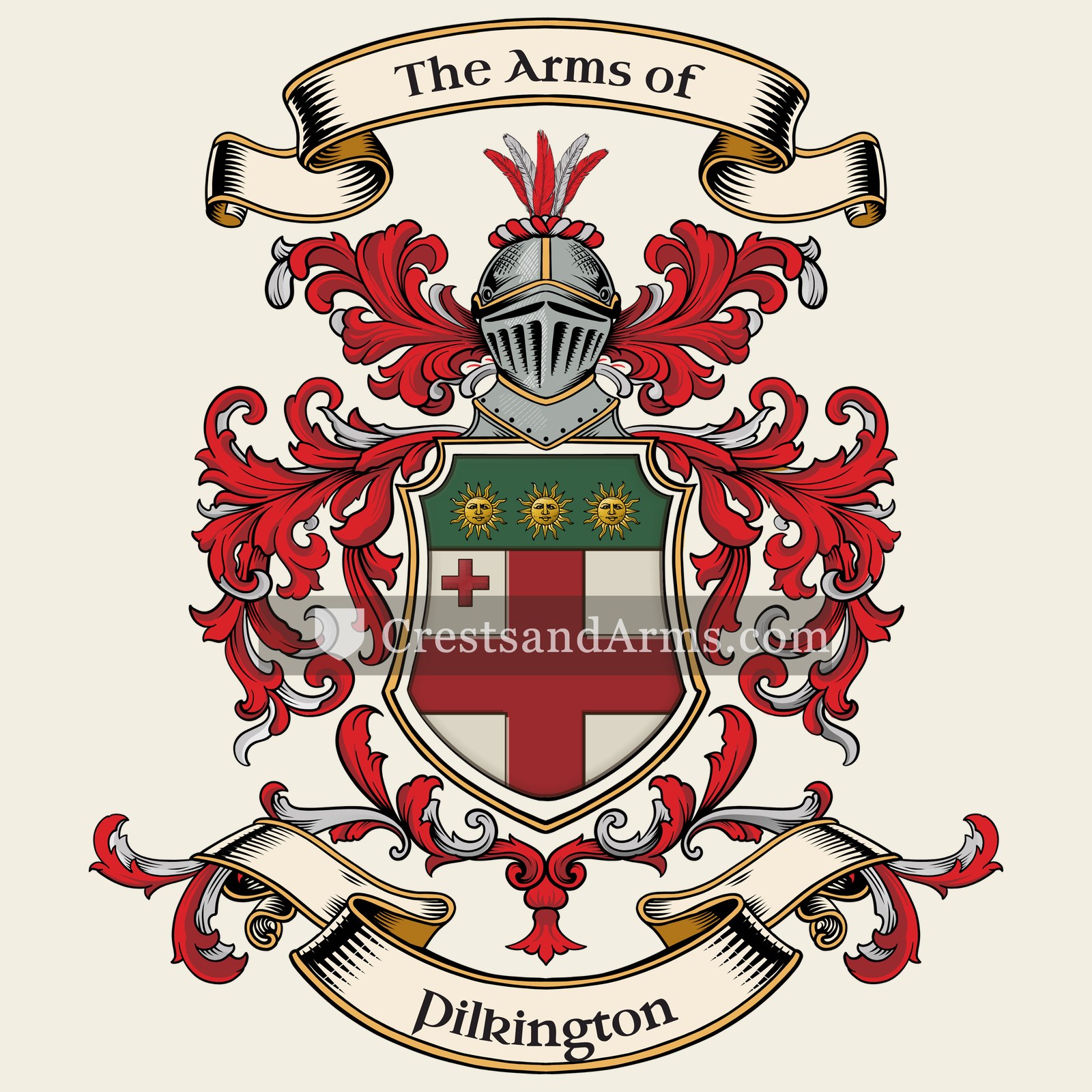
Symbols on this shield
cross symbolChristian faith and service
chiefAuthority, wisdom and dominion
sunGlory, splendour and the source of life
Colours
Silver (Argent)Means: Peace and sincerity
Red (Gules)Means: Military strength
Green (Vert)Means: Hope
Gold (Or)Means: Generosity
Historical info
Source
Sir Bernard Burke, The General Armory of England, Scotland, Ireland and Wales, London: Harrison & Sons, 1884
Blazon (the actual original written record)
“Ar. a cross patonce voided gu. on a chief vert three suns or”
DurhamDurham, c. 1551
Digital archive packCoat of arms PNG, gold border print PDF, vector SVG and the certificate of authenticity. Sent to your email in minutes.
Map of England showing where the Pilkington arms are recorded
The Pilkington arms were recorded in Durham, c. 1551.
Durham was governed by its bishop rather than the crown for most of its history, with its own courts and its own landed class. That separate world produced a tight group of families, nearly all of whom held arms.
This is where the arms were entered in the register. Families often moved to other parts of the country, so the same name can turn up in more than one region.
The body that granted and recorded arms in England in this period.
Edward VI of England
Sovereign of the period
Edward VI of England
1547–1553
Reigning in Britain when the Pilkington arms are first recorded.
How Arms Worked in England
English heraldry allowed arms to be shared by all legitimate descendants of the original owner. These symbols were treated as personal property that moved through the generations to all children. While the eldest son kept the original design, other family members could use the same shield without needing to change it or register their own unique versions.
Granting authority
The College of Arms in London has regulated the use of coats of arms throughout England and Wales since 1484.
How they got arms
Families typically obtained their coats of arms through a formal grant from the Crown or by proving their ancient right to them.
Where arms were recorded
All official coats of arms are recorded in the registers kept at the College of Arms, which date back to the fifteenth century.
The family's standing
Recorded among the armigerous families of Durham.
Origin & History of the Pilkington Family in England
The Pilkington family name originates from the Lancashire region of England, specifically from a place called Pilkington near Bury. The name itself is derived from Old English, combining the name of an early settler with the word for a farm or settlement. While the family established deep roots in the north of England, they eventually expanded their influence into neighboring areas like Durham. By 1551, records confirm that members of the family were well-established in Durham, where they became significant figures in local society and the church. This movement reflected a broader trend of northern families gaining prominence through land ownership and administrative roles during the sixteenth century. The family remained a consistent presence in the region for generations, contributing to the local history of northern England through their involvement in community and religious life.
Coat of Arms & Family Crest Details
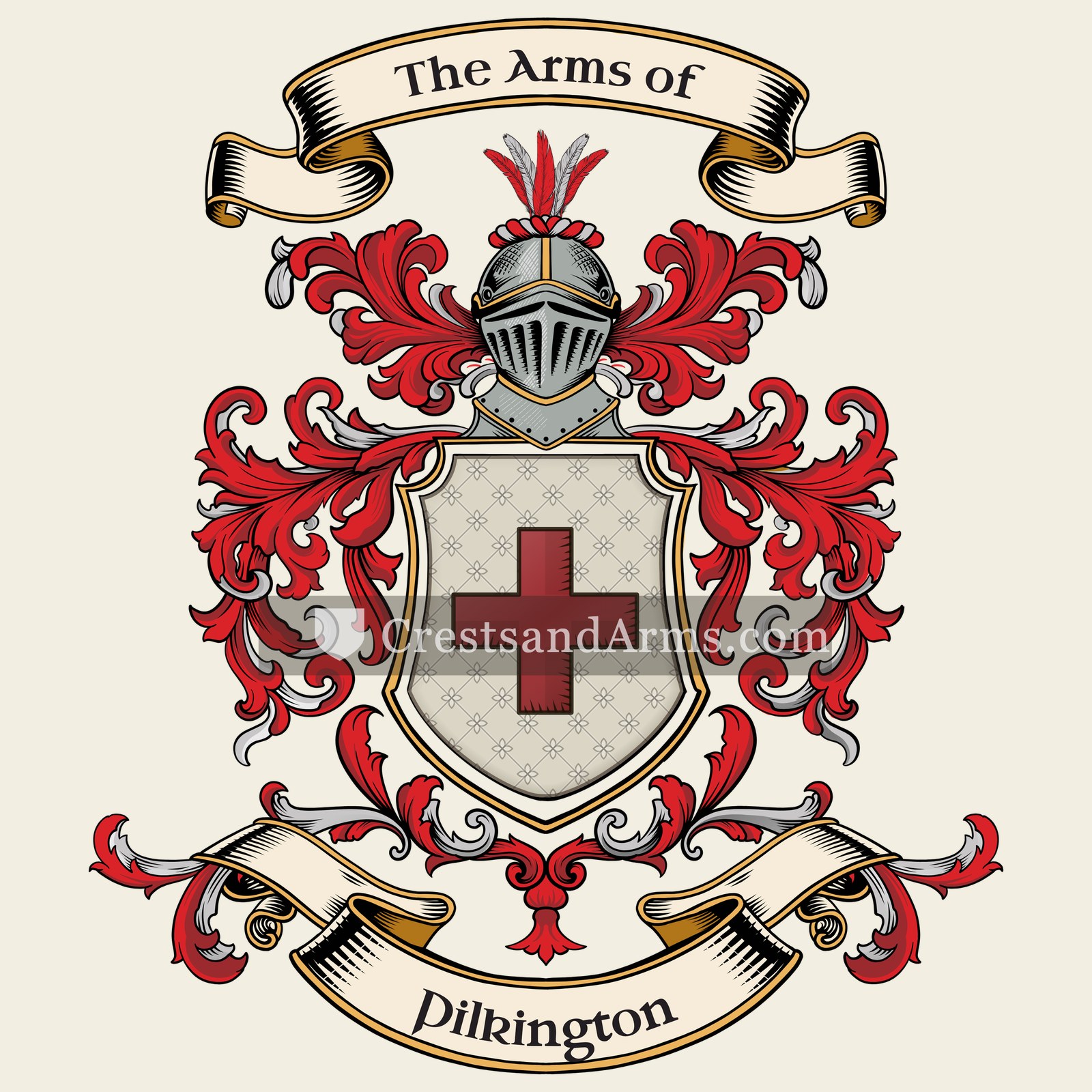
Symbols on this shield
cross symbolChristian faith and service
Colours
Silver (Argent)Means: Peace and sincerity
Red (Gules)Means: Military strength
Historical info
Source
Sir Bernard Burke, The General Armory of England, Scotland, Ireland and Wales, London: Harrison & Sons, 1884
Blazon (the actual original written record)
“Ar. a cross patonce gu. voided of the field”
WestmeathTore · Westmeath, c. 1645
Digital archive packCoat of arms PNG, gold border print PDF, vector SVG and the certificate of authenticity. Sent to your email in minutes.
Map of Ireland showing where the Pilkington arms are recorded
The Pilkington arms were recorded in Westmeath, c. 1645.
Westmeath was midland grazing country in Ireland, taken by Norman families and held for centuries. Its estates were large and passed down whole, and unbroken tenure brought arms with it.
This is where the arms were entered in the register. Families often moved to other parts of the country, so the same name can turn up in more than one region.
The body that granted and recorded arms in Ireland in this period.
Charles I of England
Sovereign of the period
Charles I of England
1625–1649
Reigning in Britain when the Pilkington arms are first recorded.
How Arms Worked in Ireland
The Ulster King of Arms granted coats of arms to individuals who proved their social standing and good character. These symbols were typically inherited by all legitimate descendants of the original holder. If a family branch wanted a unique look, they could apply for a specific change to their design through the office to ensure their identity remained distinct.
Granting authority
The Ulster King of Arms acted as the official body that regulated and issued all coats of arms throughout Ireland.
How they got arms
Families obtained their arms through formal grants issued by the office after proving their eligibility and paying the required fees.
Where arms were recorded
All official grants were recorded in the registers held by the Ulster King of Arms starting from the year 1552.
The family's standing
Recorded among the armigerous families of Westmeath.
Origin & History of the Pilkington Family in Ireland
The Pilkington family name originated in England, but it established a significant presence in Ireland by the mid-seventeenth century. Historical records confirm that members of the family were living in County Westmeath by 1645. During this period, Ireland was undergoing intense political and social upheaval, which often influenced where families settled and how they managed their land. The Pilkingtons in Westmeath were part of a broader movement of English settlers who moved to Ireland during the seventeenth century to take up roles in administration, farming, or military service. Over time, these early settlers integrated into the local community and became a recognized part of the regional landscape. By putting down roots in Westmeath, the family helped shape the local history of the area during a time of great change for the Irish nation.
Related Branches & Arms
Root word
Pylkinton
Old English place name referring to a settlement near a stream.
This name
PilkingtonDerived from a location in Lancashire, denoting the farmstead of the Pylking people.
also spelled
Pylkington
Pylkyngton
Related arms
Polkingtonsimilar arms
Bacherecorded with Pilkington, same area
Fitz-Allanrecorded with Pilkington, same area
Langtonrecorded with Pilkington, same area
Documented Sources
J. B. Rietstap, Armorial Général, Gouda: G. B. van Goor Zonen, 1884–87
Ekwall, Eilert. The Place-Names of Lancashire. 1922
Farrer, William and Brownbill, John. The Victoria History of the County of Lancaster. 1906–1914
The National Archives. Records of the Duchy of Lancaster, DL series
Digital archive packCoat of arms PNG, gold border print PDF, vector SVG and the certificate of authenticity. Sent to your email in minutes.


 cross symbolChristian faith and service
 cross symbolChristian faith and service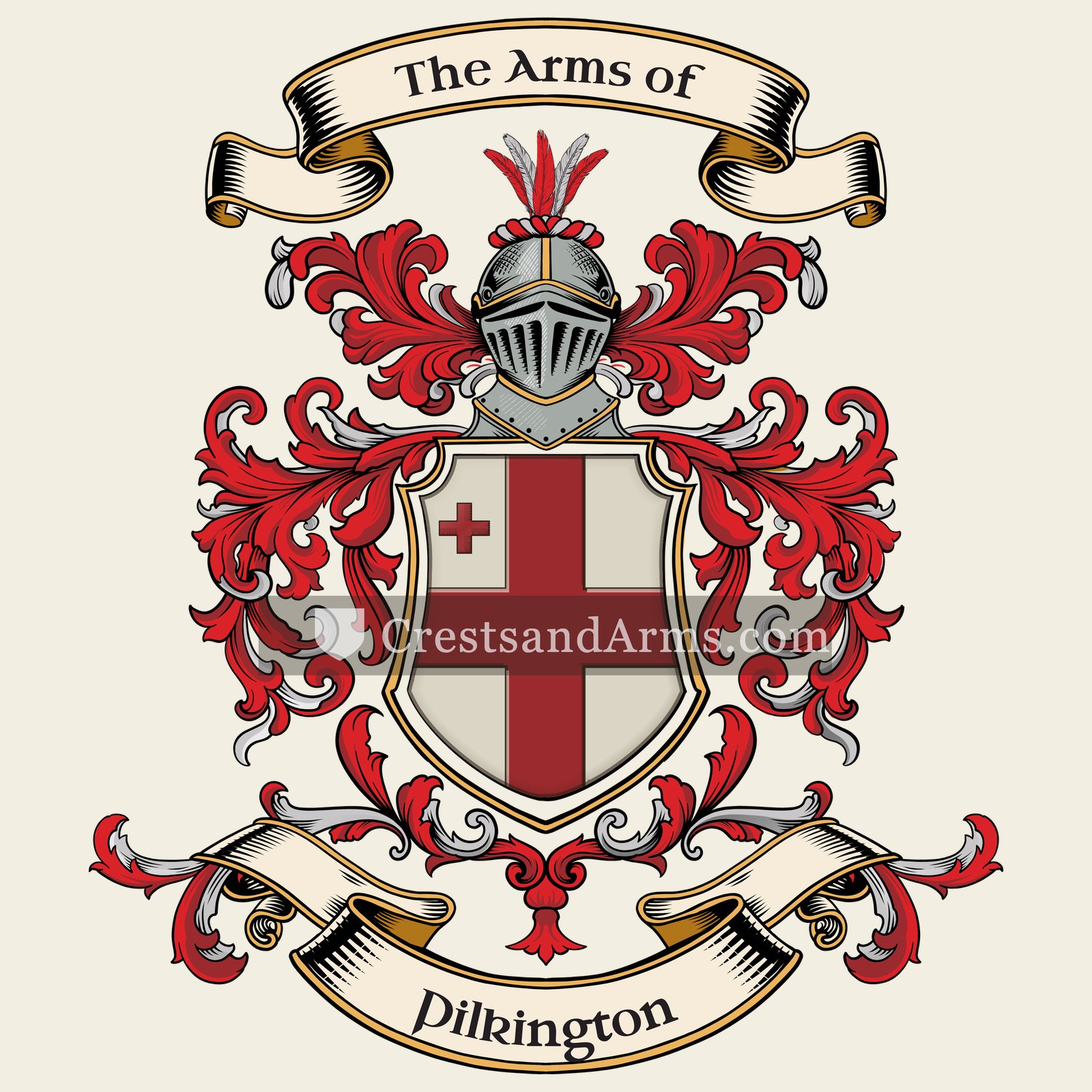


 chiefAuthority, wisdom and dominion
 sunGlory, splendour and the source of life