A record of documented arms, meaning and origin, researched for the Pimentel family lines. Documented in 2 countries.
Reg. 8135 · Spanish, P–S
Coat of Arms & Family Crest Details
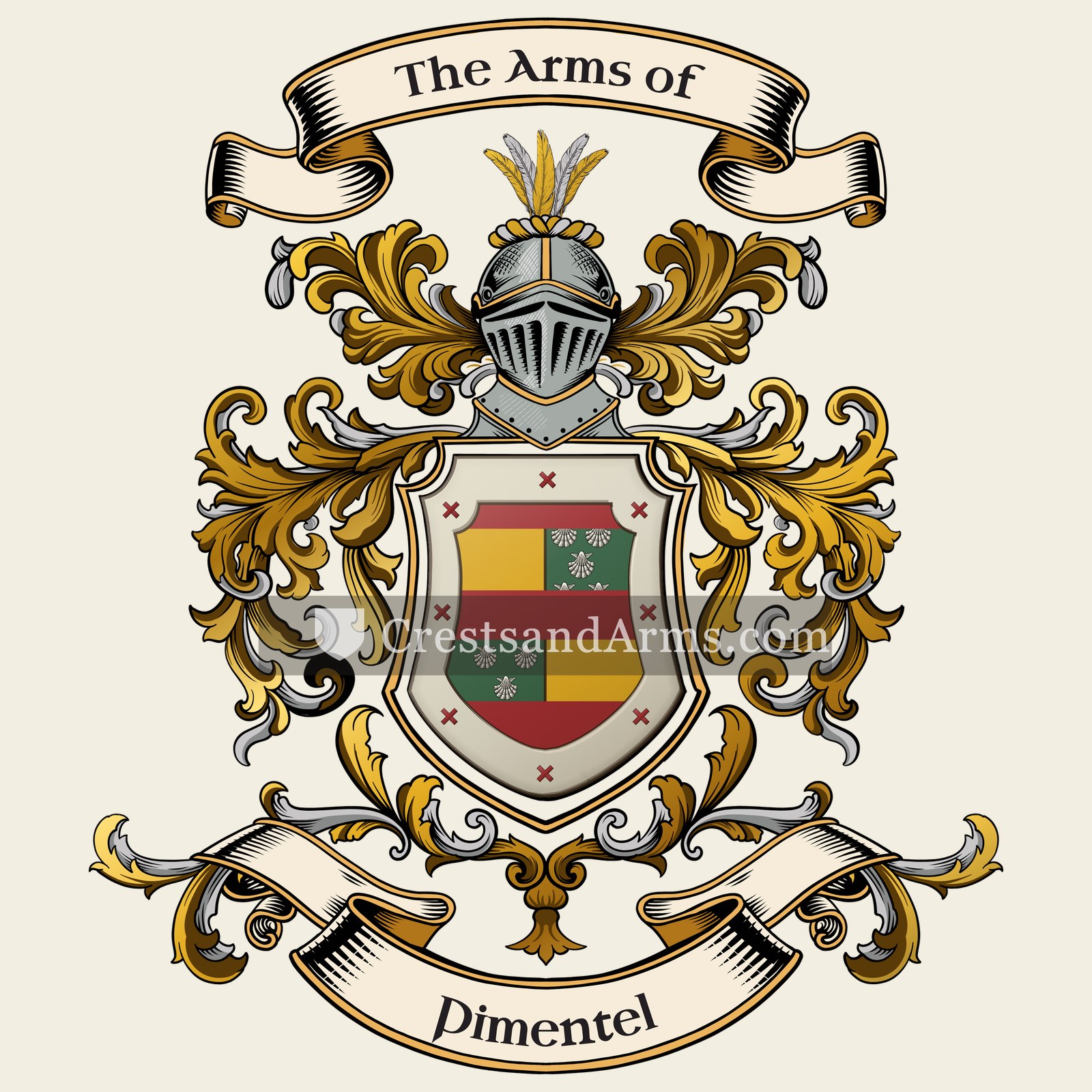
Symbols on this shield
fessThe military belt, and readiness to serve
lionCourage, strength and royalty
towerGrandeur and solidity, and a stronghold defended
Colours
Gold (Or)Means: Generosity
Red (Gules)Means: Military strength
Historical info
Source
J. B. Rietstap, Armorial Général, Gouda: G. B. van Goor Zonen, 1884–87
Blazon (the actual original written record)
“Ec.: aux 1 et 4 d'or à trois fasces de gu.; aux 2 et 3 de sin. à cinq panelles d'arg., les tiges en haut, 2, 1 et 2 [La branche des comtes de Benavente porte ces armes augmentées d'une bord. comp. de seize compons d'arg. et de gu., chaque compon d'arg. ch. d'un lion de gu. et chaque compon de gu. ch. d'une tour d'or.]”
CastileCastile, c. 1722
Digital archive packCoat of arms PNG, gold border print PDF, vector SVG and the certificate of authenticity. Sent to your email in minutes.
Map of Spain showing where the Pimentel arms are recorded
The Pimentel arms were recorded in Castile, c. 1722.
Castile was the heart of Spain and the source of most of its noble families. Land won in the long wars against the Moors was granted out to fighting men, and a man granted land was granted arms along with it.
This is where the arms were entered in the register. Families often moved to other parts of the country, so the same name can turn up in more than one region.
The body that granted and recorded arms in Spain in this period.
Philip V of Spain
Sovereign of the period
Philip V of Spain
1714–1724
Reigning in Spain when the Pimentel arms are first recorded.
How Arms Worked in Spain
In Spain, a coat of arms was considered a form of property that belonged to the entire family line. These arms were passed down from a father to all his children equally. Younger branches of the family usually kept the original design without needing to add any special marks to distinguish their specific line.
Granting authority
The Cronista Rey de Armas was the official body that regulated and granted coats of arms throughout Spain.
How they got arms
Families often obtained their arms through royal grants or by proving their noble status to the official heraldic authority.
Where arms were recorded
Coats of arms were officially recorded in the registers of the Cronista Rey de Armas starting in 1496.
The family's standing
Recorded among the armigerous families of Castile.
Origin & History of the Pimentel Family in Spain
The Pimentel family name emerged as a prominent lineage in the medieval kingdoms of Spain, particularly within the region of Castile. The name is often associated with the powerful House of Benavente, which held significant influence over Spanish politics and land ownership for centuries. By the early 18th century, the family had firmly established itself within the social and administrative structures of the Castilian heartland. Historical records from 1722 confirm that members of the Pimentel family were active participants in the local governance and economic life of these territories. Their presence during this era reflects a long-standing tradition of service and residency that helped shape the development of their local communities. As the family moved through the generations, they maintained deep roots in the Spanish landscape, contributing to the cultural and historical fabric of the region.
Coat of Arms & Family Crest Details
Symbols on this shield
fessThe military belt, and readiness to serve
saltireResolution, and St Andrew's cross
saltire coupedResolution, and the cross of St Andrew
escallopThe pilgrim's shell, and a long journey made
Colours
Gold (Or)Means: Generosity
Green (Vert)Means: Hope
Red (Gules)Means: Military strength
Silver (Argent)Means: Peace and sincerity
Historical info
Source
J. B. Rietstap, Armorial Général, Gouda: G. B. van Goor Zonen, 1884–87
Blazon (the actual original written record)
“Ec.: aux 1 et 4 d'or à trois fasces de gu.; aux 2 et 3 de sin. à cinq coquilles d'arg., 2, 1 et 2. L'écu entouré d'une bord. d'arg., ch. de huit flanchis de gu. C.: un boeuf iss. de gu., accorné d'arg., les pattes du même, le front ch. d'une coquille d'arg.”
Portugalc. 1706
Digital archive packCoat of arms PNG, gold border print PDF, vector SVG and the certificate of authenticity. Sent to your email in minutes.
Map of Portugal showing where the Pimentel arms are recorded
The Pimentel arms were recorded in Portugal, c. 1706.
Arms such as these were typically recorded in Lisboa.
Lisbon was the seat of the Portuguese crown and the port its wealth came through. Families made rich by trade and by service to the king took arms, and the crown's heralds recorded them there.
This is where the arms were entered in the register. Families often moved to other parts of the country, so the same name can turn up in more than one region.
The body that granted and recorded arms in Portugal in this period.
Peter II of Portugal
Sovereign of the period
Peter II of Portugal
1683–1706
Reigning in Spain when the Pimentel arms are first recorded.
How Arms Worked in Portugal
In Portugal, a coat of arms was a family possession that passed from a father to his children. Every legitimate descendant had the right to use the family shield without needing to change it. Younger branches of the family kept the original design, though they sometimes added small symbols to distinguish their specific line from the main branch.
Granting authority
The Cartório da Nobreza acted as the official body that managed and regulated noble titles and coats of arms in Portugal.
How they got arms
Families typically inherited their arms through bloodline, though they could also receive new grants from the crown for distinguished service.
Where arms were recorded
Coats of arms were officially recorded in the books of the Cartório da Nobreza starting in the year 1512.
The family's standing
Recorded among the armigerous families of Portugal.
Origin & History of the Pimentel Family in Portugal
The Pimentel family name carries a deep connection to the administrative and social evolution of Portugal, particularly within the bustling urban center of Lisbon. While the name has roots that stretch across the Iberian Peninsula, its presence in Lisbon by 1706 highlights a family deeply integrated into the capital’s civic and economic life during a period of immense colonial wealth. During the early eighteenth century, families like the Pimentels often served as essential links in the trade networks connecting Portugal to its overseas territories. They frequently occupied roles within the merchant class or the growing bureaucracy that managed the kingdom's affairs. By establishing themselves in Lisbon, members of the family were positioned at the heart of Portuguese intellectual and social circles, allowing them to influence the development of the city as it recovered from the challenges of the previous century. This era marked a time when the family name became synonymous with the urban identity of Lisbon, reflecting a transition from regional origins to a prominent status in the nation's capital.
Related Branches & Arms
Root word
pigmentum
Latin term for paint, pigment, or coloring matter.
This name
PimentelRefers to a person who lived near a place where pigments were produced or sold.
Documented Sources
J. B. Rietstap, Armorial Général, Gouda: G. B. van Goor Zonen, 1884–87
Soler Salcedo, Juan Miguel. Nobleza Española: Grandeza Inmemorial 1520. 2020
Vilar y Pascual, Luis. Diccionario histórico, genealógico y heráldico de las familias ilustres de la monarquía española. 1859
Archivo General de Simancas, Registro del Sello de Corte
Archivo Histórico Nacional, Sección Nobleza
Digital archive packCoat of arms PNG, gold border print PDF, vector SVG and the certificate of authenticity. Sent to your email in minutes.


 fessThe military belt, and readiness to serve
 lionCourage, strength and royalty
 towerGrandeur and solidity, and a stronghold defended
 fessThe military belt, and readiness to serve
 lionCourage, strength and royalty
 towerGrandeur and solidity, and a stronghold defended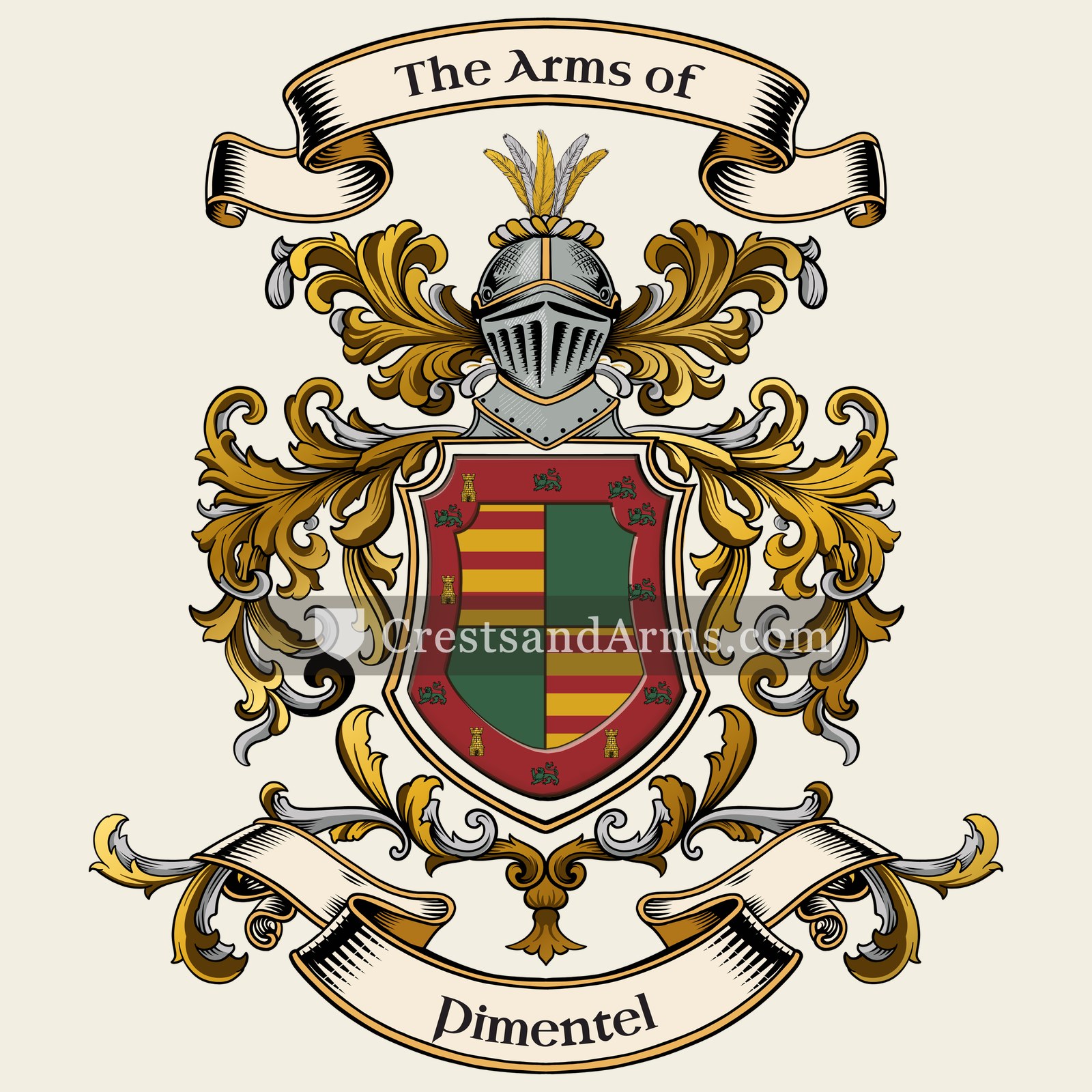


 saltireResolution, and St Andrew's cross
 saltire coupedResolution, and the cross of St Andrew
 escallopThe pilgrim's shell, and a long journey made