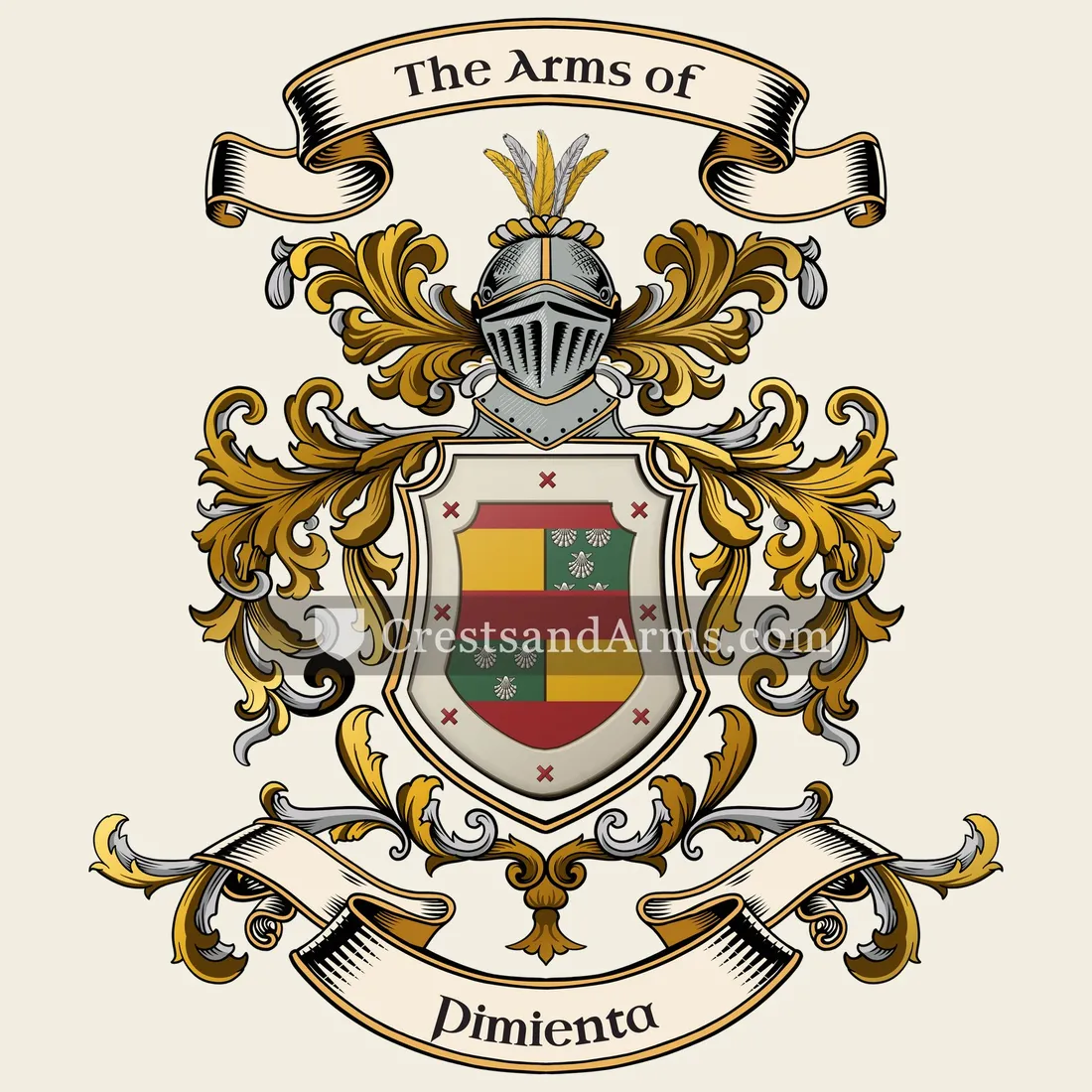
A record of documented arms, meaning and origin, researched for the Pimienta family lines. Documented in 2 countries.
Reg. 1510 · Spanish, P–S
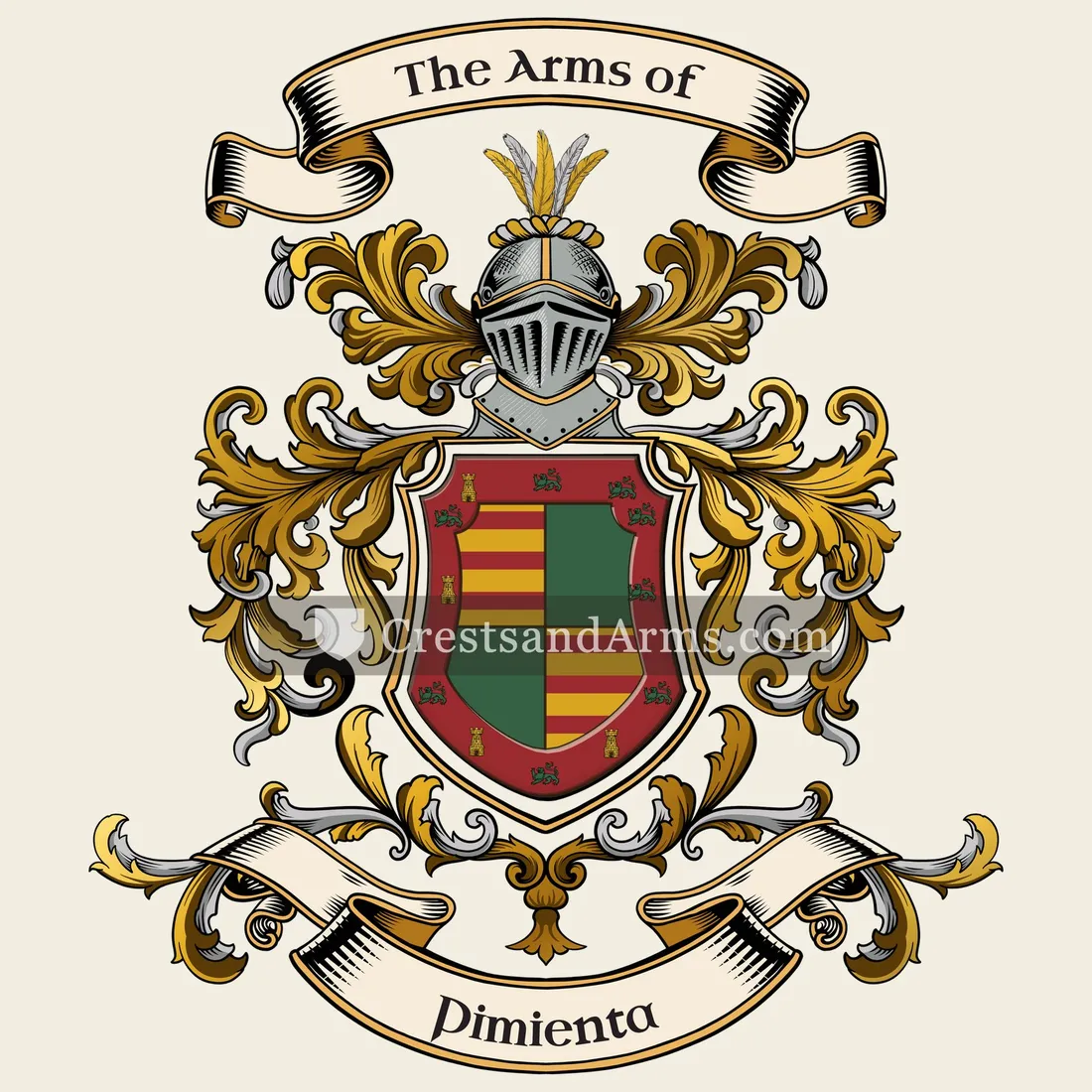
Meaning of the Pimienta family crest colors & symbols
Symbols on this shield
fessThe military belt, and readiness to serve
lionCourage, strength and royalty
towerGrandeur and solidity, and a stronghold defended
Colours
Gold (Or)Means: Generosity
Red (Gules)Means: Military strength
Historical info
Source
J. B. Rietstap, Armorial Général, Gouda: G. B. van Goor Zonen, 1884–87
Blazon (the actual original written record)
“Ec.: aux 1 et 4 d'or à trois fasces de gu.; aux 2 et 3 de sin. à cinq panelles d'arg., les tiges en haut, 2, 1 et 2 [La branche des comtes de Benavente porte ces armes augmentées d'une bord. comp. de seize compons d'arg. et de gu., chaque compon d'arg. ch. d'un lion de gu. et chaque compon de gu. ch. d'une tour d'or.]”
CastileCastile, c. 1722
Digital archive packCoat of arms PNG, gold border print PDF, vector SVG and the certificate of authenticity. Sent to your email in minutes.
Map of Spain showing where the Pimienta arms are recorded
The Pimienta arms were recorded in Castile, c. 1722.
Castile was the heart of Spain and the source of most of its noble families. Land won in the long wars against the Moors was granted out to fighting men, and a man granted land was granted arms along with it.
This is where the arms were entered in the register. Families often moved to other parts of the country, so the same name can turn up in more than one region.
The body that granted and recorded arms in Spain in this period.
Philip V of Spain
Sovereign of the period
Philip V of Spain
1714–1724
Reigning in Spain when the Pimienta arms are first recorded.
How Arms Worked in Spain
In Spain, a coat of arms was considered a form of property that belonged to the entire family line. These arms were passed down from a father to all his children equally. Younger branches of the family usually kept the original design without needing to add any special marks to distinguish their specific line.
Granting authority
The Cronista Rey de Armas was the official body that regulated and granted coats of arms throughout Spain.
How they got arms
Families often obtained their arms through royal grants or by proving their noble status to the official heraldic authority.
Where arms were recorded
Coats of arms were officially recorded in the registers of the Cronista Rey de Armas starting in 1496.
The family's standing
Recorded among the armigerous families of Castile.
Origin & History of the Pimienta Family in Spain
The surname Pimienta is a topographic and occupational name that originated in the Iberian Peninsula, likely derived from the Spanish word for pepper. During the Middle Ages, such names were often given to individuals who lived near specific landmarks or worked in the spice trade, which was a significant economic activity in medieval Spain. By the early eighteenth century, the family had established a clear presence in the region of Castile. Records from 1722 confirm that members of the Pimienta family were active participants in the social and administrative life of the Castilian heartland during this period. As the family grew, they integrated into the local communities of central Spain, contributing to the agricultural and commercial development of the area. This historical footprint reflects the broader pattern of families settling into specific provinces and solidifying their roles within the Spanish social structure over several generations.
Meaning of the Pimienta family crest colors & symbols
Symbols on this shield
fessThe military belt, and readiness to serve
saltire coupedResolution, and the cross of St Andrew
escallopThe pilgrim's shell, and a long journey made
Colours
Gold (Or)Means: Generosity
Green (Vert)Means: Hope
Red (Gules)Means: Military strength
Silver (Argent)Means: Peace and sincerity
Historical info
Source
J. B. Rietstap, Armorial Général, Gouda: G. B. van Goor Zonen, 1884–87
Blazon (the actual original written record)
“Ec.: aux 1 et 4 d'or à trois fasces de gu.; aux 2 et 3 de sin. à cinq coquilles d'arg., 2, 1 et 2. L'écu entouré d'une bord. d'arg., ch. de huit flanchis de gu. C.: un boeuf iss. de gu., accorné d'arg., les pattes du même, le front ch. d'une coquille d'arg.”
Portugalc. 1706
Digital archive packCoat of arms PNG, gold border print PDF, vector SVG and the certificate of authenticity. Sent to your email in minutes.
Map of Portugal showing where the Pimienta arms are recorded
The Pimienta arms were recorded in Portugal, c. 1706.
Arms such as these were typically recorded in Lisboa.
Lisbon was the seat of the Portuguese crown and the port its wealth came through. Families made rich by trade and by service to the king took arms, and the crown's heralds recorded them there.
This is where the arms were entered in the register. Families often moved to other parts of the country, so the same name can turn up in more than one region.
The body that granted and recorded arms in Portugal in this period.
Peter II of Portugal
Sovereign of the period
Peter II of Portugal
1683–1706
Reigning in Spain when the Pimienta arms are first recorded.
How Arms Worked in Portugal
In Portugal, a coat of arms was a family possession that passed from a father to his children. Every legitimate descendant had the right to use the family shield without needing to change it. Younger branches of the family kept the original design, though they sometimes added small symbols to distinguish their specific line from the main branch.
Granting authority
The Cartório da Nobreza acted as the official body that managed and regulated noble titles and coats of arms in Portugal.
How they got arms
Families typically inherited their arms through bloodline, though they could also receive new grants from the crown for distinguished service.
Where arms were recorded
Coats of arms were officially recorded in the books of the Cartório da Nobreza starting in the year 1512.
The family's standing
Recorded among the armigerous families of Portugal.
Origin & History of the Pimienta Family in Portugal
The surname Pimienta, which translates to pepper in Spanish, carries a history deeply rooted in the trade and cultural exchanges of the Iberian Peninsula. By the early 18th century, the family was firmly established in the bustling capital of Lisboa. During this era, Portugal served as a major hub for global commerce, and families with names related to spices often held connections to the lucrative trade routes flowing through the port of the Tagus River. The presence of the Pimienta family in Lisboa by 1706 suggests they were part of the urban middle class or merchant groups that helped define the city’s economic landscape during the reign of King João V. These early residents likely lived in the dense, vibrant neighborhoods surrounding the city center, contributing to the social fabric of a capital city that was rapidly recovering from the pressures of the previous century. Their history reflects the broader movement of families who settled in major administrative centers to participate in the growing bureaucracy and international markets of the Portuguese Empire.
Pimienta Meaning & Related Branches
Root word
pigmentum
Latin term for paint, dye, or coloring matter.
This name
PimientaRefers to a spice merchant or someone who dealt in black pepper.
Documented Sources
J. B. Rietstap, Armorial Général, Gouda: G. B. van Goor Zonen, 1884–87
Archivo Histórico Nacional, Sección Nobleza
Archivo General de Simancas, Registro del Sello de Corte
Moll, Francesc de Borja, Els llinatges catalans: Catalunya, País Valencià, Illes Balears, 1959
Faure, Roberto, Ribes, María Asunción, and García, Antonio, Diccionario de apellidos españoles, 2001
Digital archive packCoat of arms PNG, gold border print PDF, vector SVG and the certificate of authenticity. Sent to your email in minutes.


 fessThe military belt, and readiness to serve
 lionCourage, strength and royalty
 towerGrandeur and solidity, and a stronghold defended
 fessThe military belt, and readiness to serve
 lionCourage, strength and royalty
 towerGrandeur and solidity, and a stronghold defended


 saltire coupedResolution, and the cross of St Andrew
 escallopThe pilgrim's shell, and a long journey made