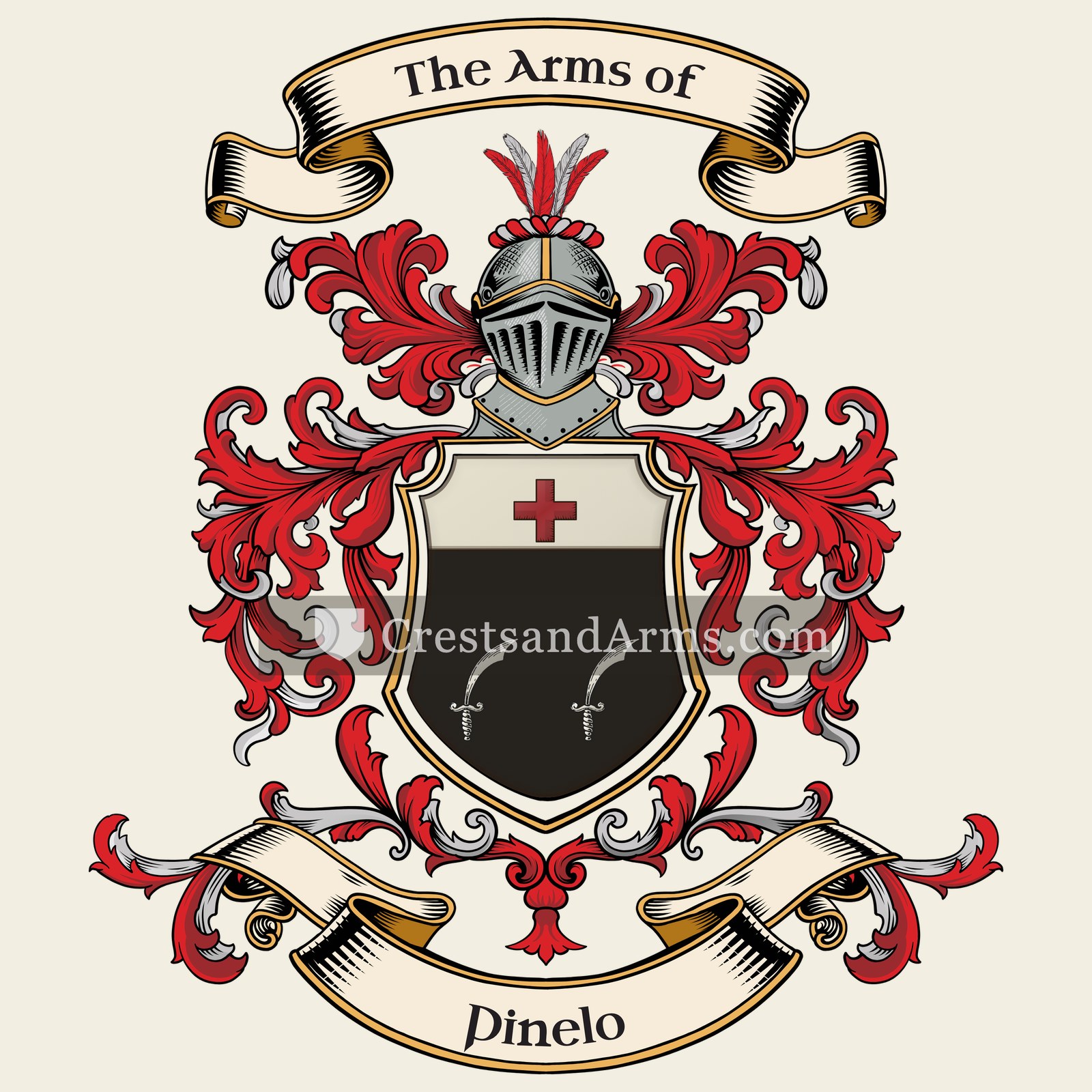
A record of documented arms, meaning and origin, researched for the Pinelo family of Finland.
Reg. 3396 · Finnish, P–S
Coat of Arms & Family Crest Details
Symbols on this shield
saltireResolution, and St Andrew's cross
chiefAuthority, wisdom and dominion
cross symbolChristian faith and service
swordJustice, and military honour
Colours
Black (Sable)Means: Constancy
Silver (Argent)Means: Peace and sincerity
Red (Gules)Means: Military strength
Historical info
Source
J. B. Rietstap, Armorial Général, Gouda: G. B. van Goor Zonen, 1884–87
Blazon (the actual original written record)
“De sa. à deux épées d'arg., garnies d'or, passées en saut., en p., surm. de six oeufs d'or, 1 en chef et les 5 autres rangés au-dessous en fasce affaissée; au chef d'arg., ch. d'une croisette pattée de gu.”
Finlandc. 1719
Digital archive packCoat of arms PNG, gold border print PDF, vector SVG and the certificate of authenticity. Sent to your email in minutes.
Map of Finland showing where the Pinelo arms are recorded
The Pinelo arms were recorded in Finland, c. 1719.
Arms such as these were typically recorded in Uusimaa.
Uusimaa was the Finnish coast facing Sweden, and the part of the country most closely tied to Stockholm. Its landowners and officers served the Swedish crown, and that service is what put their arms on record.
This is where the arms were entered in the register. Families often moved to other parts of the country, so the same name can turn up in more than one region.
The body that granted and recorded arms in Finland in this period.
How Arms Worked in Finland
Nobility in Finland held the exclusive right to register their coats of arms with the House of Nobility. These symbols were tied to the family name and were inherited by all members of the noble house. If a family branch moved or changed status, they kept their original design to maintain their identity within the official records.
Granting authority
The Finnish House of Nobility served as the official body that managed and protected all noble coats of arms.
How they got arms
Families received their arms through formal letters of nobility or by having their existing ancestral symbols confirmed by the House.
Where arms were recorded
All approved coats of arms were officially recorded in the Finnish House of Nobility Armorial starting in 1818.
The family's standing
Recorded among the armigerous families of Finland.
Origin & History of the Pinelo Family in Finland
The surname Pinelo carries a distinct history that links its early bearers to the region of Uusimaa in southern Finland by the year 1719. During this period, the area was recovering from the hardships of the Great Northern War, which had brought significant social and demographic shifts to the Finnish coastline. The name itself suggests a connection to the professional or military classes of the era, as many families during this time adopted surnames that reflected their trade or their status within the Swedish-ruled administrative system. By the early 18th century, members of the Pinelo family were established within the local parish records, participating in the agricultural and civic life of the Uusimaa province. These early ancestors were part of a resilient population that helped maintain the social fabric of the region during a time of rebuilding and transition.
Related Branches & Arms
Root word
Pinus
Latin term for the pine tree.
This name
PineloDerived from a topographic reference to someone living near a pine forest.
also spelled
Pinelo
Documented Sources
J. B. Rietstap, Armorial Général, Gouda: G. B. van Goor Zonen, 1884–87
National Archives of Finland (Kansallisarkisto), Kirkonarkistot (Parish Records), Uusimaa region
National Archives of Finland (Kansallisarkisto), Henkikirjat (Poll Tax Records), 1719
Jutikkala, Eino, Suomen historian kartasto, 1949
Paloposki, Toivo J., Suomen historian yleispiirteet, 1963
Digital archive packCoat of arms PNG, gold border print PDF, vector SVG and the certificate of authenticity. Sent to your email in minutes.


 saltireResolution, and St Andrew's cross
 chiefAuthority, wisdom and dominion
 cross symbolChristian faith and service
 swordJustice, and military honour
 saltireResolution, and St Andrew's cross
 chiefAuthority, wisdom and dominion
 cross symbolChristian faith and service
 swordJustice, and military honour