Map of Belgium showing where the Piraino arms are recorded
The Piraino arms were recorded in Gand, c. 1737.
This is where the arms were entered in the register. Families often moved to other parts of the country, so the same name can turn up in more than one region.
The body that granted and recorded arms in Belgium in this period.
Charles VI, Holy Roman Emperor
Sovereign of the period
Charles VI, Holy Roman Emperor
1711–1740
Reigning in Belgium when the Piraino arms are first recorded.
How Arms Worked in Belgium
In Belgium, a coat of arms is considered personal property that is passed down through the male line to legitimate descendants. Families often use the same shield design across generations to show their shared heritage. If a branch of the family wants to change the design, they must apply for an official update to their specific version of the arms.
Granting authority
The Conseil héraldique is the official body that regulates and approves all coats of arms in Belgium.
How they got arms
Families obtain their coats of arms through formal royal grants or by confirming their historical right to use existing designs.
Where arms were recorded
All approved coats of arms are officially recorded in the public registers of the Conseil héraldique since 1844.
The family's standing
Recorded among the armigerous families of Belgium.
Origin & History of the Piraino Family in Belgium
The surname Piraino originates from the island of Sicily, where it is linked to the town of the same name in the province of Messina. The name is derived from the Greek word *pyra*, meaning a place of fire or a funeral pyre, which suggests that the original settlement may have been associated with ancient beacon fires or volcanic activity in the region. By the early 18th century, members of the family had expanded their reach beyond the Mediterranean. Official records confirm that individuals bearing the Piraino name were established in the city of Gand, located in modern-day Belgium, by 1737. This migration indicates that the family was likely involved in the active trade networks connecting Southern Europe to the commercial hubs of the Low Countries during the Enlightenment era.
Piraino Meaning & Related Branches
Root word
Piraino
Derived from the Latin pirum meaning pear tree.
This name
PirainoA habitational name referring to a place where pear trees were cultivated.
also spelled
Pierinn
Pyerin
Pierinh
Documented Sources
J. B. Rietstap, Armorial Général, Gouda: G. B. van Goor Zonen, 1884–87
State Archives in Ghent (Rijksarchief te Gent), Parochieregisters van Gent
Girolamo Caracausi, Dizionario onomastico della Sicilia, 1993
Salvatore Trovato, Storia della lingua in Sicilia, 2011
Digital archive packCoat of arms PNG, gold border print PDF, vector SVG and the certificate of authenticity. Sent to your email in minutes.


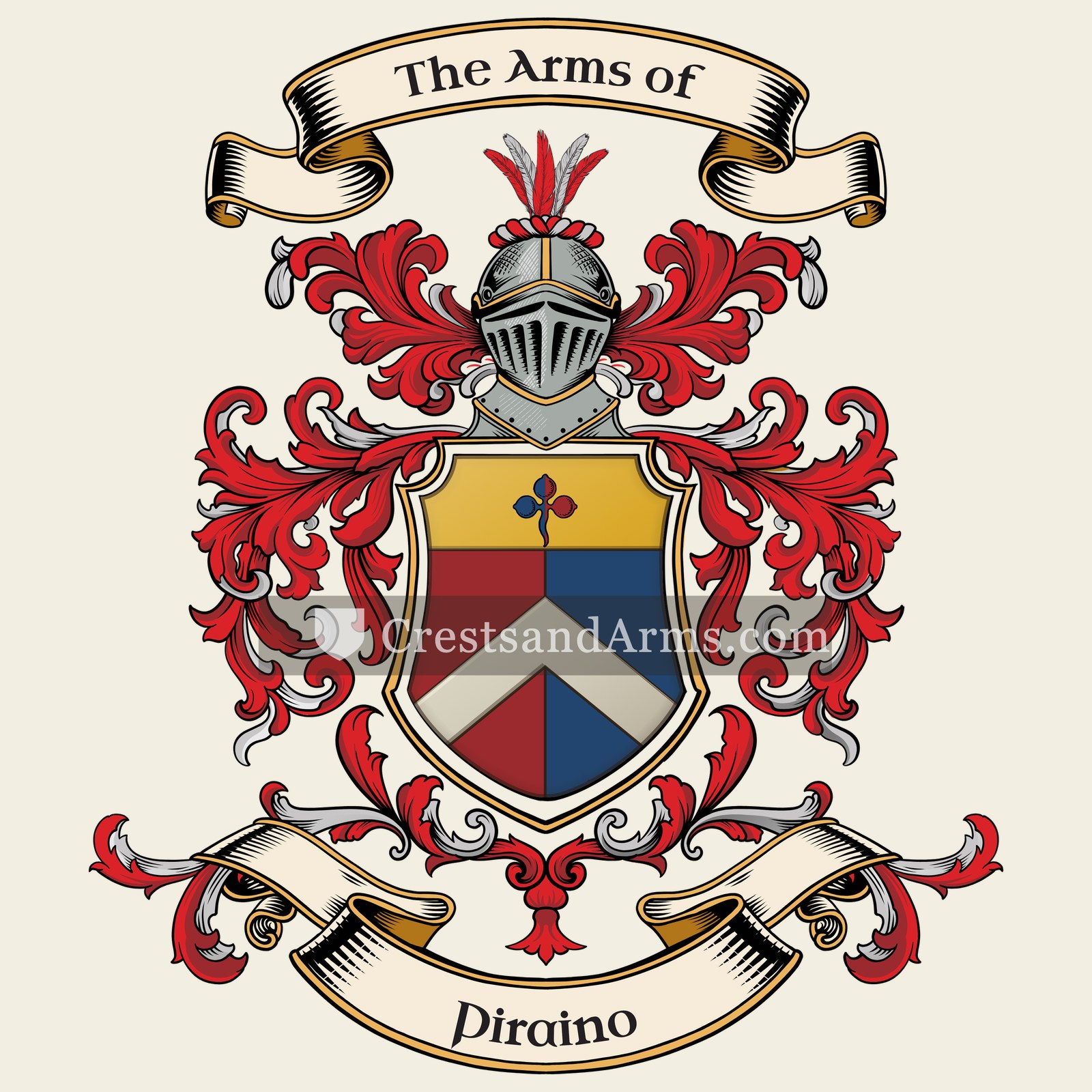
 chevronProtection, and faithful service completed
 chiefAuthority, wisdom and dominion
 trefoilPerpetuity, and the Trinity
 chevronProtection, and faithful service completed
 chiefAuthority, wisdom and dominion
 trefoilPerpetuity, and the Trinity