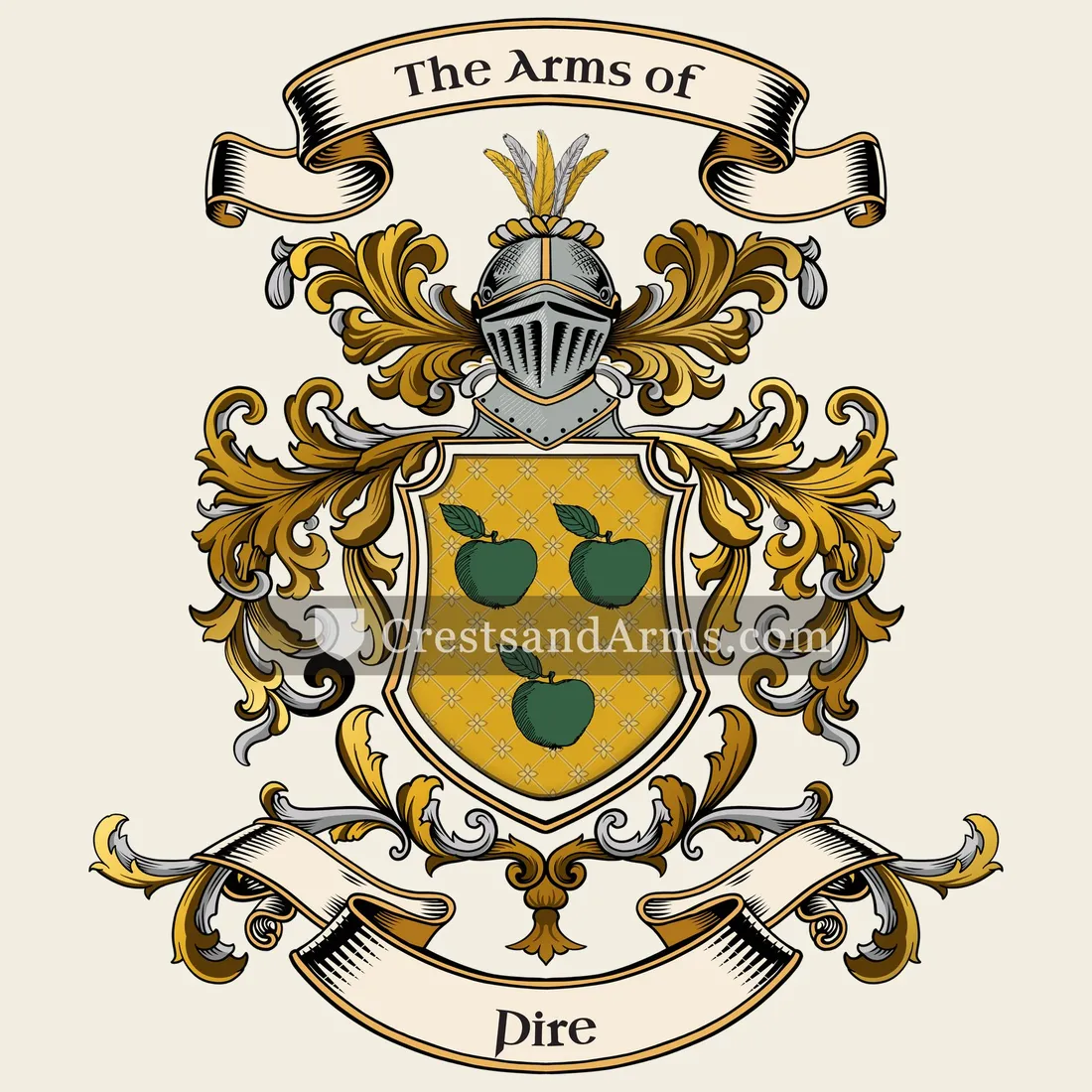
A record of documented arms, meaning and origin, researched for the Pire family lines. Documented in 3 countries.
Reg. 3368 · Britain, P–S
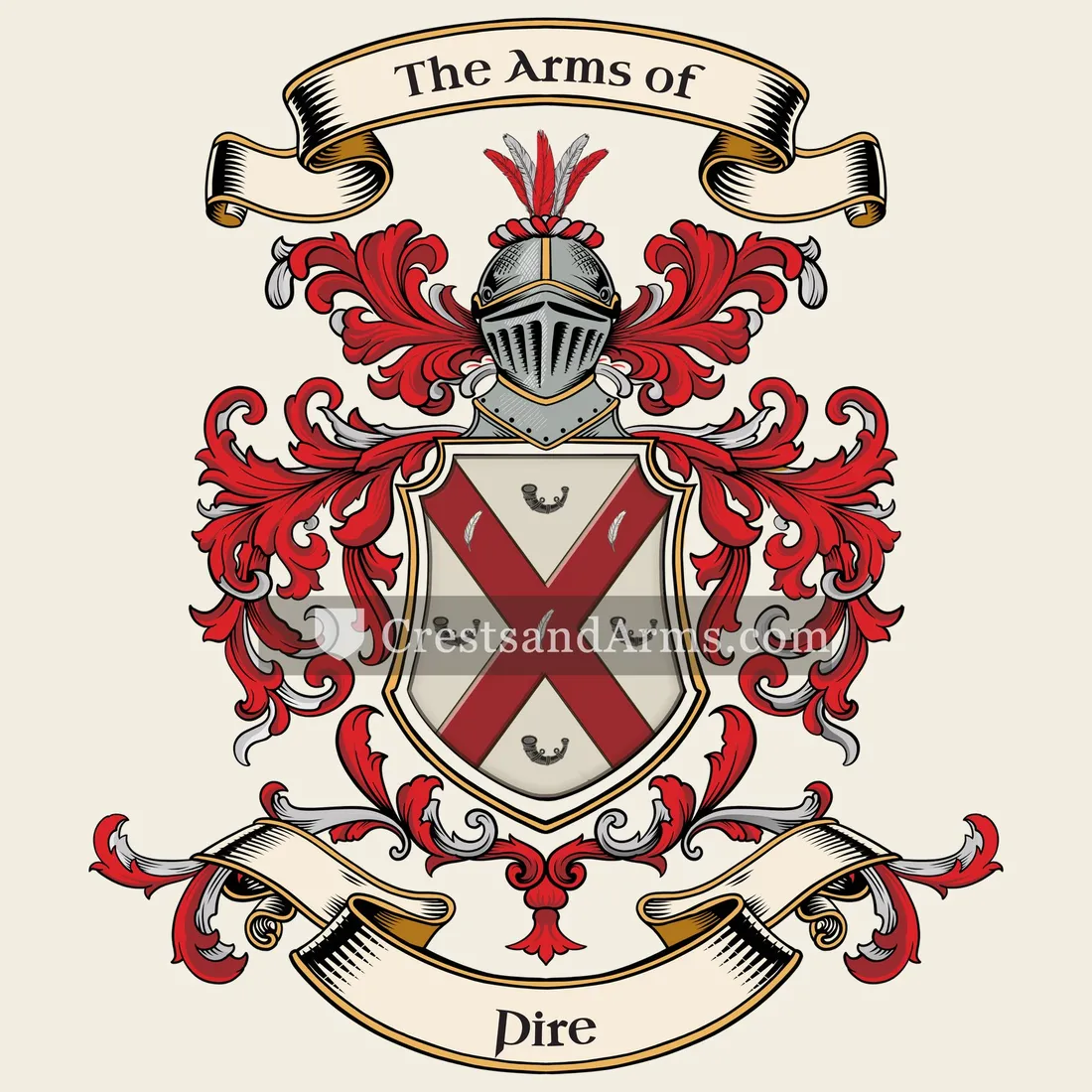
Meaning of the Pire family crest colors & symbols
Symbols on this shield
saltireResolution, and St Andrew's cross
feathersWilling obedience and serenity
hunting horn stringedOne who delights in the chase
Colours
Silver (Argent)Means: Peace and sincerity
Red (Gules)Means: Military strength
Black (Sable)Means: Constancy
Historical info
Source
J. B. Rietstap, Armorial Général, Gouda: G. B. van Goor Zonen, 1884–87
Blazon (the actual original written record)
“D'arg. au saut. de gu., ch. d'un panache de trois pl. d'aut. du champ et cant. de quatre cors-de-chasse de sa. C.: une tête et col d'aigle de sa., tenant en son bec une pl. d'aut. d'arg. D.: DEEDS, NOT WORDS.”
BritainLondres, c. 1841
Digital archive packCoat of arms PNG, gold border print PDF, vector SVG and the certificate of authenticity. Sent to your email in minutes.
Map of Britain showing where the Pire arms are recorded
The Pire arms were recorded in Londres, c. 1841.
Arms such as these were typically recorded in Kent.
Kent sits between London and the short crossing to Europe, and the trade passing through made it wealthy. Merchant families bought land with that money, and it was landowners who took coats of arms.
This is where the arms were entered in the register. Families often moved to other parts of the country, so the same name can turn up in more than one region.
The body that granted and recorded arms in Britain in this period.
Victoria
Sovereign of the period
Victoria
1837–1901
Reigning in Britain when the Pire arms are first recorded.
How Arms Worked in Britain
English heraldry allowed arms to be shared by all legitimate descendants of the original owner. These symbols were treated as personal property that moved through the generations to all children. While the eldest son kept the original design, other family members could use the same shield without needing to change it or register their own unique versions.
Granting authority
The College of Arms in London has regulated the use of coats of arms throughout England and Wales since 1484.
How they got arms
Families typically obtained their coats of arms through a formal grant from the Crown or by proving their ancient right to them.
Where arms were recorded
All official coats of arms are recorded in the registers kept at the College of Arms, which date back to the fifteenth century.
The family's standing
Recorded among the armigerous families of Britain.
Origin & History of the Pire Family in Britain
The history of the Pire family in Britain is closely tied to the shifting landscapes of the nineteenth century. While the name likely has roots in continental Europe, official records confirm that members of the family were firmly established in the county of Kent by the time of the 1841 census. During this period, Kent served as a vital gateway for trade and migration, making it a common destination for families arriving from across the English Channel. The presence of the Pire name in this region suggests that early family members were part of a growing community of workers and merchants who helped shape the local economy. By settling in Kent, these ancestors integrated into a society defined by its proximity to the coast and its connection to the wider world. Their transition into British life reflects the broader patterns of movement that defined the Victorian era, as families sought new opportunities in a rapidly industrializing nation.
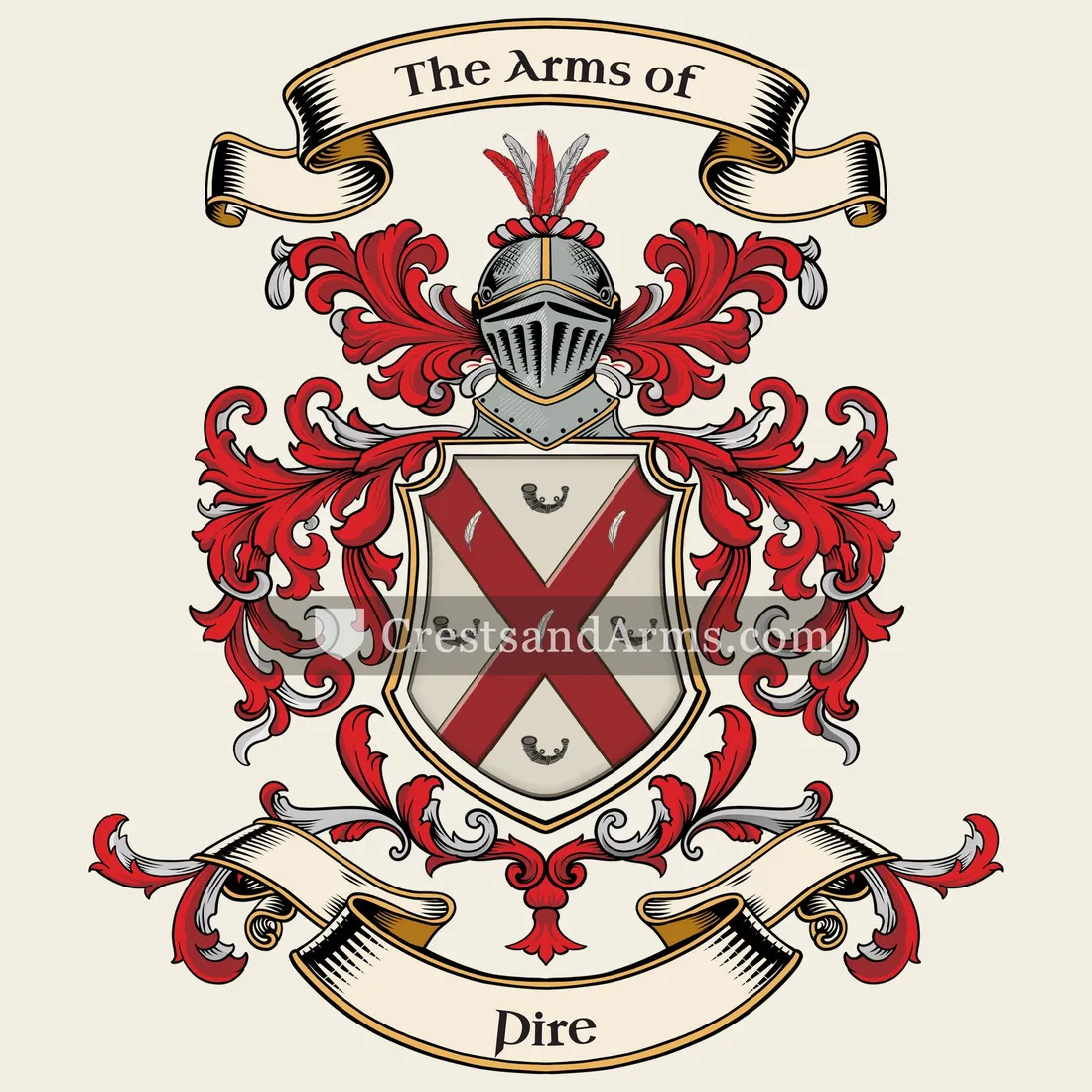
Meaning of the Pire family crest colors & symbols
Symbols on this shield
saltireResolution, and St Andrew's cross
hunting horn stringedOne who delights in the chase
feathersWilling obedience and serenity
Colours
Silver (Argent)Means: Peace and sincerity
Red (Gules)Means: Military strength
Black (Sable)Means: Constancy
Historical info
Source
Sir Bernard Burke, The General Armory of England, Scotland, Ireland and Wales, London: Harrison & Sons, 1884
Blazon (the actual original written record)
“Ar. on a saltire gu. betw. four buglehorns stringed sa. three ostrich feathers erect of the field”
EnglandLondon, c. 1620
Digital archive packCoat of arms PNG, gold border print PDF, vector SVG and the certificate of authenticity. Sent to your email in minutes.
Map of England showing where the Pire arms are recorded
The Pire arms were recorded in London, c. 1620.
This is where the arms were entered in the register. Families often moved to other parts of the country, so the same name can turn up in more than one region.
The body that granted and recorded arms in England in this period.
James VI and I
Sovereign of the period
James VI and I
1603–1625
Reigning in Britain when the Pire arms are first recorded.
How Arms Worked in England
English heraldry allowed arms to be shared by all legitimate descendants of the original owner. These symbols were treated as personal property that moved through the generations to all children. While the eldest son kept the original design, other family members could use the same shield without needing to change it or register their own unique versions.
Granting authority
The College of Arms in London has regulated the use of coats of arms throughout England and Wales since 1484.
How they got arms
Families typically obtained their coats of arms through a formal grant from the Crown or by proving their ancient right to them.
Where arms were recorded
All official coats of arms are recorded in the registers kept at the College of Arms, which date back to the fifteenth century.
The family's standing
Recorded among the armigerous families of England.
Origin & History of the Pire Family in England
The history of the Pire family in England begins with their documented presence in London during the early seventeenth century. By 1620, members of the family were established within the bustling urban landscape of the city, which served as a major center for trade and migration at the time. The name likely evolved as a variation of occupational or locational descriptors common in medieval European naming traditions. As these individuals settled into the social fabric of London, they participated in the daily life of a growing metropolis that was rapidly becoming a global hub for commerce. Their presence during this era suggests they were part of the demographic shifts that defined the Stuart period, contributing to the diverse workforce and evolving culture of the capital. Through these early records, we see the family name taking root in a society that was increasingly defined by its connections to both domestic industry and international exchange.
Meaning of the Pire family crest colors & symbols
Symbols on this shield
applePeace, plenty and long-standing settlement
Colours
Gold (Or)Means: Generosity
Green (Vert)Means: Hope
Historical info
Source
Sir Bernard Burke, The General Armory of England, Scotland, Ireland and Wales, London: Harrison & Sons, 1884
Blazon (the actual original written record)
“Or, three pears vert”
Scotlandc. 1748
Digital archive packCoat of arms PNG, gold border print PDF, vector SVG and the certificate of authenticity. Sent to your email in minutes.
Map of Scotland showing where the Pire arms are recorded
The Pire arms were recorded in Scotland, c. 1748.
Arms such as these were typically recorded in Edinburgh.
Edinburgh was the seat of Scotland's government, its courts and its heralds. Families with business there settled nearby, and being close to where arms were recorded is exactly why so many of them appear.
This is where the arms were entered in the register. Families often moved to other parts of the country, so the same name can turn up in more than one region.
The body that granted and recorded arms in Scotland in this period.
George II of Great Britain
Sovereign of the period
George II of Great Britain
1727–1760
Reigning in Britain when the Pire arms are first recorded.
How Arms Worked in Scotland
Scottish heraldry is unique because it treats a coat of arms as a piece of personal property protected by law. Only one person can own a specific design at any given time. When a family grows, the head keeps the original shield while other relatives must apply for their own distinct version with slight changes to prove their specific identity.
Granting authority
The Court of the Lord Lyon acts as the official body that regulates and controls all heraldic matters throughout Scotland.
How they got arms
Individuals obtain a legal right to their arms through a formal petition process that confirms their identity and family connection.
Where arms were recorded
All valid coats of arms are officially entered into the Public Register of All Arms and Bearings starting from 1672.
The family's standing
Recorded among the armigerous families of Scotland.
Origin & History of the Pire Family in Scotland
The family name Pire has deep roots in the urban landscape of eighteenth-century Scotland, particularly within the bustling city of Edinburgh. By 1748, records confirm that members of the family were already established residents of the capital, likely participating in the rapid social and economic expansion that defined the Scottish Enlightenment. During this period, Edinburgh was a center for trade, law, and intellectual growth, attracting families who sought to build new lives in a changing society. The presence of the Pire name in local documents from this era suggests that these early ancestors were integrated into the daily life of the city, perhaps working as skilled craftsmen or merchants who contributed to the local economy. While the name is rare, its appearance in the historical record of Edinburgh provides a clear link to the urban development of Scotland during the middle of the 1700s.
Pire Meaning & Related Branches
Root word
Petrus
A Greek word meaning a stone or a rock.
This name
PireA variant of Peter, denoting a person who is steadfast or rock-like.
also spelled
Pyrie
Piry
Peeree
Perry
Pirry
Documented Sources
J. B. Rietstap, Armorial Général, Gouda: G. B. van Goor Zonen, 1884–87
The National Archives, 1841 England Census, HO 107
Redstone, L. J., The Local Records of Kent, 1948
Digital archive packCoat of arms PNG, gold border print PDF, vector SVG and the certificate of authenticity. Sent to your email in minutes.


 saltireResolution, and St Andrew's cross
 feathersWilling obedience and serenity
 hunting horn stringedOne who delights in the chase
 saltireResolution, and St Andrew's cross
 feathersWilling obedience and serenity
 hunting horn stringedOne who delights in the chase



 applePeace, plenty and long-standing settlement