Map of Spain showing where the Pisano arms are recorded
The Pisano arms were recorded in Catalonia, c. 1722.
Catalonia lived by sea trade, and its merchant houses were as powerful as its landowners. Both sorts of family took arms, and Barcelona kept records of the houses entitled to bear them.
This is where the arms were entered in the register. Families often moved to other parts of the country, so the same name can turn up in more than one region.
The body that granted and recorded arms in Spain in this period.
Philip V of Spain
Sovereign of the period
Philip V of Spain
1714–1724
Reigning in Spain when the Pisano arms are first recorded.
How Arms Worked in Spain
In Spain, a coat of arms was considered a form of property that belonged to the entire family line. These arms were passed down from a father to all his children equally. Younger branches of the family usually kept the original design without needing to add any special marks to distinguish their specific line.
Granting authority
The Cronista Rey de Armas was the official body that regulated and granted coats of arms throughout Spain.
How they got arms
Families often obtained their arms through royal grants or by proving their noble status to the official heraldic authority.
Where arms were recorded
Coats of arms were officially recorded in the registers of the Cronista Rey de Armas starting in 1496.
The family's standing
Recorded among the armigerous families of Catalonia.
Origin & History of the Pisano Family in Spain
The surname Pisano carries a rich history that is deeply rooted in the Mediterranean region. While the name is most famously associated with people from the city of Pisa in Italy, its presence in Catalonia by 1722 suggests that families bearing this name were part of a long tradition of movement and trade across southern Europe. During this period, individuals often adopted surnames to identify their place of origin or their ancestral home when they settled in new lands. For a family in Catalonia, the name served as a link to their historical roots while they integrated into the local culture and economy of the Spanish coast. This migration pattern was common for families involved in maritime commerce, as the connections between Italian city-states and the Iberian Peninsula created a network where people, goods, and surnames flowed freely. By the early 18th century, the Pisano name was firmly established as a marker of this diverse cultural heritage.
Related Branches & Arms
Root word
Pisa
Derived from the Latin word for a marshy or swampy area.
This name
PisanoA topographic surname denoting someone who originated from the city of Pisa.
also spelled
Pisano
Pizanyo
Documented Sources
J. B. Rietstap, Armorial Général, Gouda: G. B. van Goor Zonen, 1884–87
Braudel, Fernand, La Méditerranée et le monde méditerranéen à l'époque de Philippe II, 1949
Moll, Francesc de Borja, Els llinatges catalans, 1959
Arxiu de la Corona d'Aragó, Registres de la Reial Audiència
Digital archive packCoat of arms PNG, gold border print PDF, vector SVG and the certificate of authenticity. Sent to your email in minutes.


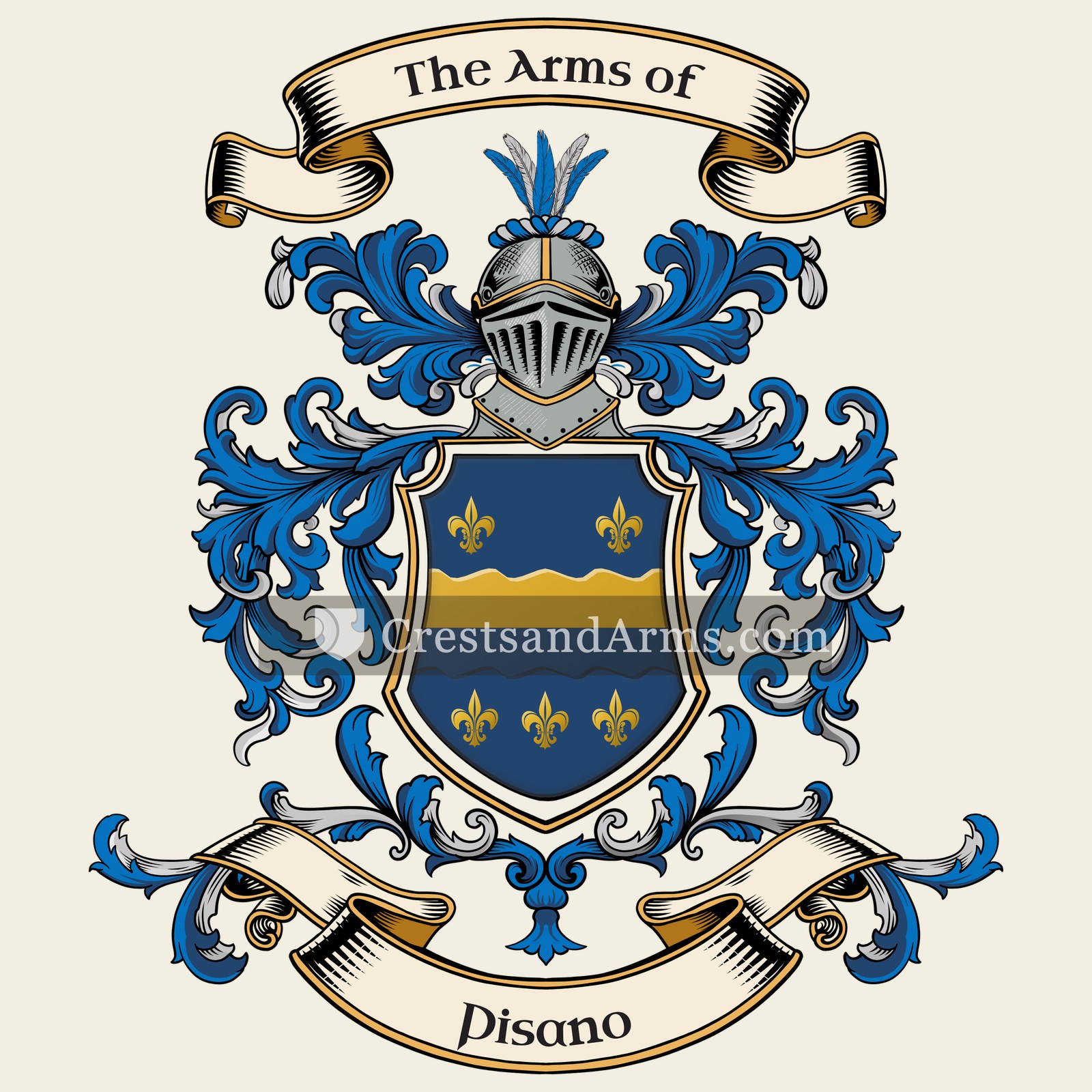
 fessThe military belt, and readiness to serve
 fleur de lisPurity, light, and the sixth son
 fessThe military belt, and readiness to serve
 fleur de lisPurity, light, and the sixth son