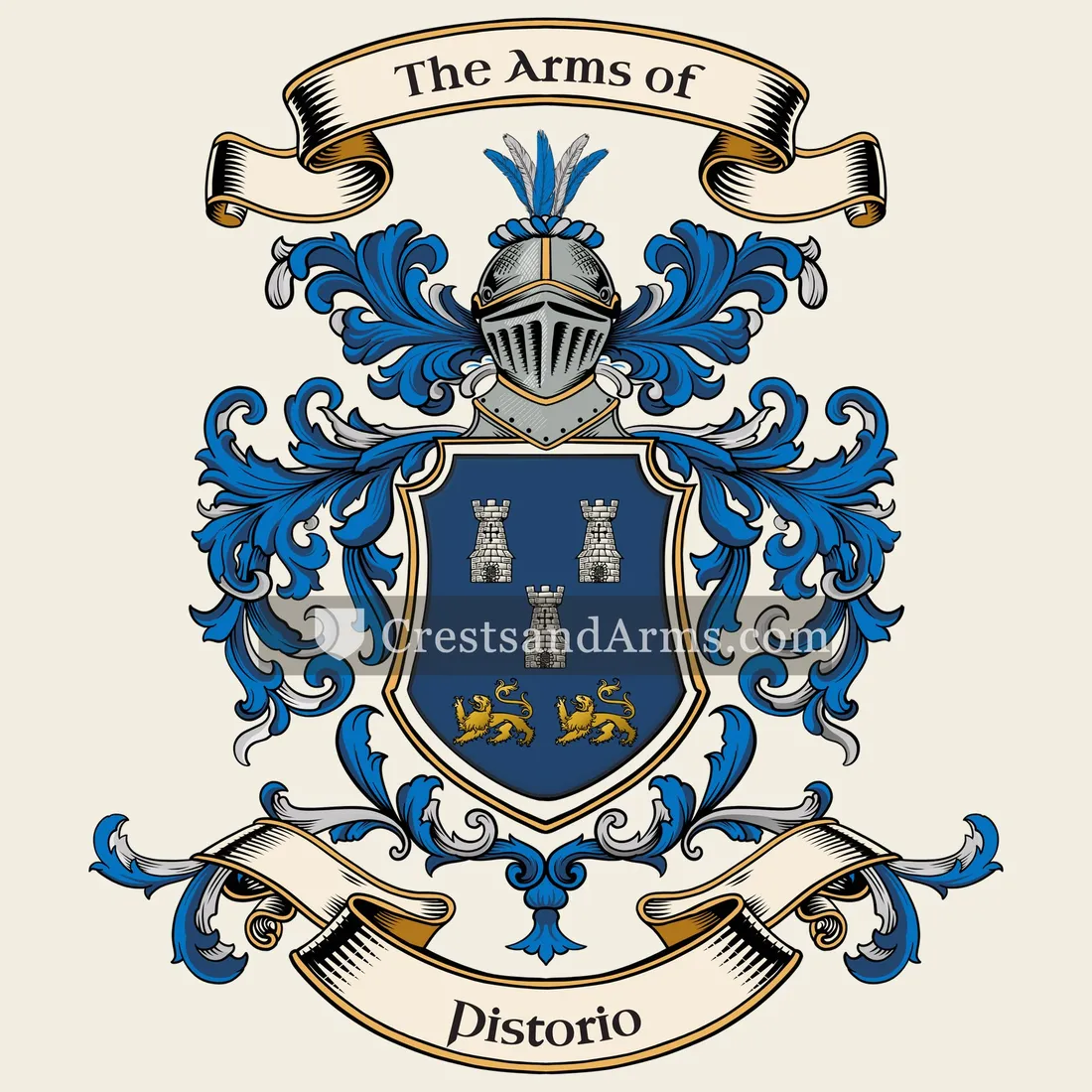
A record of documented arms, meaning and origin, researched for the Pistorio family of Austria.
Reg. 1233 · Austrian, P–S
Meaning of the Pistorio family crest colors & symbols
Symbols on this shield
towerGrandeur and solidity, and a stronghold defended
lionCourage, strength and royalty
Colours
Blue (Azure)Means: Loyalty and truth
Silver (Argent)Means: Peace and sincerity
Gold (Or)Means: Generosity
Historical info
Source
J. B. Rietstap, Armorial Général, Gouda: G. B. van Goor Zonen, 1884–87
Blazon (the actual original written record)
“D'azur à un tour d'arg., mouv. de la p., ouv. de sa., aj. au-dessus de la porte de quatre fenêtres rondes de sa., 2 et 2, et couverte d'un dôme de gu., cour. d'or; la tour adextrée et senestrée d'un mur non-crén. d'arg., touchant aux flancs, maconné de sa. et soutenant deux lions affr. d'or, appuyant leurs pattes sur le dôme. C.: une fleur-de-lis d'arg. L. d'or et d'azur.”
StyriaStyria, c. 1656
Digital archive packCoat of arms PNG, gold border print PDF, vector SVG and the certificate of authenticity. Sent to your email in minutes.
Map of Austria showing where the Pistorio arms are recorded
The Pistorio arms were recorded in Styria, c. 1656.
Styria was mountain and forest country in southern Austria, with iron in its hills. Mining and landholding both made money, and families who held either kind of property took arms to seal their papers with.
This is where the arms were entered in the register. Families often moved to other parts of the country, so the same name can turn up in more than one region.
Region
Styria
First recorded
1656
Granting Authority for the Pistorio Arms
Imperial and Royal chancery
Sodacan · CC BY-SA 3.0
The body that granted and recorded arms in Austria in this period.
Ferdinand III, Holy Roman Emperor
Sovereign of the period
Ferdinand III, Holy Roman Emperor
1637–1657
Reigning in Austria when the Pistorio arms are first recorded.
How Arms Worked in Austria
Austrian coats of arms were often linked directly to noble titles granted by the Emperor. These symbols belonged to the entire family line rather than just one individual. When a family grew, new branches kept the original design without needing to change it. This system allowed all members of a noble house to share the same identity across many generations.
Granting authority
The Imperial and Royal chancery managed all heraldic matters and controlled the official granting of arms throughout the Austrian lands.
How they got arms
Families typically received their arms through a formal imperial decree that often accompanied the elevation of a person to noble status.
Where arms were recorded
Official records of these grants were kept in the Imperial Register of Nobility which began its formal documentation process in 1453.
The family's standing
Recorded among the armigerous families of Styria.
Origin & History of the Pistorio Family in Austria
The name Pistorio carries a rich history tied to the professional traditions of early Europe. The name is derived from the Latin word *pistor*, which translates to baker or miller. In the context of the seventeenth century, this suggests that the family likely held a respected position within their community by managing essential food production. By 1656, records confirm that the family was well-established in the region of Styria, which is located in modern-day Austria. During this era, families often adopted surnames based on their trade to distinguish themselves in growing towns and villages. The presence of the Pistorio name in Styria indicates that these early ancestors were likely integrated into the local economy and social structure of the Holy Roman Empire, contributing to the agricultural and commercial life of the region during a time of significant historical transition.
Pistorio Meaning & Related Branches
Root word
Pistor
Latin term for a baker or miller.
This name
PistorioAn occupational surname denoting a descendant or employee of a baker.
also spelled
Pistore
Documented Sources
J. B. Rietstap, Armorial Général, Gouda: G. B. van Goor Zonen, 1884–87
Krones, Franz von, Beiträge zur Geschichte Steiermarks im XVII. Jahrhundert, 1862


 towerGrandeur and solidity, and a stronghold defended
 lionCourage, strength and royalty
 towerGrandeur and solidity, and a stronghold defended
 lionCourage, strength and royalty