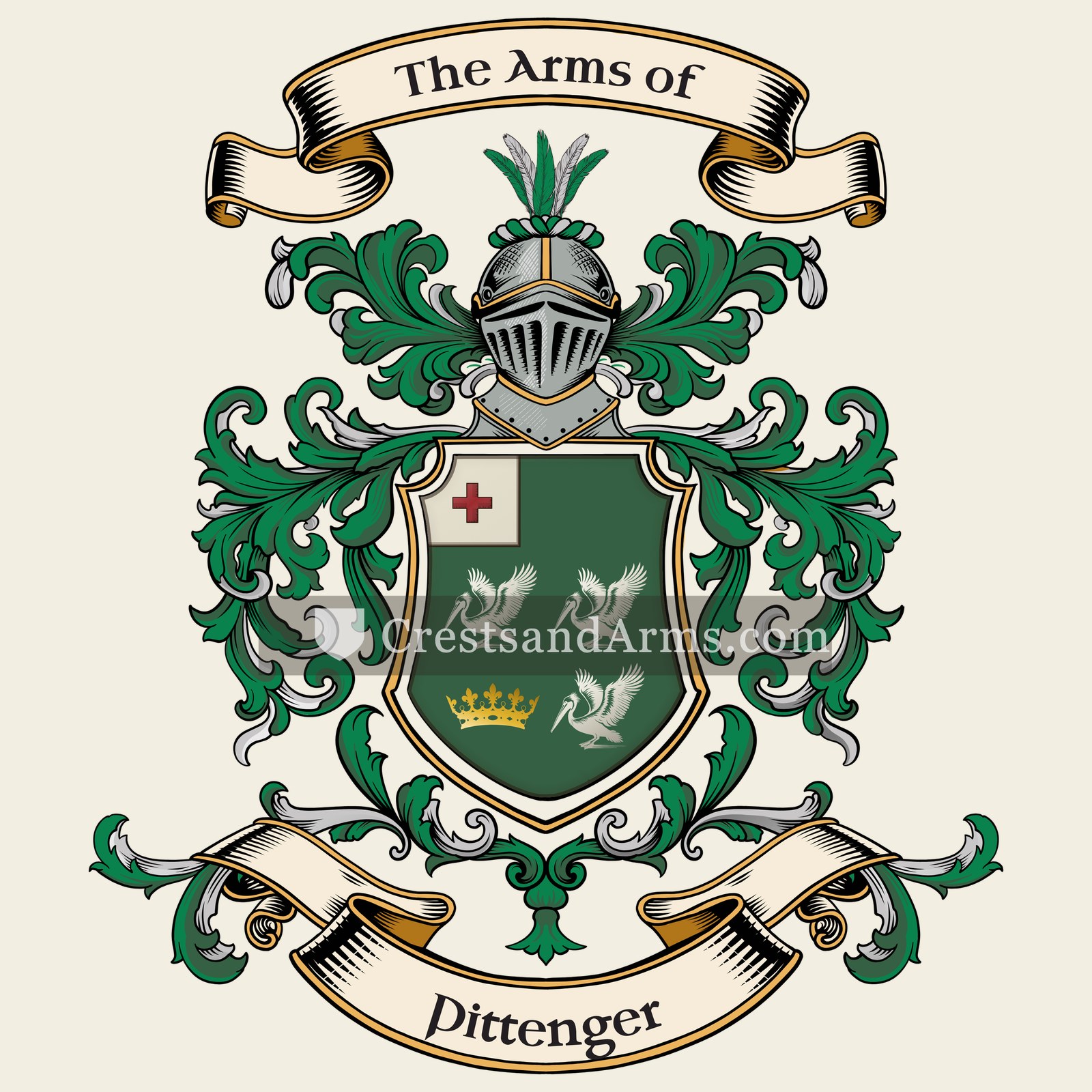
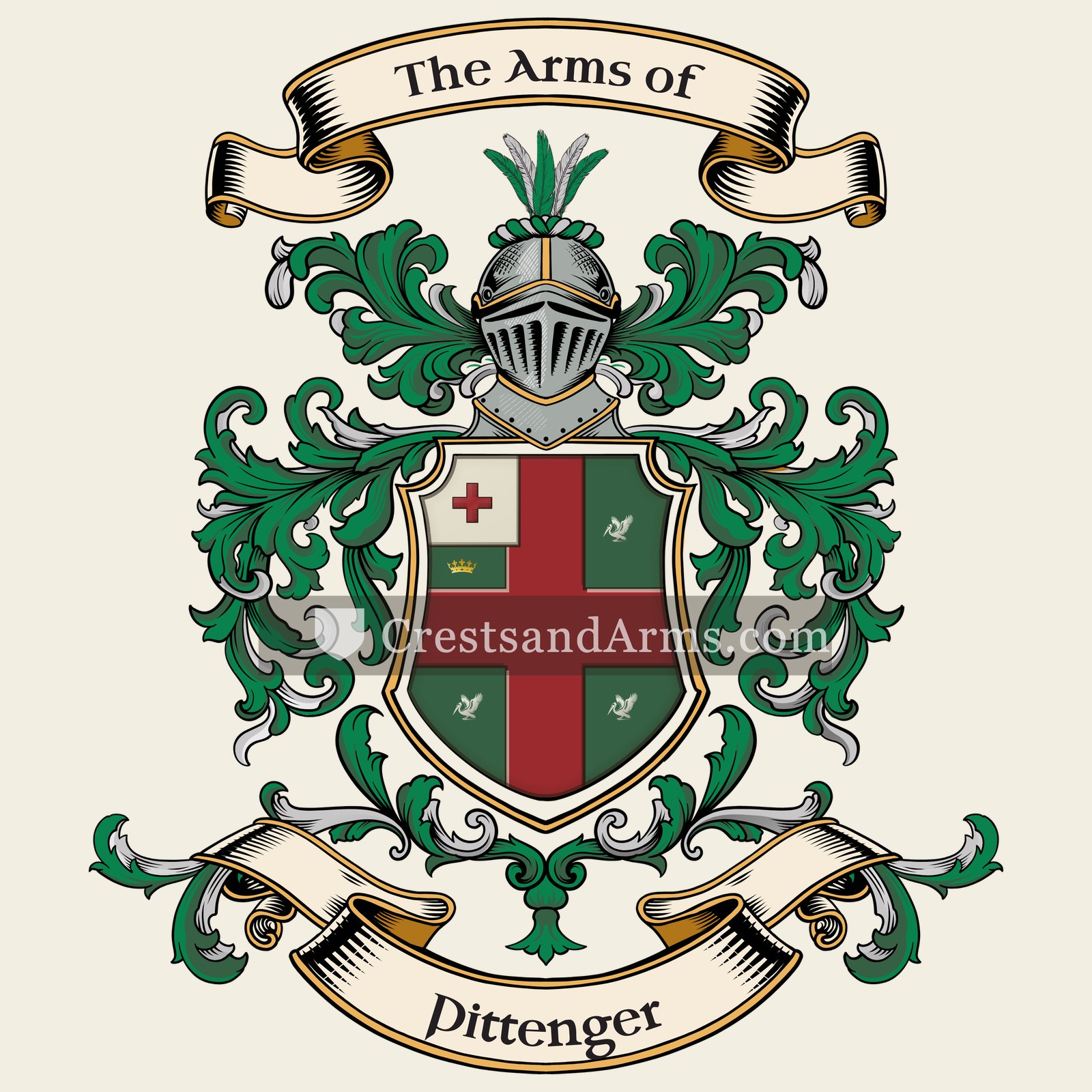
A record of documented arms, meaning and origin, researched for the Pittenger family lines. Documented in 2 countries.
Reg. 9173 · Britain, P–S
Coat of Arms & Family Crest Details
Symbols on this shield
cantonA mark of honour granted by the sovereign
cross symbolChristian faith and service
crownSovereignty, authority and just reward
pelicanSelf-sacrifice and devotion to one's children
Colours
Green (Vert)Means: Hope
Silver (Argent)Means: Peace and sincerity
Gold (Or)Means: Generosity
Red (Gules)Means: Military strength
Historical info
Source
J. B. Rietstap, Armorial Général, Gouda: G. B. van Goor Zonen, 1884–87
Blazon (the actual original written record)
“De sin. à une couronne à l'antique d'or, acc. de trois pélicans dans leurs aires au nat.; au canton d'arg., ch. d'une croix de gu. C.: un bras, arm. au nat., passé dans une couronne à l'antique de gu., la main de carn. tenant une épée d'arg, garnie d'or. T.: à dextre un mandarin chinois, tenant un rouleau de papiers; à sen. un soldat du Scinde, tenant un fusil. D.: VIRTUS IN ARDUA.”
BritainLondres, c. 1840
Digital archive packCoat of arms PNG, gold border print PDF, vector SVG and the certificate of authenticity. Sent to your email in minutes.
Map of Britain showing where the Pittenger arms are recorded
The Pittenger arms were recorded in Londres, c. 1840.
Arms such as these were typically recorded in Kent.
Kent sits between London and the short crossing to Europe, and the trade passing through made it wealthy. Merchant families bought land with that money, and it was landowners who took coats of arms.
This is where the arms were entered in the register. Families often moved to other parts of the country, so the same name can turn up in more than one region.
The body that granted and recorded arms in Britain in this period.
Victoria
Sovereign of the period
Victoria
1837–1901
Reigning in Britain when the Pittenger arms are first recorded.
How Arms Worked in Britain
English heraldry allowed arms to be shared by all legitimate descendants of the original owner. These symbols were treated as personal property that moved through the generations to all children. While the eldest son kept the original design, other family members could use the same shield without needing to change it or register their own unique versions.
Granting authority
The College of Arms in London has regulated the use of coats of arms throughout England and Wales since 1484.
How they got arms
Families typically obtained their coats of arms through a formal grant from the Crown or by proving their ancient right to them.
Where arms were recorded
All official coats of arms are recorded in the registers kept at the College of Arms, which date back to the fifteenth century.
The family's standing
Recorded among the armigerous families of Britain.
Origin & History of the Pittenger Family in Britain
The surname Pittenger is deeply rooted in the historical landscape of southeastern England, particularly within the county of Kent. While the name likely evolved from local geographic markers or descriptive terms used to identify early residents, it became firmly established in the rural communities of Kent by the early nineteenth century. Families bearing this name were often integrated into the agricultural and parish life of the region, where they lived as part of the local working population. By 1840, official census records and parish registers confirm that the Pittenger family was well-settled in Kent, participating in the daily rhythms of village life during a period of significant social and industrial change in Britain. These early records provide a clear link to the family's presence in the English countryside, marking them as a stable part of the local community long before many members began to migrate further afield.
Coat of Arms & Family Crest Details
Symbols on this shield
cantonA mark of honour granted by the sovereign
cross symbolChristian faith and service
crownSovereignty, authority and just reward
pelicanSelf-sacrifice and devotion to one's children
Colours
Green (Vert)Means: Hope
Red (Gules)Means: Military strength
Silver (Argent)Means: Peace and sincerity
Gold (Or)Means: Generosity
Historical info
Source
Sir Bernard Burke, The General Armory of England, Scotland, Ireland and Wales, London: Harrison & Sons, 1884
Blazon (the actual original written record)
“Vert an Eastern crown or, betw. three pelicans in their piety ppr. on a canton ar. a cross gu”
DevonMount Pottinger · Devon, c. 1620
Digital archive packCoat of arms PNG, gold border print PDF, vector SVG and the certificate of authenticity. Sent to your email in minutes.
Map of England showing where the Pittenger arms are recorded
The Pittenger arms were recorded in Devon, c. 1620.
Devon was a county of small manors and seafaring families. Its gentry were spread thickly across the countryside, and money made at sea often bought an estate, which in turn brought a coat of arms.
This is where the arms were entered in the register. Families often moved to other parts of the country, so the same name can turn up in more than one region.
The body that granted and recorded arms in England in this period.
James VI and I
Sovereign of the period
James VI and I
1603–1625
Reigning in Britain when the Pittenger arms are first recorded.
How Arms Worked in England
English heraldry allowed arms to be shared by all legitimate descendants of the original owner. These symbols were treated as personal property that moved through the generations to all children. While the eldest son kept the original design, other family members could use the same shield without needing to change it or register their own unique versions.
Granting authority
The College of Arms in London has regulated the use of coats of arms throughout England and Wales since 1484.
How they got arms
Families typically obtained their coats of arms through a formal grant from the Crown or by proving their ancient right to them.
Where arms were recorded
All official coats of arms are recorded in the registers kept at the College of Arms, which date back to the fifteenth century.
The family's standing
Recorded among the armigerous families of Devon.
Origin & History of the Pittenger Family in England
The Pittenger family name traces its roots to the rugged landscape of Devon, England, where the family was firmly established by the early 17th century. During this period, the name was closely tied to the rural traditions of the West Country, a region defined by its distinct agricultural practices and coastal communities. Families in this area often lived in small, tight-knit parishes where local identity was shaped by the rolling hills and the proximity to the Atlantic Ocean. By 1620, the Pittengers were part of a society undergoing significant social and economic shifts, as many families began to look toward new opportunities beyond the English coast. This era of exploration and local development suggests that the early Pittengers were likely engaged in the skilled trades or farming work that sustained Devon’s economy during the reign of King James I.
Related Branches & Arms
Root word
Pitting
Old English patronymic referring to the people or followers of Pitta.
This name
PittengerA habitational surname denoting someone who originated from a place associated with the Pitta clan.
also spelled
Pottingere
Pottynger
Potingar
Documented Sources
J. B. Rietstap, Armorial Général, Gouda: G. B. van Goor Zonen, 1884–87
The National Archives, 1841 England Census, HO 107
Kent Archives and Local History Centre, Parish Registers of Kent, P200/1/A1
Digital archive packCoat of arms PNG, gold border print PDF, vector SVG and the certificate of authenticity. Sent to your email in minutes.


 cantonA mark of honour granted by the sovereign
 cross symbolChristian faith and service
 crownSovereignty, authority and just reward
 pelicanSelf-sacrifice and devotion to one's children
 cantonA mark of honour granted by the sovereign
 cross symbolChristian faith and service
 crownSovereignty, authority and just reward
 pelicanSelf-sacrifice and devotion to one's children