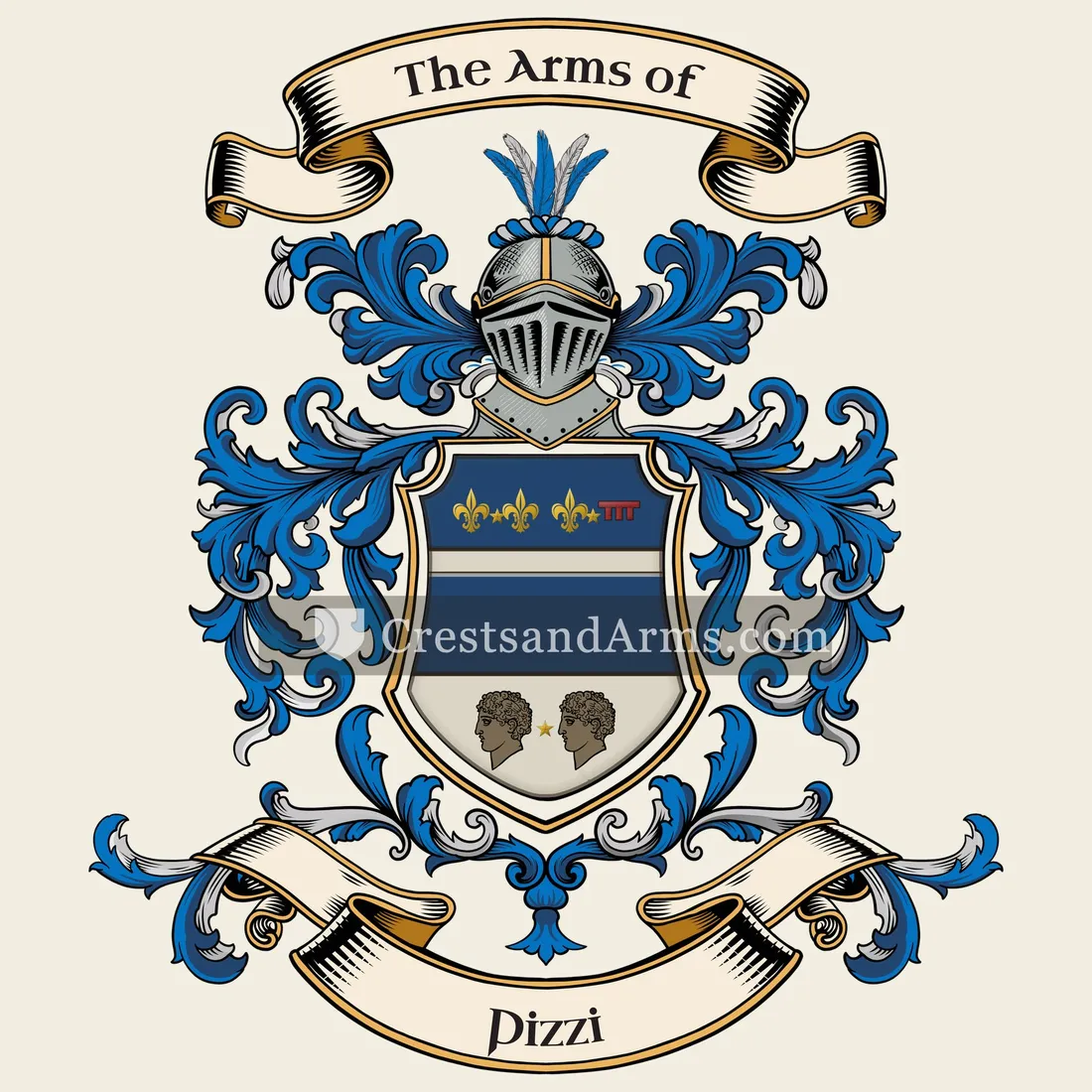
A record of documented arms, meaning and origin, researched for the Pizzi family of Italy.
Reg. 3106 · Italian, P–S
Meaning of the Pizzi family crest colors & symbols
Symbols on this shield
fessThe military belt, and readiness to serve
chiefAuthority, wisdom and dominion
labelThe eldest son, during his father's life
mulletThe third son, and a divine quality from above
savages head affrontyAn enemy overcome
fleur de lisPurity, light, and the sixth son
Colours
Silver (Argent)Means: Peace and sincerity
Blue (Azure)Means: Loyalty and truth
Gold (Or)Means: Generosity
Red (Gules)Means: Military strength
Historical info
Source
J. B. Rietstap, Armorial Général, Gouda: G. B. van Goor Zonen, 1884–87
Blazon (the actual original written record)
“D'arg. à la fasce d'azur, acc. en chef de trois étoiles (5) rangées d'or et en p. de deux têtes de More affr., les yeux bandés d'arg.; au chef d'azur, ch. de trois fleurs-de-lis d'or, rangées entre les quatre pendants d'un lambel de gu.”
ItalyBologne, c. 1775
Digital archive packCoat of arms PNG, gold border print PDF, vector SVG and the certificate of authenticity. Sent to your email in minutes.
Map of Italy showing where the Pizzi arms are recorded
The Pizzi arms were recorded in Bologne, c. 1775.
This is where the arms were entered in the register. Families often moved to other parts of the country, so the same name can turn up in more than one region.
The body that granted and recorded arms in Italy in this period.
Alvise Giovanni Mocenigo
Sovereign of the period
Alvise Giovanni Mocenigo
1763–1778
Reigning in Italy when the Pizzi arms are first recorded.
How Arms Worked in Italy
In the Italian states, coats of arms were often used by noble families to show their status and history. These symbols were passed down through the generations to all legitimate male descendants. Younger branches of a family usually kept the original design but sometimes added small changes to distinguish their specific line from the main branch.
Granting authority
Various local rulers and city governments controlled the use of coats of arms across the different Italian states.
How they got arms
Families often assumed their own arms or received them as official grants from local lords, popes, or city councils.
Where arms were recorded
Arms were recorded in local city archives or private family books rather than in one single national register.
The family's standing
Recorded among the armigerous families of Italy.
Origin & History of the Pizzi Family in Italy
The surname Pizzi finds its historical roots in the northern regions of Italy, particularly within the Emilia-Romagna area. By the late 18th century, records confirm that members of the Pizzi family were well-established residents of Bologna. The name itself is believed to have originated as a descriptive nickname, likely derived from the Italian word "pizzo," which can refer to a sharp point or a small beard. In the social context of 1775 Bologna, families with this name were often integrated into the local urban fabric, participating in the trade and civic life that defined this bustling university city. As the family grew, they became part of the long-standing cultural history of the region, contributing to the local community through their work and daily interactions in the historic streets surrounding the city center.
Pizzi Meaning & Related Branches
Root word
Pizzo
A sharp point, peak, or beak.
This name
PizziDerived from a nickname for someone with a pointed beard or a sharp facial feature.
also spelled
Pizzy
Pizzie
Pizzio
Pizzis
Pizi
Related arms
le Greslesimilar arms
Documented Sources
J. B. Rietstap, Armorial Général, Gouda: G. B. van Goor Zonen, 1884–87
Dante Olivieri, Dizionario dei cognomi italiani, 1965
Emidio De Felice, Dizionario dei cognomi italiani, 1978
Archivio di Stato di Bologna, Stato civile della Restaurazione, 1815–1865
Digital archive packCoat of arms PNG, gold border print PDF, vector SVG and the certificate of authenticity. Sent to your email in minutes.


 fessThe military belt, and readiness to serve
 chiefAuthority, wisdom and dominion
 labelThe eldest son, during his father's life
 mulletThe third son, and a divine quality from above
 savages head affrontyAn enemy overcome
 fleur de lisPurity, light, and the sixth son
 fessThe military belt, and readiness to serve
 chiefAuthority, wisdom and dominion
 labelThe eldest son, during his father's life
 mulletThe third son, and a divine quality from above
 savages head affrontyAn enemy overcome
 fleur de lisPurity, light, and the sixth son