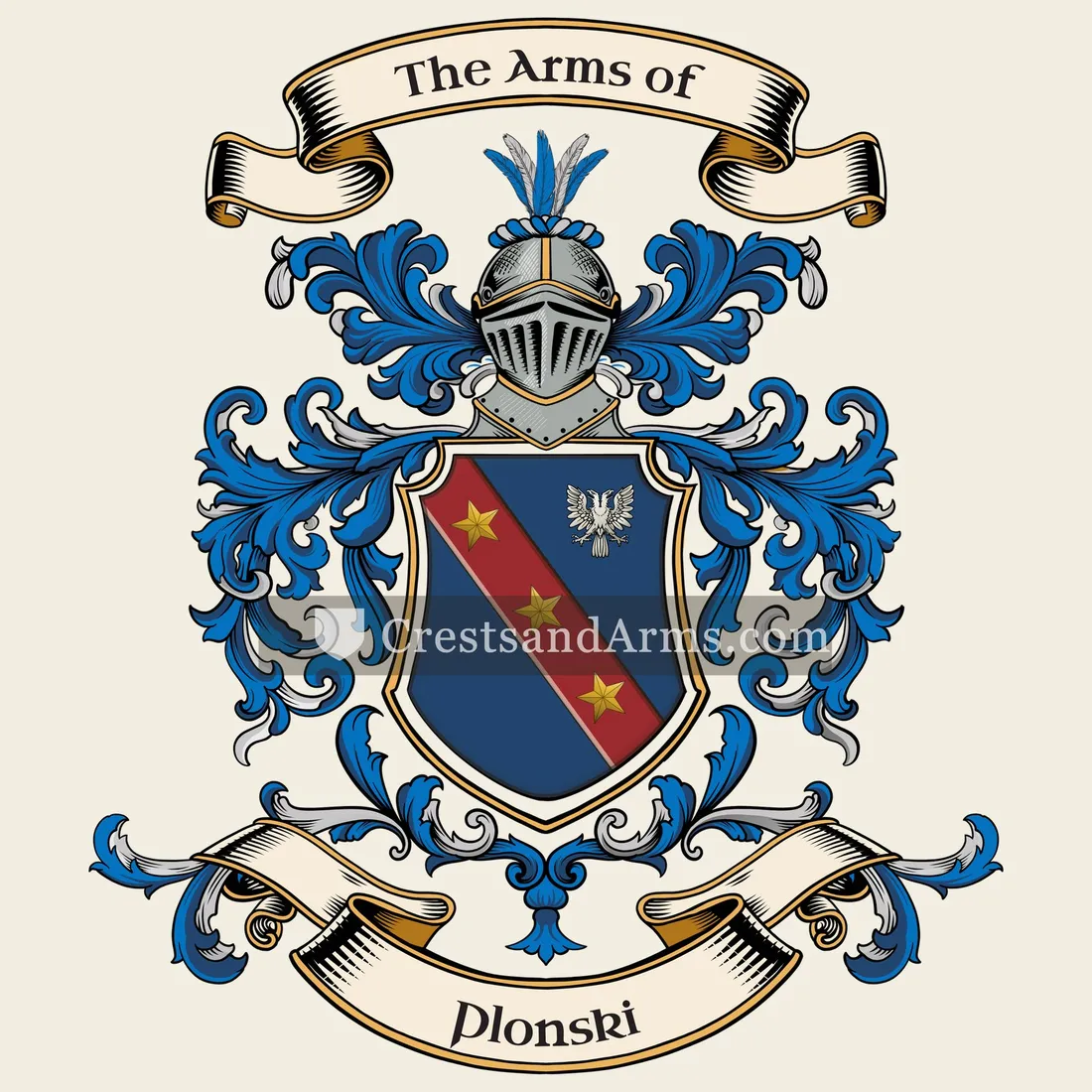
A record of documented arms, meaning and origin, researched for the Plonski family of Germany.
Reg. 0707 · German, P–S
Meaning of the Plonski family crest colors & symbols
Symbols on this shield
bendDefence, and the scarf of a commander
eagleNobility, strength and a keen mind
mulletThe third son, and a divine quality from above
Colours
Blue (Azure)Means: Loyalty and truth
Red (Gules)Means: Military strength
Silver (Argent)Means: Peace and sincerity
Gold (Or)Means: Generosity
Historical info
Source
J. B. Rietstap, Armorial Général, Gouda: G. B. van Goor Zonen, 1884–87
Blazon (the actual original written record)
“D'azur à l'aigle ép. d'arg., bq. et m. d'or; à la bande de gu. ch. de trois étoiles d'or et br. sur le tout. Cq. cour. C.: un vol, d'azur et de gu., chaque aile ch. d'une étoile d'or. L.: d'arg. et d'azur.”
Germanyc. 1719
Digital archive packCoat of arms PNG, gold border print PDF, vector SVG and the certificate of authenticity. Sent to your email in minutes.
Map of Germany showing where the Plonski arms are recorded
The Plonski arms were recorded in Germany, c. 1719.
Arms such as these were typically recorded in Bavaria.
Bavaria was a country of old landed families and walled market towns. Estates passed down the same line for centuries, and both the landowners and the leading townsmen kept arms, which is why so many Bavarian names sit in the registers.
This is where the arms were entered in the register. Families often moved to other parts of the country, so the same name can turn up in more than one region.
The body that granted and recorded arms in Germany in this period.
Charles VI, Holy Roman Emperor
Sovereign of the period
Charles VI, Holy Roman Emperor
1711–1740
Reigning in Germany when the Plonski arms are first recorded.
How Arms Worked in Germany
In the Holy Roman Empire, coats of arms were often granted to individuals by the Emperor or his representatives. These arms were then passed down through the generations to all legitimate descendants of the original holder. Younger branches of a family usually kept the same shield design without needing to change it, as the arms belonged to the entire lineage.
Granting authority
The Holy Roman Emperor held the sole power to grant new coats of arms throughout his vast imperial territories.
How they got arms
Families typically obtained their coats of arms through a formal imperial grant or by proving their noble status to the authorities.
Where arms were recorded
These grants were officially recorded in the Imperial Chancery registers, which began keeping formal records of such honors during the Middle Ages.
The family's standing
Recorded among the armigerous families of Germany.
Origin & History of the Plonski Family in Germany
The surname Plonski is rooted in the linguistic traditions of Central Europe, where it functioned as a locative name. This means the name was likely adopted by individuals to identify the specific village or region from which they originated. By the early 18th century, records confirm that members of the family were established in the Bavarian region of Germany. Life for the family in 1719 would have been defined by the agricultural rhythms of the Holy Roman Empire, where most families lived in small, tight-knit rural communities. As the family grew, the name served as a vital link to their ancestral home, helping to distinguish their lineage as they navigated the social and economic changes of the 1700s. Through these early generations, the name became a permanent marker of their identity and their long-standing presence in the Bavarian landscape.
Plonski Meaning & Related Branches
Root word
Plon
A Slavic term referring to a flat, open field or plain.
This name
PlonskiA topographic name for someone who lived on or near a flat, open plain.
also spelled
Plonsky
Related arms
Allisimilar arms
Baursimilar arms
Hess de Hessenthalsimilar arms
Documented Sources
J. B. Rietstap, Armorial Général, Gouda: G. B. van Goor Zonen, 1884–87


 bendDefence, and the scarf of a commander
 eagleNobility, strength and a keen mind
 mulletThe third son, and a divine quality from above
 bendDefence, and the scarf of a commander
 eagleNobility, strength and a keen mind
 mulletThe third son, and a divine quality from above