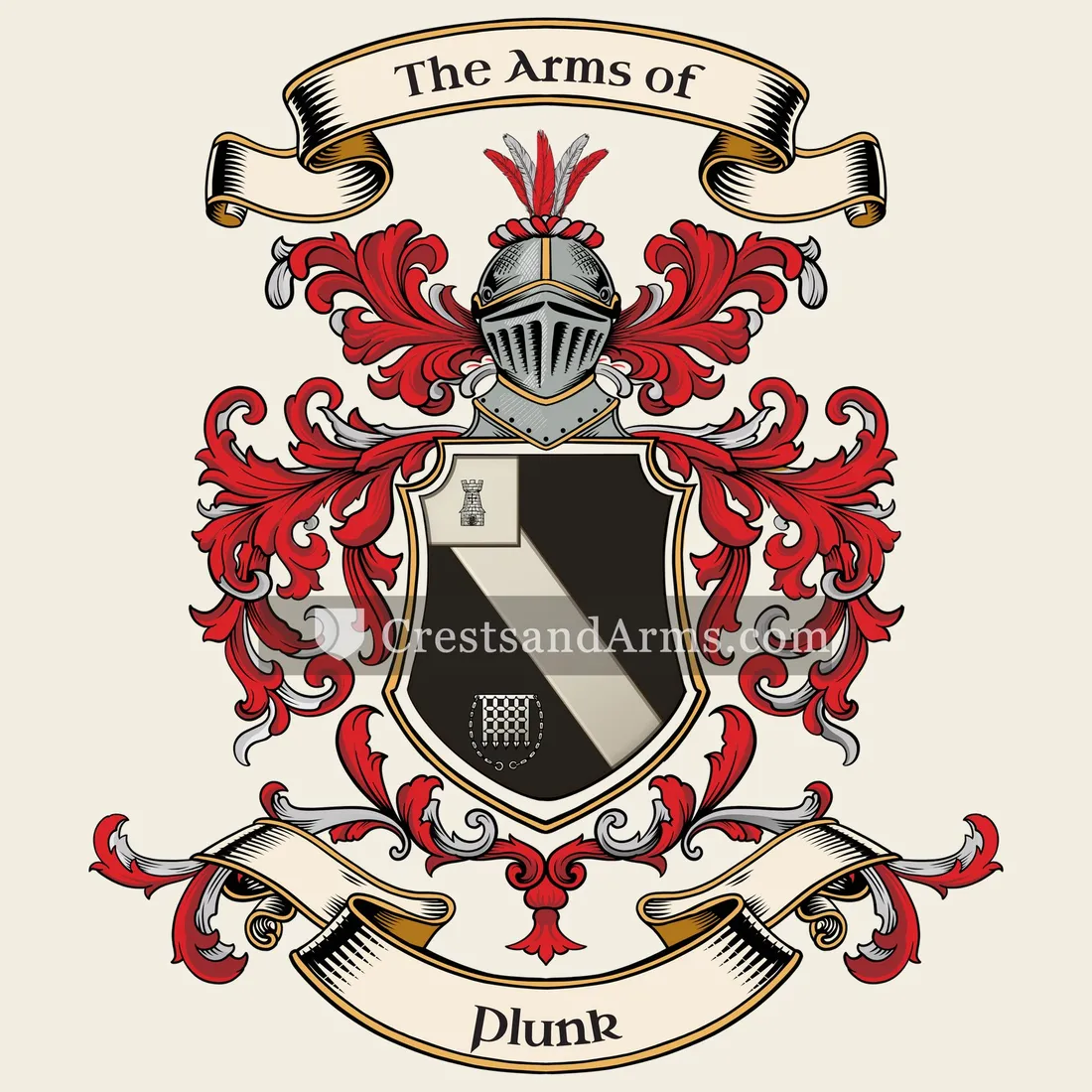
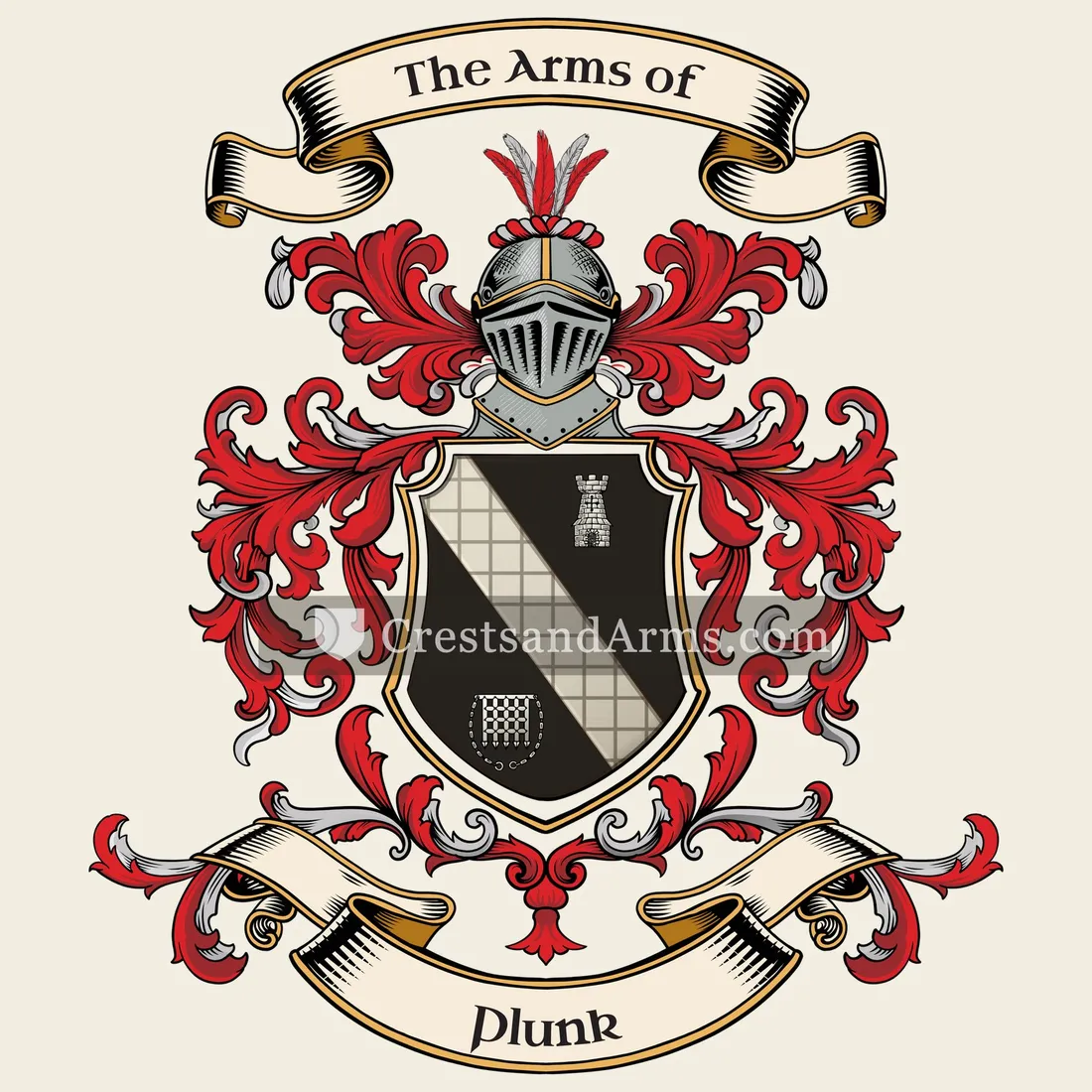
A record of documented arms, meaning and origin, researched for the Plunk family lines. Documented in 2 countries.
Reg. 7695 · French, P–S
Meaning of the Plunk family crest colors & symbols
Symbols on this shield
bendDefence, and the scarf of a commander
cantonA mark of honour granted by the sovereign
towerGrandeur and solidity, and a stronghold defended
portcullisProtection of the household, and the guarded gate
Colours
Black (Sable)Means: Constancy
Silver (Argent)Means: Peace and sincerity
Historical info
Source
J. B. Rietstap, Armorial Général, Gouda: G. B. van Goor Zonen, 1884–87
Blazon (the actual original written record)
“De sa. à la bande, acc. au canton sen. du chef d'une tour sommée de trois tourelles et en p. d'une herse sarasine, le tout d'arg. C.: un cheval pass. d'arg., l'épaule ch. d'une herse sarasine de sa. S.: une antelope au nat. et un cheval d'arg., chacun sur l'épaule d'une herse sarasine de sa. D.: FESTINA LENTE.”
Francec. 1827
Digital archive packCoat of arms PNG, gold border print PDF, vector SVG and the certificate of authenticity. Sent to your email in minutes.
Map of France showing where the Plunk arms are recorded
The Plunk arms were recorded in France, c. 1827.
Arms such as these were typically recorded in Bretagne.
More families held coats of arms in Bretagne than anywhere else in France. The land was divided into many small estates rather than a few large ones, so far more households counted as gentry, and each needed a shield of its own to be told apart.
This is where the arms were entered in the register. Families often moved to other parts of the country, so the same name can turn up in more than one region.
The body that granted and recorded arms in France in this period.
Charles X of France
Sovereign of the period
Charles X of France
1824–1830
Reigning in France when the Plunk arms are first recorded.
How Arms Worked in France
In France, a coat of arms was a mark of honor that passed down through the male line to all legitimate descendants. Families often used the same shield without changes to show their shared heritage. If a branch wanted to stand out, they could add a small mark to their shield to show their specific place in the family tree.
Granting authority
The Juge d'armes de France acted as the official authority that regulated and verified coats of arms across the country.
How they got arms
Families typically inherited their arms from ancestors, though they could also receive them through royal grants or by proving their noble status.
Where arms were recorded
Coats of arms were officially recorded in the Armorial Général de France, which began its main collection in the year 1696.
The family's standing
Recorded among the armigerous families of France.
Origin & History of the Plunk Family in France
The family name Plunk traces its roots to the coastal region of Bretagne in northwestern France. By the early 19th century, records confirm that members of the family were established in this area. Bretagne was a unique part of France because it maintained a distinct cultural identity and language separate from the rest of the country. Families living there during the 1820s often worked in maritime trades or small-scale agriculture due to the rugged landscape and proximity to the Atlantic Ocean. The Plunk family likely participated in the local community life of this region, which was undergoing significant social changes following the end of the Napoleonic era. While the name is relatively rare, its presence in Breton civil and parish registers provides a clear link to the social fabric of 19th-century France. These early ancestors lived through a time when the French government was working to standardize national records, which helped preserve the history of families like the Plunks for future generations.
Meaning of the Plunk family crest colors & symbols
Symbols on this shield
bendDefence, and the scarf of a commander
towerGrandeur and solidity, and a stronghold defended
portcullisProtection of the household, and the guarded gate
Colours
Black (Sable)Means: Constancy
Silver (Argent)Means: Peace and sincerity
Historical info
Source
Sir Bernard Burke, The General Armory of England, Scotland, Ireland and Wales, London: Harrison & Sons, 1884
Blazon (the actual original written record)
“Sa. a bend betw. a castle in chief and a portcullis in base ar”
Irelandc. 1645
Digital archive packCoat of arms PNG, gold border print PDF, vector SVG and the certificate of authenticity. Sent to your email in minutes.
Map of Ireland showing where the Plunk arms are recorded
The Plunk arms were recorded in Ireland, c. 1645.
Arms such as these were typically recorded in Dublin.
Dublin was the seat of government in Ireland and the place where grants were sought and recorded. Families with business at the castle or the courts settled nearby, and settling there put their arms on record.
This is where the arms were entered in the register. Families often moved to other parts of the country, so the same name can turn up in more than one region.
The body that granted and recorded arms in Ireland in this period.
Charles I of England
Sovereign of the period
Charles I of England
1625–1649
Reigning in France when the Plunk arms are first recorded.
How Arms Worked in Ireland
The Ulster King of Arms granted coats of arms to individuals who proved their social standing and good character. These symbols were typically inherited by all legitimate descendants of the original holder. If a family branch wanted a unique look, they could apply for a specific change to their design through the office to ensure their identity remained distinct.
Granting authority
The Ulster King of Arms acted as the official body that regulated and issued all coats of arms throughout Ireland.
How they got arms
Families obtained their arms through formal grants issued by the office after proving their eligibility and paying the required fees.
Where arms were recorded
All official grants were recorded in the registers held by the Ulster King of Arms starting from the year 1552.
The family's standing
Recorded among the armigerous families of Ireland.
Origin & History of the Plunk Family in Ireland
The history of the Plunk family in Ireland is deeply connected to the social and political shifts of the seventeenth century. By 1645, members of the family were well-established in Dublin, a city that served as the center of administration and trade during a period of intense religious and civil conflict. The name likely emerged from a blend of local linguistic influences, reflecting the diverse population of the Pale, which was the area around Dublin under English control. Families like the Plunks often navigated complex land laws and shifting political loyalties to maintain their status in the capital. Their presence in Dublin during this era suggests they were part of the urban middle class or minor gentry who played a role in the city's economic life. As the century progressed, the family had to adapt to the changing landscape of Irish society following the Cromwellian conquest and the subsequent restoration of the monarchy.
Plunk Meaning & Related Branches
Root word
Planche
A wooden board or plank used in construction.
This name
PlunkA topographic surname for someone who lived near a wooden bridge or plank walkway.
also spelled
Plunkit
Plunkett
Plonket
Plonkett
Documented Sources
J. B. Rietstap, Armorial Général, Gouda: G. B. van Goor Zonen, 1884–87
Archives départementales du Finistère, État civil (1827)
Le Moyne de La Borderie, Arthur, Histoire de Bretagne, 1896
Minois, Georges, Nouvelle histoire de la Bretagne, 1992
Digital archive packCoat of arms PNG, gold border print PDF, vector SVG and the certificate of authenticity. Sent to your email in minutes.


 bendDefence, and the scarf of a commander
 cantonA mark of honour granted by the sovereign
 towerGrandeur and solidity, and a stronghold defended
 portcullisProtection of the household, and the guarded gate
 bendDefence, and the scarf of a commander
 cantonA mark of honour granted by the sovereign
 towerGrandeur and solidity, and a stronghold defended
 portcullisProtection of the household, and the guarded gate