Map of Italy showing where the Plush arms are recorded
The Plush arms were recorded in Rome, c. 1775.
This is where the arms were entered in the register. Families often moved to other parts of the country, so the same name can turn up in more than one region.
The body that granted and recorded arms in Italy in this period.
Alvise Giovanni Mocenigo
Sovereign of the period
Alvise Giovanni Mocenigo
1763–1778
Reigning in Italy when the Plush arms are first recorded.
How Arms Worked in Italy
In the Italian states, coats of arms were often used by noble families to show their status and history. These symbols were passed down through the generations to all legitimate male descendants. Younger branches of a family usually kept the original design but sometimes added small changes to distinguish their specific line from the main branch.
Granting authority
Various local rulers and city governments controlled the use of coats of arms across the different Italian states.
How they got arms
Families often assumed their own arms or received them as official grants from local lords, popes, or city councils.
Where arms were recorded
Arms were recorded in local city archives or private family books rather than in one single national register.
The family's standing
Recorded among the armigerous families of Italy.
Origin & History of the Plush Family in Italy
The history of the Plush family in Italy is deeply tied to the vibrant social landscape of Rome during the late eighteenth century. By 1775, members of the family were already established residents within the city, a time when Rome was a major center for European culture and religious administration. Families living in the city during this period often navigated a complex world of guild memberships, parish record-keeping, and local trade networks that defined their daily lives. The name itself likely evolved through the regional dialects of the Italian peninsula, reflecting the linguistic shifts common among families living in urban centers. As residents of Rome, the early Plush family would have witnessed the significant political and social transitions that characterized the city before the turn of the century. Their presence in the historical record during this era suggests they were part of the steady stream of citizens who contributed to the unique identity of the Roman population.
Meaning of the Plush family crest colors & symbols
Symbols on this shield
fessThe military belt, and readiness to serve
chequyConstancy, and the counting-board
cross symbolChristian faith and service
fleur de lisPurity, light, and the sixth son
roundelA coin, and one who has been to the crusades
mulletThe third son, and a divine quality from above
lionCourage, strength and royalty
roseThe seventh son, and beauty with grace
Colours
Red (Gules)Means: Military strength
Gold (Or)Means: Generosity
Blue (Azure)Means: Loyalty and truth
Historical info
Source
J. B. Rietstap, Armorial Général, Gouda: G. B. van Goor Zonen, 1884–87
Blazon (the actual original written record)
“Ec.: aux 1 et 4 taillé de gu. sur or; au léopard lionné de l'un à l'autre; aux 2 et 3 d'arg. à la fasce échiq. d'or et d'azur, acc. de trois roses de gu. A une croix d'azur, br. sur l'écartelé, chaque bras ch. de deux fleurs-de-lis d'or. Sur le tout d'azur à une partie d'un globe terrestre artificiel, mouv. du canton sen. de la p. et dirigé vers une étoile polaire d'or, posée au canton dextre du chef. Trois cq. cour. C.: 1° un griffon iss. d'arg.; 2° un vol d'azur semé d'étoiles (5) d'or; 3° trois pl. d'aut., une d'arg. entre deux de gu., ch. chacune en haut d'une rose de l'un à l'autre.”
Swedenc. 1700
Digital archive packCoat of arms PNG, gold border print PDF, vector SVG and the certificate of authenticity. Sent to your email in minutes.
Map of Sweden showing where the Plush arms are recorded
The Plush arms were recorded in Sweden, c. 1700.
Arms such as these were typically recorded in Stockholm.
Stockholm held the Swedish court and the House of Nobility, where every noble family's arms were entered and kept. Families ennobled for service registered there, which is why so many are recorded around the city.
This is where the arms were entered in the register. Families often moved to other parts of the country, so the same name can turn up in more than one region.
The body that granted and recorded arms in Sweden in this period.
Carl XII of Sweden
Sovereign of the period
Carl XII of Sweden
1697–1718
Reigning in Italy when the Plush arms are first recorded.
How Arms Worked in Sweden
In Sweden, a coat of arms belonged to a noble family as a whole rather than just one individual. These arms were passed down through the generations to all legitimate descendants. Younger branches of the family used the same shield without needing to change it. This system ensured that the entire lineage shared the same identity and status under the law.
Granting authority
The Riddarhuset, or House of Nobility, regulated all noble coats of arms in Sweden under royal authority.
How they got arms
Families received their coats of arms through royal grants of nobility which were then officially registered with the House.
Where arms were recorded
Coats of arms were officially recorded in the Swedish House of Nobility register starting in the year 1626.
The family's standing
Recorded among the armigerous families of Sweden.
Origin & History of the Plush Family in Sweden
The history of the Plush family in Sweden begins in the bustling urban environment of Stockholm during the early 1700s. At this time, Stockholm was a growing center of trade and administration, attracting individuals from various professional backgrounds to settle within its walls. The name likely emerged as a descriptive identifier during this period of rapid social change. Families living in the capital during the eighteenth century often navigated a society defined by strict social hierarchies and the influence of the Swedish Church. As residents of a major port city, early members of the family were positioned at the heart of the nation’s economic life. While the name remains rare, its presence in the capital suggests that these early ancestors were part of the foundational fabric of Stockholm as it transitioned into a modern European city.
Plush Meaning & Related Branches
Root word
Pluvia
Latin term referring to rain or falling water.
This name
PlushA topographical or occupational surname likely denoting someone living near a rainy area or a water source.
also spelled
Pollus
Documented Sources
J. B. Rietstap, Armorial Général, Gouda: G. B. van Goor Zonen, 1884–87
Archivio di Stato di Roma, Stato delle Anime, 1775
Delumeau, Jean, Vie économique et sociale de Rome dans la seconde moitié du XVIe siècle, 1957
Visceglia, Maria Antonietta, Roma papale: Potere, famiglia e curia, 2002
Digital archive packCoat of arms PNG, gold border print PDF, vector SVG and the certificate of authenticity. Sent to your email in minutes.


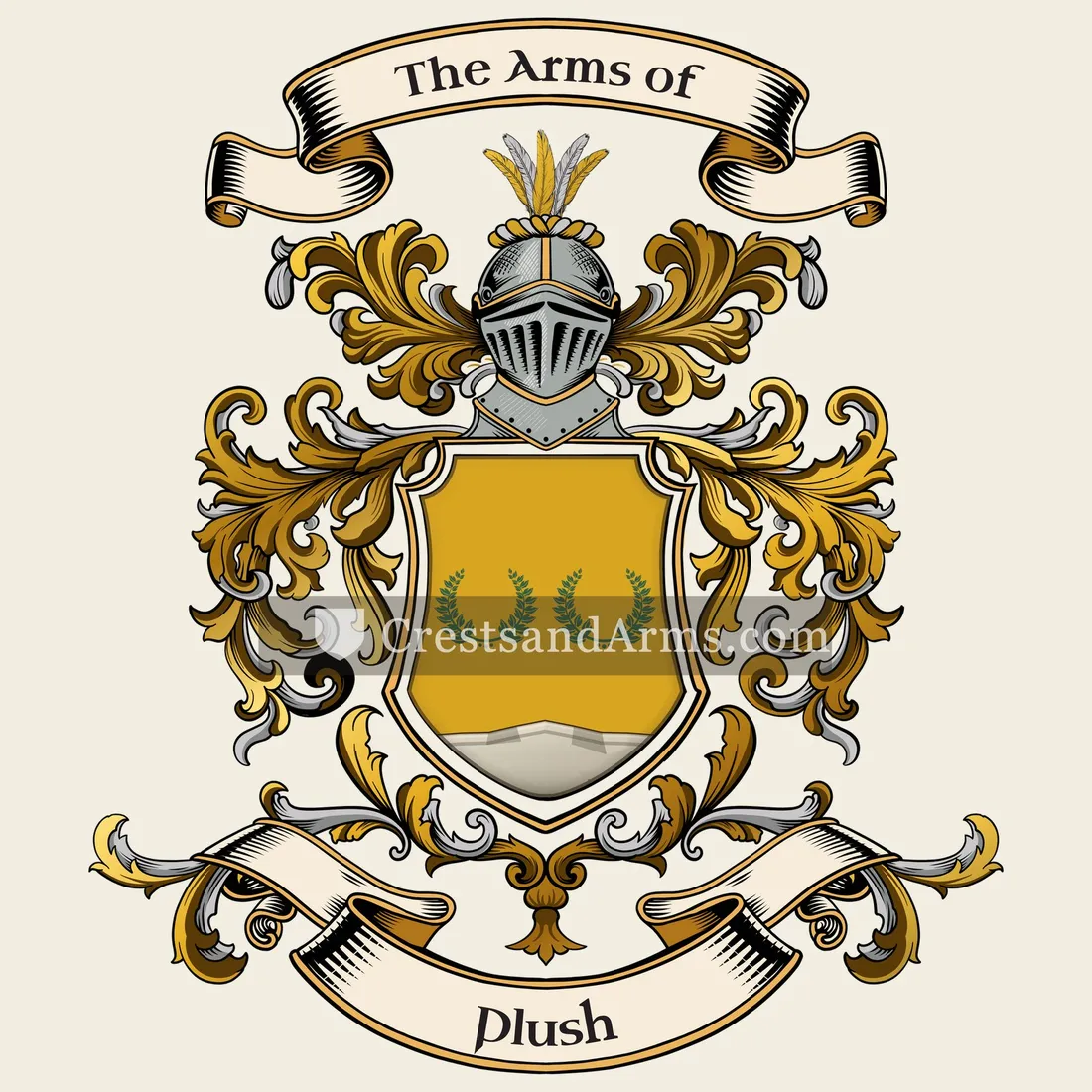
 mountThe ground held, and steadfastness upon it
 wreathHonour, and a victory crowned
 mountThe ground held, and steadfastness upon it
 wreathHonour, and a victory crowned


 fessThe military belt, and readiness to serve
 chequyConstancy, and the counting-board
 cross symbolChristian faith and service
 fleur de lisPurity, light, and the sixth son
 roundelA coin, and one who has been to the crusades
 mulletThe third son, and a divine quality from above
 lionCourage, strength and royalty
 roseThe seventh son, and beauty with grace