Map of Norway showing where the Pluto arms are recorded
The Pluto arms were recorded in Norvège, c. 1605.
Arms such as these were typically recorded in Oslo.
Oslo held the Norwegian court and the offices that went with it. Norway's landed families were few and most held some post under the crown, and a post of that kind was what brought a shield.
This is where the arms were entered in the register. Families often moved to other parts of the country, so the same name can turn up in more than one region.
The body that granted and recorded arms in Norway in this period.
Christian IV of Denmark
Sovereign of the period
Christian IV of Denmark
1588–1648
Reigning in Norway when the Pluto arms are first recorded.
How Arms Worked in Norway
Norwegian families often assumed their own coats of arms freely without needing official permission from the crown. These symbols functioned as personal seals for merchants and farmers rather than just marks of nobility. Families passed these designs through generations as private property. When branches split, they frequently modified the original colors or shapes to create distinct versions for their own use.
Granting authority
The Norwegian royal chancery oversaw the formal recognition of noble status and the official registration of coats of arms.
How they got arms
Most families simply adopted their own unique designs to use on seals and property, though some sought royal confirmation.
Where arms were recorded
Official records of noble arms were kept in the royal chancery archives, which began documenting these grants during the union period.
The family's standing
Recorded among the armigerous families of Norway.
Origin & History of the Pluto Family in Norway
The history of the Pluto family name in Norway is deeply connected to the urban development of Oslo during the early seventeenth century. Records confirm that members of the family were established residents of the city by 1605, a time when Oslo was undergoing significant administrative and social changes under Danish rule. The name itself is quite distinct, as it does not follow the traditional patronymic naming patterns common in Norway at the time, which usually relied on a father’s first name followed by "sen" or "datter." Instead, the use of a fixed surname suggests that the family may have held a specific professional status or originated from a different cultural background within the broader Baltic or North Sea trade network. By maintaining this unique identifier in the official city registers, the early Pluto family stood out among their contemporaries, marking them as a notable part of the capital’s growing merchant and artisan class during the transition into the modern era.
Pluto Meaning & Related Branches
Root word
Ploutos
Ancient Greek term referring to wealth, riches, or abundance.
This name
PlutoDerived from the Roman god of the underworld, symbolizing hidden wealth and subterranean riches.
also spelled
Plutte
Pluth
Pluthe
Documented Sources
J. B. Rietstap, Armorial Général, Gouda: G. B. van Goor Zonen, 1884–87
Oslo City Archives (Oslo byarkiv), Oslo bys regnskaper (1605)
The National Archives of Norway (Arkivverket), Rentekammeret, Stattholderarkivet
Bull, Edvard, Oslos historie: Bind 1, 1922
Schia, Erik, Oslo innerst i Viken: Liv og virke i middelalderbyen, 1991
Digital archive packCoat of arms PNG, gold border print PDF, vector SVG and the certificate of authenticity. Sent to your email in minutes.


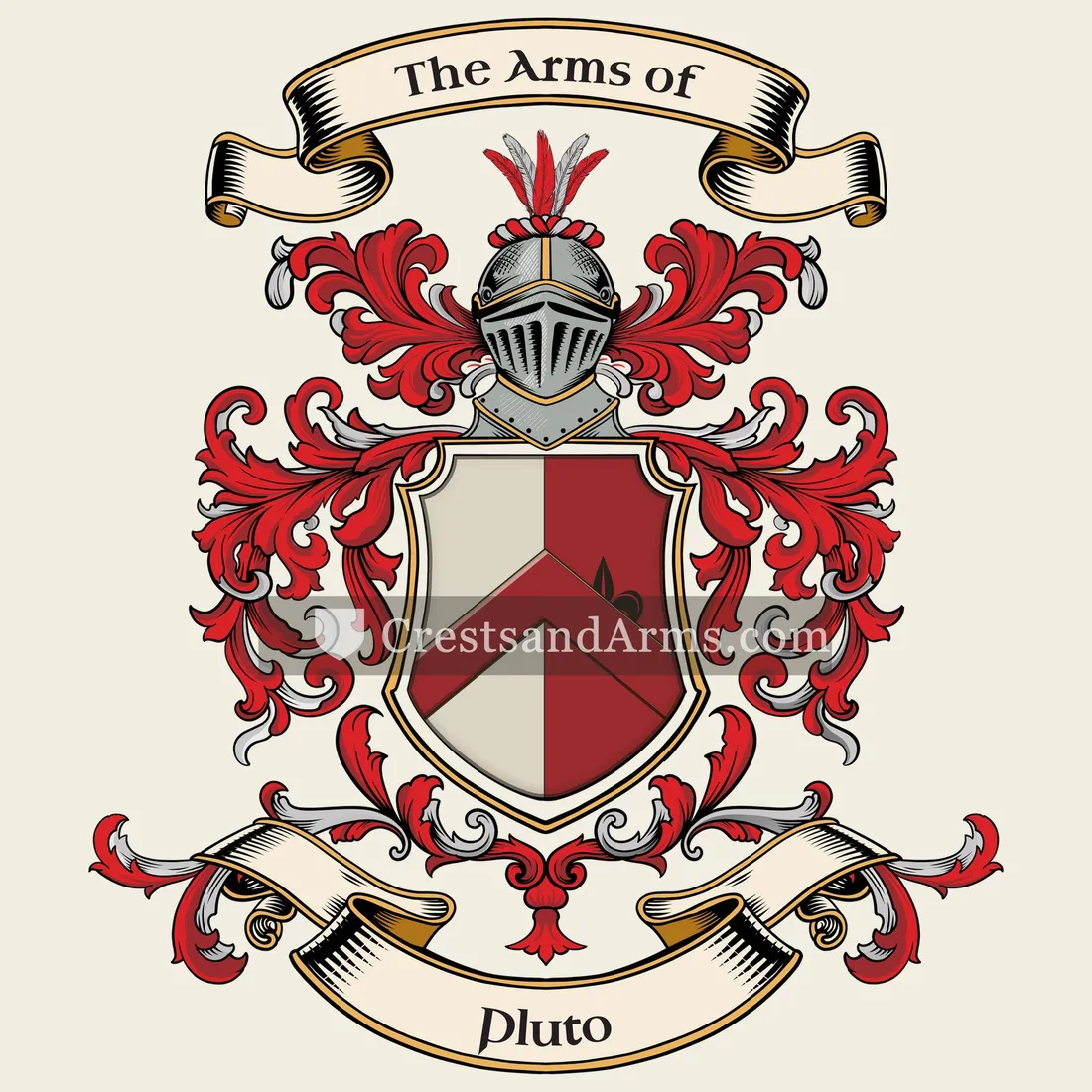
 chevronProtection, and faithful service completed
 fleur de lisPurity, light, and the sixth son
 chevronProtection, and faithful service completed
 fleur de lisPurity, light, and the sixth son