A record of documented arms, meaning and origin, researched for the Pohlman family lines. Documented in 2 countries.
Reg. 5884 · Russian, P–S
Meaning of the Pohlman family crest colors & symbols
Symbols on this shield
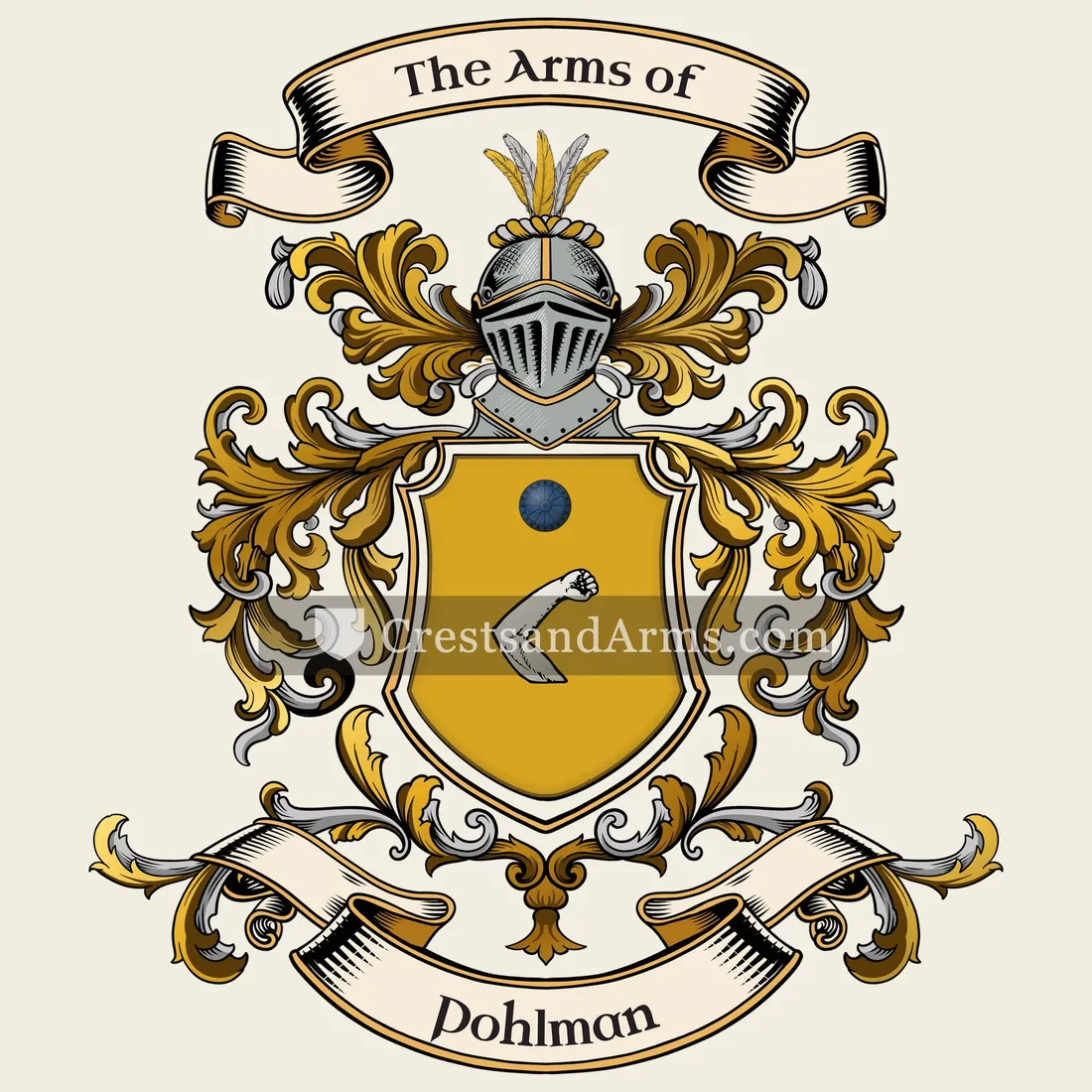
armA person of action, industrious and laborious
roundelA coin, and one who has been to the crusades
Colours
Gold (Or)Means: Generosity
Silver (Argent)Means: Peace and sincerity
Blue (Azure)Means: Loyalty and truth
Historical info
Source
J. B. Rietstap, Armorial Général, Gouda: G. B. van Goor Zonen, 1884–87
Blazon (the actual original written record)
“D'or à un senestrochère, arm. d'arg., la main de carn. supp. une boule d'azur. C.: trois glands d'or, mouv. de deux tiges effeuillées de sin., entre un vol de sa.”
RussiaEsthonie, c. 1784
Digital archive packCoat of arms PNG, gold border print PDF, vector SVG and the certificate of authenticity. Sent to your email in minutes.
Map of Russia showing where the Pohlman arms are recorded
The Pohlman arms were recorded in Esthonie, c. 1784.
Arms such as these were typically recorded in Moscow.
Moscow held the Russian court, and rank there came from service rather than land. Families who served the Tsar were entered in the registers of nobility, and that entry is where their arms are recorded.
This is where the arms were entered in the register. Families often moved to other parts of the country, so the same name can turn up in more than one region.
The body that granted and recorded arms in Russia in this period.
Catherine II of Russia
Sovereign of the period
Catherine II of Russia
1762–1796
Reigning in Russia when the Pohlman arms are first recorded.
How Arms Worked in Russia
Russian heraldry was strictly tied to the nobility and the state service system. Families proved their ancient status or earned new rank to receive an official grant from the Tsar. These symbols were then inherited by all legitimate children of the noble line. If a family lacked proof of their status, they were often excluded from the official records entirely.
Granting authority
The Herald Master's Office acted as the central state body that strictly regulated and verified all noble heraldic symbols.
How they got arms
Families typically received their arms through a formal state grant or by proving their noble status to the government authorities.
Where arms were recorded
All approved coats of arms were officially recorded in the General Armorial of the Noble Families of the Russian Empire starting in 1797.
The family's standing
Recorded among the armigerous families of Russia.
Origin & History of the Pohlman Family in Russia
The history of the Pohlman family in Russia is deeply connected to the movement of skilled professionals across Europe during the eighteenth century. By 1784, records confirm that members of the family were already established in Moscow, a city that served as a major hub for foreign merchants, craftsmen, and intellectuals seeking new opportunities under the Russian Empire. The name itself originates from German roots, likely describing someone who lived near a pool or a marshy area. As these individuals settled in Russia, they often integrated into the local urban society by contributing their expertise to the growing administrative and commercial sectors of the capital. Over time, the family became part of the diverse cultural fabric of Moscow, adapting to the Russian language and customs while maintaining their distinct ancestral identity. This transition highlights how families of European descent helped shape the professional landscape of Russia during a period of significant modernization.
Meaning of the Pohlman family crest colors & symbols
Symbols on this shield
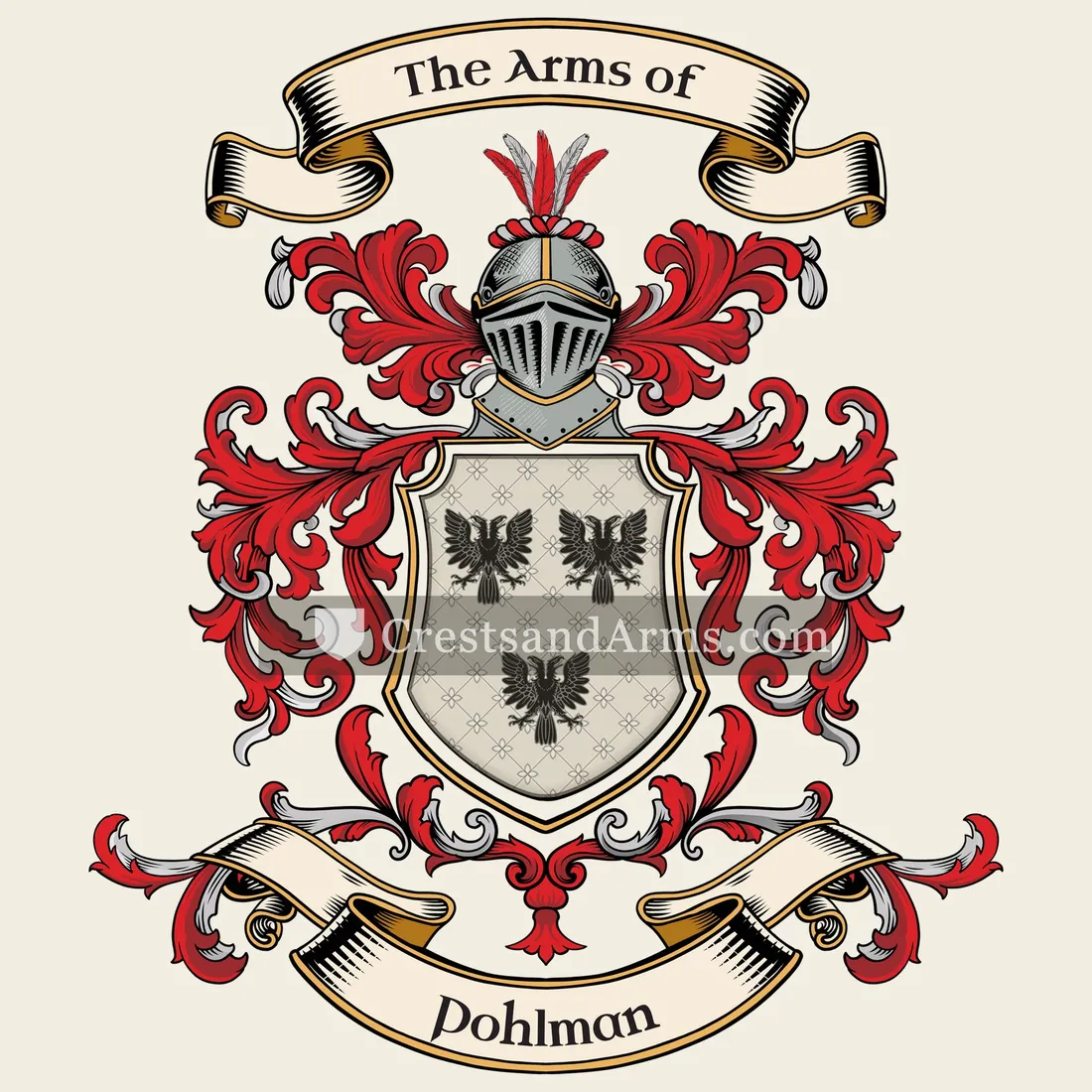
eagleNobility, strength and a keen mind
Colours
Silver (Argent)Means: Peace and sincerity
Black (Sable)Means: Constancy
Historical info
Source
J. B. Rietstap, Armorial Général, Gouda: G. B. van Goor Zonen, 1884–87
Blazon (the actual original written record)
“D'arg. à trois aigles de sa. Cq. cour. C.: un sauvage iss., tenant une massue posée sur son épaule.”
Germanyc. 1765
Digital archive packCoat of arms PNG, gold border print PDF, vector SVG and the certificate of authenticity. Sent to your email in minutes.
Map of Germany showing where the Pohlman arms are recorded
The Pohlman arms were recorded in Germany, c. 1765.
Arms such as these were typically recorded in Bavaria.
Bavaria was a country of old landed families and walled market towns. Estates passed down the same line for centuries, and both the landowners and the leading townsmen kept arms, which is why so many Bavarian names sit in the registers.
This is where the arms were entered in the register. Families often moved to other parts of the country, so the same name can turn up in more than one region.
The body that granted and recorded arms in Germany in this period.
Francis I, Holy Roman Emperor
Sovereign of the period
Francis I, Holy Roman Emperor
1745–1765
Reigning in Russia when the Pohlman arms are first recorded.
How Arms Worked in Germany
In the Holy Roman Empire, coats of arms were often granted to individuals by the Emperor or his representatives. These arms were then passed down through the generations to all legitimate descendants of the original holder. Younger branches of a family usually kept the same shield design without needing to change it, as the arms belonged to the entire lineage.
Granting authority
The Holy Roman Emperor held the sole power to grant new coats of arms throughout his vast imperial territories.
How they got arms
Families typically obtained their coats of arms through a formal imperial grant or by proving their noble status to the authorities.
Where arms were recorded
These grants were officially recorded in the Imperial Chancery registers, which began keeping formal records of such honors during the Middle Ages.
The family's standing
Recorded among the armigerous families of Germany.
Origin & History of the Pohlman Family in Germany
The surname Pohlman originates from the German regions where it functioned as a descriptive name for people living near a specific type of terrain. In the German language, the root word "Pohl" refers to a pool, a small lake, or a marshy area. Therefore, the name likely identified an ancestor who lived near a body of water or a low-lying wetland. By the time members of the family were documented in Bavaria in 1765, the name had already become a stable way to distinguish individuals within their local communities. During the eighteenth century, life in Bavaria was deeply tied to the land and the agricultural cycles of the region. Families with this name were often part of the rural population that managed the fields and water sources that defined their landscape. As the family grew, the name traveled with them, serving as a permanent link to the geography of their ancestral home in southern Germany.
Pohlman Meaning & Related Branches
Root word
Pole
A person originating from Poland or a field dweller.
This name
PohlmanA topographic or habitational name for someone living near a field or of Polish descent.
also spelled
Pohlman
Polman
Documented Sources
J. B. Rietstap, Armorial Général, Gouda: G. B. van Goor Zonen, 1884–87
Erik-Amburger-Datenbank, Ausländer im vorrevolutionären Russland, 2024
Russian State Historical Archive (RGIA), Fond 1343: Records of the Heraldry Department of the Governing Senate (Subject files on foreign-origin families)
Moscow City Archive (TsIAM), Fond 51: Moscow City Magistrate records regarding foreign residents in the 18th century
Digital archive packCoat of arms PNG, gold border print PDF, vector SVG and the certificate of authenticity. Sent to your email in minutes.


 armA person of action, industrious and laborious
 roundelA coin, and one who has been to the crusades
 armA person of action, industrious and laborious
 roundelA coin, and one who has been to the crusades


 eagleNobility, strength and a keen mind