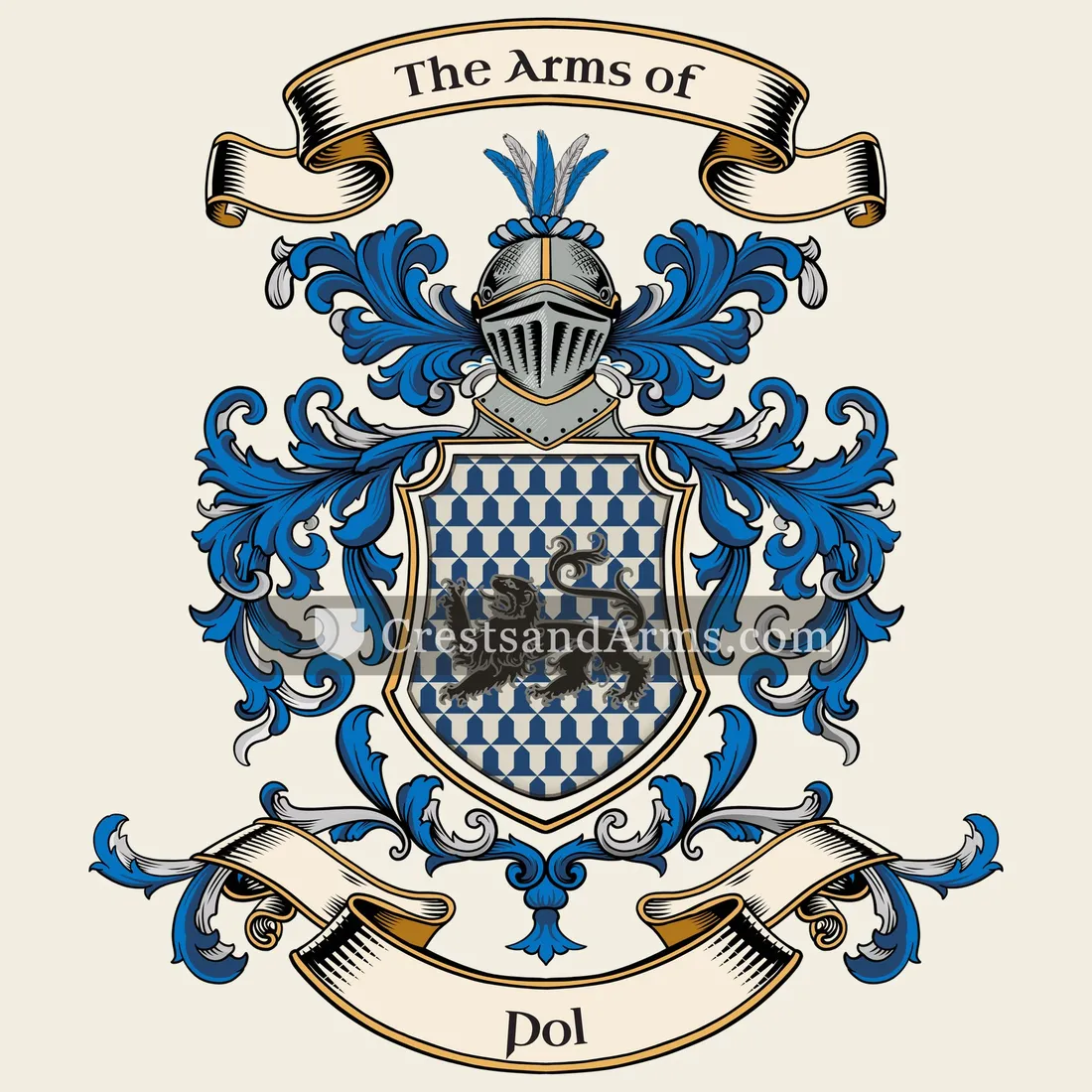
A record of documented arms, meaning and origin, researched for the Pol family lines. Documented in 2 countries.
Reg. 5324 · Dutch, P–S
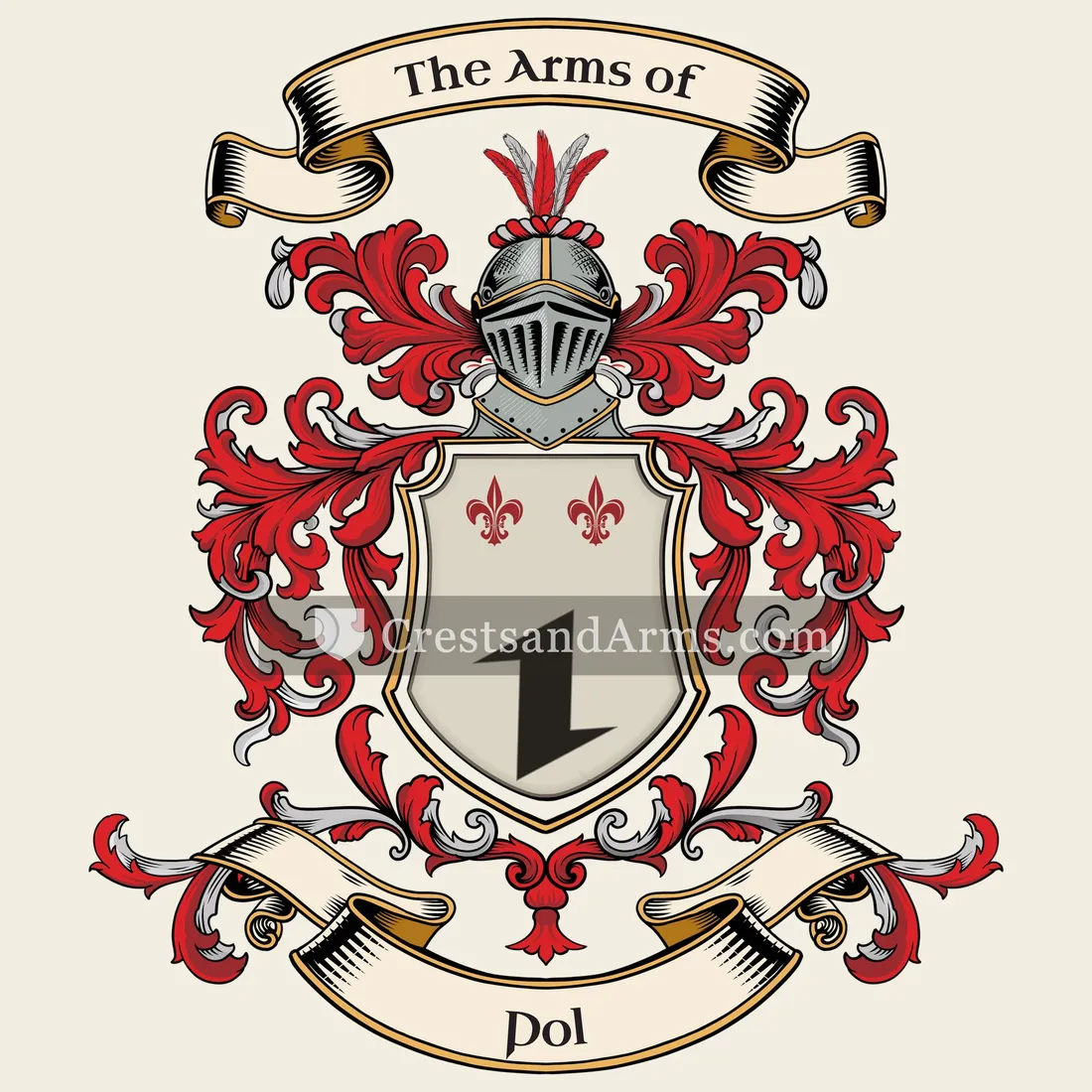
Meaning of the Pol family crest colors & symbols
Symbols on this shield
cramponFirm hold on what has been gained
fleur de lisPurity, light, and the sixth son
Colours
Silver (Argent)Means: Peace and sincerity
Black (Sable)Means: Constancy
Red (Gules)Means: Military strength
Historical info
Source
J. B. Rietstap, Armorial Général, Gouda: G. B. van Goor Zonen, 1884–87
Blazon (the actual original written record)
“D'arg. à un crampon de sa., posé en pal, acc. en chef de deux fleurs-de-lis de gu. (ou, les fleurs-de-lis posées l'une au canton sen. du chef et l'autre au canton dextre de la p.)”
NetherlandsHoorn Holl, c. 1815
Digital archive packCoat of arms PNG, gold border print PDF, vector SVG and the certificate of authenticity. Sent to your email in minutes.
Map of Netherlands showing where the Pol arms are recorded
The Pol arms were recorded in Hoorn Holl, c. 1815.
This is where the arms were entered in the register. Families often moved to other parts of the country, so the same name can turn up in more than one region.
Region
Hoorn
Town
Hoorn Holl
First recorded
1815
Granting Authority for the Pol Arms
Hoge Raad van Adel
Photograph made by me · CC BY-SA 3.0
The body that granted and recorded arms in Netherlands in this period.
William I of the Netherlands
Sovereign of the period
William I of the Netherlands
1815–1840
Reigning in Netherlands when the Pol arms are first recorded.
How Arms Worked in Netherlands
In the Netherlands, coats of arms were often used by noble families and those who held specific public offices. These arms were passed down through the generations to legitimate descendants. Younger branches of a family usually kept the original design without needing to add special marks. This system ensured that the family identity remained clear and consistent over many years.
Granting authority
The Hoge Raad van Adel is the official body that regulates and manages noble titles and coats of arms in the Netherlands.
How they got arms
Families typically obtained their coats of arms through official royal grants or by proving their long-standing historical use of the symbols.
Where arms were recorded
Coats of arms are officially recorded in the registers held by the Hoge Raad van Adel, which began its work in 1814.
The family's standing
Recorded among the armigerous families of Netherlands.
Origin & History of the Pol Family in Netherlands
The family name Pol is a classic example of a topographic surname, which means it was originally chosen to describe the landscape where a person lived. In the Dutch language, the word "pol" refers to a small hill, a mound, or a raised piece of land in a marshy area. During the time when surnames were becoming permanent in the Netherlands, people often took these names to identify themselves by their specific farm or homestead. By 1815, records confirm that members of the Pol family were living in the historic port city of Hoorn. At that time, Hoorn was a vital center for trade and maritime activity, and families like the Pols were part of the growing urban population that helped shape the region. Because the name is tied to the physical geography of the Dutch countryside, it suggests that the earliest ancestors of the family were likely farmers or landholders who lived on elevated ground to protect their homes from the frequent flooding common in the low-lying Dutch landscape.
Meaning of the Pol family crest colors & symbols
Symbols on this shield
lionCourage, strength and royalty
Colours
Black (Sable)Means: Constancy
Historical info
Source
J. B. Rietstap, Armorial Général, Gouda: G. B. van Goor Zonen, 1884–87
Blazon (the actual original written record)
“Vairé d'arg. et de gu.; au lion de sa., cour. d'or, arm. et lamp. du même, br. sur le tout.”
Franche-ComteFranche-Comte, c. 1663
Digital archive packCoat of arms PNG, gold border print PDF, vector SVG and the certificate of authenticity. Sent to your email in minutes.
Map of France showing where the Pol arms are recorded
The Pol arms were recorded in Franche-Comte, c. 1663.
Franche-Comte sat between France and the Empire and changed hands more than once. Border families held their land under arms and expected to defend it, so a shield was a practical thing rather than an ornament.
This is where the arms were entered in the register. Families often moved to other parts of the country, so the same name can turn up in more than one region.
The body that granted and recorded arms in France in this period.
Louis XIV of France
Sovereign of the period
Louis XIV of France
1643–1715
Reigning in Netherlands when the Pol arms are first recorded.
How Arms Worked in France
In France, a coat of arms was a mark of honor that passed down through the male line to all legitimate descendants. Families often used the same shield without changes to show their shared heritage. If a branch wanted to stand out, they could add a small mark to their shield to show their specific place in the family tree.
Granting authority
The Juge d'armes de France acted as the official authority that regulated and verified coats of arms across the country.
How they got arms
Families typically inherited their arms from ancestors, though they could also receive them through royal grants or by proving their noble status.
Where arms were recorded
Coats of arms were officially recorded in the Armorial Général de France, which began its main collection in the year 1696.
The family's standing
Recorded among the armigerous families of Franche-Comte.
Origin & History of the Pol Family in France
The family name Pol has deep roots in the Franche-Comté region of eastern France, where records confirm members of the family lived as early as 1663. During this period, the region was a crossroads of culture and trade, situated between the Kingdom of France and the lands of the Holy Roman Empire. Families with this name were often integrated into the local agricultural or artisan communities that defined the rugged landscape of the Jura Mountains. Because the name is a shortened form of the name Paul, it likely originated as a way to identify a person by their father’s given name or as a simple nickname in a small village setting. Over time, these families became fixtures of the local parish registers, which tracked their births, marriages, and deaths as they navigated the complex social changes of the seventeenth century. Their presence in the region highlights a long history of stability and local identity within the historical province of Franche-Comté.
Pol Meaning & Related Branches
Root word
Pol
Derived from the Latin Paulus meaning small or humble.
This name
PolA topographic name for someone living near a pool or small body of water.
also spelled
Poll
Pole
Paul
Related arms
Poolvariant spelling
de Hartrecorded with Pol, same area
van Akerlakenrecorded with Pol, same area
Documented Sources
J. B. Rietstap, Armorial Général, Gouda: G. B. van Goor Zonen, 1884–87
Meertens, P.J., De betekenis van Nederlandse familienamen, 1957
Noord-Hollands Archief, Bevolkingsregister van de gemeente Hoorn, 1815
Van der Schaar, J., Woordenboek van voornamen, 1964
Digital archive packCoat of arms PNG, gold border print PDF, vector SVG and the certificate of authenticity. Sent to your email in minutes.


 cramponFirm hold on what has been gained
 fleur de lisPurity, light, and the sixth son
 cramponFirm hold on what has been gained
 fleur de lisPurity, light, and the sixth son


 lionCourage, strength and royalty