Map of Britain showing where the Polack arms are recorded
The Polack arms were recorded in Britain, c. 1703.
Arms such as these were typically recorded in Kent.
Kent sits between London and the short crossing to Europe, and the trade passing through made it wealthy. Merchant families bought land with that money, and it was landowners who took coats of arms.
This is where the arms were entered in the register. Families often moved to other parts of the country, so the same name can turn up in more than one region.
The body that granted and recorded arms in Britain in this period.
Anne of Great Britain
Sovereign of the period
Anne of Great Britain
1702–1707
Reigning in Britain when the Polack arms are first recorded.
How Arms Worked in Britain
English heraldry allowed arms to be shared by all legitimate descendants of the original owner. These symbols were treated as personal property that moved through the generations to all children. While the eldest son kept the original design, other family members could use the same shield without needing to change it or register their own unique versions.
Granting authority
The College of Arms in London has regulated the use of coats of arms throughout England and Wales since 1484.
How they got arms
Families typically obtained their coats of arms through a formal grant from the Crown or by proving their ancient right to them.
Where arms were recorded
All official coats of arms are recorded in the registers kept at the College of Arms, which date back to the fifteenth century.
The family's standing
Recorded among the armigerous families of Britain.
Origin & History of the Polack Family in Britain
The family name Polack arrived in Britain during a period of significant migration and social change. While the name clearly points to origins in Poland, its presence in the historical record of Kent by 1703 suggests that early members of the family were part of the small but growing communities of continental Europeans settling in southern England. During the early eighteenth century, Kent served as a vital gateway for travelers and merchants arriving from across the English Channel. Families like the Polacks often integrated into local trade networks or specialized crafts, finding a place within the bustling economy of the region. By establishing themselves in Kent, these early ancestors contributed to the diverse cultural landscape of the county, leaving behind a legacy that reflects the long history of movement between Britain and the European continent.
Meaning of the Polack family crest colors & symbols
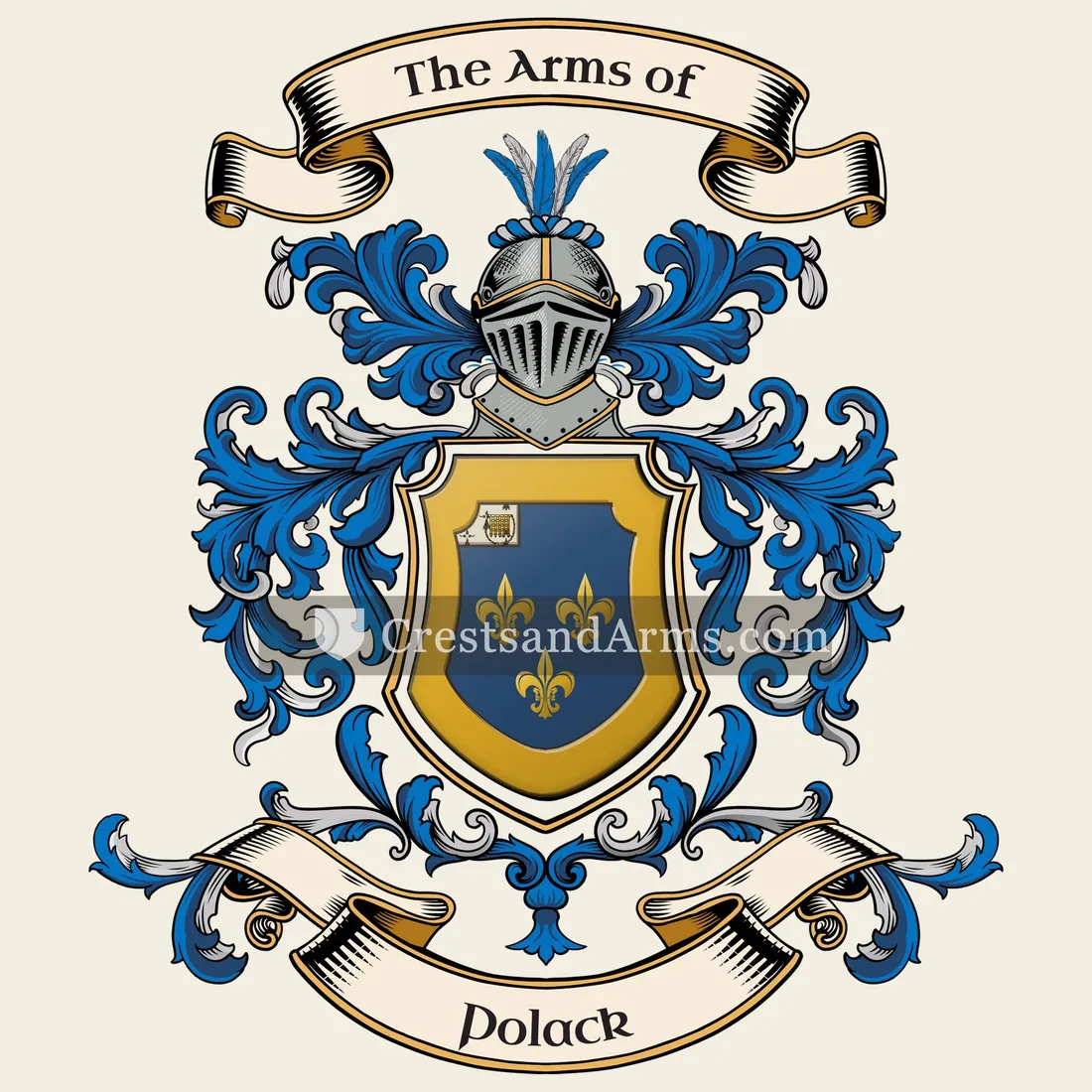
Symbols on this shield
bordureA difference between branches of one family
cantonA mark of honour granted by the sovereign
fleur de lisPurity, light, and the sixth son
portcullisProtection of the household, and the guarded gate
Colours
Blue (Azure)Means: Loyalty and truth
ErmineMeans: Dignity
Gold (Or)Means: Generosity
Historical info
Source
Sir Bernard Burke, The General Armory of England, Scotland, Ireland and Wales, London: Harrison & Sons, 1884
Blazon (the actual original written record)
“Az. three fleurs-de-lis within a bordure engr. or, a canton erm. thereon a portcullis of the second”
MiddlesexTemple Hatton · Middlesex, c. 1866
Digital archive packCoat of arms PNG, gold border print PDF, vector SVG and the certificate of authenticity. Sent to your email in minutes.
Map of England showing where the Polack arms are recorded
The Polack arms were recorded in Middlesex, c. 1866.
Middlesex was the county around London, and City money flowed straight into it. Merchants and officials bought estates within reach of the capital, and a new estate brought a coat of arms with it.
This is where the arms were entered in the register. Families often moved to other parts of the country, so the same name can turn up in more than one region.
The body that granted and recorded arms in England in this period.
Victoria
Sovereign of the period
Victoria
1837–1901
Reigning in Britain when the Polack arms are first recorded.
How Arms Worked in England
English heraldry allowed arms to be shared by all legitimate descendants of the original owner. These symbols were treated as personal property that moved through the generations to all children. While the eldest son kept the original design, other family members could use the same shield without needing to change it or register their own unique versions.
Granting authority
The College of Arms in London has regulated the use of coats of arms throughout England and Wales since 1484.
How they got arms
Families typically obtained their coats of arms through a formal grant from the Crown or by proving their ancient right to them.
Where arms were recorded
All official coats of arms are recorded in the registers kept at the College of Arms, which date back to the fifteenth century.
The family's standing
Recorded among the armigerous families of Middlesex.
Origin & History of the Polack Family in England
The surname Polack is an occupational or locative name that historically identified individuals who originated from Poland. While the name has deep roots in Central and Eastern Europe, its presence in England became more prominent during the nineteenth century as families migrated westward to seek new economic opportunities. By 1866, records confirm that members of the Polack family were established in the county of Middlesex, which was then a bustling center of trade and industry near London. These early residents likely integrated into the urban workforce, contributing to the diverse cultural landscape of the region during the Victorian era. As they settled into their new surroundings, the family name served as a link to their ancestral heritage while they built their lives within the growing British society of the time.
Polack Meaning & Related Branches
Root word
Polak
A person originating from Poland.
This name
PolackAn ethnic or topographic surname denoting someone who came from Poland.
also spelled
Polock
Pollack
Pollok
Polok
Documented Sources
J. B. Rietstap, Armorial Général, Gouda: G. B. van Goor Zonen, 1884–87
Cesarani, David. The Jews in Britain: A History. 1996
Endelman, Todd M. The Jews of Georgian England, 1714–1830: Tradition and Change in a Liberal Society. 1999
The National Archives, Kew. Naturalization Papers and Related Documents. Series HO 1
Digital archive packCoat of arms PNG, gold border print PDF, vector SVG and the certificate of authenticity. Sent to your email in minutes.


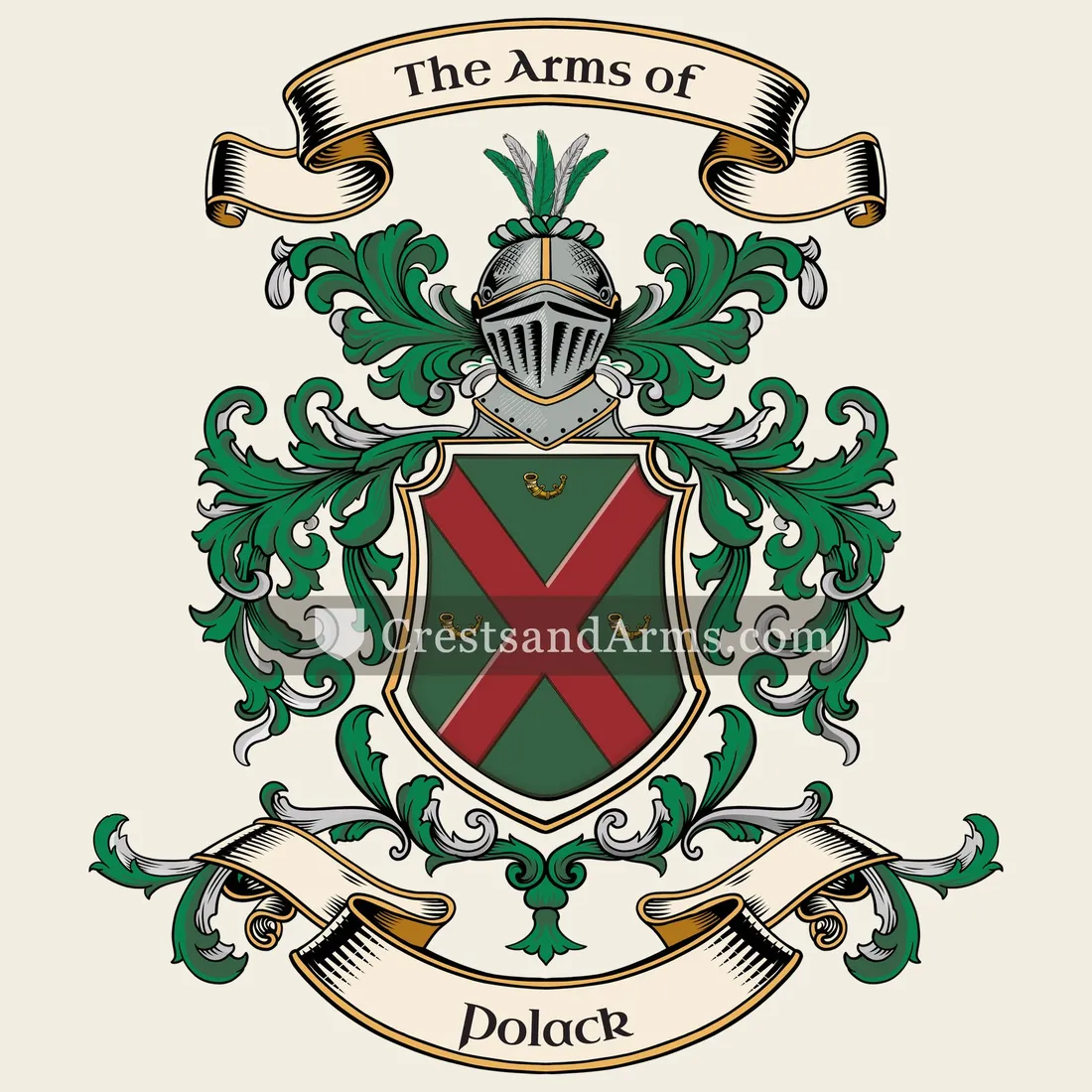
 saltireResolution, and St Andrew's cross
 hunting horn stringedOne who delights in the chase
 saltireResolution, and St Andrew's cross
 hunting horn stringedOne who delights in the chase


 bordureA difference between branches of one family
 cantonA mark of honour granted by the sovereign
 fleur de lisPurity, light, and the sixth son
 portcullisProtection of the household, and the guarded gate