Map of Belgium showing where the Pollan arms are recorded
The Pollan arms were recorded in Gand, c. 1737.
This is where the arms were entered in the register. Families often moved to other parts of the country, so the same name can turn up in more than one region.
The body that granted and recorded arms in Belgium in this period.
Charles VI, Holy Roman Emperor
Sovereign of the period
Charles VI, Holy Roman Emperor
1711–1740
Reigning in Belgium when the Pollan arms are first recorded.
How Arms Worked in Belgium
In Belgium, a coat of arms is considered personal property that is passed down through the male line to legitimate descendants. Families often use the same shield design across generations to show their shared heritage. If a branch of the family wants to change the design, they must apply for an official update to their specific version of the arms.
Granting authority
The Conseil héraldique is the official body that regulates and approves all coats of arms in Belgium.
How they got arms
Families obtain their coats of arms through formal royal grants or by confirming their historical right to use existing designs.
Where arms were recorded
All approved coats of arms are officially recorded in the public registers of the Conseil héraldique since 1844.
The family's standing
Recorded among the armigerous families of Belgium.
Origin & History of the Pollan Family in Belgium
The family name Pollan has roots that trace back to the region of Flanders, specifically within the city of Ghent. By the year 1737, records confirm that members of the family were established residents in this area. During the eighteenth century, Ghent was a bustling center for trade and textile production, which likely influenced the daily lives and occupations of early family members. The name itself is thought to have evolved from local linguistic patterns common in the Low Countries during that era. As the family grew, they became part of the social fabric of the city, contributing to the local community through their work and civic participation. Over time, the name remained tied to this region as generations moved through the changing political and economic landscapes of Europe.
Pollan Meaning & Related Branches
Root word
Paulus
Latin for small or humble.
This name
PollanA patronymic surname derived from the personal name Paul, indicating a descendant of Paul.
also spelled
Pollayn
Polain
Pollan
Documented Sources
J. B. Rietstap, Armorial Général, Gouda: G. B. van Goor Zonen, 1884–87
Stadsarchief Gent, Parochieregisters: Dopen, Huwelijken en Begrafenissen, 1737
De Potter, Frans and Jan Broeckaert, Geschiedenis van de gemeenten der provincie Oost-Vlaanderen, 1864
Digital archive packCoat of arms PNG, gold border print PDF, vector SVG and the certificate of authenticity. Sent to your email in minutes.


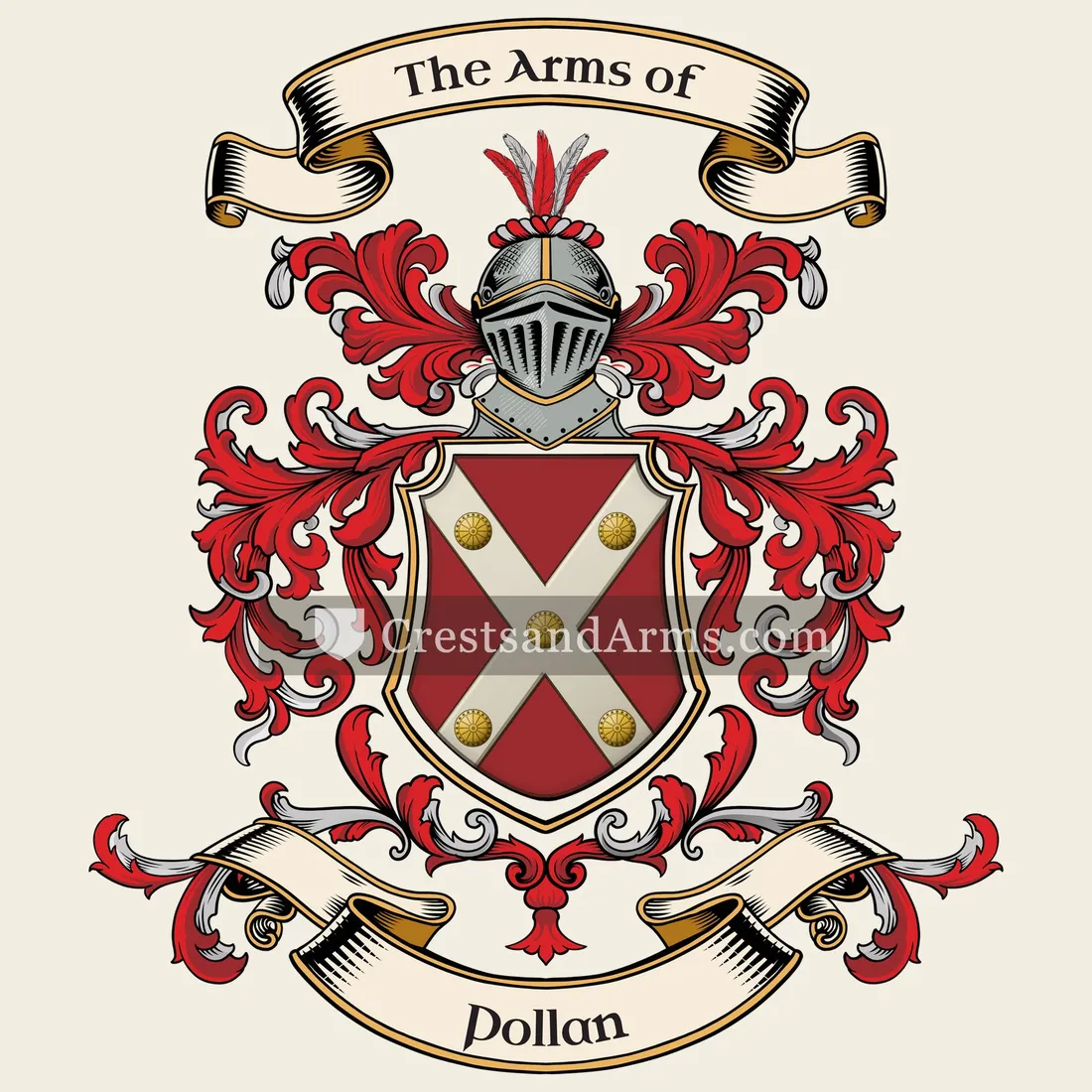
 saltireResolution, and St Andrew's cross
 roundelA coin, and one who has been to the crusades
 saltireResolution, and St Andrew's cross
 roundelA coin, and one who has been to the crusades