Map of England showing where the Pollard arms are recorded
The Pollard arms were recorded in Cornwall, c. 1620.
Cornwall was a county apart, with its own language and its own tight-knit gentry. Tin and the sea made money there, and families who made it bought land, which is what brought arms with it.
This is where the arms were entered in the register. Families often moved to other parts of the country, so the same name can turn up in more than one region.
The body that granted and recorded arms in England in this period.
James VI and I
Sovereign of the period
James VI and I
1603–1625
Reigning in England when the Pollard arms are first recorded.
How Arms Worked in England
English heraldry allowed arms to be shared by all legitimate descendants of the original owner. These symbols were treated as personal property that moved through the generations to all children. While the eldest son kept the original design, other family members could use the same shield without needing to change it or register their own unique versions.
Granting authority
The College of Arms in London has regulated the use of coats of arms throughout England and Wales since 1484.
How they got arms
Families typically obtained their coats of arms through a formal grant from the Crown or by proving their ancient right to them.
Where arms were recorded
All official coats of arms are recorded in the registers kept at the College of Arms, which date back to the fifteenth century.
The family's standing
Recorded among the armigerous families of Cornwall.
Origin & History of the Pollard Family in England
The surname Pollard emerged in medieval England as a descriptive nickname, likely referring to a person with a closely cropped hairstyle or a pollarded tree. While the name appeared in various regions across the country, it became deeply rooted in the southwestern counties, particularly in Devon and Cornwall. By the early seventeenth century, families bearing this name were well-established in the Cornish landscape, participating in the local agricultural and social life of the region. These early ancestors were part of a period of significant migration and settlement, as families began to solidify their presence in specific parishes. Their history reflects the broader patterns of English life during the transition from the Elizabethan era to the early Stuart period, where local identity was closely tied to land and community standing.
Coat of Arms & Family Crest Details
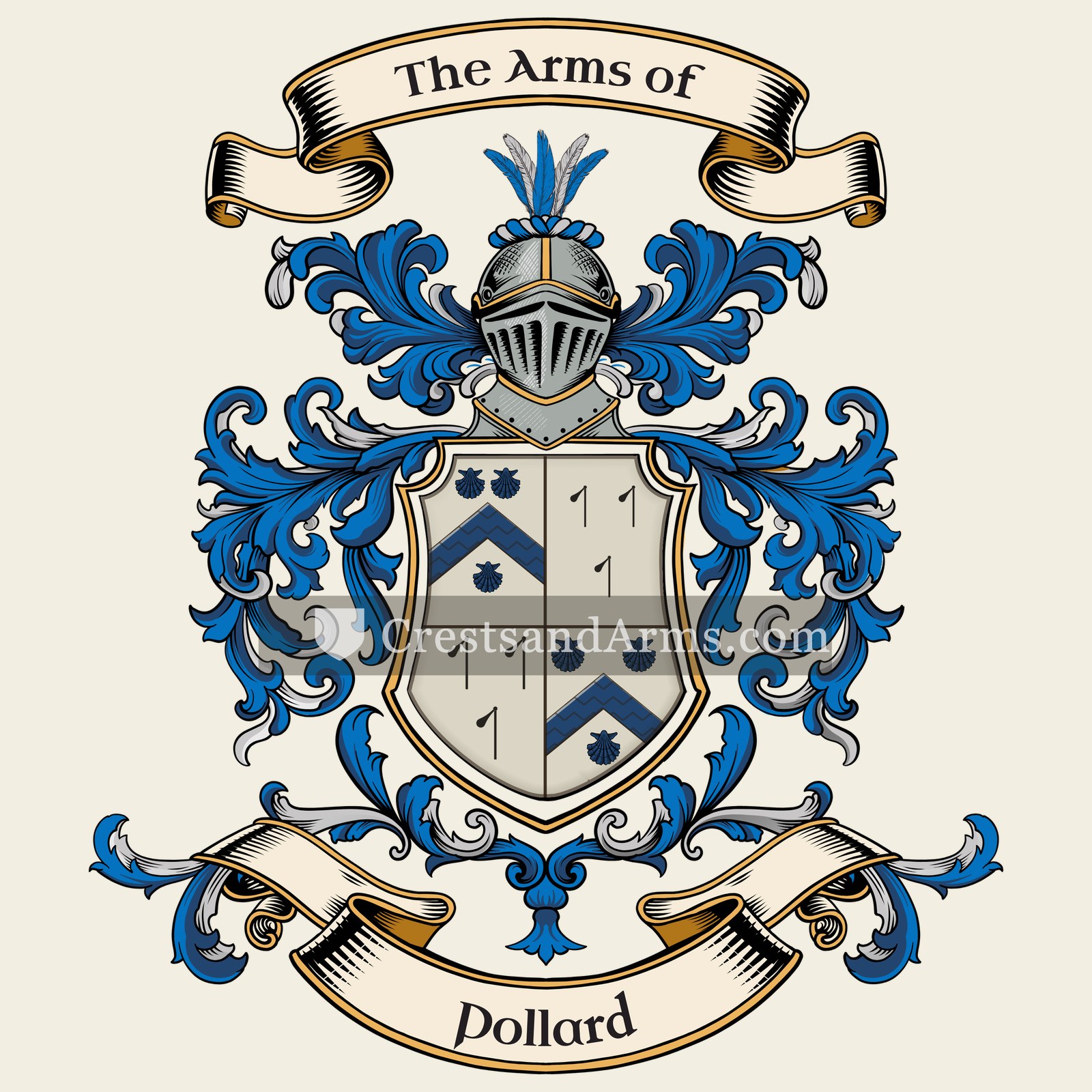
Symbols on this shield
chevronProtection, and faithful service completed
escallopThe pilgrim's shell, and a long journey made
flailDiligence in husbandry and hard labour
Colours
Silver (Argent)Means: Peace and sincerity
Blue (Azure)Means: Loyalty and truth
Black (Sable)Means: Constancy
Historical info
Source
Sir Bernard Burke, The General Armory of England, Scotland, Ireland and Wales, London: Harrison & Sons, 1884
Blazon (the actual original written record)
“Quarterly, 1st and 4th, ar. a chev. betw. three escallops az., for POLLARD; 2nd and 3rd, ar. three hempbrakes sa., for HAMPSON”
WestmeathCastle Pollard · Westmeath, c. 1718
Digital archive packCoat of arms PNG, gold border print PDF, vector SVG and the certificate of authenticity. Sent to your email in minutes.
Map of Ireland showing where the Pollard arms are recorded
The Pollard arms were recorded in Westmeath, c. 1718.
Westmeath was midland grazing country in Ireland, taken by Norman families and held for centuries. Its estates were large and passed down whole, and unbroken tenure brought arms with it.
This is where the arms were entered in the register. Families often moved to other parts of the country, so the same name can turn up in more than one region.
The body that granted and recorded arms in Ireland in this period.
George I of Great Britain
Sovereign of the period
George I of Great Britain
1714–1727
Reigning in England when the Pollard arms are first recorded.
How Arms Worked in Ireland
The Ulster King of Arms granted coats of arms to individuals who proved their social standing and good character. These symbols were typically inherited by all legitimate descendants of the original holder. If a family branch wanted a unique look, they could apply for a specific change to their design through the office to ensure their identity remained distinct.
Granting authority
The Ulster King of Arms acted as the official body that regulated and issued all coats of arms throughout Ireland.
How they got arms
Families obtained their arms through formal grants issued by the office after proving their eligibility and paying the required fees.
Where arms were recorded
All official grants were recorded in the registers held by the Ulster King of Arms starting from the year 1552.
The family's standing
Recorded among the armigerous families of Westmeath.
Origin & History of the Pollard Family in Ireland
The Pollard family name in Ireland is deeply connected to the period of land settlement and administrative change during the eighteenth century. While the name itself has roots in medieval England, its presence in County Westmeath by 1718 marks a significant chapter in the family history within the Irish Midlands. During this era, families like the Pollards often integrated into the local gentry by acquiring estates and participating in the management of rural lands. They became active members of the local community, often serving in administrative or legal roles that helped shape the development of the region. By establishing themselves in Westmeath, the family became part of a network of landowners who navigated the complex social and political landscape of the time. Their long-standing presence in the area suggests a successful transition into Irish life, where they remained rooted for generations.
Pollard Meaning & Related Branches
Root word
Poll
A Middle English term referring to a rounded head or top.
This name
PollardA nickname for someone with a close-cropped haircut or a large, round head.
also spelled
Polarde
Related arms
Pottonsame arms
Westcotesimilar arms
Heskethrecorded with Pollard, same area
Mandleyrecorded with Pollard, same area
Documented Sources
Sir Bernard Burke, The General Armory of England, Scotland, Ireland and Wales, London: Harrison & Sons, 1884
Bardsley, Charles Wareing, A Dictionary of English and Welsh Surnames, 1901
Reaney, P.H., A Dictionary of British Surnames, 1958
The National Archives, Probate records of the Prerogative Court of Canterbury, PROB 11
Cornwall Archives, Parish registers of baptisms, marriages and burials, DDP series
Digital archive packCoat of arms PNG, gold border print PDF, vector SVG and the certificate of authenticity. Sent to your email in minutes.


 chevronProtection, and faithful service completed
 escallopThe pilgrim's shell, and a long journey made
 chevronProtection, and faithful service completed
 escallopThe pilgrim's shell, and a long journey made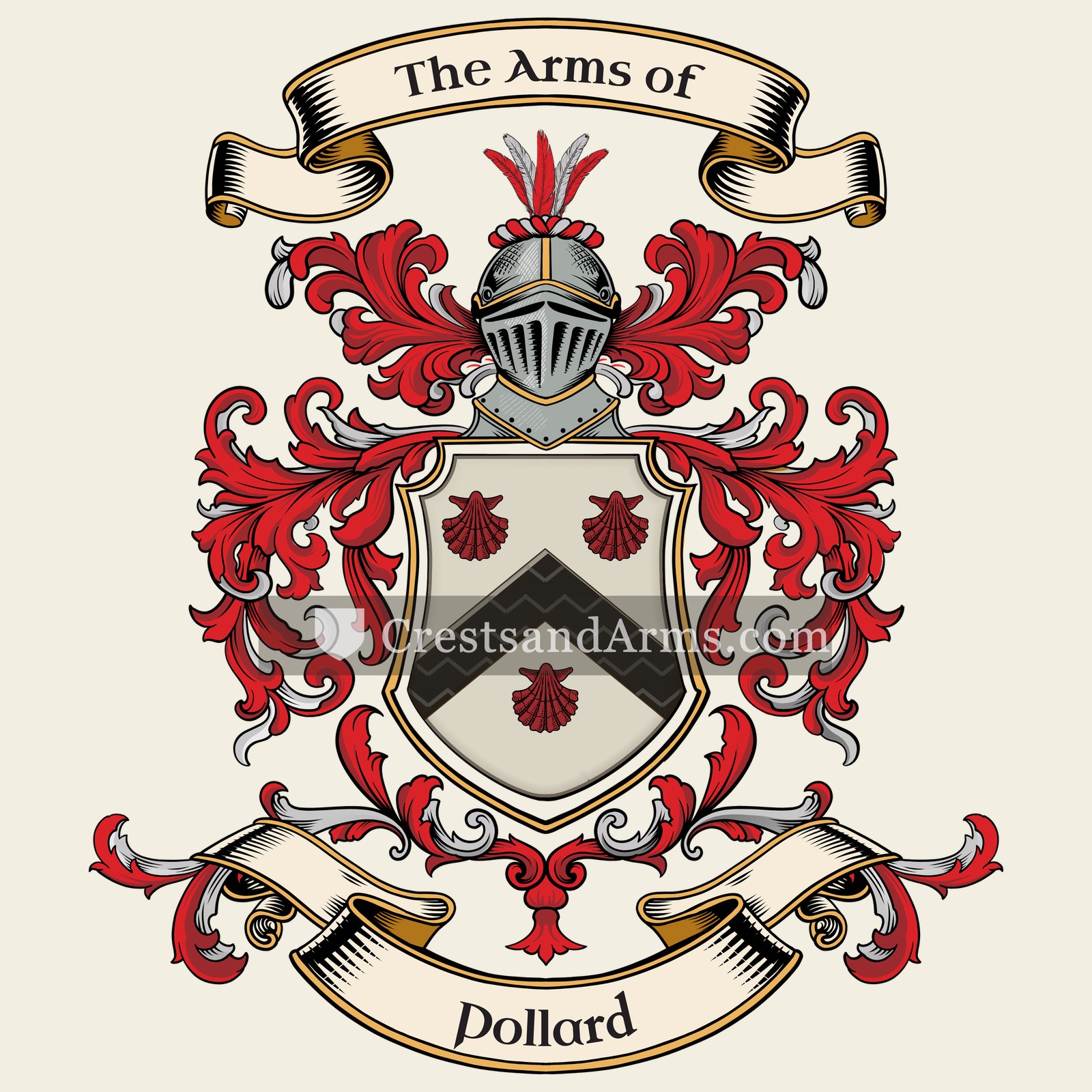


 flailDiligence in husbandry and hard labour