Map of Britain showing where the Pollock arms are recorded
The Pollock arms were recorded in Britain, c. 1703.
Arms such as these were typically recorded in Kent.
Kent sits between London and the short crossing to Europe, and the trade passing through made it wealthy. Merchant families bought land with that money, and it was landowners who took coats of arms.
This is where the arms were entered in the register. Families often moved to other parts of the country, so the same name can turn up in more than one region.
The body that granted and recorded arms in Britain in this period.
Anne of Great Britain
Sovereign of the period
Anne of Great Britain
1702–1707
Reigning in Britain when the Pollock arms are first recorded.
How Arms Worked in Britain
English heraldry allowed arms to be shared by all legitimate descendants of the original owner. These symbols were treated as personal property that moved through the generations to all children. While the eldest son kept the original design, other family members could use the same shield without needing to change it or register their own unique versions.
Granting authority
The College of Arms in London has regulated the use of coats of arms throughout England and Wales since 1484.
How they got arms
Families typically obtained their coats of arms through a formal grant from the Crown or by proving their ancient right to them.
Where arms were recorded
All official coats of arms are recorded in the registers kept at the College of Arms, which date back to the fifteenth century.
The family's standing
Recorded among the armigerous families of Britain.
Origin & History of the Pollock Family in Britain
The name Pollock is primarily associated with a locational origin, derived from the lands of Pollock in Renfrewshire, Scotland. The name itself is thought to come from the Old English word "poll," which refers to a small head or a rounded hill, describing the local landscape where the first families settled. By the early 18th century, members of the family had moved across the British Isles, establishing a notable presence in Kent by 1703. During this period, families often migrated for work in agriculture or trade, and the movement of the Pollock name into southern England reflects the broader trend of internal migration during the late Stuart era. As these individuals settled into new communities, they integrated into the local parish systems, which served as the primary method for recording births, marriages, and deaths before modern census records existed.
Meaning of the Pollock family crest colors & symbols
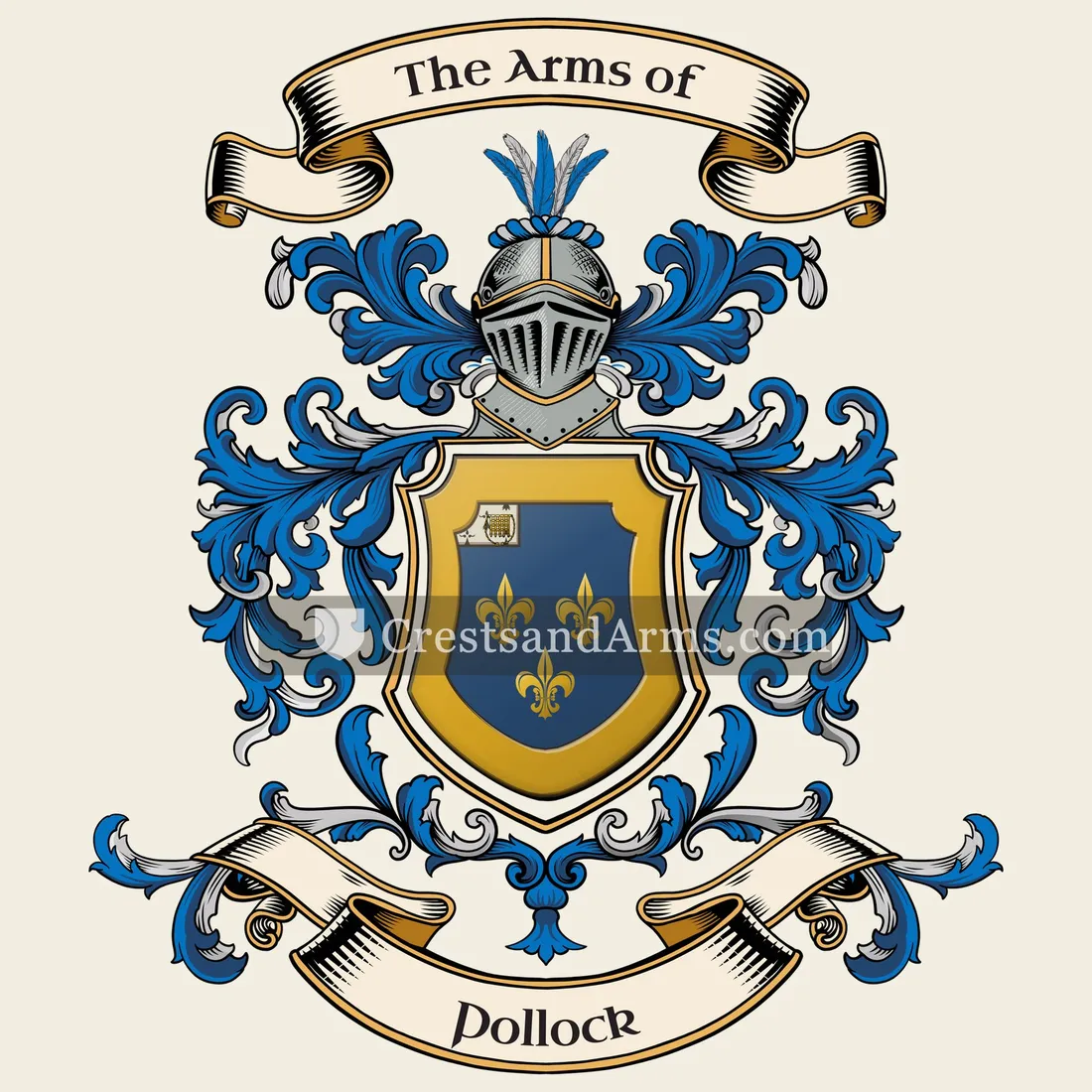
Symbols on this shield
bordureA difference between branches of one family
cantonA mark of honour granted by the sovereign
fleur de lisPurity, light, and the sixth son
portcullisProtection of the household, and the guarded gate
Colours
Blue (Azure)Means: Loyalty and truth
ErmineMeans: Dignity
Gold (Or)Means: Generosity
Historical info
Source
Sir Bernard Burke, The General Armory of England, Scotland, Ireland and Wales, London: Harrison & Sons, 1884
Blazon (the actual original written record)
“Az. three fleurs-de-lis within a bordure engr. or, a canton erm. thereon a portcullis of the second”
MiddlesexTemple Hatton · Middlesex, c. 1866
Digital archive packCoat of arms PNG, gold border print PDF, vector SVG and the certificate of authenticity. Sent to your email in minutes.
Map of England showing where the Pollock arms are recorded
The Pollock arms were recorded in Middlesex, c. 1866.
Middlesex was the county around London, and City money flowed straight into it. Merchants and officials bought estates within reach of the capital, and a new estate brought a coat of arms with it.
This is where the arms were entered in the register. Families often moved to other parts of the country, so the same name can turn up in more than one region.
The body that granted and recorded arms in England in this period.
Victoria
Sovereign of the period
Victoria
1837–1901
Reigning in Britain when the Pollock arms are first recorded.
How Arms Worked in England
English heraldry allowed arms to be shared by all legitimate descendants of the original owner. These symbols were treated as personal property that moved through the generations to all children. While the eldest son kept the original design, other family members could use the same shield without needing to change it or register their own unique versions.
Granting authority
The College of Arms in London has regulated the use of coats of arms throughout England and Wales since 1484.
How they got arms
Families typically obtained their coats of arms through a formal grant from the Crown or by proving their ancient right to them.
Where arms were recorded
All official coats of arms are recorded in the registers kept at the College of Arms, which date back to the fifteenth century.
The family's standing
Recorded among the armigerous families of Middlesex.
Origin & History of the Pollock Family in England
The surname Pollock is primarily associated with a geographic origin in Scotland, but the family established a notable presence in England by the mid-nineteenth century. Records confirm that members of the family were living in the county of Middlesex by 1866, a time when the region was rapidly transforming due to the expansion of London. During this period, families with this name often moved south to participate in the growing professional and administrative sectors of the British capital. While the name itself is derived from the lands of Pollock in Renfrewshire, those who migrated to England helped integrate the lineage into the social fabric of the Victorian era. By settling in Middlesex, these individuals became part of the broader demographic shifts that defined England during the Industrial Revolution. Their presence in the region reflects the movement of families who sought new opportunities in the heart of the expanding English economy.
Pollock Meaning & Related Branches
Root word
Polloc
A Gaelic term referring to a small pool or pond.
This name
PollockA topographic name for someone who lived near a small pool or pond.
also spelled
Polock
Pollack
Pollok
Polok
Related arms
Pollokvariant spelling
Documented Sources
J. B. Rietstap, Armorial Général, Gouda: G. B. van Goor Zonen, 1884–87
Black, George Fraser. The Surnames of Scotland: Their Origin, Meaning, and History. 1946
Johnston, James B. Place-Names of Scotland. 1934
The National Archives (UK). Records of the Prerogative Court of Canterbury, PROB 11
Digital archive packCoat of arms PNG, gold border print PDF, vector SVG and the certificate of authenticity. Sent to your email in minutes.


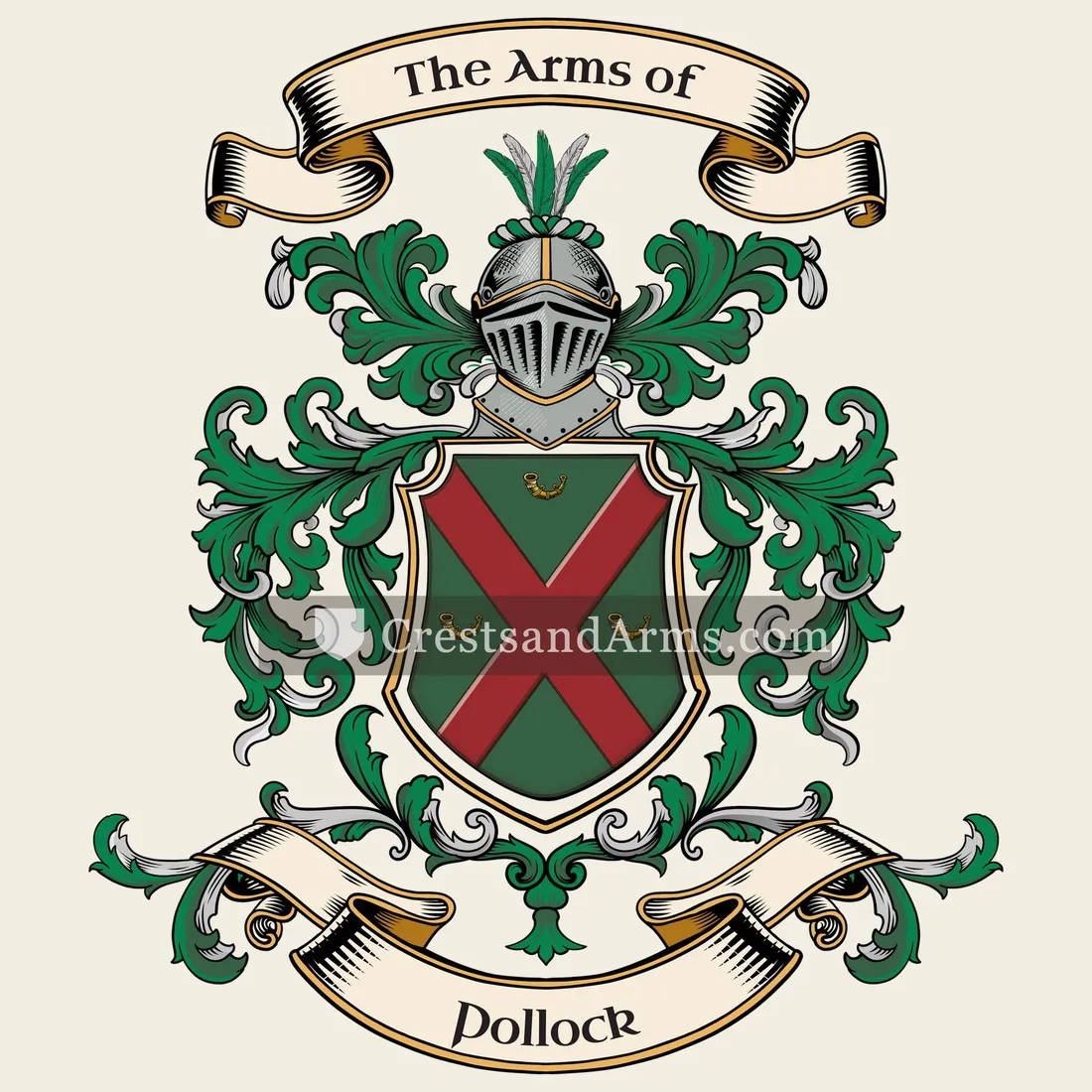
 saltireResolution, and St Andrew's cross
 hunting horn stringedOne who delights in the chase
 saltireResolution, and St Andrew's cross
 hunting horn stringedOne who delights in the chase


 bordureA difference between branches of one family
 cantonA mark of honour granted by the sovereign
 fleur de lisPurity, light, and the sixth son
 portcullisProtection of the household, and the guarded gate