Map of France showing where the Pons arms are recorded
The Pons arms were recorded in Picardie, c. 1663.
Picardie lay on the northern road into France and saw armies pass through it repeatedly. Its landowners were soldiers as often as farmers, and a soldier needed a shield he could be recognised by.
This is where the arms were entered in the register. Families often moved to other parts of the country, so the same name can turn up in more than one region.
The body that granted and recorded arms in France in this period.
Louis XIV of France
Sovereign of the period
Louis XIV of France
1643–1715
Reigning in France when the Pons arms are first recorded.
How Arms Worked in France
In France, a coat of arms was a mark of honor that passed down through the male line to all legitimate descendants. Families often used the same shield without changes to show their shared heritage. If a branch wanted to stand out, they could add a small mark to their shield to show their specific place in the family tree.
Granting authority
The Juge d'armes de France acted as the official authority that regulated and verified coats of arms across the country.
How they got arms
Families typically inherited their arms from ancestors, though they could also receive them through royal grants or by proving their noble status.
Where arms were recorded
Coats of arms were officially recorded in the Armorial Général de France, which began its main collection in the year 1696.
The family's standing
Recorded among the armigerous families of Picardie.
Origin & History of the Pons Family in France
The surname Pons has deep roots in the French landscape, evolving from a personal name of Latin origin that signifies a bridge or a path. By the mid-seventeenth century, the family was well-established in the Picardie region, a historic area in northern France known for its strategic importance and agricultural wealth. In 1663, records confirm that members of the Pons family were active participants in the social and economic life of this province. During this era, families in Picardie often lived in close-knit rural communities where they worked as skilled laborers or landowners. The presence of the name in this specific region suggests that the family had integrated into the local culture long before the mid-1600s. As the family grew, they contributed to the unique identity of northern France, leaving a lasting mark on the history of their local parishes and towns.
Coat of Arms & Family Crest Details
Symbols on this shield
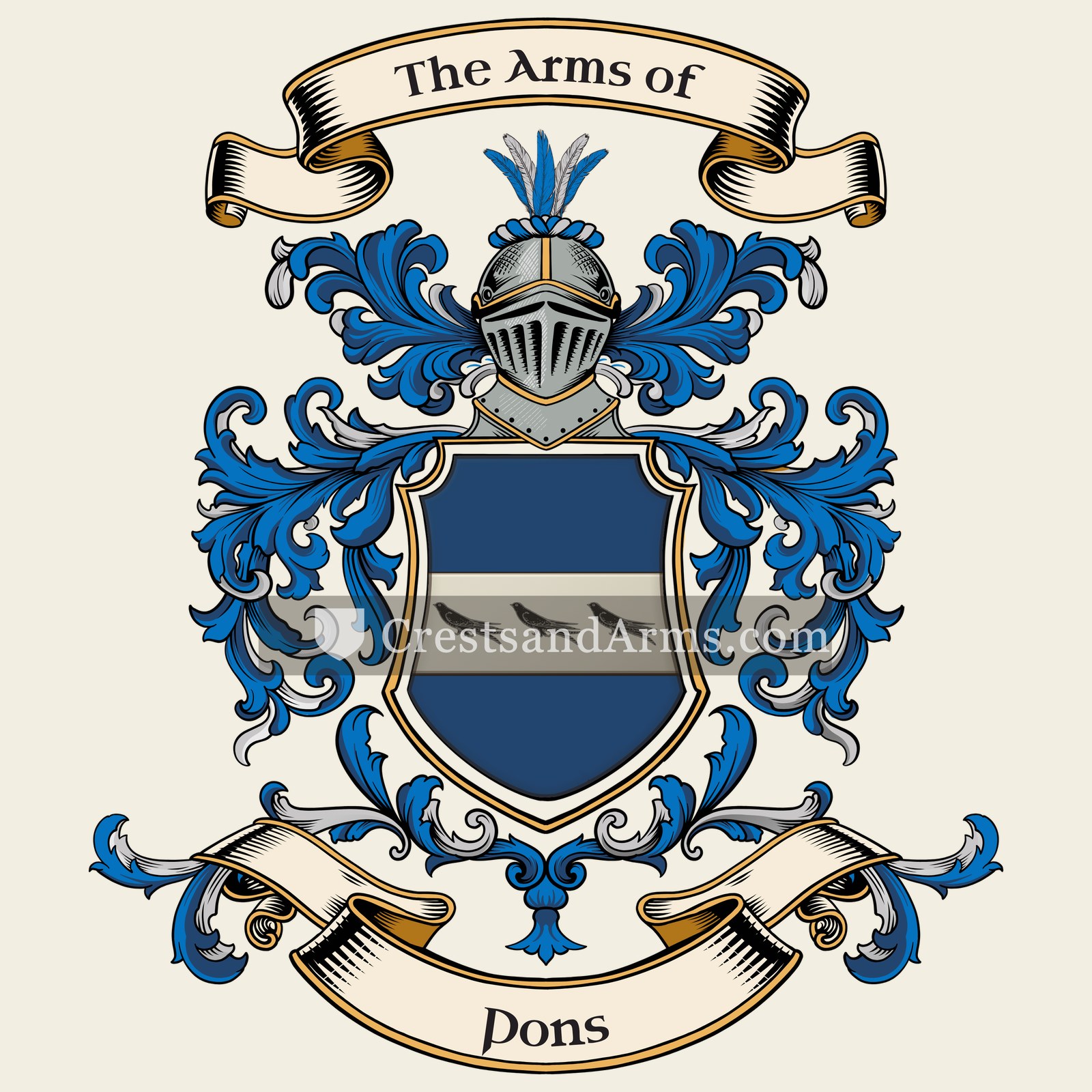
fessThe military belt, and readiness to serve
martletA younger son, who must win his own land
Colours
Blue (Azure)Means: Loyalty and truth
Silver (Argent)Means: Peace and sincerity
Black (Sable)Means: Constancy
Historical info
Source
J. B. Rietstap, Armorial Général, Gouda: G. B. van Goor Zonen, 1884–87
Blazon (the actual original written record)
“D'azur à la fasce d'arg., ch. de trois oies ou merlettes de sa. Cq. cour. C.: une oie ou merlette ess. de sa. L. d'arg. et d'azur [V. Mathias-Pous, Mogge-Pous et Stavenisse-Pous.]”
ZeelandZeeland, c. 1875
Digital archive packCoat of arms PNG, gold border print PDF, vector SVG and the certificate of authenticity. Sent to your email in minutes.
Map of Netherlands showing where the Pons arms are recorded
The Pons arms were recorded in Zeeland, c. 1875.
Zeeland was a scatter of islands in the south-west of the Netherlands, living on the sea and on land reclaimed from it. Families who drained and held that land were counted among the gentry, and gentry carried arms.
This is where the arms were entered in the register. Families often moved to other parts of the country, so the same name can turn up in more than one region.
Region
Zeeland
First recorded
1875
Granting Authority for the Pons Arms
Hoge Raad van Adel
Photograph made by me · CC BY-SA 3.0
The body that granted and recorded arms in Netherlands in this period.
William III of the Netherlands
Sovereign of the period
William III of the Netherlands
1849–1890
Reigning in France when the Pons arms are first recorded.
How Arms Worked in Netherlands
In the Netherlands, coats of arms were often used by noble families and those who held specific public offices. These arms were passed down through the generations to legitimate descendants. Younger branches of a family usually kept the original design without needing to add special marks. This system ensured that the family identity remained clear and consistent over many years.
Granting authority
The Hoge Raad van Adel is the official body that regulates and manages noble titles and coats of arms in the Netherlands.
How they got arms
Families typically obtained their coats of arms through official royal grants or by proving their long-standing historical use of the symbols.
Where arms were recorded
Coats of arms are officially recorded in the registers held by the Hoge Raad van Adel, which began its work in 1814.
The family's standing
Recorded among the armigerous families of Zeeland.
Origin & History of the Pons Family in Netherlands
The surname Pons has roots that stretch back to ancient linguistic traditions, but its presence in the Netherlands is tied to the movement of families across European borders. By the year 1875, records confirm that members of the Pons family were established in the province of Zeeland. This region, known for its complex network of islands and its long history of maritime trade, likely served as a hub for the family due to its accessibility to international shipping routes. During the late 19th century, Zeeland was a place of significant social change, and families living there were often involved in agriculture or the bustling port industries that connected the Netherlands to the rest of the world. The arrival and settlement of the Pons family in this coastal province reflect the broader patterns of migration and family growth that defined the Dutch landscape during the Victorian era.
Related Branches & Arms
Root word
Pontius
Derived from the Latin word for bridge or fifth.
This name
PonsA habitational name for someone living near a bridge or a patronymic derived from the Roman name Pontius.
also spelled
Ponz
Related arms
Lavennesimilar arms
Documented Sources
J. B. Rietstap, Armorial Général, Gouda: G. B. van Goor Zonen, 1884–87
Dauzat, Albert. Dictionnaire étymologique des noms et prénoms de France. 1951
Morlet, Marie-Thérèse. Dictionnaire étymologique des noms de famille. 1991
Archives départementales de la Somme, Registres paroissiaux et d'état civil
Digital archive packCoat of arms PNG, gold border print PDF, vector SVG and the certificate of authenticity. Sent to your email in minutes.


 crescentHonour by the sovereign, and the second son
 crescentHonour by the sovereign, and the second son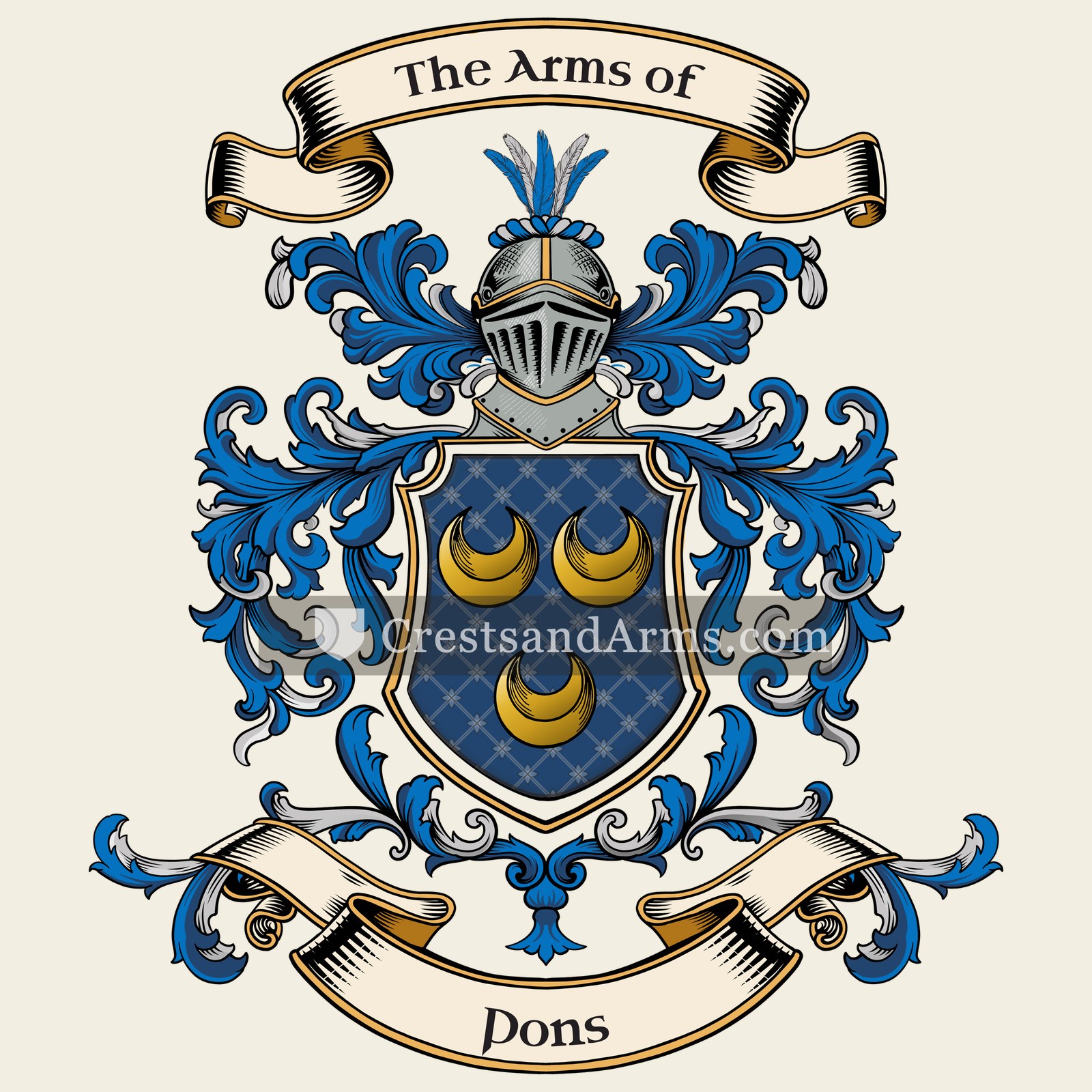


 fessThe military belt, and readiness to serve
 martletA younger son, who must win his own land