Map of Britain showing where the Poole arms are recorded
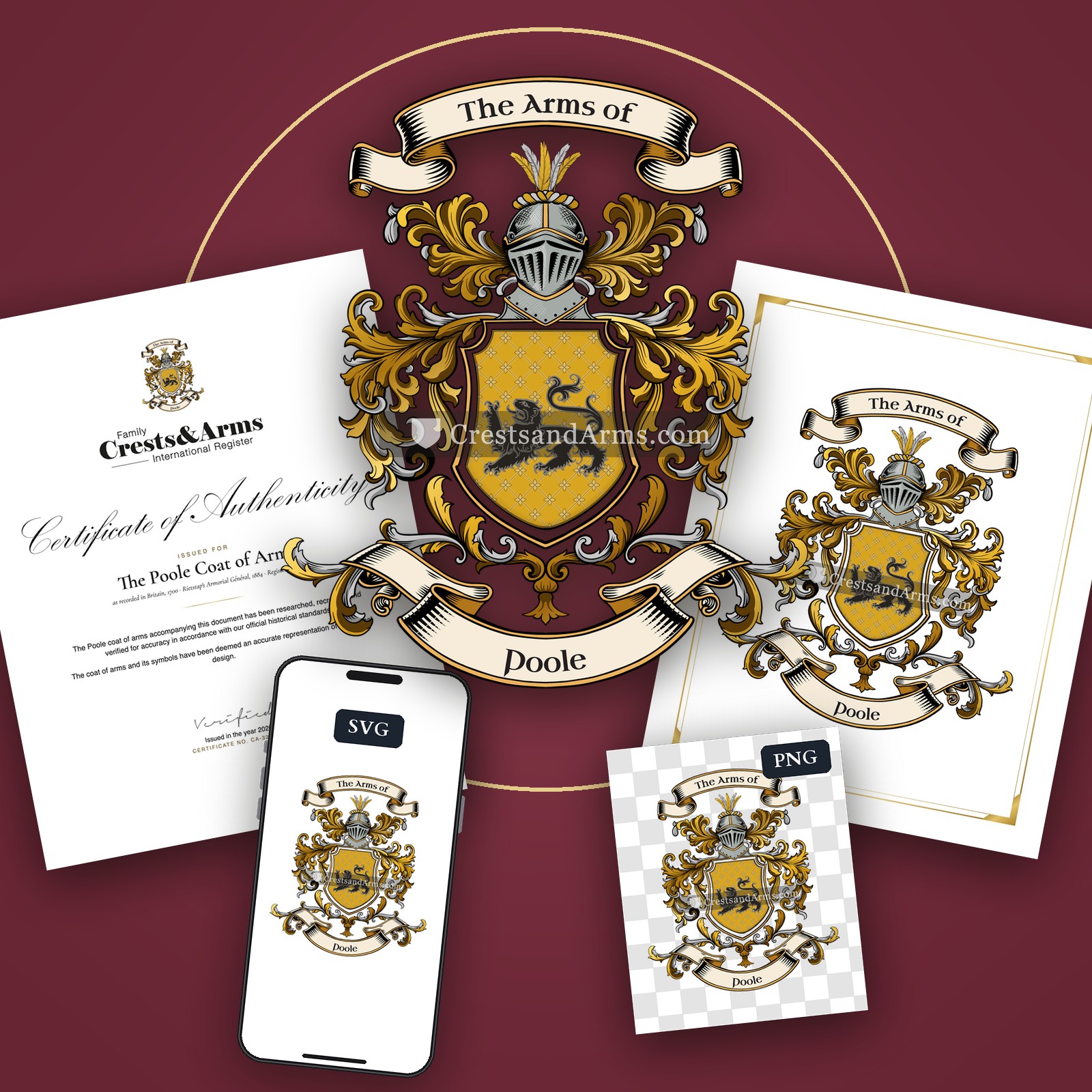
The Poole arms were recorded in Britain, c. 1700.
Arms such as these were typically recorded in Kent.
Kent sits between London and the short crossing to Europe, and the trade passing through made it wealthy. Merchant families bought land with that money, and it was landowners who took coats of arms.
This is where the arms were entered in the register. Families often moved to other parts of the country, so the same name can turn up in more than one region.
The body that granted and recorded arms in Britain in this period.
William III of England
Sovereign of the period
William III of England
1694–1702
Reigning in Britain when the Poole arms are first recorded.
How Arms Worked in Britain
English heraldry allowed arms to be shared by all legitimate descendants of the original owner. These symbols were treated as personal property that moved through the generations to all children. While the eldest son kept the original design, other family members could use the same shield without needing to change it or register their own unique versions.
Granting authority
The College of Arms in London has regulated the use of coats of arms throughout England and Wales since 1484.
How they got arms
Families typically obtained their coats of arms through a formal grant from the Crown or by proving their ancient right to them.
Where arms were recorded
All official coats of arms are recorded in the registers kept at the College of Arms, which date back to the fifteenth century.
The family's standing
Recorded among the armigerous families of Britain.
Origin & History of the Poole Family in Britain
The surname Poole is a locational name that originated in England, meaning it was first given to people who lived near a pool, a small lake, or a tidal inlet. In the centuries before standardized spelling, the name appeared in various forms such as Pole or Polle, reflecting the local dialects of the regions where these families settled. By the time the family was firmly established in Kent during the early 1700s, the name had become a common identifier for those living near distinct water features or within towns named after such landmarks. Many families with this name were part of the growing agricultural and merchant classes, often moving between rural parishes to find work in farming or early trade. Because the name describes a common natural feature, it emerged independently in several different parts of Britain, allowing the family to build deep roots in local communities long before the modern era of record-keeping.
Meaning of the Poole family crest colors & symbols
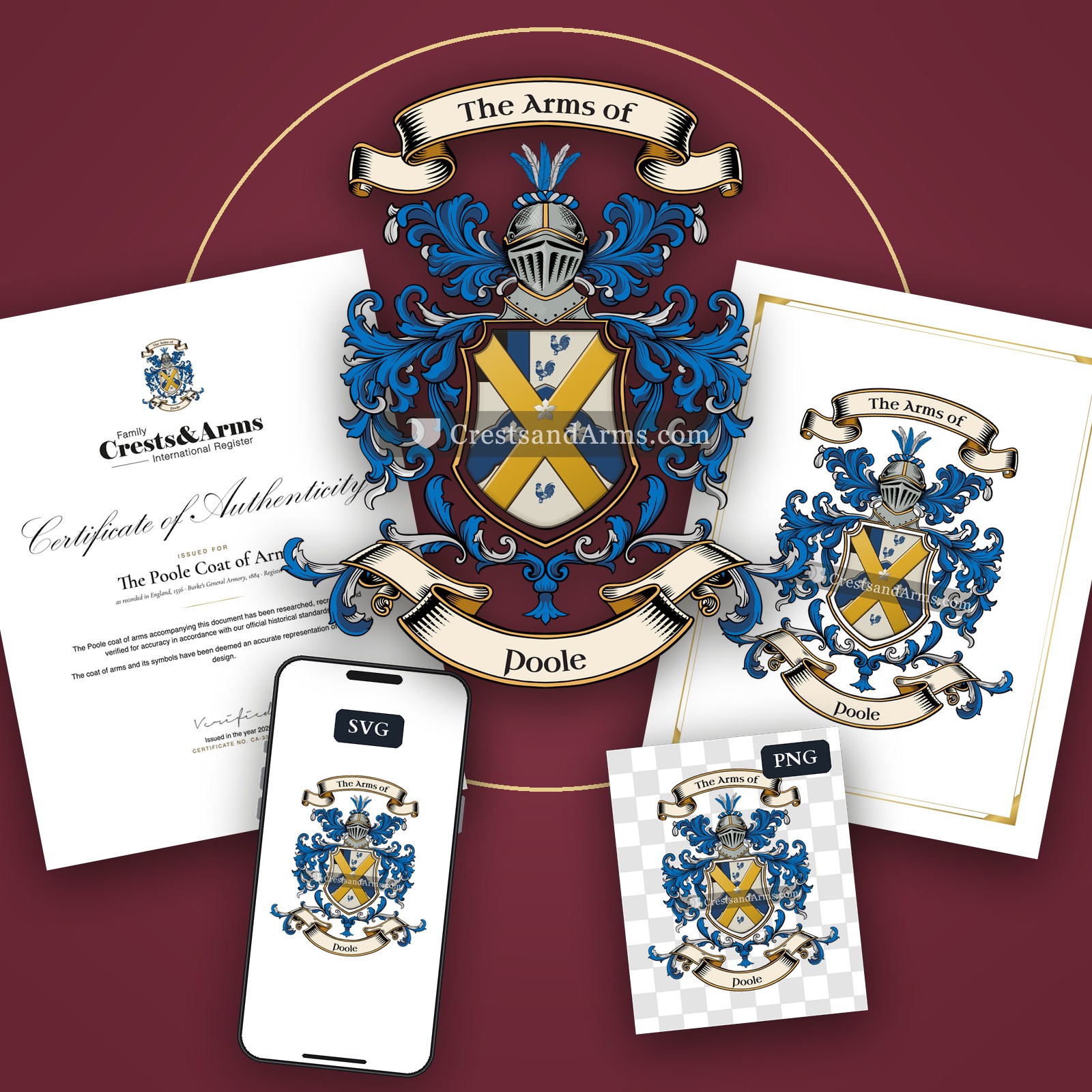
Symbols on this shield
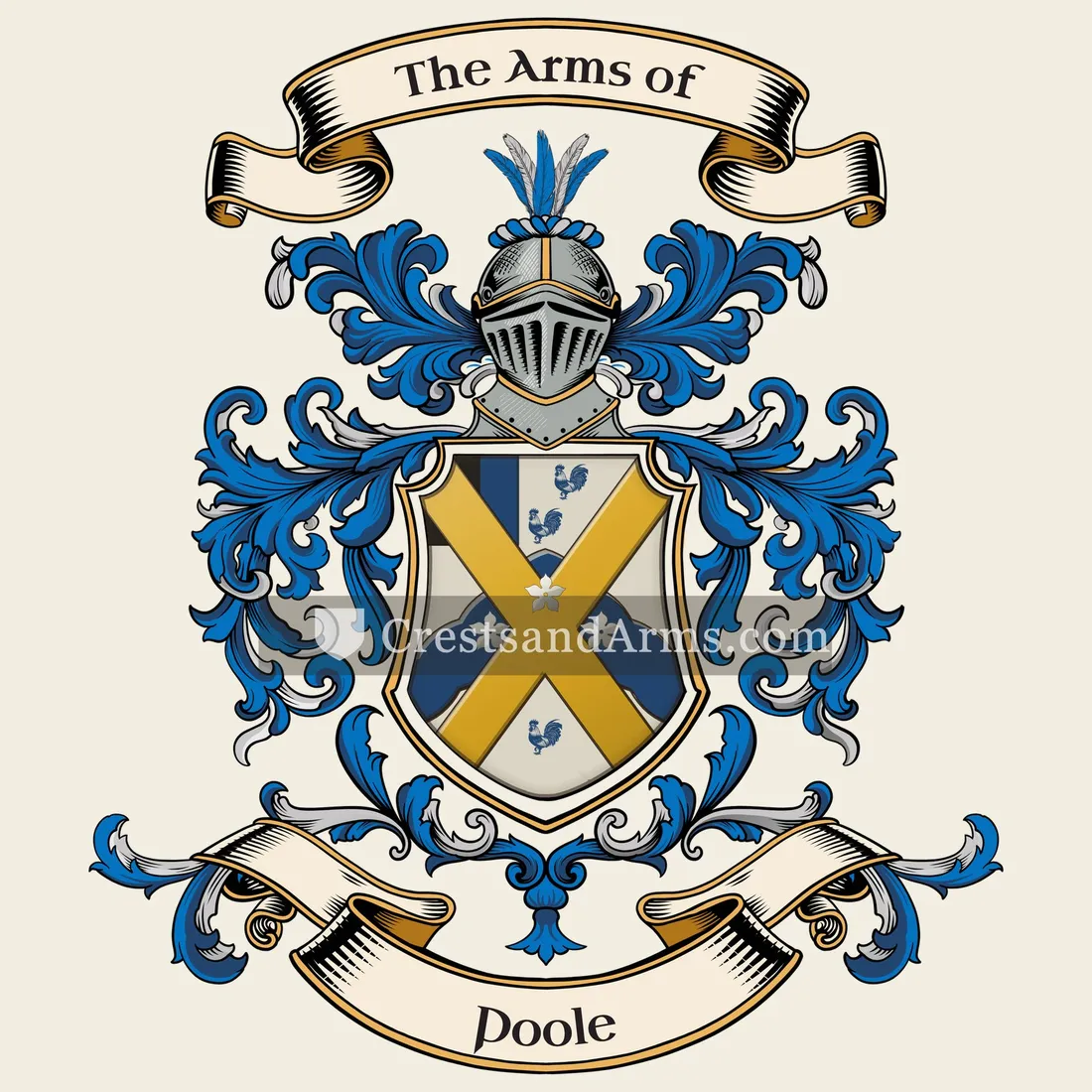
chevronProtection, and faithful service completed
cantonA mark of honour granted by the sovereign
paleMilitary strength, and a fortified defence
saltireResolution, and St Andrew's cross
cockCourage, vigilance and readiness for battle
cinquefoilHope and joy
Colours
Silver (Argent)Means: Peace and sincerity
Blue (Azure)Means: Loyalty and truth
Black (Sable)Means: Constancy
Gold (Or)Means: Generosity
Historical info
Source
Sir Bernard Burke, The General Armory of England, Scotland, Ireland and Wales, London: Harrison & Sons, 1884
Blazon (the actual original written record)
“Ar. on a chev. engr. betw. three heathcocks az. as many cinquefoils of the field, on a canton per pale or and sa. a saltire couped counterchanged”
EnglandPeterborough, c. 1556
Digital archive packCoat of arms PNG, gold border print PDF, vector SVG and the certificate of authenticity. Sent to your email in minutes.
Map of England showing where the Poole arms are recorded
The Poole arms were recorded in Peterborough, c. 1556.
This is where the arms were entered in the register. Families often moved to other parts of the country, so the same name can turn up in more than one region.
The body that granted and recorded arms in England in this period.
Mary I
Sovereign of the period
Mary I
1553–1558
Reigning in Britain when the Poole arms are first recorded.
How Arms Worked in England
English heraldry allowed arms to be shared by all legitimate descendants of the original owner. These symbols were treated as personal property that moved through the generations to all children. While the eldest son kept the original design, other family members could use the same shield without needing to change it or register their own unique versions.
Granting authority
The College of Arms in London has regulated the use of coats of arms throughout England and Wales since 1484.
How they got arms
Families typically obtained their coats of arms through a formal grant from the Crown or by proving their ancient right to them.
Where arms were recorded
All official coats of arms are recorded in the registers kept at the College of Arms, which date back to the fifteenth century.
The family's standing
Recorded among the armigerous families of England.
Origin & History of the Poole Family in England
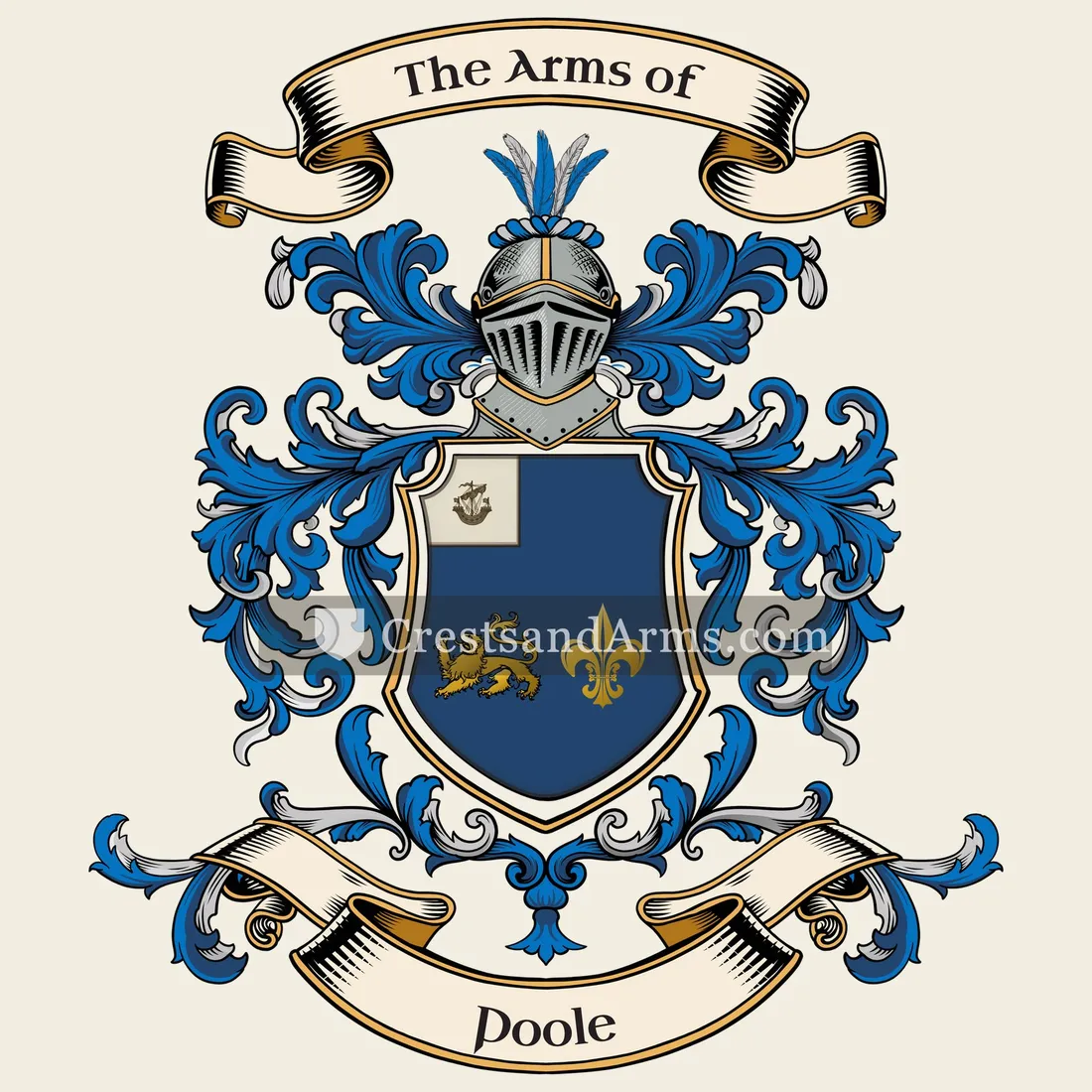
The surname Poole is a locative name, meaning it was originally adopted by people who lived near a pool, a small lake, or a tidal inlet. In England, the name emerged independently in several different regions as families began to identify themselves by the local geography of their homes. By the middle of the sixteenth century, the name was well-established in various parts of the country, including the cathedral city of Peterborough. Records from 1556 confirm that members of the Poole family were active residents in this area during the reign of Queen Mary I. At this time, families were often tied to the land through agriculture or local trade, and the name served as a practical way to distinguish individuals within growing parish communities. As the population moved and shifted throughout the English countryside, the name spread from these early local roots to become a recognized part of the regional history.
Meaning of the Poole family crest colors & symbols
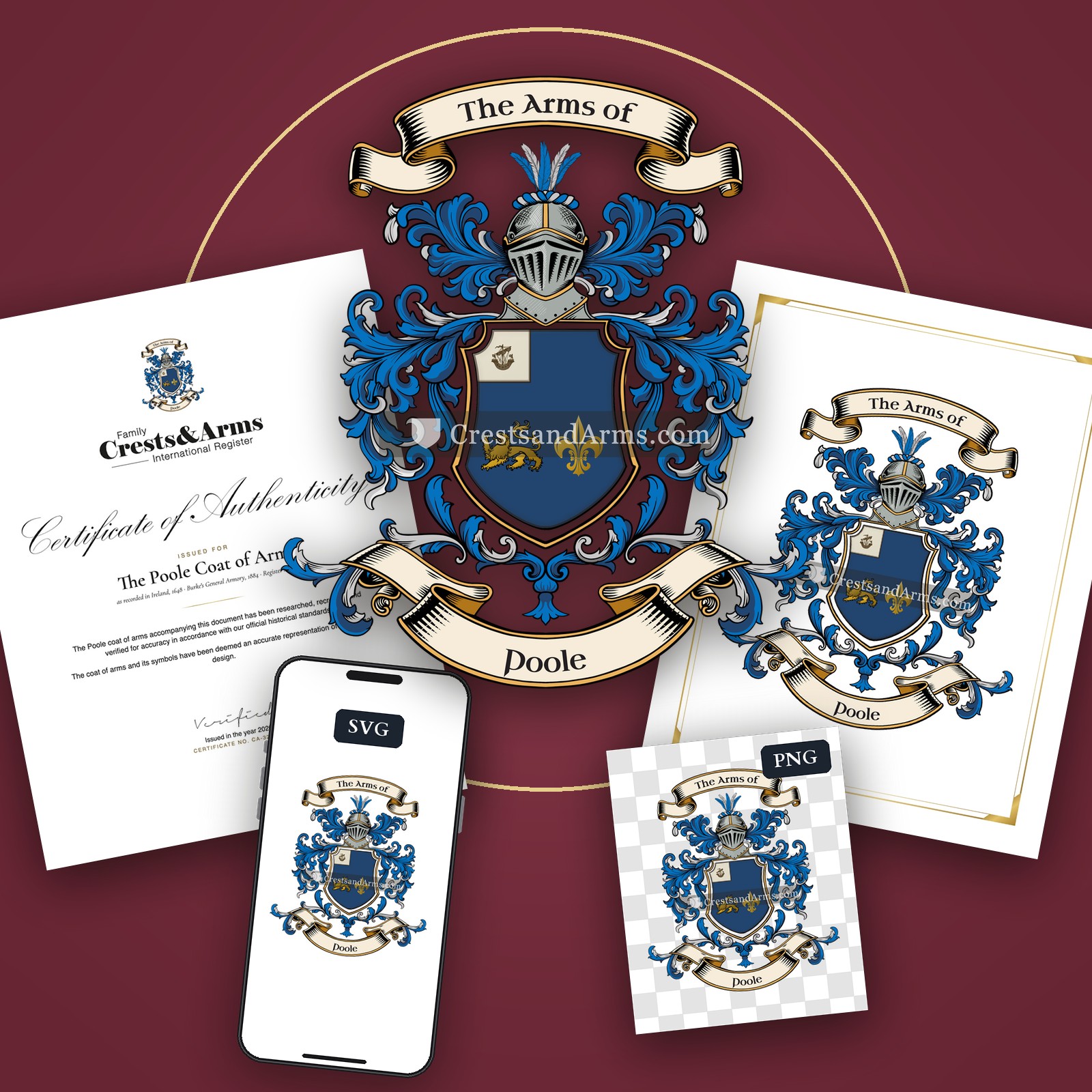
Symbols on this shield
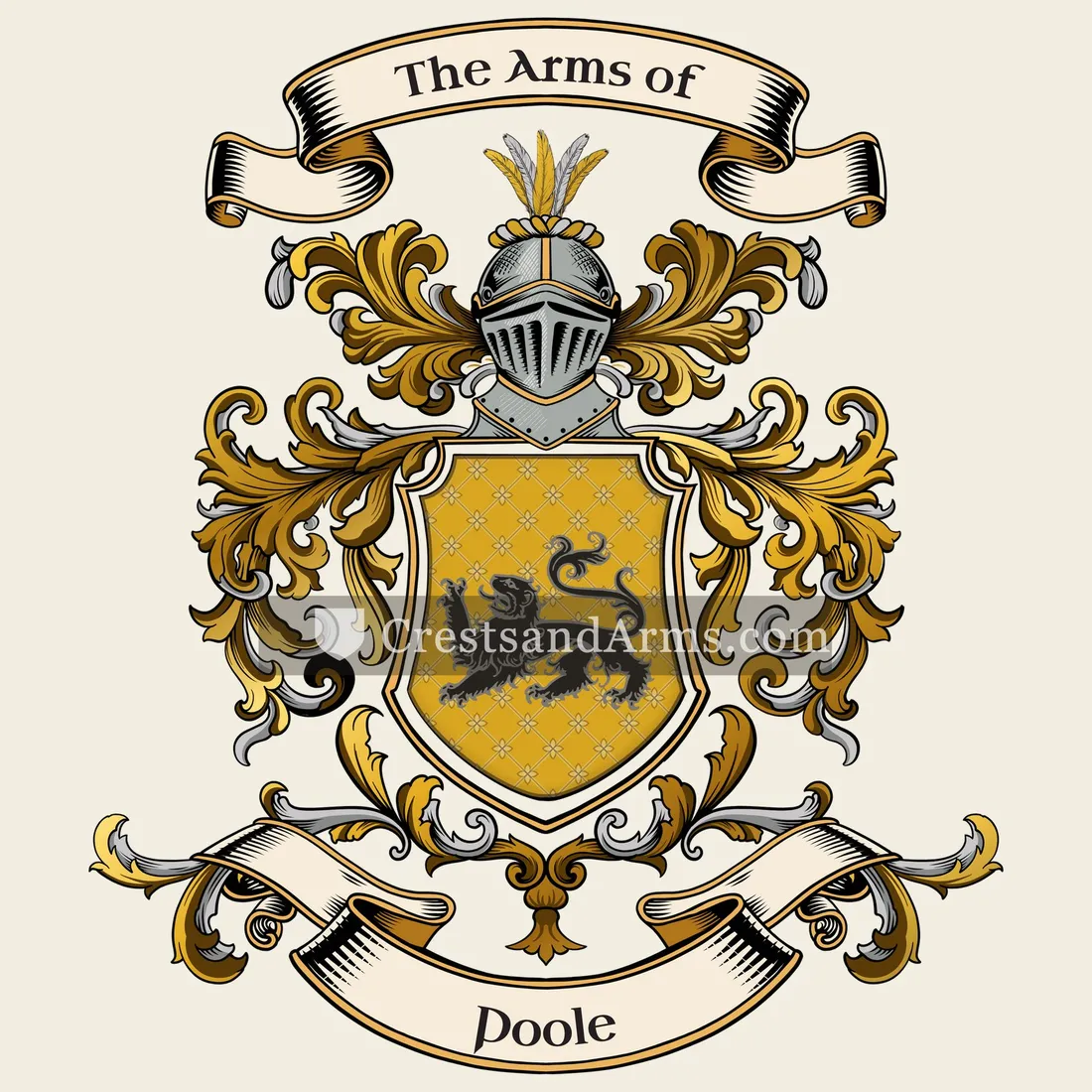
cantonA mark of honour granted by the sovereign
lionCourage, strength and royalty
fleur de lisPurity, light, and the sixth son
shipEnterprise, and a great voyage undertaken
Colours
Blue (Azure)Means: Loyalty and truth
Silver (Argent)Means: Peace and sincerity
Gold (Or)Means: Generosity
Historical info
Source
Sir Bernard Burke, The General Armory of England, Scotland, Ireland and Wales, London: Harrison & Sons, 1884
Blazon (the actual original written record)
“Az. semée-de-lis or, a lion ramp. guard. of the last, on a canton ar. a ship with her mainsail furled ppr”
Irelandc. 1648
Digital archive packCoat of arms PNG, gold border print PDF, vector SVG and the certificate of authenticity. Sent to your email in minutes.
Map of Ireland showing where the Poole arms are recorded
The Poole arms were recorded in Ireland, c. 1648.
Arms such as these were typically recorded in Dublin.
Dublin was the seat of government in Ireland and the place where grants were sought and recorded. Families with business at the castle or the courts settled nearby, and settling there put their arms on record.
This is where the arms were entered in the register. Families often moved to other parts of the country, so the same name can turn up in more than one region.
The body that granted and recorded arms in Ireland in this period.
Charles I of England
Sovereign of the period
Charles I of England
1625–1649
Reigning in Britain when the Poole arms are first recorded.
How Arms Worked in Ireland
The Ulster King of Arms granted coats of arms to individuals who proved their social standing and good character. These symbols were typically inherited by all legitimate descendants of the original holder. If a family branch wanted a unique look, they could apply for a specific change to their design through the office to ensure their identity remained distinct.
Granting authority
The Ulster King of Arms acted as the official body that regulated and issued all coats of arms throughout Ireland.
How they got arms
Families obtained their arms through formal grants issued by the office after proving their eligibility and paying the required fees.
Where arms were recorded
All official grants were recorded in the registers held by the Ulster King of Arms starting from the year 1552.
The family's standing
Recorded among the armigerous families of Ireland.
Origin & History of the Poole Family in Ireland
The history of the Poole name in Ireland is deeply connected to the shifting political landscape of the seventeenth century. While the surname has roots in England, records confirm that members of the family were firmly established in Dublin by 1648. During this period, Dublin served as a center for administrative and military activity, making it a common destination for families arriving from across the Irish Sea. These early settlers often integrated into the urban life of the city, participating in the local economy and civic governance as the region underwent significant social changes. By establishing themselves in the capital during the mid-1600s, the Poole family became part of the complex migration patterns that defined the era, eventually spreading their influence into other parts of the country as they adapted to life in Ireland.
Poole Meaning & Related Branches
Root word
pol
Old English word for a pool or small body of water.
This name
PooleA topographic name for someone who lived near a pool or a small lake.
also spelled
Poule
Polle
Pooel
Pool
Related arms
Poolsame arms
Polesimilar arms
Pollévariant spelling
Poollvariant spelling
Documented Sources
J. B. Rietstap, Armorial Général, Gouda: G. B. van Goor Zonen, 1884–87
Reaney, P.H., A Dictionary of English Surnames, 1991
Cottle, Basil, The Penguin Dictionary of Surnames, 1967
The National Archives, Parish registers and settlement examinations for the county of Kent, 1700–1750
Kent History and Library Centre, Archdeaconry Court of Canterbury probate records, 1700–1720
Digital archive packCoat of arms PNG, gold border print PDF, vector SVG and the certificate of authenticity. Sent to your email in minutes.


 lionCourage, strength and royalty
 lionCourage, strength and royalty


 chevronProtection, and faithful service completed
 cantonA mark of honour granted by the sovereign
 paleMilitary strength, and a fortified defence
 saltireResolution, and St Andrew's cross
 cockCourage, vigilance and readiness for battle
 cinquefoilHope and joy

 fleur de lisPurity, light, and the sixth son
 shipEnterprise, and a great voyage undertaken