Map of Belgium showing where the Porch arms are recorded
The Porch arms were recorded in Belgium, c. 1737.
Arms such as these were typically recorded in Brabant.
Brabant lay at the heart of the Low Countries, where the trade routes met. Its towns were wealthy and its landowners many, and both kinds of family kept arms, which is why the region is so heavily represented.
This is where the arms were entered in the register. Families often moved to other parts of the country, so the same name can turn up in more than one region.
The body that granted and recorded arms in Belgium in this period.
Charles VI, Holy Roman Emperor
Sovereign of the period
Charles VI, Holy Roman Emperor
1711–1740
Reigning in Belgium when the Porch arms are first recorded.
How Arms Worked in Belgium
In Belgium, a coat of arms is considered personal property that is passed down through the male line to legitimate descendants. Families often use the same shield design across generations to show their shared heritage. If a branch of the family wants to change the design, they must apply for an official update to their specific version of the arms.
Granting authority
The Conseil héraldique is the official body that regulates and approves all coats of arms in Belgium.
How they got arms
Families obtain their coats of arms through formal royal grants or by confirming their historical right to use existing designs.
Where arms were recorded
All approved coats of arms are officially recorded in the public registers of the Conseil héraldique since 1844.
The family's standing
Recorded among the armigerous families of Belgium.
Origin & History of the Porch Family in Belgium
The history of the Porch family in Belgium is deeply rooted in the historical region of Brabant, where records confirm their presence as early as 1737. During the eighteenth century, Brabant was a central hub for trade and agriculture under the rule of the Austrian Netherlands. Families like the Porchs often lived in these bustling communities, where surnames were frequently tied to the specific location of a person’s home or their occupation near a porch or entryway. As members of the local population, they would have navigated the complex social and economic shifts of the era, including the transition from feudal traditions to the early stages of industrial development. Their survival and growth in this region reflect the broader movement of families who helped shape the cultural and social landscape of the Low Countries during the Enlightenment period.
Coat of Arms & Family Crest Details
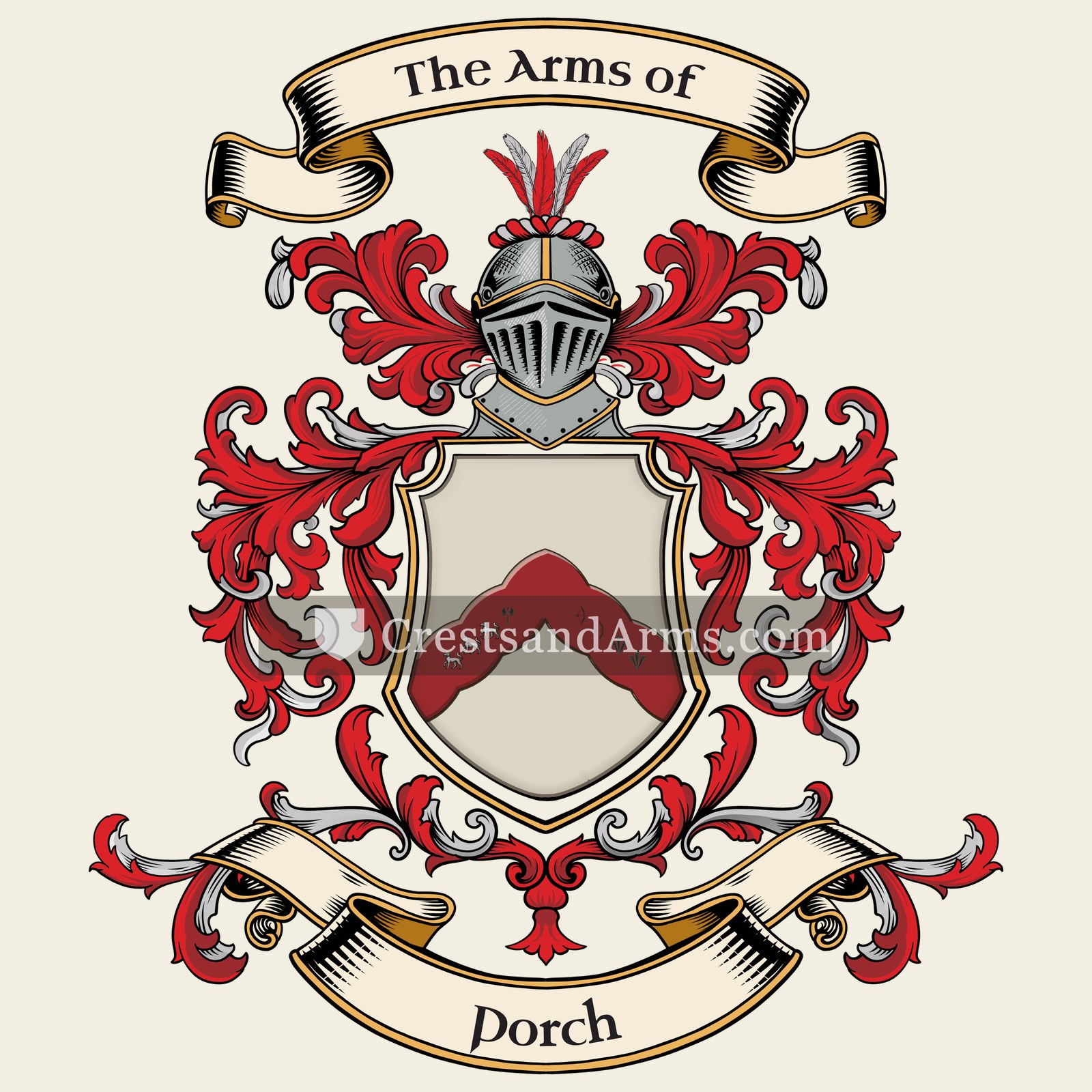
Symbols on this shield
chevronProtection, and faithful service completed
axeThe execution of military duty
wolfReward from long service and hard work
bowReadiness, and the strength held in reserve
arrowReadiness for battle, and affliction endured
Colours
Silver (Argent)Means: Peace and sincerity
Red (Gules)Means: Military strength
Black (Sable)Means: Constancy
Historical info
Source
Sir Bernard Burke, The General Armory of England, Scotland, Ireland and Wales, London: Harrison & Sons, 1884
Blazon (the actual original written record)
“Ar. on a chev. engr. gu. surmounted by another chev. plain or, charged with a battle axe erect betw. two bows stringed, each surmounting two arrows in saltire, points downwards sa. three wolves' heads erased of the field, quartering REEVES”
SomersetEdgarley · Somerset, c. 1620
Digital archive packCoat of arms PNG, gold border print PDF, vector SVG and the certificate of authenticity. Sent to your email in minutes.
Map of England showing where the Porch arms are recorded
The Porch arms were recorded in Somerset, c. 1620.
Somerset was rich farming country with a thick scattering of manor houses. Its gentry were numerous and long-settled, and a settled landed family almost always ended up with arms.
This is where the arms were entered in the register. Families often moved to other parts of the country, so the same name can turn up in more than one region.
The body that granted and recorded arms in England in this period.
James VI and I
Sovereign of the period
James VI and I
1603–1625
Reigning in Belgium when the Porch arms are first recorded.
How Arms Worked in England
English heraldry allowed arms to be shared by all legitimate descendants of the original owner. These symbols were treated as personal property that moved through the generations to all children. While the eldest son kept the original design, other family members could use the same shield without needing to change it or register their own unique versions.
Granting authority
The College of Arms in London has regulated the use of coats of arms throughout England and Wales since 1484.
How they got arms
Families typically obtained their coats of arms through a formal grant from the Crown or by proving their ancient right to them.
Where arms were recorded
All official coats of arms are recorded in the registers kept at the College of Arms, which date back to the fifteenth century.
The family's standing
Recorded among the armigerous families of Somerset.
Origin & History of the Porch Family in England
The surname Porch is a topographical name, meaning it was originally used to identify people who lived near a specific landmark. In medieval England, families often took their names from the physical features of their surroundings, and the term porch referred to a covered entrance or a gatehouse of a church or manor. By the year 1620, records confirm that the Porch family was well-established in the county of Somerset. During this period, Somerset was a region defined by its agricultural landscape and growing trade, which likely provided the stability needed for the family to put down deep roots. These early ancestors were likely tenant farmers or skilled tradespeople who became associated with the name because their homes were situated near a prominent entryway or a local parish porch. Over time, as the family grew and moved throughout the region, the name transitioned from a simple description of their location into a permanent family identifier passed down through generations.
Related Branches & Arms
Root word
Porta
Latin word meaning a gate, door, or passage.
This name
PorchA topographic name for someone who lived near a gate or entrance to a town.
also spelled
Porcher
Porchers
Documented Sources
J. B. Rietstap, Armorial Général, Gouda: G. B. van Goor Zonen, 1884–87
State Archives in Belgium (Algemeen Rijksarchief), Parochieregisters van Brabant
Vannieuwenhuyze, Bram, Brabantse steden en hun bewoners in de achttiende eeuw, 2015
Digital archive packCoat of arms PNG, gold border print PDF, vector SVG and the certificate of authenticity. Sent to your email in minutes.


 bendDefence, and the scarf of a commander
 bendDefence, and the scarf of a commander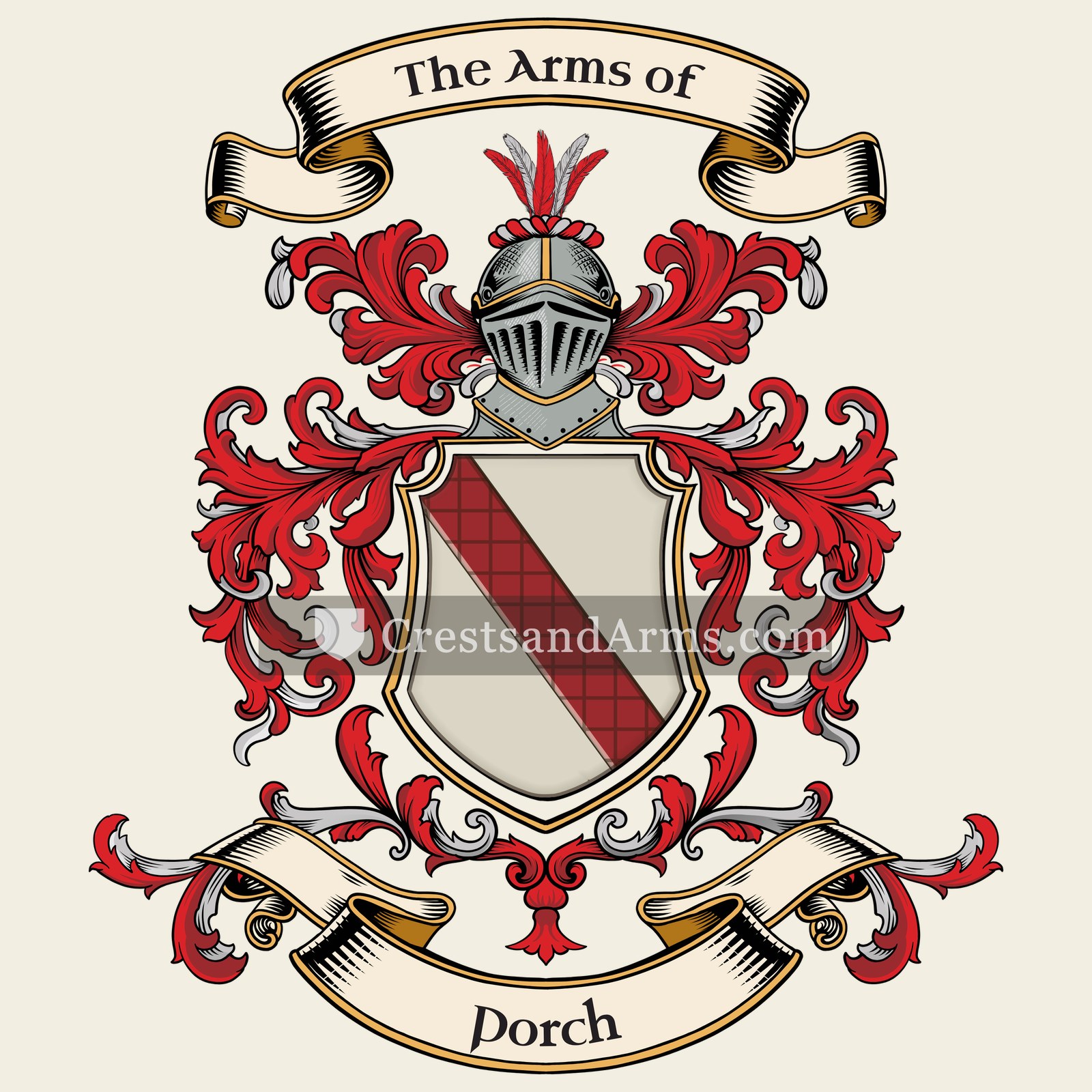


 chevronProtection, and faithful service completed
 axeThe execution of military duty
 wolfReward from long service and hard work
 bowReadiness, and the strength held in reserve
 arrowReadiness for battle, and affliction endured