Map of Switzerland showing where the Porta arms are recorded
The Porta arms were recorded in Cully, c. 1745.
This is where the arms were entered in the register. Families often moved to other parts of the country, so the same name can turn up in more than one region.
The body that granted and recorded arms in Switzerland in this period.
How Arms Worked in Switzerland
In Switzerland, coats of arms were not restricted to the nobility and were often adopted by common citizens and families. These symbols were passed down through generations to show family identity. When branches of a family grew, they often changed small details of the design to distinguish their own line from the original group.
Granting authority
Cantonal and civic authorities managed the use of coats of arms within their specific regions and local jurisdictions.
How they got arms
Families typically assumed their own coats of arms based on local custom rather than receiving them from a central monarch.
Where arms were recorded
Arms were recorded in various cantonal and civic registers starting from the fourteenth century throughout the Swiss region.
The family's standing
Recorded among the armigerous families of Switzerland.
Origin & History of the Porta Family in Switzerland
The family name Porta has deep roots in the Swiss region of Vaud, where it is closely tied to the history of the village of Cully along the shores of Lake Geneva. By 1745, records confirm that members of the Porta family were already established in this area, living among the terraced vineyards that define the local landscape. The name itself is derived from the Latin word for gate or door, suggesting that the earliest ancestors may have lived near a prominent entrance to a town or a fortified gateway. In the eighteenth century, families in this region were often deeply involved in the local agricultural economy, particularly the cultivation of grapes and the production of wine. As the Porta family settled in Cully, they became part of a tight-knit community that relied on the lake for trade and the surrounding hills for their livelihood. Their presence in the village archives during this period reflects a time when families were becoming more permanently rooted in specific Swiss cantons, helping to shape the social and cultural identity of the Vaudois countryside.
Coat of Arms & Family Crest Details
Symbols on this shield
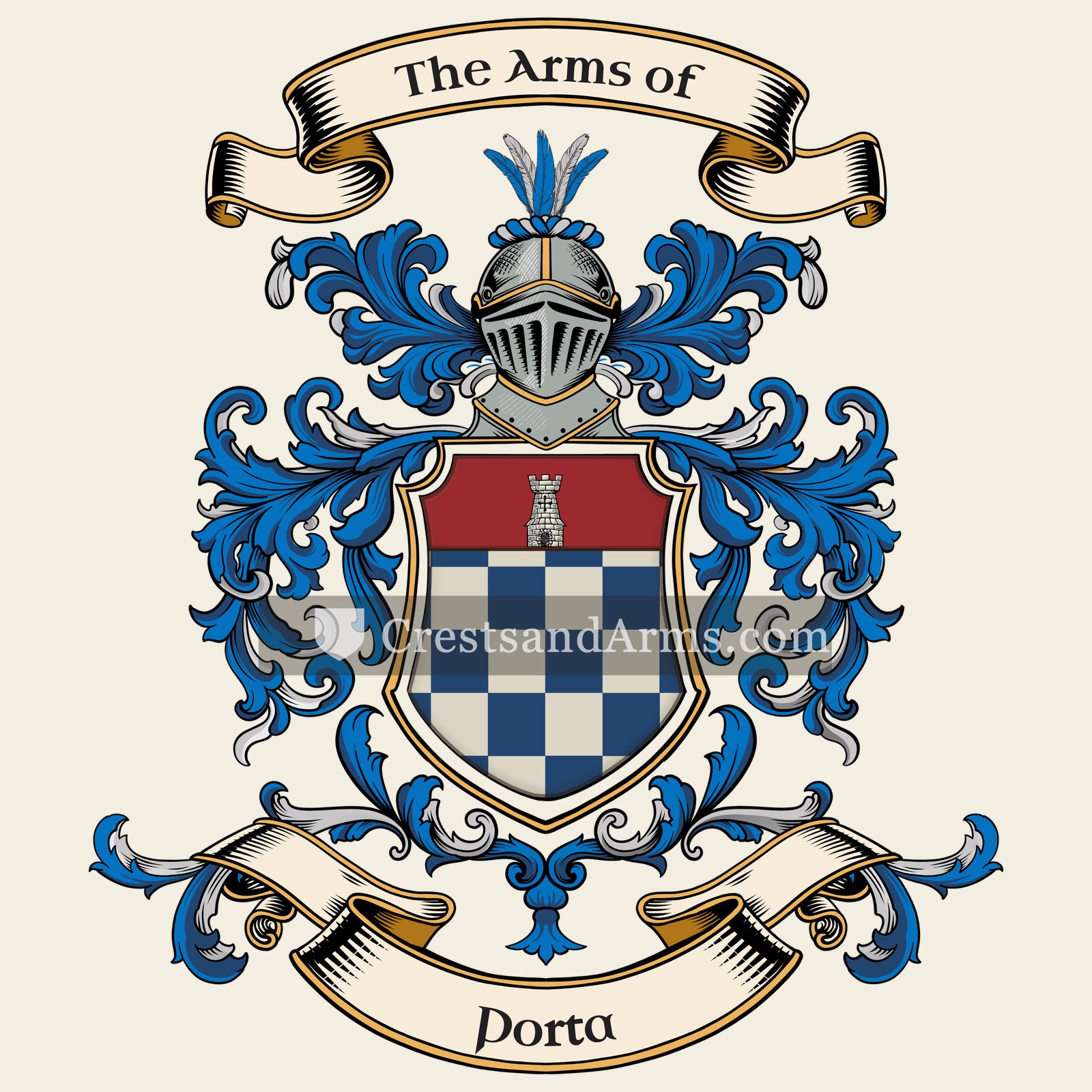
chequyConstancy, and the counting-board
chiefAuthority, wisdom and dominion
towerGrandeur and solidity, and a stronghold defended
Colours
Silver (Argent)Means: Peace and sincerity
Red (Gules)Means: Military strength
Blue (Azure)Means: Loyalty and truth
Historical info
Source
J. B. Rietstap, Armorial Général, Gouda: G. B. van Goor Zonen, 1884–87
Blazon (the actual original written record)
“Echiq. d'arg. et d'azur de huit tires sur cinq; au chef de gu., ch. d'une tour au nat.”
ItalyMantoue, c. 1775
Digital archive packCoat of arms PNG, gold border print PDF, vector SVG and the certificate of authenticity. Sent to your email in minutes.
Map of Italy showing where the Porta arms are recorded
The Porta arms were recorded in Mantoue, c. 1775.
This is where the arms were entered in the register. Families often moved to other parts of the country, so the same name can turn up in more than one region.
The body that granted and recorded arms in Italy in this period.
Alvise Giovanni Mocenigo
Sovereign of the period
Alvise Giovanni Mocenigo
1763–1778
Reigning in Switzerland when the Porta arms are first recorded.
How Arms Worked in Italy
In the Italian states, coats of arms were often used by noble families to show their status and history. These symbols were passed down through the generations to all legitimate male descendants. Younger branches of a family usually kept the original design but sometimes added small changes to distinguish their specific line from the main branch.
Granting authority
Various local rulers and city governments controlled the use of coats of arms across the different Italian states.
How they got arms
Families often assumed their own arms or received them as official grants from local lords, popes, or city councils.
Where arms were recorded
Arms were recorded in local city archives or private family books rather than in one single national register.
The family's standing
Recorded among the armigerous families of Italy.
Origin & History of the Porta Family in Italy
The surname Porta is a classic example of a topographic name, which means it was originally given to families based on where they lived. In medieval Italy, the name identified people who resided near a city gate or a significant entrance to a fortified town. Because these gates were vital hubs for trade and defense, the name became common in various regions as families rose to prominence in local civic life. By the late 18th century, the family had established a notable presence in the city of Mantua. Records from 1775 indicate that members of the Porta family were active participants in the social and economic fabric of this historic Lombard city. Their history reflects the broader Italian tradition of families rooting themselves in specific urban centers, where they often served as merchants, craftsmen, or local officials who helped manage the daily operations of the city gates and the surrounding neighborhoods.
Related Branches & Arms
Root word
Porta
Latin term referring to a gate, door, or mountain pass.
This name
PortaA topographic name for someone who lived near a city gate or a mountain pass.
Related arms
Braschisimilar arms
Braschi-Onestisimilar arms
Espavolsimilar arms
Mayerlesimilar arms
Documented Sources
J. B. Rietstap, Armorial Général, Gouda: G. B. van Goor Zonen, 1884–87
Archives cantonales vaudoises, État civil ancien (Cully)
Archives communales de Cully, Registres de la population
Ansermet, Jean-Daniel, Cully: Histoire d'un bourg viticole, 1995
Dictionnaire historique de la Suisse, Noms de famille en Suisse, 2002
Digital archive packCoat of arms PNG, gold border print PDF, vector SVG and the certificate of authenticity. Sent to your email in minutes.


 towerGrandeur and solidity, and a stronghold defended
 mulletThe third son, and a divine quality from above
 towerGrandeur and solidity, and a stronghold defended
 mulletThe third son, and a divine quality from above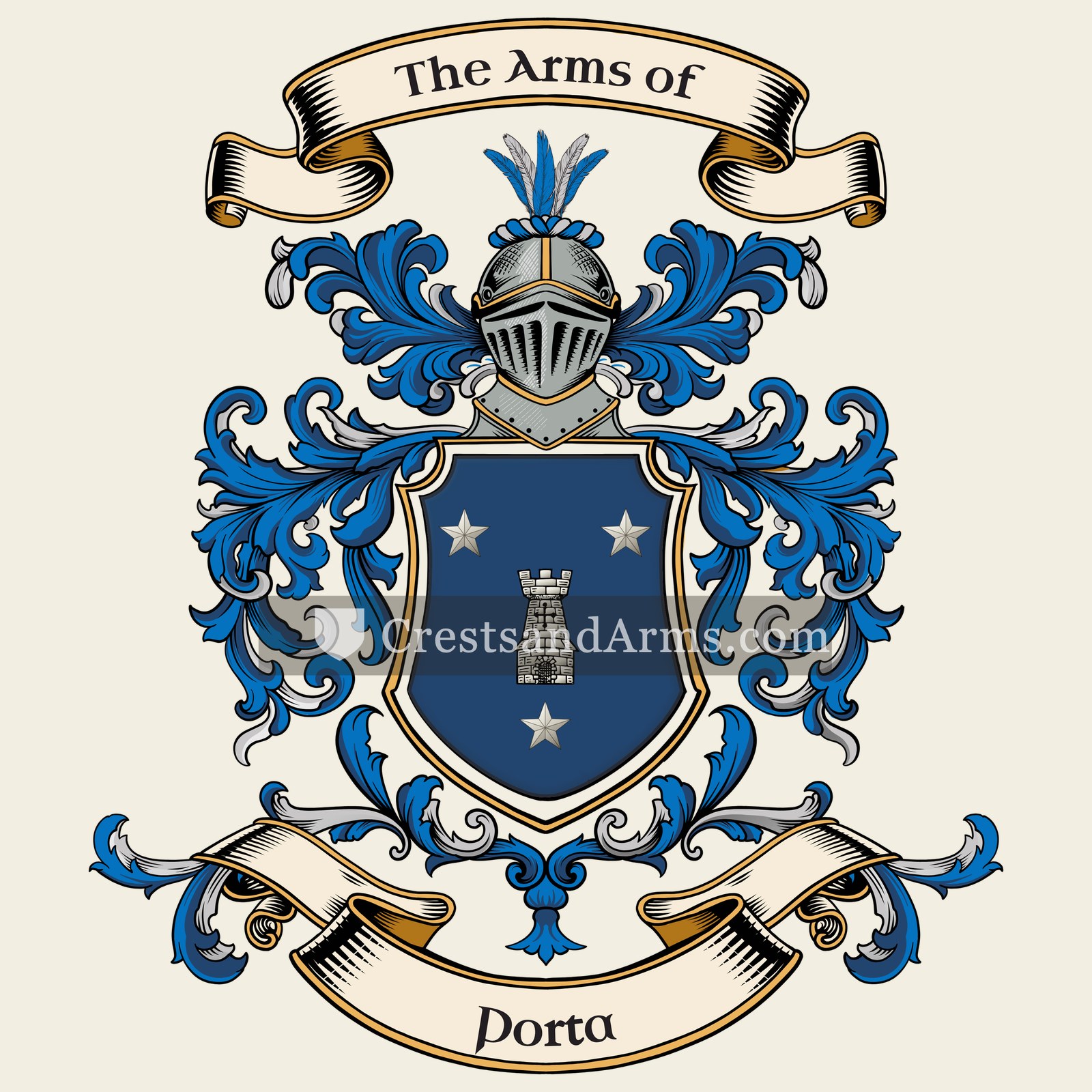

 chequyConstancy, and the counting-board
 chiefAuthority, wisdom and dominion